 Episode 93
· 49:40
What's up? I'm Ron Rapatalo, and this is the Ronderings podcast. Around here, I sit down with guests for real, unpolished conversations about the lessons and values that shaped them. And I'll be right there with you, sharing my own take, laughing at myself when I need to, and wondering out loud about this messy thing called life. Glad you pulled up a chair.
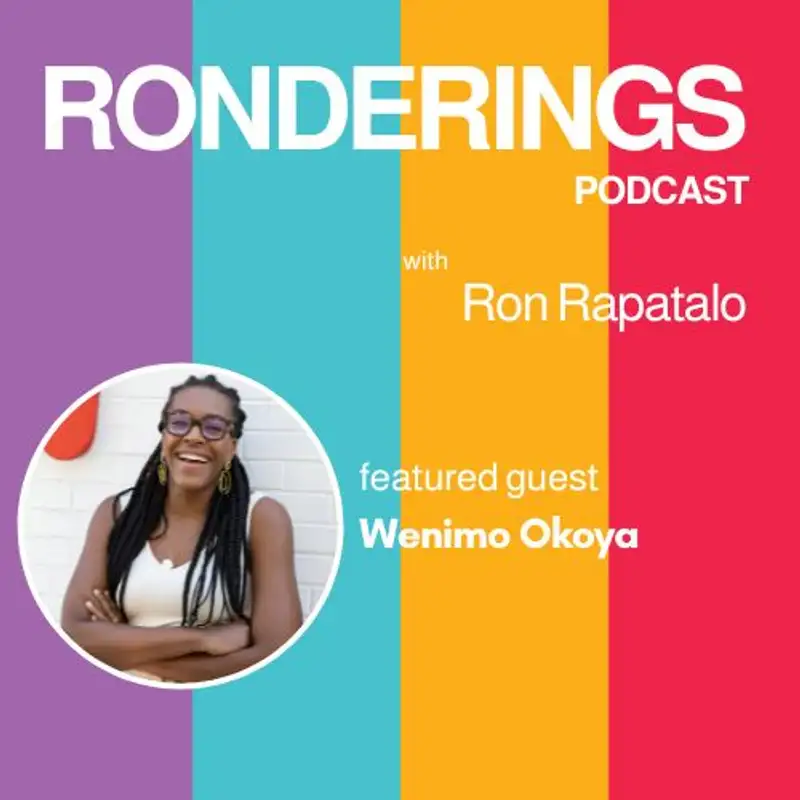
Ron Rapatalo:Let's get into it. What if the thing we're missing in schools, nonprofits, and organizations isn't another framework, but the courage to slow down and really connect? On today's episode of Ronderings, I'm joined by Wenimo Okoya, educator, public health scholar, founder of Healing Schools, and a deep believer that community itself is medicine. Wenimo's journey spans Newark classrooms , Columbia University, Children's Health Fund, the JED Foundation, now leading a nonprofit born out of pandemic era healing circles for educators of color. In this conversation, we talk about why adults carrying trauma are expected to implement wellness frameworks for kids, how we've overcomplicated connection at work, and why three simple questions could be more powerful than any icebreaker we've ever used.
Ron Rapatalo:This episode is about healing, trust, urgency culture, what it really means to care for the people doing the work. Let's get into it. Hey, friends. Before we get started, I wanna share something that's been a big part of my own journey. Two years ago, I published my book Leverage.
Ron Rapatalo:That experience cracked something open for me. I saw how publishing isn't just about pages, about owning your story, sharpening your voice, and amplifying your impact. The part that meant the most, readers reached out to me to say they felt seen. That's when I knew this work mattered. I loved it so much I cofounded Leverage Publishing Group with friends who would make know this world inside and out.
Ron Rapatalo:Now we help leaders, entrepreneurs, and change makers turn their ideas into books and podcasts that actually move people. Got a star in you, and I know you do. Let's chat. Find me on LinkedIn or at leverage publishing group dot com, because the world doesn't just need more books, it needs your book. Alright.
Ron Rapatalo:Let's get to today's episode. Peace. Ronderings fan. Really excited to introduce a newest friend on the mic that I happened to meet at a EdLoC National Convening. I think it was two year, oh my God.
Ron Rapatalo:And to fast forward that it took this long for you to get on the mic. So Wenimo Okoya, welcome to the Ronderings mic. How are doing today?
Wenimo Okoya:Thank you. Happy to be here. I'm well, I'm okay, despite the world being on fire.
Ron Rapatalo:Oh, that has been a common thing every time I ask a guest how they're doing recently is that yes, the world is it's hard. If you don't notice it, you're not trying to notice.
Wenimo Okoya:Mhmm.
Ron Rapatalo:It's my take. Mhmm. Yeah. Or you agree with the world being on fire and it's okay with you, which is in itself problematic. Mhmm.
Ron Rapatalo:I would say. Mhmm. Yeah. So How are you? I'm okay.
Ron Rapatalo:At the time of this recording, I think I mentioned to you when we weren't recording that my missus is on a work trip, so I'm solo batting for the week. So it's juggling a lot of balls, but Mhmm. I'm okay. I'm okay.
Wenimo Okoya:I'm glad to hear that.
Ron Rapatalo:Thank you for asking. Let's get right into it. What is your story?
Wenimo Okoya:What is my story? So I purposely didn't, like, write any notes down or prep this because I tend to end my story with, I think, the part of my identity that's the most prominent. I'm a mom. And so I'm like backwards telling my story because that's the part of my identity that I'm, that feels the most present for me right now. And a colleague of me mine who actually she works for GirlTREK told me that they at their organization introduce themselves by their matrilineal lineage.
Wenimo Okoya:So I'd like to do the same because it made me think about like who I come from. So I am Wenimo, who's the daughter of Grace, who's the daughter of Estolita, who's the daughter of Maude. And my mom's family comes from St. Vincent And The Grenadines. And my grandmother was an entrepreneur and now I'm an entrepreneur.
Wenimo Okoya:So I think that, you know, the women that I come from have really helped kind of shape me into the person I am today. And I hadn't really thought until recently when I was asked to introduce myself that way about why I think I have this entrepreneurial bug inside of me. And my dad is from Nigeria, West Africa. So I am the daughter of immigrants, a black woman, born in Brooklyn, but New Yorkers say I can't claim Brooklyn because I was raised in Jersey. So I'm in New Jersey and I live here now.
Wenimo Okoya:How long were you
Ron Rapatalo:how long did you stay in Brooklyn before moving to New Jersey?
Wenimo Okoya:Because Like two weeks. So Oh, yeah. It doesn't count. Yeah. It's just on my birth certificate.
Ron Rapatalo:As a native New Yorker, I get to ask that question. Yeah. Even though I will now live in Jersey City as an adult,
Wenimo Okoya:I was
Ron Rapatalo:born and raised in the boroughs. So it's one of those things that as you know, New Yorkers could be very haughty about.
Wenimo Okoya:Of course, and my husband's from Queens and he like, it took him a long time to change his license over. And it was, yeah, it was hard. I hear that. Yeah. But I, so that's who I come from.
Wenimo Okoya:And fast forward after being born leaving Brooklyn, we're going up in Jersey. I started my career as a classroom teacher in Newark. After yeah, Newark, New Jersey. Nork, N O R K is how it's pronounced properly.
Ron Rapatalo:Correct them. Come on now. Exactly. Which school did you teach at? And I'm assuming you taught at New Republic schools.
Wenimo Okoya:You teach? I did. I taught well, I taught both because I was there during a wild time. So I taught at Alexander Street School and then in 2009 and then Chris Christie, our wonderful governor, cut the budget to Newark Public Schools. It's when the Zuckerberg money came in and every first year teacher in Newark Public Schools was XX, including myself.
Wenimo Okoya:So I had no choice but to go charter after that. But I taught right down the street
Ron Rapatalo:Yeah.
Wenimo Okoya:In the same neighborhood, in the same community. Yeah. It was a wild, wild, wild time.
Ron Rapatalo:Yeah. I don't know if I told you this. I worked in Newark when Cammy was there. Oh yeah. Because that new leaders world and so I was in between jobs.
Ron Rapatalo:Uh-huh. Then interim chief talent officer and I still kept in touch when I reached out to that person. Were like, well, I'm sure you know, but Cammy formerly she's the chief program officer there, Superintendent. We need support and people like you and she remembers you and that's so all that consulting money. Was part of.
Wenimo Okoya:Well thank you for taking my job away from me. I know, I'm kidding. You're a little drop in the bucket. But yeah, a lot of all that everyone talks about that time. Consultant money was going to consultants and first year teachers were losing their jobs.
Wenimo Okoya:And I don't even know what happened after I left. I was the only science teacher in my school. So like I imagine my kids Yeah. Didn't have an accredited science teacher after that. But it made me who I am as an educator and, like, really shaped everything that I believe about education.
Wenimo Okoya:I think I would be a better teacher now if I went back. And I left the classroom not because I was I didn't care about education anymore. I didn't want to be in education anymore, but because I kind of got a taste of, like, thinking about macro challenges. And I wanted to think about how we bring health programs into schools. And this was a time when no one was really thinking about that.
Wenimo Okoya:There wasn't a course to do that. There wasn't a path, like a pathway to do that. So I started asking around and folks suggested that I get a master's of public health. So I went to Columbia, got a master's of public health, but I got really like, I don't know, I got this itch to be with kids. So I started doing random things like tutoring and working at a summer youth program that in Washington Heights that that like pushed students or channels, created a pathway for young people in Washington Heights to move into medical and health field.
Wenimo Okoya:So I just like needed to work with kids. I felt this itch and no one was really working in or with education and public health at the time, except for one professor, my friend and mentor, Dr. Carolyn Belell, who taught a class called Issues in School Based Health. And I was like, yes, it exists. Like there is a way to integrate public health and education.
Wenimo Okoya:Because I was actually, like, ready to quit. I went to the chair of our department. I was like, no one here works in schools. Like, I want to I came here to study the public health to figure out how to get this work done in schools. Yeah.
Wenimo Okoya:And it was Carolyn that kind of saved my path that way. And she was one of the only black professors that I had in a very white institution. And like really brought me, took me under her wing. Kind of like, you know, before we got on, you and I were talking about how connections really help, like, help you navigate and find your way. And she is the one who kind of showed me that.
Wenimo Okoya:She, like, took me by the hand, brought me into rooms. Mary Bassett was the health commissioner in New York City at the time, and she was like invited to a luncheon. She brought me there. I like learned how to like have small talk with places with with folks.
Ron Rapatalo:Sounds like the professor was a big mentor. Do you still keep in touch with her?
Wenimo Okoya:Oh yeah, yeah. I just had dinner. She was at my wedding. Know, she's, yeah, she's a really special person. Yeah.
Wenimo Okoya:And it's, I think it's because of that, that I believe that mentorship is like a huge part of how I navigate. And so I now teach the class that she taught. I was her TA and Oh, that's like a Yeah. So she handed that on to me. And so now like now issues in school based health is like a field that exists.
Wenimo Okoya:Wow. Yeah. And so in public health school, I was like the teacher person. And then I went and got doctorate in health education. And in the school of education, I was the public health person.
Wenimo Okoya:So I like never really found my way. Or I did find my way. I think I found my way at this point. But folks didn't really see health and education as being integrated. But I worked the entire time I was in my doc program, starting a program called Healthy and Ready to Learn at the Children's Health Fund.
Wenimo Okoya:So like doing what I had sought out to do around integrating health and education. I was doing a lot of professional development in all five boroughs, even Staten Island across the city.
Ron Rapatalo:I'm like, let me pause as the New Yorker after going to even Staten Island. No, no. I didn't say like that. You said it like that. That's how I interpret it.
Ron Rapatalo:You said even Staten Island.
Wenimo Okoya:I said even Staten Island.
Ron Rapatalo:You said even Staten Island. That's there's a difference. I just couldn't help it interpret. It's like every time someone talks about New York City and then adds anything where it's like, yeah, it's Staten Island. I laugh because it's like
Wenimo Okoya:that poor borough.
Ron Rapatalo:They're they're like the stepchild of New York City. And they know it. We know it.
Wenimo Okoya:Yeah, they do. Some people say all four boroughs. And I'm like, y'all, there is
Ron Rapatalo:a I live in Jersey City and like admittedly there are folks who will come up to me is like we would rather take Jersey City than I'm like, yeah, I mean, that's not my ball of wax, but like, hey, we can make it happen.
Wenimo Okoya:Why not? Poor Staten Island. Yeah. And like, they they do come over to Jersey a good amount. So like, then they kind of perpetuated in that way.
Ron Rapatalo:Yeah. Yeah.
Wenimo Okoya:Yeah. So I was doing a lot of training, a lot of PD with folks, school nurses, teachers, counselors, and parents. A lot of the adults are working with students. And then I kept hearing folks saying like, they had I was doing trauma training for adults about young people's trauma. And then folks like every single time would come up to me and be like, wow, I think that's what I experienced.
Wenimo Okoya:Right?
Ron Rapatalo:Like, oh, wow.
Wenimo Okoya:Yeah. Like them learning about their students trauma made them recognize like, oh, that's what's happening to me, right? That's what happened to me. That's why I'm this way. And then I kept kind of like having this itch to address it directly, but couldn't because of the way that I was funded and the way that the work was oriented.
Wenimo Okoya:And then a lot of what they were experiencing around compassion, fatigue, vicarious trauma, like felt like echoes of my own story teaching in Newark. So started kind of building it into our work and like seeds of healing schools were being planted throughout that time. And then the pandemic happened and it became sort of impossible to ignore it. And I started holding healing circles on Zoom with my good friend and colleague, Janelle, for teachers who work with students of color to just like be themselves. We called it the well at the time.
Wenimo Okoya:And then I went to the JED Foundation for a couple of years to start a program related to mental health and suicide prevention in high schools, which was so like all light work, know, like trauma, suicide prevention, healing, and kept hearing the same thing again, that like the folks who were supposed to be implementing these mental health and suicide framework, suicide prevention frameworks that we had created that were evidence based, like super strong. They themselves had their own mental health challenges, were dealing with vicarious trauma, compassion fatigue, and it didn't feel like there was a solution to support them. And so I had the opportunity to incubate the idea for Healing Schools at the Blue Ridge Labs at the Robin Hood Foundation. And that's where Healing Schools was born. And I feel really lucky to be able to do this work.
Wenimo Okoya:It doesn't even feel like work, honestly. Sometimes I like am in the work and I sit back and look at my team doing things and say things like, can't believe I get to be paid to create healing space for teachers. Sometimes that looks like circle, but sometimes that looks like hula hooping or laughing or like engaging in aromatherapy or journaling. You know, so I that's my story. And I'm a mom.
Wenimo Okoya:I started there because I always forget how to I'm still learning how to weave that into my story. It's a huge part of my identity. But I think very much the way that I orient myself in the world now, even more than when I was an educator, is shaped by being Zarya's mother.
Ron Rapatalo:Alright. Let me keep it real. A lot of us have write a book sitting on our goals list, maybe for years. I sure did. Good news is there's more than one way to get it done.
Ron Rapatalo:If you've got more money than time, a ghost writer can help bring your story to life. If you got more time than money, a great book coach can guide you through the process step by step. If you've already written a thing, you'll want someone to shepherd you through publishing so you don't waste time or cash. Here's the thing though, no matter how you do it, the real win is writing the right book. The one that builds your credibility, grows your business, and actually makes a difference.
Ron Rapatalo:That's what the team at Books That Matter is all about. Head to booksthatmatter.org and get some feedback in your ID or manuscript. Don't sit on it any longer, your book could be exactly what the world needs. This sounds very familiar. Having two kids myself, I know that a lot of my wife's identity is centered on being the mother to Sofia and Avon.
Ron Rapatalo:Know? I'm not
Wenimo Okoya:saying it's not
Ron Rapatalo:a huge part of my identity as a father, but I do feel a palpable emotional difference in the way that she talks about it versus me. Like, I love my girls, but I don't often start by saying I'm a father all the time. It's it's there in the story.
Wenimo Okoya:Right. Uh-huh.
Ron Rapatalo:It's not last, but it's certainly not first.
Wenimo Okoya:Yeah. As well. Yeah. I feel like it's everything. Right?
Wenimo Okoya:And it's like the girl check intro around, like, I've I'm the mother of Zarya and the daughter of Grace, who's the daughter of Aslita, who's the daughter of Maude. Like, feel like there's so much power in that and in ways that I can't even articulate why it matters so much to me.
Ron Rapatalo:You know, I've seen this theme. It's by the very nature of the asking the what's your story question. It reminds me of the episodes that Skip Gates has on Finding Your Roots. When you started there, I started seeing a family tree in my head. Right?
Ron Rapatalo:How much do you know about, cause you started on your mom's side, that history leading up to like great grandmother, maybe even higher.
Wenimo Okoya:Yeah, I don't know beyond great grandmother. And I didn't know her. She died when my grandmother was young, actually. And I had to ask my mom when we were doing that exercise. I was like, know my grandmother's name, but I don't know my great grandmother's name.
Wenimo Okoya:And she's like, I know it, I know it, I know it. And she had to think. And she called me like randomly, like in the middle of the next day, what's mod? What's mod? And since knowing that I've been trying to do some like Internet research, I might like go back to St.
Wenimo Okoya:Vincent and see what's in the archives around, you know, who else who else I might have been related to. I found my mother's maiden name is Monroe, which is certainly like a slave owner name. And I found like I found it connected to a like, you know, colonizer who had the last name Monroe. So I've been like trying to like do an internet search around it, but it's hard to do without handing your data biodata over to the guy.
Ron Rapatalo:Yeah. Was about to say that. I was gonna ask you. I I mean, my missus played around with it more. She did.
Ron Rapatalo:I think we did ancestry.com and like randomly found because she's from Baltimore City that she had like cousins like living in her. I don't want to neighborhood, but like in the city that she unbeknownst to her. So that becomes the amazing, like uncovering relatives that had been right around the corner from the quote unquote for
Wenimo Okoya:some people.
Ron Rapatalo:Not even realizing.
Wenimo Okoya:Yeah, it's pretty incredible. I'm I'm tempted to do it. My brother did it, and I want to see how much I can just like use his. Maybe I can just use this part of
Ron Rapatalo:the same family tree, so there's gonna be he's done the work and like, you can probably then maybe do some of the archiving because when I watch those Finding Roots episodes inevitably past the DNA, there's all the historical research,
Wenimo Okoya:right?
Ron Rapatalo:You can go back home and like, get the access to the archives and dig through it. Like it's amazing what these folks find is like Skip Gates does dramatic fashion is like, we found this out. Turn the page, please. And the person was like, what?
Wenimo Okoya:Yeah. And
Ron Rapatalo:they'll read the thing. And I'm like, it is some of my favorite TV to watch because this is like the discovering of self and your roots, right? I would say as related to like, and you sure have seen this in your research or in your academia, There's so much that passes on to us in terms of like health and things
Wenimo Okoya:Absolutely.
Ron Rapatalo:From previous generations, right? And while those things don't predict that you're gonna get those things, they certainly, like not knowing the picture means that you're sort of like walking around without really knowing.
Wenimo Okoya:Right. Yeah. Mhmm. Yeah. There's so much.
Wenimo Okoya:So much of it is there's so much in genetics. The knowing, like, for sure for, like, practical reasons. Also, I think, like, in connection to self, like having something about ancestral wisdom, like knowing that I came from this like entrepreneurial woman who Like made her my grandmother, just like she did hair in her house and my mom helped her. She started a bar and restaurant that like most people who are from San Vincent. Yeah.
Wenimo Okoya:Most of them. Yeah. Called Calabash, which is like what you call a empty coconut shell that's turned into a bowl. Yes. Mhmm.
Wenimo Okoya:Yeah. And and and my brother has a barbershop in Brooklyn that's called calabash, like, as in homage. Yeah. Mhmm. Yeah.
Ron Rapatalo:So I'm curious, right, because I always like to ask these questions is, particularly in your mother's line, was being a healer involved in health something that runs through your mother's line or is that something that like started with you?
Wenimo Okoya:I mean, I think it's definitely part of my like, you'll see I have like tiki time in my Vinci tiki time actually like on my windowsill here. Oh my god. Yeah. It's I mean, many, many immigrant communities, I think, have like these like healing modalities. Like I remember being sick in St.
Wenimo Okoya:Vincent and my grandmother would take like a like an orange from her yard and squeeze the juice into a cup and heat it up and like mix it with honey. And my mom all to this day grows peppermint in her backyard, not peppermint. Another type of mint. Don't know what type of mint is. Strongest kind mint in her backyard.
Wenimo Okoya:If I'm sick, she'll like dry it and boil it for me and I so believe. Yeah, right? All that stuff and my dad's a doctor. So like yeah, so I had an actually thought doctor never heard of it. Yes, it's not a thing.
Wenimo Okoya:Yeah, yeah, not a thing. They don't exist. Yeah, Yeah. So my dad's a doctor and it was funny having them, like whenever I was sick, listening to them have conversations about like, my dad just like, kind of didn't really believe in those remedies, like, just like, but now he's like, can I have some of that?
Ron Rapatalo:Right. Y'all healthy though, because look, I'm taking my share of prescription drugs, but there's something like growing up when I was younger and being a child of Philippine immigrants, my mom with supplements and herbs, she's the share, like a lot of like hustling Philippine women who came to America Mhmm. Had all kinds of like side side jobs. So one of the things she used to do was sell Shaklee. I don't even know Shaklee exists anymore.
Ron Rapatalo:One of the many like, you know, MLM, like, you know, vitamin companies or things you can sell. And so I took all these things. My mom was like, just take these. I was like, what is don't act like, okay. I don't want you.
Ron Rapatalo:But having childhood asthma, I think part of why my childhood asthma heal was a result of these like supplements and herbs. They were not the things I would get at the doctor's office.
Wenimo Okoya:Right. Yeah. Yeah. It's all and something that I think I've learned is that like, we have so much of the resources, like within our community, right? Like, And I was, I did a circle yesterday with some preservice teachers I asked them like just two, it was the simplest circle that we do.
Wenimo Okoya:It's ask them like three questions. One, how are you arriving? Because like folks don't actually like know what's going on in their mind, body, heart. And they don't think about how they're arriving in space. But like, what do you have?
Wenimo Okoya:What do you need from this community? And what do you have the capacity to give? Some folks had a really hard time answering the need question, but the capacity to give question, I think like showed them how much resource was actually in their community and in that circle. And I think about that with my own community, like, however I might define it, if it's my neighborhood, my family, my friends, my colleagues, like we have so much resource within us and the powers that be don't want us to feel like we have the resources within us. They want us to think that we have to like consume more in order to have what we need.
Ron Rapatalo:Every amazing equity practitioner like you is making me think of Chastity Lord is gonna be a future guest as of this recording. Benny Vasquez, who's the chief equity officer of the KIPP Foundation. Mhmm. This question of asking what do you need and what do you have the capacity to
Wenimo Okoya:give Mhmm.
Ron Rapatalo:Based on people articulate is is something that I've heard equity leaders. And so when I have started doing my own onboarding conversations inside of orgs, I would ask the three questions I learned from Benny, it was like, what's your story? Which then I've incorporated into Ronderings, right? Which takes a while, This is not something that's like, people say, it's one minute ago. Like I don't wanna hear your bio, like what's your story that's different than a bio?
Ron Rapatalo:What do you need, And what do you bring into this space? That awareness and what I will tell, I remember one time he asked in an interview, and this is probably third or fourth time I've said this on a Ronderings podcast because it sat with me. It totally changed the mood of the interview. First of all, took fifteen, twenty minutes to get through everybody, including the interviewers, but it set the ground. It's like the person we interviewed is like, I've never I'm like, it changed the dynamic.
Ron Rapatalo:It didn't feel like an interview anymore because it set the ground of like, we care about you as human.
Wenimo Okoya:Right. What
Ron Rapatalo:times do we do that?
Wenimo Okoya:Yeah. I know. Right? Yeah.
Ron Rapatalo:And this is across many places with like people who are good people, right? The intention of knowing to ask that with consistency is something that I find.
Wenimo Okoya:Mhmm.
Ron Rapatalo:It just doesn't happen all that often. Mhmm. Unless I'm in equity spaces intentionally. That's where it happens more.
Wenimo Okoya:Well, you know, the the, like, the definition of equity that we all use is that, like, we're giving everyone what they need. If you don't know what they need, how can you give everyone what they need?
Ron Rapatalo:I mean, because I mean, I mean, look, I am spiritually intuitive and I have a sense for wisdom and I'd like for someone out of their own mouth to tell me rather than be like, I have this feeling using my Tyler Henry gifts and be like, I sense this like, no, you have to say it because it's yours. Yeah.
Wenimo Okoya:Well, and also my needs change from like sometimes from minute to minute. That's certainly from day to day.
Ron Rapatalo:Oh my God.
Wenimo Okoya:Yeah, absolutely. From day to day. And what's powerful about that circle and like those with those questions.
Ron Rapatalo:Yeah,
Wenimo Okoya:is that I've done it two days back to back with the same group. And it's been a completely different circle, right? Like we don't I think that like, you know, as educators, we think we have to like create a fresh, you know, plan for everything. But like the power of circle and questions is that like, because different people are showing up in different ways in different spaces, you have a completely different conversation even if you ask the same question every single day. So I think that like, and maybe excuse me if I'm going tangential, but I just feel like we've over complicated connection to like, you know, I've like started teaching and like, I got like a bank of like 45 icebreakers, but we should just like simplify the questions.
Wenimo Okoya:It's just about connecting. It's not about connecting creatively. Like we don't need to innovate on connection. We just
Ron Rapatalo:need Crayons to and all these things. I mean, I'm not on what it's just, I know it sometimes when those things happen because this goes with like my own, like school trauma of like taking art classes where like, I used to not think I was creative. I'm just creative in a different way. Like this is creation, like doing this. Absolutely.
Ron Rapatalo:This is my vibe, right? But like drawing, I think, right? Really, it's something where like, it takes me some time, right? It's not something that I see relatively well yet. And it's funny because when I think of these icebreakers, right, and you mentioned connection, right?
Ron Rapatalo:I've started a, now starting my second one quarterly, and you're welcome to join if you want, and it's gonna be around how do we leverage AI while still staying centered on humanity. Right? And like you, like I've realized more and more that I hold circles with people.
Wenimo Okoya:Absolutely, yep.
Ron Rapatalo:Right? And it was something that my purpose coach, was one of my recent guests whose episode will come out in some months from here, had seen for me in one of her readings of me that I was holding circles of elephants. Right? Because she's used the elephant as a metaphor for like who I am. I can get, I don't wanna wax wet
Wenimo Okoya:it because
Ron Rapatalo:it's not like
Wenimo Okoya:Now I wanna know more.
Ron Rapatalo:Yeah, well I have to like have lunch with you because I can tell because it's one of those things like, haven't seen Julie in two years, but like, she's been so helpful to me in sharing, you know, me thinking of the health side that I've spent a lot of time into is like that spiritual mental health.
Wenimo Okoya:I've been
Ron Rapatalo:going to therapy. So this ties to the question I wanna ask you, what patterns are you seeing in your work from a leader, like a staff level, but also on a systemic level that you're trying to like work on in your organization?
Wenimo Okoya:Patterns I want to work on. So like that I wanna make better?
Ron Rapatalo:Yeah.
Wenimo Okoya:Okay. One of the things and so I guess I can speak. We try to do our work internally as well as externally and be like, we believe in mirror mirror work. Yeah. One of the things that I am trying to do is, like, create rituals that are repeatable, that you don't have to think about, if that makes sense.
Wenimo Okoya:So like,
Ron Rapatalo:so
Wenimo Okoya:like one of the things that I think that we do sometimes is when things feel really urgent, we actually, even though we're organization an that has healing in our name, we move past the connection piece and we'll kind of like, we'll be like, all right, let's just get to the business but like just building in rituals and spaces to connect. So like doing that in in a small way, in an every meeting basis, in a monthly way in terms of the way that we gather as a team every month, it's the same agenda which is different topics every month, but like space to connect, having on a quarterly basis, like in person connection time. We've even been talking about like making our staff meetings like a little bit longer so that there is time to connect since we talk a lot rather than like cutting off the connection because we've got limited time. So I think one of the things that I'm trying to correct for is the urgency that we put on ourselves, taking away from the opportunity to connect. And then also recognizing what the barriers actually are.
Wenimo Okoya:Like sometimes you do have a constraint of time. So what can we do? What can be like a micro practice or a micro shift in our practice that might go a long way and create genuine connection across people. So if the objective of every meeting or engagement is connection, then we make space and time for it, right? If the objective If it's not an explicit objective, then it doesn't happen.
Wenimo Okoya:And I think that that's true too in a lot of spaces. So when we work with schools, when we work with nonprofit leaders as well, they don't have time and space for connection because it's not an objective. It's something that people assume will just happen genuinely. I mean, will happen like authentically or naturally, but it doesn't happen if it's not on the agenda. So like just building it into the way that you already make things happen.
Ron Rapatalo:Quick pause in the action here. I know a lot of us leaders, entrepreneurs, folks just trying to do good work and felt that grind of pushing a boulder uphill by ourselves. The learning is you don't actually have to do it all alone. Genius discovery program at thought leader path, like having a think tank in your corner. It's not some cookie cutter formula, but your story, your plan of impact, giving you the clarity and assets to take the next big step.
Ron Rapatalo:I've seen people go through this and walk out with their voices amplified, ideas sharpened, some even launching podcasts like this one Ronderings. So if you're tired of grinding in the dark and you're ready to step into your impact with right support, check out geniusdiscovery.org. Yeah, we're such a if I think about this right, I have this push pull of like trying to like figure out with the education sector, although I think I've seen that education, while it's there's accountability and it feels outcomes driven, a lot of the accountability is really on inputs, is what I've observed over some time.
Wenimo Okoya:Yeah. What are you doing?
Ron Rapatalo:Yeah. And so for me, it's just like, if I think about, you know, at the end of it all, whether I like it or not, right, and I have my push pull with accountability is that public education is built on accountability systems, right, at some level, to oversimplify And for a so how would you fit in connection inside of these accountability systems? Because I think about like, how is this done where that's just the way the business is done rather than the leader cares about it. In my experience, when the leader cares about it and they model it, it happens a lot more, right? Because the systems are stickier when you, Wenimo, care about it.
Ron Rapatalo:You obviously do, right? This is something you're constantly churning about. I, as in my full time job as Strong Consulting have been asked to like lead our culture work because I care about it. I think about it enough, right? And not to say that the other teammate, my other colleagues and leaders don't care about it, but like, because it's something that like is core to my identity difference, core to my identity, I'm going to spend more time thinking about it, seeing things.
Ron Rapatalo:I saw someone post something about it. And I was like, I put in the chat GTE, I was like, how can I change how I'm thinking about doing this as strong consulting based on this really dope article my friend wrote? Gave some things, and it's just sit with it. It doesn't mean I implement it. It's just like, it's food for thought because I think you're Like my experience of like creating like healthy cultures, which then in that container hopefully then turns into individual healthy behavior rather than the other way around.
Ron Rapatalo:Right? You could be individually healthy in a system of unhealthiness. I'm like, that's like asking you to work uphill, which is not usually going to happen for the majority of people. Right?
Wenimo Okoya:Mhmm.
Ron Rapatalo:Is create the rituals and culture of like, this is what we not only expect, but this is just something that we enjoy doing.
Wenimo Okoya:Right.
Ron Rapatalo:Because I think the joy factor of, like, being healthy
Wenimo Okoya:needs to
Ron Rapatalo:be added to this conversation as well. Because at times it feels laborious, like, wants to be Whatever.
Wenimo Okoya:Yeah. Exactly. I don't wanna eat I don't wanna eat lettuce all the time.
Ron Rapatalo:I do like a good Caesar salad, though.
Wenimo Okoya:I I'll do like a good Caesar salad.
Ron Rapatalo:Yeah. My way of eating lettuce. Right? And that's our family default salad is eating a really good Caesar. Like, the entire family will settle on that.
Ron Rapatalo:It's that and broccoli.
Wenimo Okoya:Do you make, do you make the dressing from scratch? Like, or is it like, are you using like a bag Caesar salad? No judgment, this is just a question.
Ron Rapatalo:Bag Caesar salad. Uh-huh. Occasion, the missus will make something from scratch because she just, I don't know if, well, I don't wanna presume you cook, right? My missus is a savant in the kitchen and surprise, surprise, what is she learning from? Grandma.
Ron Rapatalo:Grandma's the type of cook where it's just like watching her cook. Yeah. There's no, you can't learn because it's so, it's
Wenimo Okoya:They're not measuring anything.
Ron Rapatalo:No, it's all. And she, I watch her in the kitchen and at the time she's made dressing, not for Caesar salad, but other things, she's like, I just made this up for the dumplings. I'm like, and I'm in a crystal, I'm like, what the fuck this is, what the fuck did you, this is so just like, I'm like, how did you go? I was like, I don't know, it just tastes good. Yeah.
Ron Rapatalo:But that's a way to like express healthiness, Because if the food tastes good, whatever you define is tasting good, right?
Wenimo Okoya:You
Ron Rapatalo:can make food that tastes good that's healthy, rather than the other way around. So many have been socialized that like food tastes good when it's not healthy. While that's, there's a partial truth to that, but that's not universal. Right.
Wenimo Okoya:Mhmm. Yeah. And if I'm more likely to eat lettuce, if it's covered in Caesar dressing, it's better that I get lettuce that way. Right?
Ron Rapatalo:The recent hack I've been doing right is I know how much spinach has a good amount of protein and iron and other things. I now just put a whole wad of it in my protein
Wenimo Okoya:because it shrinks. Yeah. Mhmm. You barely taste it.
Ron Rapatalo:I don't even know it's there, frankly. And I take, like, a heat like, a freaking handful and a half.
Wenimo Okoya:Mhmm.
Ron Rapatalo:Right? And for me, it's like one of these, like, innocuous ways for me to make sure I'm eating healthy because otherwise, you know, I'm like your stereotypical guy when he eat meat and potatoes every meal. Carbs. I'm like, Ron, that is not good for your cholesterol and high blood pressure and diabetes. High being Filipino, damn it, sucks.
Ron Rapatalo:Yeah.
Wenimo Okoya:I think I'm trying to remember your original question. I feel like we, oh, it was around accountability.
Ron Rapatalo:Yes.
Wenimo Okoya:Because you're right. Like you said, that it's like who you are and it is very much like who I am.
Ron Rapatalo:Yeah.
Wenimo Okoya:But I think that And as a researcher, so I push my glasses up whenever I say I'm a researcher, because I'm like
Ron Rapatalo:You are a researcher.
Wenimo Okoya:I am a researcher. Yeah.
Ron Rapatalo:The identities.
Wenimo Okoya:Yes, I do. As a researcher, I think about how what what you can measure and what gets measured. You can hold people accountable for, right? You can measure trust. You can measure climate and culture.
Wenimo Okoya:You can measure like teachers. One of the things we measure are administrators, teacher admin trust. So like, I believe I can bring this problem or problems to my administrator. And we see that actually improves over time in the work that we do. So I feel like if we could shift the rule to be focused less on test scores, of course, like, I mean, we are where we are.
Wenimo Okoya:But if we were focused on both, if we managed to get chronic absenteeism and attendance as an engagement metrics into, you know, state policy and was focused on a national level, I think we could get trust, like collegial trust, admin teacher trust. Think about like nonprofits. Yeah. You know, like, does my team trust me? Like that matters.
Wenimo Okoya:And if every person that has one who reports to them on my team gets evaluated based on how trustworthy they are in the eyes of their direct report, I think that can make a huge difference in them knowing that creating culture is part of their job. So I think it's like about getting creative about utilizing metrics. Yeah. I would love to see that happen if there was accountability for like, are you creating a trusting environment? Do the parents in your community trust you?
Wenimo Okoya:Do the teachers in your community trust you? Do you trust your colleagues? And there are tons of other metrics of, like, connectedness and, climate, culture that we could use, but that's one that I think is easy to distill.
Ron Rapatalo:Yeah. Something you may be interested in when I was mentioning doing these virtual building authentic connection events.
Wenimo Okoya:Mhmm.
Ron Rapatalo:I got that idea because I've become a Foundation for Social Connection ambassadors. So they're a nonprofit that focuses on what the research is saying about building social connection and how to do it on an individual, relationship, or like systemic level, right? And this idea of like measuring it and like trust is the currency, I will make the following statement that feels so like, just like true is that, I don't know if any sustainable, well performing organization across any sector, will just have trust at its core. Right. And I can go sports, I can go corporate, I can go school, you know what I'm saying?
Ron Rapatalo:And it's funny because it's not measured, but I bet if you were to interview any of those leaders that have been around long enough to like lead through that change and like, well, yeah, we got the results, but you know what centers this trust? And I hear this in sports all the time because I'm a sports nut and a. Spurs, the Kansas City Chiefs, my Yankees in the nineties, It was trust. This trust. Yes, you got to tell, but you know, I got trust.
Ron Rapatalo:Trust is going to be talent as well as trust is in the ballpark of of that talent.
Wenimo Okoya:Right? Yeah, right.
Ron Rapatalo:It just and it strikes me as crazy that we are so outcomes driven. And unfortunately, some of this is zooming out. It's just like we are a capitalistic society that cares about the bottom line. And so therefore, the priorities are different in a truly capitalistic society versus one. Dare we say, oh, it's socialist.
Ron Rapatalo:Like, when did that become? It's weird, right? Because of the way it was manifested. But I think in concept for me, socialism has always made more sense because it's like, let's take care of each other for the common good. And yes, there are countries like Finland and many others who like benefit from that.
Ron Rapatalo:And like generally have, in my eyes, much more thriving societies than what the hell is going on right now in America to be clear. You know what I'm saying? It comes with some other things you have to like balance, but like, isn't that better if you having to pay higher taxes and you get all these things versus all that? Like this just, I, you know, it strikes me as like we continue to have our priorities in the wrong place here.
Wenimo Okoya:Absolutely. Yeah. And I think as a society, I don't know that we are okay with trusting that like intermediary outcomes will lead to the long term outcomes. Right. Like even if the causal pathway is really clear, I oftentimes have to like really paint it out, like draw the picture fully that like, you know, I'm talking to someone, whether it be a funder or some other part, like a district.
Wenimo Okoya:Oh, I care about student outcomes. Right? Like, what is what you have to do? What is what you're doing have to do with student outcomes? And so then I have to paint the picture and say, like, actually, research shows that when teachers stay longer-
Ron Rapatalo:Does that feel great to say, to prove your point? My research says, and you want me to pull the journal out, but I
Wenimo Okoya:think you can
Ron Rapatalo:see because I know you're not going to read the trust that.
Wenimo Okoya:Right. Yeah. Here are the internal citations. But you know, if the intermediary like metric is like is trust and teachers having lower levels of stress, perceived stress, decreased depressive symptoms, lower feelings of burnout, right? Which we've seen in our programming, right?
Wenimo Okoya:Over and over again. And if we know that teachers who are more well create a better classroom environment, are you out of time? Create a better classroom environment, then like, then we really need to spend a lot of time like addressing what's in the middle. Like you actually can't get to what's in the end unless you address what's the middle. But what gets funded is like something that is directly addressing that distal outcome versus like looking at more proximal outcomes.
Wenimo Okoya:And that that drives me crazy. Bugs me.
Ron Rapatalo:Drives me crazy too. Mhmm. So we're towards the end of our time together. So I'm gonna ask you what the title of this podcast is. What is your Ronderings?
Ron Rapatalo:What's the lesson or value you'd like to share with the audience today?
Wenimo Okoya:The lesson that I want to share that I've been, I'm trying to learn this myself too, is that we don't have to make these massive changes to the way that we work. We have to make tiny, like micro shifts to our practice. I think that it feels like a big undertaking to change culture. But if you change your practice to make sure that every single one on one session included a check-in question where you genuinely ask someone how they're arriving in that space and listen and take note of that and follow-up based on on the response there, right? If every staff meeting in a school or even in a nonprofit organization or corporation had an opportunity for people to turn and talk to their neighbor and ask them like, how are you doing?
Wenimo Okoya:How are you arriving? Would take two minutes in a meeting, and make people feel more connected to their colleagues, which is something that we need in a time that we're six years post COVID and we're healing from the isolation of that time. So if community is medicine, the public health intervention is to infuse moments for community into every moment of And every
Ron Rapatalo:it's so funny, like my kind of like Ronderings for myself as I hear you talk about it. We've talked a good deal of this episode on connection. And I don't know how many people would have instantly made the connection. I think you and I do because we're in this work in different ways, right? How much connection is part of one's health?
Wenimo Okoya:Oh yeah, it's every It's
Ron Rapatalo:not the people think, I think when people default, they hear health, take physical health. Might think mental, they might think spiritual every once in a while, but like the relationship part of it, the connection, I think often gets missed. It's not something, and yet the research, the literature, my own, our experiences dictate incredibly otherwise. And if you watch the Blue Zones like I did on Netflix, was like, shoot, if I'm gonna live long, I wanna live a life where I'm like, boy, if I'm at that age, it's not like eight that I may not be able to control all those variables. I could start controlling those variables now around finding my connections, moving, you know, eating healthy.
Ron Rapatalo:It's just all these things like there's a formula to these things that we listen and our ancestors knew this, visited Gremdi in Nigeria in The Philippines, right? They were on to something.
Wenimo Okoya:Right. Yeah. So they lived in villages and small communities, right?
Ron Rapatalo:Well, before we go, how can people find you? And what would you like to promote?
Wenimo Okoya:So folks can find Healing Schools at Healing Schools on Instagram. You can follow me or connect with me on LinkedIn. My name is Wenimo Okoya. It's here. Wenimo Okoya.
Wenimo Okoya:And I would like to kind of just talk about the fact that we're trying to bring this work to as many schools as possible. And I think that this is an opportunity in this moment to create professional development opportunities, spaces in schools and in communities where well-being, community and connection is centered. So reach out to me or you can go to our website, healingschools.org and connect with us if you want to work with us. So thank you so much for the time, Ron. This really time flew by.
Ron Rapatalo:Yeah. I I am already someone who wants to evangelize the work that you're doing. It's something that I I I hold deep personal professional importance for. We should definitely talk a lie offline about how I can get the word out. I admittedly serve on two charter school boards, that's easy for me to share with them if they're interested in talking.
Ron Rapatalo:But What is it? I make the circuits in talking to school, surprise surprise at the conferences I go to, sharing the work that you do. I feel like it's something that often just gets missed.
Wenimo Okoya:Yeah.
Ron Rapatalo:Now I can hear all the talk about academia, even like broadly culture, but like this stuff, it's just, you're right, these small little, using James Clear's language, like systems of habits. We did that, the other stuff I think would more easily fall in place because I feel like the focus on those things is pretty clear, but I think it falls apart because we don't have the connection and trust
Wenimo Okoya:right. Yeah, absolutely. Yeah.
Ron Rapatalo:Well, in the words of one of my favorite sports heroes, Dion Sanders, we always come hot with amazing guests like Wenimo Okoya. If there's one thing I'm taking away from this conversation with Wenimo, it's this, connection doesn't require innovation, it requires intention. Whether you're leading a school, a nonprofit, or a team that's consistently short on time, Wenimo reminds us that healing isn't an add on, it's a practice built into how we meet, how we ask questions, and how we show up for one another. The two questions she shared, are you arriving, what do you need, do you have the capacity to give, might be the simplest leadership tool you'll hear all year. If this episode resonated, share it with someone who's carrying a lot and still showing up every day.
Ron Rapatalo:And as always, keep reflecting, keep connecting, and keep finding your own Ronderings. Peace. Before we wrap, I've gotta give a huge shout out to the crew that helps make Ronderings come alive every week, podcasts that matter. Their mission, simple but powerful. Every great idea deserves a voice.
Ron Rapatalo:So if you've been sitting on that spark of a show or story, don't overthink it. Just start. Head to podcastmatter.com, and let their team bring your vision to life. Till next time. Keep pondering.
Ron Rapatalo:Keep growing. Keep sharing your voice with the world. Peace. Thank you for listening to today's Ronderings. I enjoyed hanging out with me and my guests, and I hope you leave with something worth chewing on.
Ron Rapatalo:If it made you smile, think, or even roll your eyes in a good way, pass it along to someone else. I'm Ron Rapatalo, and until next time, keep blondering, keep laughing, and keep becoming.
Listen to Ronderings using one of many popular podcasting apps or directories.