 Episode 102
· 59:29
What's up? I'm Ron Rapatalo and this is the Ronderings podcast. Around here, I sit down with guests for real, unpolished conversations about the lessons and values that shaped them. And I'll be right there with you, sharing my own take, laughing at myself when I need to, and wondering out loud about this messy thing called life. Glad you pulled up a chair.
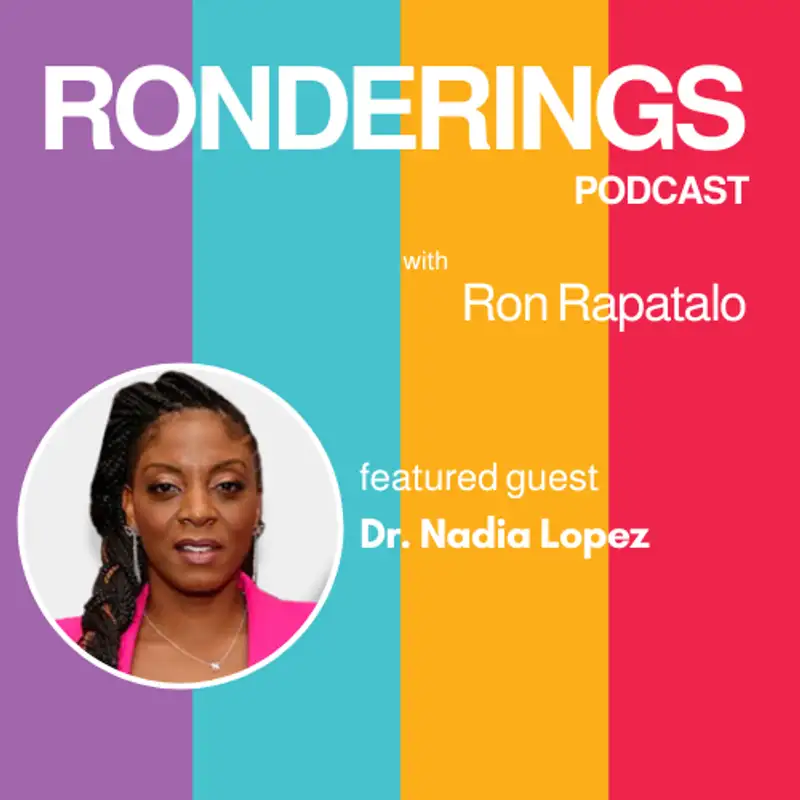
Ron Rapatalo:Let's get into it. What happens when a nurse who never planned to teach becomes one of the most powerful voices in education? On this episode of Ronderings, I sit down with Dr. Nadia Lopez, an educator whose journey started in critical care nursing, detoured through corporate America, and ultimately landed in a seventh grade special education classroom in Brooklyn. Dr. Lopez shares how her nursing background shaped her philosophy, shape behaviors, not labels, know the child before you read the IEP, understand the context before you diagnose the problem. We talked about the moment she realized many of her students didn't have a single book at home, and thousands of unused books sitting in storage changed the way she saw equity.
Ron Rapatalo:From global education systems in Dubai and Sweden to her own autoimmune diagnosis while serving as a principal, this conversation is about what happens when leaders give everything to the system, and the system doesn't give back. This isn't just a conversation about schools. It's a conversation about sustainability, humanity, and who we become when we finally choose ourselves. Ronderings fam. I've been waiting a minute because before I got on this episode as I was driving back from picking up my kids, I told my missus, I'm like, I'm recording a podcast episode today.
Ron Rapatalo:She's with you. I said, you know Dr. Nadia Lopez? She's like, oh, I know Dr. Nadia Lopez. I'm like, if you are a k 12 ed and you don't know Dr. Nadia Lopez, I don't know, fam. You've been sleeping under a rock.
Ron Rapatalo:And so I feel very privileged to have Dr. Nadia Lopez, who comes from the New Leaders World, which is how I know her, on the mic. How are doing today, Nadia?
Dr. Nadia Lopez:You know, I'm doing good. And I'm excited to be here in this conversation with you because we've been trying to get this together. So let her rip.
Ron Rapatalo:This is what happens. You try to schedule with busy people who don't have assistants. It was just like That's
Dr. Nadia Lopez:right. I want that.
Ron Rapatalo:And it's just me right now. I had an assistant my last job, but not this one. And so everything is calmly and me gently nudging and persisting. To get little these calendars. Yeah.
Ron Rapatalo:So Nadia, without further ado, what is your story?
Dr. Nadia Lopez:You know, interestingly enough, my story, especially when it comes to education, is that I never wanted to be an educator. That was not that wasn't what I forecasted for myself. I was supposed to be a nurse. That was the intention. I went to school.
Ron Rapatalo:We would we would have hung out then some somehow, some way, because let's be clear. There's Filipinos in every damn hospital in America, particularly nurses. Yes. Would have found each other.
Dr. Nadia Lopez:Interesting. It's would have found each other. And it wasn't once I went through the nursing program, graduated, did everything from my licensure, I really love critical care nursing.
Ron Rapatalo:And
Dr. Nadia Lopez:I love the intensity. I love the one on one understanding the, you know, not just the diagnoses, but just the patient and providing that critical care. And when I was going to actually full fledged go into the hospitals, they told me I would have to go back to med surg. And I was like, I don't wanna do that because you have so many patients. You can have 20 to 30 patients.
Dr. Nadia Lopez:It's just writing nursing notes, giving out medications, doing vitals. And I was like, I don't particularly want to do that. And I get bored very easily and there's nothing creative about it. Right? And so in order to move in the ranks of patient advocacy or doing patient education, you still have to do your time.
Dr. Nadia Lopez:And so I found myself in this quandary of like, what am I going to do? I don't want to be so bored that I end up killing a patient. I'll go and work for Verizon, the phone company.
Ron Rapatalo:Oh, wow.
Dr. Nadia Lopez:My mother, who was a nurse's assistant, was so offended that I had gone
Ron Rapatalo:to Yeah.
Dr. Nadia Lopez:I felt like this was more of your dream. Like, I love studying medicine. I love really understanding the body and taking care of ourselves. But I just knew that God never intended me to do things in that manner in terms of like the rote requirements of the position. So I was just like, listen, I am gonna give you this degree.
Dr. Nadia Lopez:You've earned it. You've, you know, you raved me. You put me through school.
Ron Rapatalo:Yes.
Dr. Nadia Lopez:But I have to really figure this out. And so I went to work for Verizon because they were willing to pay for me to go back to school. And I was like, okay. Yeah. So I thought maybe getting my MBA was the thing because there was a point in my life when I was in college that I was like, maybe I should go for a business degree.
Dr. Nadia Lopez:But as I was pursuing that and I was almost finished my degree, I realized it wasn't what you know, it's who you know in business. And I also didn't feel like I was called to do that. And then I had my daughter and I was just like, I wanna be what was like inspiring to me outside of my parents. The only thing I could think of was teachers and how they helped my mom, especially her being an immigrant to this country. My mother had to rely really on the teachers to help navigate through the education system.
Dr. Nadia Lopez:And so she used to tell me, When you come home, you have to know your work. When you come home, you have to make sure that you are prepared because I can't help you. Right? And it's not like she she has a sixth grade education, but her understanding is from the fluency of someone who speaks and writes Spanish, right? And so- Yeah.
Dr. Nadia Lopez:So being reliant on the education system meant that she had to find the best schools, the best teachers. And so I felt like I wanted to do that. Cause at that point, I remember a lot of my friends who had children were like, you know, the school system, these teachers, they're just so different. And I was like, I had a really great experience. And so I went through the teaching fellows.
Dr. Nadia Lopez:Okay. And what most people don't know is that I didn't get into the teaching fellows. They rejected me. And I was like, how dare you? Like, the fact that I didn't want to be a teacher, and then I did decide to be a teacher, y'all got it wrong.
Dr. Nadia Lopez:And I'm really prepared. I did a lesson. I had charts. I had handouts. I went above and beyond.
Dr. Nadia Lopez:I went to my mentors who were in education. And I was like, what should I do? And they went over and they was like, oh my god. This is amazing. Yes.
Dr. Nadia Lopez:And one of them happened to be the deputy superintendent. So -Uh -And she used to be the assistant principal when I was in junior high school. So I knew I was doing something right. And so for me to get a letter that said that they didn't feel I could handle the rigor after I had been through a nursing program, I felt offended.
Ron Rapatalo:-Mm.
Dr. Nadia Lopez:And so ultimately her director of HR called me and said, Hey, we're just following up. Wanna know about your experience in coming on board. And I was like, Oh, there won't be any experience because I didn't get accepted. And Sandra was like, What? I said, I got this letter that says otherwise.
Dr. Nadia Lopez:And she was like, This conversation never happened. And so in the meanwhile, I literally was praying and I was writing it down in my book because one of my friends said, You know, if you really, really want it, sometimes God will make you feel like you're not going into that direction because education is a calling. And when it comes to children, you're gonna have major impact. So he has to know your heart and your intention. And so I was like, you know what?
Dr. Nadia Lopez:Verizon will still pay for me to go back to school if push comes to shove. Yeah. I just wanted to get started immediately.
Ron Rapatalo:Right.
Dr. Nadia Lopez:And within, I say a week, a week and a half, I received a phone call
Ron Rapatalo:I was Look at at that. Okay.
Dr. Nadia Lopez:And it was the executive director apologizing for sending me the wrong letter and that I had gotten accepted into the program and that I would be starting in June. And the great thing was that Verizon had sent me a package for me to, like a buyout. So I was like, okay. And so Sandra called me and she said, so, you know, Mrs. Abbott called them and she wanted them to put it in writing as to how you weren't qualified because as an educator who educated you, that would mean that she then had done a disservice by children.
Dr. Nadia Lopez:And so she needed in writing for them to specify what areas I was deficient in, and they couldn't produce that. So here I am. That led me to becoming an educator. And so Wow.
Ron Rapatalo:Isn't that great? Yeah. I I often think about those things. Right? And this is not to throw shade on, you know, new teacher project or even working new leaders for seven years and seeing how selection criteria are assessed.
Ron Rapatalo:But those processes clearly are not perfect. And the fact that when you mentioned something earlier, now wanting to get business because it was who you knew, but you're getting that foot in really was who you knew because someone advocated for you. And when folks can't produce it, you know, when I hear, like, oh, we sent you the wrong letter. I'm like, you send the wrong letter. You're covering your ass.
Dr. Nadia Lopez:Exactly, exactly.
Ron Rapatalo:No, you, someone did a disservice on your end and you're trying to cover up. Exactly. Wow.
Dr. Nadia Lopez:So I'm grateful for that, you know? And then once I became a leader myself, I ensured that I advocated for those who I felt who experienced some type of injustice in trying to get into the program, knowing that there were people who were substitutes at my school and I knew their capabilities. And there were folks that they were sending who had gone through the program that I was like, Do you want to put your name behind this? Because this person should not be in front of children. And so you realize the importance of paying it forward, but like you said, the process of selecting people are not often done with fidelity, right?
Dr. Nadia Lopez:And until you challenge and say, Show me the proof. Yeah. You know, they're like, oh, wait, wait, wait. Let's backpedal. Let's let's When make this
Ron Rapatalo:did you first start teaching when you entered education?
Dr. Nadia Lopez:It was early two thousands.
Ron Rapatalo:Okay.
Dr. Nadia Lopez:It was like yeah. It was early two thousands.
Ron Rapatalo:Do you remember the school and the grade or the subject?
Dr. Nadia Lopez:I special education.
Ron Rapatalo:Okay.
Dr. Nadia Lopez:It was Dr. Susan S. McKinney. So those who are from Brooklyn know it's Sands. And I taught My first grade was seventh grade.
Dr. Nadia Lopez:-Wow. -And I was in a ICT class.
Ron Rapatalo:-Oh, boy.
Dr. Nadia Lopez:-And that was in Fort Green, Brooklyn. So it was a time. It was a time. -Yeah. -Before it got pretty in terms of, like Fort Greene has always been a place where there was a core area of homes that you knew that reflected wealth, but there was the projects.
Dr. Nadia Lopez:And so Susan S. McKinney is right smack dab between Fort Greene and Farragut projects. So, you you get the demographics of both sides and those children had tremendous amount of challenges. They were being raised by a family member, parents who may have either been abusive physically, mentally, or on drugs, unfortunately, but some of the most resilient children, just amazing. We also had a lot of children who were impacted by lead paint, so we had a significant number Oh, of
Ron Rapatalo:gosh. Students with Jesus, yeah. Special And needs.
Dr. Nadia Lopez:We had kids who literally whose families won a lot of the court cases against the city because they were impacted by lead paint.
Ron Rapatalo:I'm seeing a parallel between you originally wanted to pursue being a critical care nurse and then adding up your first year of teaching as a special education teacher. I don't know if that dawned on you that you would pursue something that required that level of intimacy and care in the classroom. But I'm curious how that level of, like, intimacy and care pervaded not only your classroom approach, but certainly your leadership approach.
Dr. Nadia Lopez:Well, here's here's the thing. They they put me in special education even though all of my credits said science. So I was just like
Ron Rapatalo:Piratey.
Dr. Nadia Lopez:Right? Like, I was like
Ron Rapatalo:gonna put you where there's a there's a vacancy.
Dr. Nadia Lopez:Here's a here's a need. Right? So we're gonna put you there. And there was really no training. Right?
Dr. Nadia Lopez:Like, they were just like, yeah. Here's you're gonna take these classes and you figure it out. Right? And so that that just, it's like they throw you into the den with the wolves and you have to figure it out. But,
Ron Rapatalo:what,
Dr. Nadia Lopez:what is parallel when you think about nursing and you think about special education is nurses don't focus on the diagnoses, focus on the behaviors and the habits. And so you're very intentional about what do we need to do, what strategies, what interventions are necessary, how do we educate the patient so that there's better outcomes. And so when you're a special education teacher, you know, oftentimes you So now it's like in New York City, you have CESAs, but you know, back then you would just have the hard copy of a IEP. Yeah. And sometimes you can't get through the IEP.
Dr. Nadia Lopez:So for me, I always wanted to know the scholar first. I wanted to see them in their environment. I wanted to know just one on one what the deficiencies were, the behaviors. And then I would read the IEP because sometimes the person who wrote it was just copying and pasting from someone else.
Ron Rapatalo:That's right.
Dr. Nadia Lopez:They had a limited vocabulary, if you will, or understanding of special education. So it was very generic. It didn't really tell you anything about the child. And then it didn't even provide strategies that really could be scaffolded across all subject areas. So I would get to know the young scholar and then realize that some of these behaviors are based off of neglect or limitations in what's happening in the household, right?
Dr. Nadia Lopez:Which always made me think of, it didn't matter if the child has special needs because if you really looked at it, a lot of our children could benefit from interventions because they were deprived. So the first thing I would ask all of the kids was, do you have a library at home? And they you know, immediately a library? Libraries are buildings. And I'm like, see?
Dr. Nadia Lopez:Okay. So let's get a little bit deeper here. Do you have a collection of books? Like a bookshelf of books? No.
Dr. Nadia Lopez:And so as a kid, I grew up with books, right? Same. My daughter had books, right?
Ron Rapatalo:That's Which
Dr. Nadia Lopez:before I even gave birth, I was reading books. And I remember my colleagues at Verizon, like, What are you doing? And I was like, She can hear. She's developing. She can hear.
Dr. Nadia Lopez:So I used to read during my breaks to my daughter. And it was just very interesting that the young people would say, No, we don't have books, right? So they don't have access. And what's always interesting is you would go into these storage rooms throughout the school building with thousands of books on shelves that were like from ten, fifteen years ago that they were no longer using. And I was like, why don't we just give it to the kids, right?
Dr. Nadia Lopez:Like, could add this to their library at home.
Ron Rapatalo:Right.
Dr. Nadia Lopez:It doesn't have to be related to anything specific, but as long as you're giving them information for them to read, that's access.
Ron Rapatalo:So -Absolutely. Yeah.
Dr. Nadia Lopez:So that made me realize how we need to look at the children holistically. We need to understand their hearts and minds because that's always the thing that would influence their ability to learn. If they are experiencing the deprivation of not having food at home, they're not getting physical affection. Right? Like being told that they're loved, but then also being hugged.
Dr. Nadia Lopez:Right? And just being reminded that they're cared for. They it stunts their growth. It stunts their ability to really thrive. And so I took that to heart.
Dr. Nadia Lopez:Yeah. And so that's why I'm always grateful. Like, even though I did not want to go into nursing, it grounded the foundation of how to care. And that's always what I bring into any environment, whether it's in education or beyond that, it's this level of care, and always constantly listening and asking questions because that's also very important. Questions, asking the right ones.
Ron Rapatalo:If I think back to many selection criteria, whether it's for anything in education, you pinpointed something that I don't think is screened nearly as well as it could be, this level of empathy and care, which I think is so integral to be able to have the empathy and build. And if you have I also think you need some level of cultural competence in how you measure that. Mean, there's but I think both of those things allow for then this level of, hey. I'm gonna do what it takes. Because I think oftentimes what I've seen, right, is the do what it takes comes with achieving certain things.
Ron Rapatalo:Right? And that can be sometimes a reasonable proxy, but I think what often gets this is I'm totally, like, talking anecdotally or this is, like, hunches of, like, having seen enough selection criteria in places that I've worked to kind of have an opinion on this, is that a lot of these selection criteria get built out of like, this is how we want things in white normative places to have teachers and leaders come in, and forgetting that our brilliance, particularly as people of color, comes from that emotional and cultural intelligence that often gets unfactored or, if not, barely assessed in these processes. Because I will just say what I you know, if I woulda seen your stuff in senior lesson, like, how the hell is she not in this program? Like, I just when you develop it, like one of the gifts of working at New Leaders is, being around so many brilliant folks who worked on staff who poured into me as someone who never taught in a classroom. But to be able to have enough of an assessment lens, to be able to have enough of an opinion through these criteria, who moves forward, who does not, what do you give feedback.
Ron Rapatalo:But I think that level of empathy is something that sticks out for a leader like you that I don't often see is elevated because I don't think that's easy to teach at all.
Dr. Nadia Lopez:So it's not. Right? And but I also think it comes from upbringing. It comes from your environment. That's So what you my There's one thing about my mom and one thing about our family is that they didn't come from, you know, wealth.
Dr. Nadia Lopez:They came from always caring for each other and how you care is, you know, coming together as a family. The basic minimum is just valued and appreciated. And one thing my mom would always do is that, my mom is from Guatemala, so we would go to Guatemala every year.
Ron Rapatalo:Oh, wow. Beautiful.
Dr. Nadia Lopez:And so, you know, I understood poverty from a different lens of what poverty is in The United States, right? And so
Ron Rapatalo:It's different back home.
Dr. Nadia Lopez:It's different. Like one uniform, one pair of shoes. As soon as you get home, you take the shoes off and you play barefoot in the street because that's it. You don't have anything else. And we would be at each other's homes, you know, like Yeah.
Dr. Nadia Lopez:It it there was a sense of community and there was a sense of love and there was no making fun of each other because you didn't have. It was a understanding of, you know, there's so much more that's important and valued. And so, so, so I understood that. I understood that even as a child when my parents separated and I was in junior high school, which is why I love the era of middle school was that my mom was went from having to become, she wasn't like so much the stay at home mom. She worked, but my mom didn't have to take care of all of the bills.
Dr. Nadia Lopez:Once my dad wasn't there, she was responsible for all of the bills and she didn't know how to manage that, right? So things got sacrificed and we were eating out of the food pantry and we were like, you know, there was plantain and beans. There was like, you know, just bare minimum. We had the box of USD cheese, right? The hard cheese that made the great grilled cheese.
Dr. Nadia Lopez:Yep. Right? Like, so
Ron Rapatalo:we all
Dr. Nadia Lopez:know what that's That's
Ron Rapatalo:like, uh-huh. I do.
Dr. Nadia Lopez:And it humbles you differently because the kids at school didn't know. Right? Because she had a credit card and she had me in the flyers clothes, so no one knew. But I knew what we weren't eating. Right?
Dr. Nadia Lopez:Like, I didn't I didn't have what everybody else had. And then I had my cousin and my best friend who lived we all lived in the same building. They didn't know what was going on. So I would go upstairs by them. I would have a good meal.
Dr. Nadia Lopez:Then I would come downstairs and, you know, not make her feel bad and, you know, not eat because I already ate. So, you know, all of these things that you do. And so that also gave me this lens of there are children sitting in our schools with a story and no one knows.
Ron Rapatalo:-Yeah. -And because
Dr. Nadia Lopez:I was really, really good at what I did in terms of, like, I was in a gifted school, and so I didn't give problems. I was focused, and I was reading, and I was doing projects. Yeah. So you fall through the cracks because you're not the one who's causing the problems.
Ron Rapatalo:That's right.
Dr. Nadia Lopez:So, you know, you sit in the classroom and I will recognize that, yeah, I have the ones who are just throwing chairs because they angry about life, but then there's the other one who's just sitting real quiet, observing a lot, not saying anything because what happens in the house stays in the house and you don't say anything.
Ron Rapatalo:That's right.
Dr. Nadia Lopez:But I recognize you. Yeah. You know? Yep. And so for me, the other thing, as you were talking, that stands out is that I became a global educator because once I was nominated and became part of the Global Teacher Prize, it allowed me to go to Dubai and convene with all these amazing educators all over But the what was important was learning and hearing their stories, right?
Dr. Nadia Lopez:And hearing how they have to educate children, right? Because we think of like, Oh, we're working in these communities. That's deprive, yes, in comparison to other places. We're working with children who are not on the same in terms of grade level. But when you have someone who is teaching in Uganda or Madagascar, and they literally teach in one room or they teach under a tree, and when it's rainy season, the kids don't come to school because they can't make it to school, right?
Ron Rapatalo:Right.
Dr. Nadia Lopez:Like empathy, compassion, it's something that you have to develop. And I've always felt like what is often the problem in education is we talk about humanity, but we don't understand the components of it. Right? If you really understood how to be empathetic, if you really understood acts of kindness and compassion, then this idea of cultural competence, we would all have it Because then you would get to understand. You know what I'm saying?
Ron Rapatalo:Like, You can which build is the curiosity not for cultural competence if you have those other values.
Dr. Nadia Lopez:Yes. Right? Because
Ron Rapatalo:You can't know everything culturally about everybody. Right? You can ask questions and believe in it.
Dr. Nadia Lopez:So that's why I always encourage people. I'm like, You know, you really should travel. Because when you travel, you get a different lens. Because sometimes we come with our privilege and we come with what we think is we're better than. And I'm like, if you only went around the world, you would see we're not.
Dr. Nadia Lopez:Like you can go to places like Netherlands, Sweden, and Switzerland, where they got it going on and how they teach and how children are what their expectations are up until sixth grade before they go to school and when they're seven years old, and how like, everything is sustainability and they teach the children to be in community, like, it's different. Right? And so that's why children thrive differently. And then when you go to Asian countries, you see how there is a regard for educators. There is a regard for tradition, right, and culture, and these things that they might not Like, some places are not Let's say, they take ideas that already exist and make it innovative.
Dr. Nadia Lopez:They don't often make the thing, but they study. They look at what makes it tick and they try to make it better, right? -Mm so they have time and the way they roll out education. So you think about half of the things we do here. So AI is a thing.
Dr. Nadia Lopez:By next month, everybody needs to know AI. You go to Korea, you go to Japan, you go to China, they've been rolling it out for the past seven years. Been a process, Right?
Ron Rapatalo:Yeah. I Yeah.
Dr. Nadia Lopez:We started off with this gray first, and then we rolled it up, and then all of the people were professionally developed, and the whole country moved forward with it. It wasn't Yeah. Little microcosms and then ta da, and then everybody's failing at it, and then we're trying to figure it out. So, you know, and and see, that's why I loved education as opposed to nursing. Right?
Dr. Nadia Lopez:Because I always said, whatever I do, I want to learn a lot about it. And now, like hindsight is twentytwenty. Now that I'm this age and all the things that I've gone through, when it comes to my health and understanding wellness, I'm more in tuned and wanting to learn and I'm more like, I'm studying around health and I'm understanding the advancements in medicine and I'm trying to make sure that people understand how to care for themselves. But I just think that oftentimes we don't really understand the implications of when we neglect to really know the role of kindness, edge empathy and compassion in our classrooms for one another and for the children, how far we can go.
Ron Rapatalo:Yeah. I almost feel like a full circle moment's happening here, right? Because you started so if I hope folks in the audience, as you're listening to this, if you haven't followed Nadia's wellness journey, you should, because you've been extremely upfront on what you dealt with as a principle, right? And how you've had to learn about this is my line learn more about wellness outside of the principalship. So that very much feels like, I think, what you're learning about wellness in some ways is like you wanted to be a critical care Where are you thinking full circle now in terms of like because so much of what I see you talking about online is certainly about wellness for educators, right?
Ron Rapatalo:I'm curious, where do you see where do you see this going? Right? Because I could see these two things dovetailing really well because you've learned so much from your own journey, traveled the world to see how education is going, to be able to, like, pour into a system that frankly is designed to act broken. And it's not broken because it's broken. It's broke because it's designed to act that way.
Ron Rapatalo:Right? And so I'm curious where you're kind of coming full circle and what you're thinking.
Dr. Nadia Lopez:You know, interestingly enough, again, the beauty of traveling has allowed me to see that even in the most advanced educational spaces, if you take time to talk to the educators, first thing I ask them is, So how are you caring for yourselves?
Ron Rapatalo:Oh, my gosh. Oh, that is that's a provocative question to ask our our fellow educators. This is like And
Dr. Nadia Lopez:they're they're just like, you know, like, if you ask the first question of, like, how are things going? Oh, it's going great. You know, school is great. The kids are great, blah, blah, blah. They come from a place of, I want to tell you all the things that are going well.
Dr. Nadia Lopez:And then I look and I say, that sounds good. But I'm going to ask you and I'm going to lean in with care and love. How are you taking care of you? How is your heart and spirit doing?
Ron Rapatalo:The first question you asked me before we started talking record, which then got me to just tell you. Because in my heart and my spirit, when like, if someone asks me something like that that feels very soulful, I'm gonna talk about my nephew because it's on my mind. Yeah. Don't talk about it. But it is.
Ron Rapatalo:It's gonna sit with me for a long time.
Dr. Nadia Lopez:Mhmm. And so I had a coach who every time we would get on a call, and this was not, this wasn't a education coach. This was someone who was helping me to think through transition.
Ron Rapatalo:Oh, okay.
Dr. Nadia Lopez:When I was sick. And she would always get on a call and say, How's your heart and spirit? And what I recognize, the intention around asking me that question is because it forces you to stop and listen, which goes back to the nursing, right? Of what are you saying to me and giving you the space and intentionality to listen because we're not often given that breath. And so I got to understand that from a global perspective that we're all running on fumes.
Dr. Nadia Lopez:One of my best girlfriends who was my mentor, I met her through the Global Teacher Prize. She was the board of directors for the Varkey Foundation and she was English. Her name was Karen. Or Karen Giles. And Karen was my version of Michelle Obama, the same height.
Ron Rapatalo:She would walk into a
Dr. Nadia Lopez:room and she commanded attention. Like you would just hear her speak and just wanna gobble everything up because that's what she was and who she is still to this for me. She invited me to The UK and she was like, Nat, I want you to come and I want, I want to bring women of color who are leaders for conversation because all that you've been through in terms of your health recovery, we don't have, we don't have the space and nor do we have anyone who will speak up about their process. Yeah. And so she put everything together, right?
Dr. Nadia Lopez:Like she, there was a cottage house on the campus and she had all these educators come. And we had this conversation where I basically said, oftentimes by the time we end up in the hospital, it's really too late. Like, we've gotten to a place where there's something really wrong.
Ron Rapatalo:Yeah.
Dr. Nadia Lopez:And we're either gonna have to be out for some time or it's irreparable, right? And so we have to really listen to our bodies. I knew I had all the red flags and alarms going off, but the kids, who else is gonna do it? And then there was just a lot of guilt, right? Were a lot of people who were telling me, like, If you're not here, what's gonna happen to the school?
Dr. Nadia Lopez:And I was like, But if I'm not alive, what's gonna happen to my family? Like, no one was thinking about that. But we all make these decisions about the kids and the school until you get sick and you realize, like, none of those people who are asking the questions are in the hospital with you, are in the process of recovery having to go for the blood work and the follow-up test and getting the bad news or waiting for the good news. And so I had the conversation and she interviewed me, right? And that was October 2023.
Dr. Nadia Lopez:Yeah. No, October 2022. After my birthday, January 2023, her brother calls me and says, you know, you know, it's birthday. Your And I was like, Karen didn't even call me. I was laughing and joking.
Dr. Nadia Lopez:Yeah. And he was like, you know, she had these headaches. And I had to go to the school and pick her up and take her to the doctor. But we had to just go to the emergency room because she couldn't even drive. I And was like, she couldn't drive.
Ron Rapatalo:He was He like,
Dr. Nadia Lopez:says, so they did a CAT scan and they found a tumor. And so we have to go they found a mass and we have to go to the oncologist next week. And I was like, what? Uh-huh. So they go to the oncologist the following week, and they were like, she has glioblastoma.
Ron Rapatalo:There
Dr. Nadia Lopez:it's it's stage four and is malignant. And there is no and it's terminal. Right? Like, was boom, boom, boom. And I'm like, what?
Dr. Nadia Lopez:And so they were like, we're gonna go in. We're gonna do the surgery. And normally we could get maybe up to forty percent of it out. They got seventy five percent of it out. She calls me like within hours after having the surgery.
Dr. Nadia Lopez:She's on the phone with me. She's lucid. Wow. -All of these things.
Ron Rapatalo:Oh my goodness. God bless.
Dr. Nadia Lopez:Yeah. And then she passed away March 2024. Right? And so I share that because she and I had the conversation after I met with those women and I said, Karen, when are you gonna slow down? Like, you can retire at this point.
Dr. Nadia Lopez:You've done so much. You can write books. You can lecture. You can speak around the world. You've traveled everywhere.
Dr. Nadia Lopez:And she was like, Naz, I'm not ready yet in a couple of years. And I was like, Karen, take it from me. Girl, you don't have to do this. Like, you can't done enough. And I take it as a gift.
Dr. Nadia Lopez:And every year, I do a gift with love where I invite, like, almost a 100 women for brunch Oh, wow. For dinner. Mhmm. And I bring together medical professionals and mental health experts Oh, as a way of honoring her because what she did was selfless. I don't know if Karen knew she was sick or not.
Dr. Nadia Lopez:Going back in retrospect, there were questions she was asking me that I was like, Karen, how come you don't know that answer? Right? And I was just like, that's so not like her. Right? But we went out, we stayed out till four in the morning.
Dr. Nadia Lopez:We were dancing. We were having such a good time. I don't know if she knew something was wrong. And she was ignoring the signs just like I had been ignoring all the signs. And once she got sick, it was a matter of I'm grateful for her brother who allowed me to call her, FaceTime her, all the way up until she Right?
Dr. Nadia Lopez:Couldn't speak And so I strongly encourage people to take care of themselves. And so when it comes to me and what that means is I'm at a place of I feel like my calling is to help those leaders care for themselves. I feel like there's always been this professional development on how to increase your scores, technology and input you know, inputting it or implementing it into your schools and school culture and student behavior. But where's the professional development about your own personal sustainability in order to do this work? Because at the end of the day, one of my own criticisms is that when I was sick, not even the union reached out to me, right?
Dr. Nadia Lopez:And my expectations would have been, this is data for you all to gather and ask your leaders, how many of you are dealing with autoimmune diseases? How many of you have high blood pressure? How many of you are dealing with diabetes? Right? And all of these things seem be
Ron Rapatalo:staggering if it ever got collected. Let's be clear.
Dr. Nadia Lopez:Yes. And if you had those numbers, now you could use that when you're negotiating with the Department of Ed and say, Our leaders need wellness days, like, for real. Like, Our leaders need professional development around sustainability. Like, they need to implement these things. And that wasn't necessarily it hasn't been the case, right?
Ron Rapatalo:Yeah. And
Dr. Nadia Lopez:so what I have found that I do now is I started coaching women on how to care for themselves using AI, right? So that we can minimize some of the work that they have to do because it's just too much. It's just too tedious. And I was like, we could get this knocked out in like thirty minutes as opposed to you doing till 10:00 and not, you know, 11:00 like I used to do. Mhmm.
Dr. Nadia Lopez:And then really figuring out, like, what brings you joy in this? Yeah. And who on your team do we need to develop? Because you can't even see within the forest because you're it's so you're so caught between the weeds. You can't see anything.
Dr. Nadia Lopez:So that has been really, really gratifying for me because what I always tell them is I don't want you to have to go through what I went through. It's just, it's the wake up call was watching my mom with her Bible sit in the hospital. Yeah. Praying over me and just asking God to, you know, save me. Right?
Dr. Nadia Lopez:And for her, it was a little deeper because my mom had five miscarriages before me and she had a miscarriage after me. So I am I am her everything.
Ron Rapatalo:Yeah. And I
Dr. Nadia Lopez:just, I never wanted my mother or my daughter I never wanted my mother to eulogize me, but I definitely didn't want my daughter to be 18 having to eulogize me either. So that for me was like really, really important for, you know, to start to say, how do I take these lessons? How do I help someone else who is in the seat be around? And also like, you can make it through your time as a as a leader. And the unfortunate part is that when you leave the position and you finally rest, then you have all of these ailments.
Dr. Nadia Lopez:And there are a lot of people who die as soon as they leave the position because their body now doesn't even know how to de stress. Yep. Right? It'd just be like, Oh, we're sitting and we're chilling? We're gonna chill forever.
Dr. Nadia Lopez:That's what Yeah.
Ron Rapatalo:I'm curious, like, and I know you're not saying this, but I wanna elevate this to more of what I see, particularly working in school systems, is kind of the what is the school system's responsibility for wellness? Because, like, I'm all day every day just like you. I'm gonna pour into myself, pour into others individually. Right? But I I think my take is that only goes so far if the system is quote unquote malignant by design.
Ron Rapatalo:And so I'm curious, like, when you are supporting these, particularly women leaders of color, particularly in education, right, When you're pouring it to them, what advice are you giving them around take care of yourself and you're in this position of power? These are the kinds of things you wanna start paying attention to in your system to make sure the system takes care of y'all, all of y'all, as much as it can.
Dr. Nadia Lopez:Mhmm. Mhmm. So I actually have a framework. It's the heart framework, and it literally outlines ways in which it's almost like a checklist of them going through. So the H starts off with your heart and spirit.
Dr. Nadia Lopez:How are you just feeling? Right? How are you just feeling? And if you took off tomorrow, I want you to take a day off. Give yourself a day.
Dr. Nadia Lopez:How does your heart and spirit feel when you're not in that space? And why? Right? Because we don't give ourselves that permission. When I was sick, I had one hundred and fifty six PTO days.
Ron Rapatalo:Oh my god. That's a
Dr. Nadia Lopez:lot. Right. Fuck. Because I never took off. I never took off.
Dr. Nadia Lopez:Right?
Ron Rapatalo:That's bananas. Yeah.
Dr. Nadia Lopez:So I literally could take off seven months straight. But here's the thing in corporate, because that's where I worked, I started out. When you are sick, they don't exhaust your days. You go out on disability. They give you disability and they pay you in a short term.
Dr. Nadia Lopez:Then if it's long term, then, you know, they talk you through what you need to do. I had no idea that when you are out, you have to utilize your own time. So when the one hundred and fifty six days were done, had to get surgery because of the complications of the steroids that I was on. The doctor called me and was like, We can't do the surgery because you don't have insurance. And I was like, That's not possible.
Dr. Nadia Lopez:And he was like, Well, you know, you might need to call your department ed because we don't have anything on file anymore. Wow. I called them and they were like, Yeah, we separated you from payroll and you don't have insurance. And I was like, I'm confused. What?
Dr. Nadia Lopez:And they were like, Yeah, you don't have any more days left. So you don't tell me? And I was like, So what am I supposed to do? You can come back to work. And I was like, I can't.
Dr. Nadia Lopez:I literally cannot come back to work. So they were like, can get That's a medical
Ron Rapatalo:were told you can come back. How is My it can god. So
Dr. Nadia Lopez:the doctor so they told me I could do a medical sabbatical. In order to do a medical sabbatical, you have to go through the union, get this paperwork filled out. So you fill out the paperwork, the union signs it, and it goes to the same office that has approved the one hundred and fifty six days for me to go out. Right? Right.
Dr. Nadia Lopez:So I did all of that. They turned around and sent me a letter and said, no, we're denying you a medical sabbatical because we don't feel that you are your health requires additional time off. And I was like, but y'all approved one hundred and fifty six days. My kidney specialist has submitted. They asked for my entire file.
Dr. Nadia Lopez:So my primary care sent the kidney specialist, all of the surgery, the biopsy reports, everything. And they were like, no. And then they tried to deny me FMLA. And I was like, I wasn't on FMLA. You had to have been, because no one could believe that I had one hundred and fifty six days.
Dr. Nadia Lopez:I said, I didn't do FMLA yet. So they had to give me FMLA. And the union was the one who had to provide me with insurance. That's the only way I could get a surgery. Right?
Dr. Nadia Lopez:And these are the conversations that I have with my with those who I'm coaching because we're not asking those questions. We're not thinking about getting sick. We're not thinking that they're gonna reject us. Right? Here Yeah.
Dr. Nadia Lopez:I I've been working. I never took overtime. I never took procession money. I'm pouring into the children. We're on the map.
Dr. Nadia Lopez:The whole world knows about us. We're elevating education. Then you had the audacity to say to me, well, you can come back to work. And I was like, I'll die. Like, I will die.
Dr. Nadia Lopez:Yeah. So, again, who was gonna eulogize me? Because I was replaceable, right?
Ron Rapatalo:That's right.
Dr. Nadia Lopez:What you're saying to my mother and what you're saying to my daughter is that I'm not important enough. Right? That's the first thing. Second thing, my daughter was in her first year of college. She was going into her first year of college.
Dr. Nadia Lopez:So no. 2020. So she was she was in her first year of college. I was like, so you don't care that I have to pay bills. I have two homes that I have to manage.
Dr. Nadia Lopez:Right? I have two elderly parents. Like, y'all don't care. So when you're sitting here not taking your days off, when you're sitting here working all of these hours, when you are with the headaches, the stomach aches, the body aches, you're not sleeping well, your hair is falling out, all of these things for a system that when you fall apart will not be there to pick you up. What could you possibly expect of your family to feel?
Dr. Nadia Lopez:Right? Cause for me, the pivotal point was my daughter is gonna think that she wasn't good enough for me to live and not good enough to walk away for something Yeah, like
Ron Rapatalo:that's it. You hit the nail right
Dr. Nadia Lopez:on the So that wasn't enough. Like, couldn't do it anymore because what I'm teaching her as a young Black woman who's gonna show up in the workforce is, by my example, this is what we have to do. And that's not necessarily the case, right? Like, no. So my walking away was essentially teaching my daughter her value and also teaching the young children who I had been leading for so long their value.
Dr. Nadia Lopez:Because most recently I went out with one of my scholars, we went to brunch. Yeah. And she was like, You know, when I saw online that you were sick, like, it made me cry. And I was like, Really? And she was like, You know why?
Dr. Nadia Lopez:Because, you know, you have, you told everybody, but you were still in your recovery. And she says, I'm not gonna lie. There was at one point that we were all looking at you like, is she okay? She said, you would come, your hair was always done, your clothes was always fly, but your face, she said, You look like you had been through it, you were going through it. And she was like, We didn't have the language back then because we were 11 and 12, but we knew like something was wrong.
Ron Rapatalo:-Yeah.
Dr. Nadia Lopez:-And I said, Girl, because I was always fighting battles, right? I was fighting y'all all the time because you always want to have pushback, but I said, I literally was fighting the system who felt like you all weren't good enough and then making me feel like I wasn't good enough, right? -Wow. -And so she said to me, but I'm so glad that you stepped away because then she was like, now that I'm a young woman in the workforce, I just know my value and my worth. And I will walk away because I'd never want my family to go through what your family had to go through.
Dr. Nadia Lopez:And so those are the things that remind me of like, it's not just about teaching in a classroom, right? It's our existence and how we show up and the children are always watching. They're always watching. Watching.
Ron Rapatalo:That is right. Yeah. So I can close this thread before I ask you the Ronderings question. I've often because I'm from New York like you, so I like to ask provocative questions. Sometimes I've asked folks, you know, the way that we work in this sector can feel like someone's giving you a gun that's loaded, and you decide if you want to shoot yourself or not, Right?
Ron Rapatalo:Because the end of it all, like, you're working so hard that it's this crawl to a slow death, right, and the system ultimately finds you replaceable using your example. And there are probably tens of thousands of other silent examples. You've just been extremely vocal about yours to your credit. Right? And it's something that I watch.
Ron Rapatalo:Like, we the system has taken advantage of your empathy, your generosity, your kindness Yeah. And thousands and millions of others to be able to, like, quote unquote, do what's best for kids, but not really because you have to fight tooth and nail to do what's best for kids. And so it's just I find the martyrdom in this space, like, it's always troubled me, which is why I think I have this very I have this tense relationship with K-twelve education because my father died of a major heart attack at 52. And at 10, I I don't that sits with me. You know?
Ron Rapatalo:Just like I talked to you with the the the murder of my nephew a couple weeks ago from the time of this recording, right, those things sit with that proximity. When you find when you have loved ones that have panicked at certain times of your life in certain ways, sticks. I'm like and using New York language, like, I ain't no punk. I ain't going down like that. That's and I think I'm situated, I think, because of my identity and how I grew up, like, to act, I think, a little earlier with a bit of selfishness, to be honest with I you, just feel like I'm not gonna sacrifice like that because I saw what it did to my dad who worked from 6AM to 2AM every day for thirty years, like twenty five years, and he came to this country and he died.
Ron Rapatalo:He died.
Dr. Nadia Lopez:He's 52, which is a year and a half
Ron Rapatalo:away from my age now, which
Dr. Nadia Lopez:is crazy. Yeah. You know, when you asked me about, like, what's the responsibility of the Department of Ed or just school systems in general, one of the things that is very interesting to me is that when a child doesn't show up for school, right, after three days, you have to contact the family to say, Hey, what's going on? Right?
Ron Rapatalo:Yeah.
Dr. Nadia Lopez:And then after like five days, it kicks in a four zero seven. And that four zero seven is like someone has to actually go to the house with a letter, attendance teacher, it's like, Hey, they need to come back to school. And if they don't come back, then we send ACS workers, right? Like, you put in a report, and then they go to check on the child, and then the parent is held accountable. When I didn't show up for work, there was no call.
Dr. Nadia Lopez:There was no, like, are you okay? And even if the district office on a district level, like, I had to submit my papers, but there was no anyone on any other level like, what's going on? Because she's never out. She's never out. Right?
Dr. Nadia Lopez:That's one. Second, the same way we survey the kids to find out what they liked about the school, the same way we survey the teachers, there's no actual survey for the leaders. So that, you know, there's this pressure of we are constantly under evaluation. Have your, in New York, principals' performance observations. You have the school quality review.
Dr. Nadia Lopez:Then you have the school review from the teacher the teachers, the kids, and their parents. There's never a time that the leader actually gets an opportunity to evaluate the system of how you're supported. And if you are, the crazy thing about it is that they'll send you an email to say, Hey, you didn't fill out this paperwork. So now you know that you're being tracked. And you're like, I'm not answering it because I don't know where this is gonna land.
Dr. Nadia Lopez:And then retaliation comes into play, right?
Ron Rapatalo:Amen. Yeah.
Dr. Nadia Lopez:At the end of the day, I remember having a conversation with someone in a position. And I said to them, No one came to check. No one ever called me. And so they looked in their systems and he was like, Oh, we didn't. I said, Right.
Dr. Nadia Lopez:I said, But what, like, what takes away from you just calling and asking or just doing a survey? He says, Because there's HIPAA law violations, we can't ask people about what their illnesses are. I said, You can just ask me if I'm willing to tell you. And I will tell you, right? Like I said, maybe not everybody's going to disclose, but you can do like anonymous.
Dr. Nadia Lopez:How many of you have dealt with hypertension? How many of you have dealt with the autoimmune disease? How many of you are seeing a doctor right now? How many of do that. I said, there's all this money for research and all of this documentation about how we could better schools, but y'all not doing anything to better our experience as leaders?
Dr. Nadia Lopez:It's just crazy to me. Right?
Ron Rapatalo:Yeah. It's
Dr. Nadia Lopez:There should be intentionality about investing in the wellness. There's mindfulness for the children. There isn't necessarily specifics around all this professional development days that we have. There's no wellness day for educators. Do wellness day.
Dr. Nadia Lopez:Do one of these PD days. People are coming with their sweats. You're to come in with your leggings And or we're going to do mindfulness. We're going to do yoga. We're going to do breath work.
Dr. Nadia Lopez:We're going to do something. We're going to talk about our feelings. Whatever is required. Put the money in the budget. Give each school, it doesn't require a lot, 1,500.
Dr. Nadia Lopez:We can hire someone to come in and do these practices that can be utilized and they could walk away with doing it and knowing how to do it so it could be done outside of the school, right?
Ron Rapatalo:Yeah.
Dr. Nadia Lopez:It's not rocket science.
Ron Rapatalo:It's not.
Dr. Nadia Lopez:But until someone from Harvard comes along or Sage University, and then there's some research, and then there's a law that's passed in Congress, and then all of a sudden money trickles in, and then they're like, Oh, why don't we do this? Then it'll make sense. But in the meantime, how many people would have died or
Ron Rapatalo:Yeah.
Dr. Nadia Lopez:Be so ill that they can't return to their positions?
Ron Rapatalo:Oh my god. Nadia, we can can talk about this for another couple of hours, but we're at the time of the episode. I wanna ask you the Ronderings question.
Dr. Nadia Lopez:Yes.
Ron Rapatalo:What lesson or value do you wanna share with the audience today?
Dr. Nadia Lopez:I mean, at the end of the day, I think that the lesson throughout this whole journey has been, one, it may seem like education has been a thorn for me, but it was actually the best place. Like it was my, it saved me in so many ways. And there are so many educators that I would have to thank. And even the children that I've met along the way who have made me better, right? And so I wouldn't choose another profession to be in, but what I would say to all of those leaders and just you know, people who are doing the due diligence of educating our children, to listen to your body, to take time, to be intentional about your rest.
Dr. Nadia Lopez:You can't tell children education is the key. You can't tell them that they'll be better in life. You can't tell them to be their very best when you're not doing that for yourselves. Oh, say it. You become hypocrites.
Dr. Nadia Lopez:You become hypocrites.
Ron Rapatalo:Bingo. Bingo. Kids kids are very observant. They see everything. That's They do.
Ron Rapatalo:You hit the tension right there for me and Kate Tolvedt, which I'm optimistic we'll eventually solve for, and hopefully don't have to wait for Harvard and some research study to, like, save Hopefully. Yeah. Hopefully. So Nadia, how do people find you, and what would you like to promote?
Dr. Nadia Lopez:So you can find me across all socials at the Lopez Effect, and that's also on my website. But I'm on LinkedIn a lot. I'm on Instagram, Threads, TikTok, all the good things. Yeah. And, you know, stay tuned.
Dr. Nadia Lopez:By the time this airs, I will be launching a new endeavor that's Huge. Yes. Yes. That's specifically focused on health and wellness and ensuring that we are caring and living our best selves.
Ron Rapatalo:Look at the full circle. Didn't follow your mom's dreams of being a critical care nurse, but look how it comes full circle Yeah. Wow, that's amazing. I knew it. My heart, I was like, wait a second.
Ron Rapatalo:Nadia's next big thing is gonna be doing some biz I knew it. Well Yeah. I feel so blessed to have had you on Ronderings because Thank you. You just shared your wisdom and your journey and ways of vulnerability that I think is a real model. Because look, in the success what people don't hear, which is by design when I interview, it's like, I don't want to hear all this.
Ron Rapatalo:I mean, people can read that, and not to pooh pooh your accomplishments. You're ridiculously accomplished, right? But it's the journey, it's the struggle, and it's the lesson. And I want to thank you again for sharing that with us. And in the words of one of my favorite sports heroes of all time, Deion Sanders, we always come in hot with amazing guests like Dr. Nadia Lopez.
Ron Rapatalo:Peace, y'all. One line from Dr. Lopez keeps echoing in my head. The system will replace you. Your family cannot. After banking 156 unused PTO days, battling an autoimmune condition, and fighting just to receive basic medical leave protections, she came to a powerful realization.
Ron Rapatalo:We have attendance protocols for students, but none for leaders. The wellness checks, the required restoration, no system accountability. Now through her heart framework, doctor Lopez coaches women leaders to build sustainable careers, not sacrificial ones. Renonymous health surveys, the mandatory wellness feeding days, challenging systems to care for the people doing the care. This episode is a reminder that leadership isn't martyrdom.
Ron Rapatalo:It's responsibility to others and to ourselves. If you're leading, supporting leaders, and building systems meant to serve communities, this conversation is for you. Peace. Thank you for listening to today's Ronderings. I enjoyed hanging out with me and my guests, and I hope you leave with something worth chewing on.
Ron Rapatalo:If it made you smile, think, or even roll your eyes in a good way, pass it along to someone else. I'm Ron Rapatalo until next time, keep Ronderings, keep laughing, and keep becoming. Podcaststhatmatter.org.
Listen to Ronderings using one of many popular podcasting apps or directories.