 Episode 73
· 52:33
(00:00:00) Ron Rapatalo: What's up? I'm Ron Rapatalo and this is the Ronderings Podcast. Around here, I sit down with guests for real, unpolished conversations about the lessons and values that shape them. I'll be right there with you, sharing my own take, laughing at myself when I need to, and wondering out loud about this messy thing called life. Glad you pulled up a chair. Let's get into it.
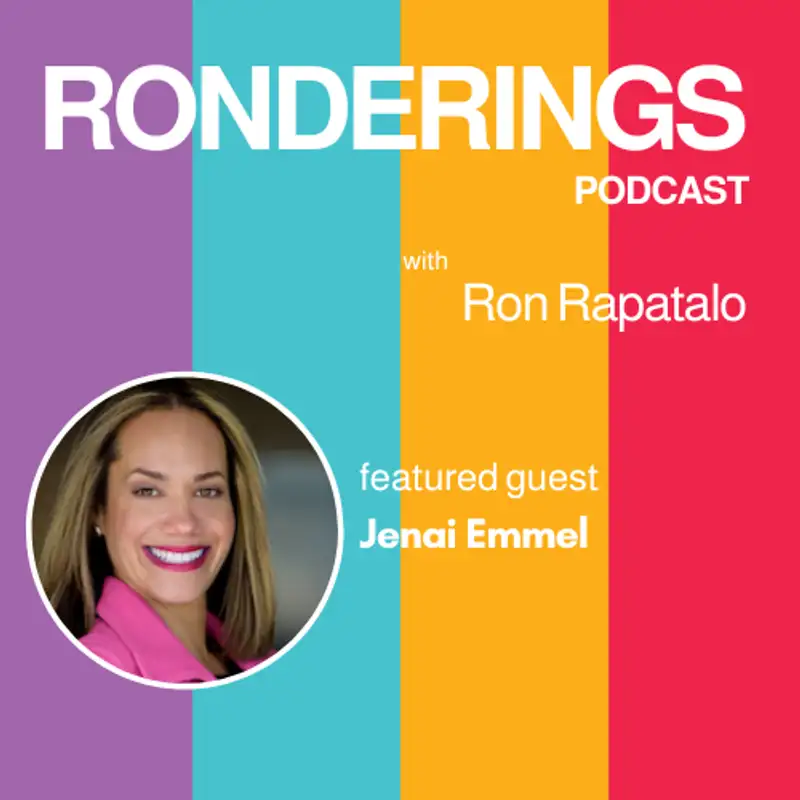
(00:00:25) Ron Rapatalo: Welcome to another episode of Ronderings, the space where we explore the real stories behind leadership, purpose, and growth. Today I'm joined by Dr. Jenai Emmel, someone who's been reimagining what's possible in education for more than 25 years. Through her consulting firm, Byrd, she's helped schools and systems redesign themselves with focuses on equity, inclusion, and student-centered learning. In this conversation, Jenai opens up about her multicultural roots, her faith in Buddhism, her journey through leadership, and how identity design thinking can transform not just schools, but the people in them. Let's jump in.
(00:01:05) Ron Rapatalo: Hey friends, before we get started, I want to share something that's been a big part of my own journey. Two years ago, I published my book, Leverage. That experience cracked something open for me. I saw how publishing isn't just about pages, it is about owning your story, sharpening your voice, and amplifying your impact. The part that meant the most was when readers reached out to me to say they felt seen. That's when I knew this work mattered. I loved this so much I co-founded Leverage Publishing Group with friends who know this world inside and out. Now we help leaders, entrepreneurs, and change-makers turn their ideas into books and podcasts that actually move people. You got a star in you, and I know you do. Let's chat. Find me on LinkedIn or leveragepublishinggroup.com because the world doesn't just need more books, it needs your book. All right, let's get to today's episode. Peace.
(00:02:15) Ron Rapatalo: Ronderings Universe. I know I always say I have the hot guest in the words of Deion Sanders, but I'm bringing another one to y'all because y'all have asked and I'm here to do what I got to do. So, we have Dr. Jenai Emmel on the mic who I met, I think, at a Teach For America school of color convening in '18 or '19 or something, right? Because Kai introduced us, correct?
(00:02:45) Jenai Emmel: Yes. Yep.
(00:02:47) Ron Rapatalo: Good old Kai Adley. I need to have Kai on this mic. It's just about his heart.
(00:02:52) Jenai Emmel: I bet.
(00:02:53) Ron Rapatalo: Worldwide Kai. I don't know where Kai is by now.
(00:02:56) Jenai Emmel: I don't either, actually. Oh my god. Philadelphia, right? I don't know.
(00:03:00) Ron Rapatalo: Yep. Yep. But he always travels and does his thing. So, you know, he might be on his bike tour right now or I don't know, doing something because he represents athletes as a sports agent. That's one of his newer gigs. Yeah.
(00:03:15) Jenai Emmel: Okay, cool.
(00:03:17) Ron Rapatalo: Yeah, lots of evolution.
(00:03:19) Jenai Emmel: I am doing great and um yeah, I can't complain living in DC and just yeah, I'm trying to enjoy my life.
(00:03:26) Ron Rapatalo: Great. Well, let's get right into it. Jenai, what is your story?
(00:03:31) Jenai Emmel: All right. Um I am just first of all just honored that you asked. It's nice to have a space to just share a little bit more about myself. And to your point, we've known each other for years, but I don't know how deeply we've spoken about just like the big picture. So, as I was thinking about how to prepare this, I was like, how do I make this structured and interesting? And so, what I came away with—I know, right? Just like me—I came away with a thematic approach to introducing myself to your audience and to you.
(00:04:05) Jenai Emmel: So, I've got like six ideas that I'm going to share and I think I'll move through them pretty quickly. Um, but the first thing I wanted to start off with in terms of my story is just more of like thinking about identity and values. So, I've got a few ideas that resonate a ton for me here. And the first is that I really identify with being an American. So, when I think of all of my dimensions of difference, that one is probably the most important one to me. And I don't know if you knew that I come from a very long line of military service.
(00:04:35) Jenai Emmel: So, men in positions in my family going all the way back to the Civil War. So, back to the Civil War down to my grandfather. He was only one of two men in his battalion to return in World War II. I've got a cousin actually that just passed away, but that was a Marine and did tours of duty in Iraq and Afghanistan.
(00:05:05) Jenai Emmel: So, I really come from a military background. I'm an Air Force brat. I've moved for a lot of my life and I really make a lot of decisions through that national lens. My work is national. I feel very much like a national person. Um, and really that national sense of patriotism is what fuels my work and a lot of my decisions. So that's like the first thing that I would really say is I've got a strong sense of patriotism and a service orientation and a lot of it is tied to my national identity. So that's like the first theme.
(00:05:35) Ron Rapatalo: Okay.
(00:05:36) Jenai Emmel: The second theme is that I see myself as being multicultural and from a lot of different perspectives. Again, thinking about dimensions of difference. Ethnically, my mom is generally representing the UK and is Dutch and French, and my dad is African-American. And so, I've got that multicultural vibe in terms of upbringing and sense of identity. But I also, I don't know, Ron, if you knew, even though the US is such a Christian-forward place, I grew up in a Buddhist family and so I've got a little bit more of an eastern orientation.
(00:06:15) Ron Rapatalo: There's a lot of ahas happening right now. Like the deep military family, which you might have told me at one time, but I didn't know about the depth of like doctors in your family and then hearing that you grew up in a Buddhist tradition. I have Buddhist friends in my circle so we should chop it up about that at some point here.
(00:06:40) Jenai Emmel: I would love to because it is a dominant kind of framework in my life and without going into the weeds here I absolutely—because I've only grown up with the Buddhist philosophy—I'm very aware of that as just a huge driver of how I think about the world. And I think the probably the most important thing to say is that concept of the lotus flower. It's a beautiful flower, but it blooms in the swamps and in the mud and it needs those nutrients and those challenges to reach its full potential. And so that framework alone is huge for me and I really think a lot about that honoring my challenges is a necessary part of my growth.
(00:07:20) Jenai Emmel: Um but then celebrating those successes that can only come as a result of that learning. So that's again another time, let's talk about Buddhism because that's been huge. Um, and then I think the other kind of multicultural sense is I'm originally from San Francisco but moved around the country, really came of age in Boston and so I've got that regional diversity and I've lived in like three-fifths of the country. Either lived or worked in three-fifths of the country.
(00:07:50) Ron Rapatalo: That's what I was about to ask you. It sounds like your national lens. I was like, what state have you not been in? Right.
(00:07:55) Jenai Emmel: Actually, a lot. I'm like, I haven't spent a lot of time in Idaho. I've not spent a lot of time in like the North Dakotas, in actually like Arkansas and Alabama, but I've been to most other places. I've not been to Hawaii, which is like embarrassing to even admit at this juncture, but um—
(00:08:15) Ron Rapatalo: Here.
(00:08:16) Jenai Emmel: Okay, I'm not the only one. Oh my goodness.
(00:08:18) Ron Rapatalo: So, I have these things as "not yet," right? Because we will end up there one of these days because I always see from people I know that grew up there and people that visited, it's just so multicultural.
(00:08:35) Jenai Emmel: Totally. Exactly. Yeah. No, I think everybody is probably fusion of some kind, which I think would really speak to me. But where I was going with this second theme is that inclusion is kind of everything for me because I grew up really feeling othered in some way. I was not this, I was not that. I was something in between. I was not part of the Christian tradition, but absorbing it, but really coming from the Buddhist sense.
(00:09:05) Jenai Emmel: And I've been geographically really diverse. So, my sense of roots isn't quite the same. And so, as I think about how I'm making decisions in today's world, that first lens is being an American. The second is about multiculturalism and inclusion and making sure that all the work I do really has those lenses in mind. And the very last frame around how I think about myself and my story is I have a very significant growth orientation.
(00:09:25) Jenai Emmel: Part of it is because that's what Buddhism is all about. So my whole wherewithal is about transformation and reaching enlightenment. But I also just come from this kind of achievement background. My dad's in aerospace medicine. My mom started off her career as a dancer and then became an engineer.
(00:09:55) Ron Rapatalo: I know. It's so interesting.
(00:09:56) Jenai Emmel: So, I have this sense of like super work ethic, a lot of service. I'm an only child, so I've got this pressure. I think I've grown up with a real strong sense that I needed to be successful. So, achievement and growth are significant for me. And then the last thing that I will say is I went to a fantastic high school that had this really strong perspective on what success looked like and they really led us through what I term the four A's.
(00:10:25) Jenai Emmel: Everybody had to be an artist. Everybody needed to be an activist. Everyone should be an athlete and everyone should be an academic. And while there were choices in all of those things, that framework is how I think about growth and achievement and success. I'm going to need to focus on photography. I've got to make sure I'm putting my education and service orientation first. I want to also—I'm working on swimming a mile every day. I learned how to do the flip turns this summer. I ski. I do a lot of sports. And then I've got three degrees. I'm thinking about going back to school, if you can believe it, Ron. So, this—
(00:11:05) Ron Rapatalo: I know, right? And I still feel like a slacker. I'm like, what am I doing? I'm such a late bloomer.
(00:11:09) Jenai Emmel: But all of this is that it's all about loving to learn. It's about wanting to grow. And it's about a balanced sense of that growth. So, those are the three big themes that I want to introduce around identity and kind of how I see myself. And then I just got three other ideas in terms of how I think about my story. But do you want me to pause there or should I keep going?
(00:11:30) Ron Rapatalo: I want to elevate something we said in the quasi-green room before I hit record. Right? Okay. When I told you the definition of the prototypical Ronderings guest—and some of this is just like straight intuition and feel, right? You know, because you and I met at TFA Edlock some years back and have stayed in touch over the years, especially through like career advice, etc.
(00:11:50) Jenai Emmel: Absolutely.
(00:11:51) Ron Rapatalo: And I gave you "multi-hyphenated leader." Clearly, you gave the four—I'm like, wait a second, that's a really good framework because I think I've stumbled onto that with all the things that I do. I'm really smart, I try to be really creative, I try to be athletic, and then also do good social justice work. So I love that framing first of all. But then the other part, the "sacred syncretism"—I'm going to have to ask you about how Buddhism impacts your leadership and how that got because for me, you said it twice and like energy goes beep beep beep beep.
(00:12:20) Jenai Emmel: I know, right?
(00:12:22) Ron Rapatalo: I'm yeah, but let's get those other three ideas to the forefront and then I'm going to go back to that.
(00:12:28) Jenai Emmel: That sounds great. Um okay. And I'm also thrilled that you asked, but I love that framework that you shared because I do feel like the personal, the professional, and the spiritual is absolutely how I'm moving forward. I just turned 47 like a week ago and I'm just, one, happy to be alive. Um I think secondly, I just really want to be balanced and so I'll get into that theme in just a second.
(00:12:50) Jenai Emmel: So the last kind of hub of ideas is around really my ideas around work because we did meet in a professional space and it's a huge part of my identity. But the way that I wanted to introduce my story—before I get into exactly what I do—is that, Ron, and I think this will identify with you and I think maybe even your wife and certainly a lot of your audience, is that my work is way beyond work. It is a calling there.
(00:13:20) Ron Rapatalo: Yes.
(00:13:21) Jenai Emmel: Such a deep sense of commitment to what I do. It is actually why I believe I'm on the planet—to focus on children, to focus on schools. And I have been really lucky to have that inspiration arrive in my life in college and all of the choices that I've made is because I was so awakened by some of the education work that I had started. But I really am deeply into it.
(00:13:45) Jenai Emmel: And for a lot of my 20s and 30s, I feel like it was all that I was really doing and it's why balance is so important to me as I move through 40s and approaching 50s. It's certainly the reason I'm not married because that person would have been number two for the vast majority of my life and I really want to be in love and I want that to be the frame of why you end up with somebody. Um and I think for me I want to be able to wait for that to happen but I needed to go through my journey in prioritizing the mission of my work and I don't regret it. It's been non-traditional I think to put it first to the degree that I have.
(00:14:25) Jenai Emmel: But that calling is for me really helpful and beautiful. And I just feel really lucky to have that sense that I'm always going to be thinking about education and kids and what I can do to make a difference for them. So that I think is the first frame that I have around telling my story. And that brings me into what I exactly do.
(00:14:45) Ron Rapatalo: It's like people are like, "Who are you and what do you do, girlfriend? Can you please get to that?" But uh Ron, this is—I was—I had it teed up, right? I have the Center for Education News here on one of my tabs. I was going to get there, but I want to hear about what you're doing now because I think that's really fascinating.
(00:15:05) Jenai Emmel: Okay. Thank you for asking. And that's like the second and almost final frame. So, first in the big picture, it's important for folks to know I'm 25 years into a career in education. It's been a real substantial journey and I've done everything from being a high school English teacher to being a director of instruction to being an assistant principal to leading schools, but most of my experience is in central office reform.
(00:15:35) Jenai Emmel: But now what's so amazing to think about is I am in my 13th year consulting under my own umbrella, Ron. So I have now hit the mark where I've consulted more than I have worked full-time for another organization. And so that's a really big seismic shift when you think about it. Um, and the work that I do is all about org design.
(00:16:00) Jenai Emmel: So, a couple of things to know—and this is actually your listeners and audience are going to hear it first because I spent the summer rebranding. I had an organization called Organization Design Partners and that's all about org design, and then I had Center for Education News. This summer I really felt like these ventures aren't different. I actually think that they're opposite sides of the same coin and conceptually I need to merge these. I need to find greater coherence in this. And so I rebranded under the company Byrd, B-Y-R-D.
(00:16:35) Jenai Emmel: Byrd is what you'll see now if you find me on LinkedIn. And so it's just to know that I've merged these two kind of houses or initiatives and brought it under one consulting organization. And what I do—and this is I think the importance of this commentary—is that Byrd is a total mirror and reflection of what I do really best in the world. It's a vehicle for me to make a difference. And so at this point I'm really fine-tuning it.
(00:17:05) Jenai Emmel: But what I do is org design by using stakeholder perspective to inform strategy and structure and culture and processes in an organization. And so what that looks like is I am solely concerned with student experience and teacher experience and leader experience or family members or board members, community leaders, and understanding what they think is going well or not in an org. And then I'm using those findings and ideas to work with my partners on how we restructure our organization in light of the needs that we hear coming from our schools or the people that we're supporting.
(00:17:35) Jenai Emmel: I lead those kinds of processes based on all of the org design that I've done and I do that work all around the country. It's been really amazing. So that's sort of the biggest engine that I have is around org design and it's really using communications and continuous improvement to do that. And a few years ago, I added another segment, which is where that Center for Education News comes from.
(00:18:05) Jenai Emmel: Because I think this is not going to be surprising to you, but when you're in the spaces we're in, we talk about it all the time. We're talking about education all of the time.
(00:18:15) Ron Rapatalo: Yeah.
(00:18:16) Jenai Emmel: I was really struck by the fact that when I turned on the news, it felt like such a limited, if not almost non-existent discussion happening in the larger public. Absolutely, I really was so struck by that. So I used my dissertation when I was still at USC to explore that issue of—am I right or is this just my subjective experience? What really is happening? And so I studied 30 years of news broadcasts to prime time audiences on Fox, CNN, ABC, CBS.
(00:18:45) Ron Rapatalo: And what percentage talked about K-12 education? It's probably a pittance.
(00:18:48) Jenai Emmel: Guess. Take a guess.
(00:18:50) Ron Rapatalo: 2%.
(00:18:51) Jenai Emmel: Oh my god. Have we talked before or are you incredibly intuitive? Because that is the number. Over 30 years it was 2.3% or less and in my study it was like 0.14 or something. It was absolutely—
(00:19:05) Ron Rapatalo: I know. I knew it was low. I was trying to go really obnoxiously low without saying 1%. And 2% felt like a good—wow. I mean I'm not surprised, right? Um, it's funny, um, when I think about what K-12 education news could be, right? From a satire perspective, have you ever seen the Key and Peele skit on pretending SportsCenter was used in the world of K-12 ed and looking at teacher salary gains?
(00:19:25) Ron Rapatalo: What if—I'm not saying it needs to be like that, right? But the level of attention that's paid in sports—
(00:19:30) Jenai Emmel: Yeah.
(00:19:31) Ron Rapatalo: —and the day-by-day and elevating educators like that. It made me sad watching it, right? Because I found the humor in it and then I felt sad after watching going, but that's never going to happen in that iteration, right? It has to be something different that fits the space. But I'm like, what if we talked about—the way I read The Athletic is the way I consumed K-12 education news.
(00:19:55) Jenai Emmel: I love it. And I love—
(00:19:56) Ron Rapatalo: I read The Athletic more than anything, right? I do read more about sports than I do anything.
(00:20:00) Jenai Emmel: Okay.
(00:20:01) Ron Rapatalo: I read very little on K-12 admittedly because of the way it is shared and what I take it to be as generally very blah for me as a consumer.
(00:20:10) Jenai Emmel: Without boring the audience with all of the details of this, I feel exactly the same way. Not only is it infrequent, but it's highly negative, overly simplistic, and often just really not amplifying the complexity of work and challenges and successes that are happening in our systems. And so really, Center for Education News is sort of taking those findings and operationalizing them. And so now I know the nature of the news at least for that period. What can I do about it?
(00:20:40) Jenai Emmel: And you said this actually when we were in the green room and it really struck me about you've been doing recruiting work and you've been in this HR pipeline space for so long and you've been interviewing as a function of your work forever. Now you've got Ronderings which is just an extension of that same background. I feel the same way. I've been evaluating more than 600 schools in my life. I've done so much evaluation.
(00:21:05) Jenai Emmel: All I do is conduct focus groups and interview and I think I can do something about this. But the work that I am doing under Byrd is advocacy work and it's not meant to just be my voice, but it is meant to take those principles of elevating student and educator voice to add complexity and attention to the issues. And so that's what Byrd is doing. We're basically leading org design or we're leading advocacy. And no matter what kind of change campaign we're working with you on, that's how I see the work.
(00:21:35) Ron Rapatalo: In the ed space from my own watch of it—as someone who attends a lot of the conferences and reads enough but talks a lot with leaders like you—the one-on-ones at the conferences are good for business development, it's good for accelerating my knowledge of the space admittedly because I find out a lot that's just not on wax, right?
(00:21:55) Jenai Emmel: Yeah.
(00:21:56) Ron Rapatalo: Um, so remember when I talked about bringing Buddhism back into the conversation? Here it goes.
(00:22:00) Jenai Emmel: Okay.
(00:22:01) Ron Rapatalo: There's something about the way you've brought together your two businesses of org design and this focus on education news that feels like a Buddhist approach.
(00:22:10) Jenai Emmel: Yeah.
(00:22:11) Ron Rapatalo: So, I'm wondering if you, in your own words, would articulate one, how do you see Buddhism has impacted the way that you're doing this new synergistic work. And then to rewind this back, I want the origin story of like how was Buddhism introduced to you? How has that impacted your journey? Because from an American context, someone who looks like you, no one is going to think you're Buddhist, right? They're going to be like, are you Thai? Are you Tibetan? No one or you're a white male who found it on some trip.
(00:22:45) Jenai Emmel: White Lotus notwithstanding season two. Let's not talk because that season is crazy.
(00:22:50) Ron Rapatalo: So funny. Everybody loves that show.
(00:22:52) Jenai Emmel: Yeah. Um okay, I am happy and first of all just thank you for asking about it. I love that we get to just explore some of these issues because I don't feel like I talk about it enough, but it is really dominant. So in terms of origin story, my mom was introduced to the practice. It's called Soka Gakkai International is the organization and she was introduced in San Francisco when she was 19.
(00:23:20) Jenai Emmel: And so she's like one of the original groups of people in the US that really started this practice. So when I was born she was 24 turning 25. And my mom grew up strict Catholic. So really I think the piece around Buddhism is it changed her life. She was really able to overcome significant challenges and that is really what led to a lot of my good beginnings because my mom made a lot of sacrifices early in life really fueled by her Buddhist practice and I think also my birth.
(00:23:55) Jenai Emmel: So I have only known Buddhism my entire life grew up in Soka Gakkai International and the core phrase that may ring a bell for people is called Nam Myoho Renge Kyo. It basically just means devotion to the mystic law of cause and effect. And so that framework of cause and effect is so significant because you are always accountable when you're a Buddhist for the outcomes in your life. It is some action, thought or deed that you have generated that results in both the positive things and the struggles that you have.
(00:24:25) Jenai Emmel: So I really feel that curriculum of highs and lows in my life is for me to become the person I need to be and to reach my full potential. So I think that frame on cause and effect is really a dominant leadership lens as well. I think the second thing I told you is about the lotus flower where I really do see challenges as essential. But another dynamic that I've not shared is this concept of you and your environment are one.
(00:24:55) Jenai Emmel: And I think that is really a big part of how I see the world. It's like if I'm wondering about the absence in the news, then the solution is within me. It means that if I see a gap, then I also have a gap and how can I fill my personal gap around this issue and hopefully that will translate into impact in my community. If I see something in my environment that I'm also upset about on a personal level, I need to look within and figure out okay what is going on.
(00:25:25) Jenai Emmel: So I guess I just feel like you can't separate yourself from your community. Your community is also you and they go hand in hand. So a lot of my work around education is that sense that if I want anything to change about the world, I have to first start with my own leadership and then see what I can generate outside of myself. But it really does start with you.
(00:25:50) Ron Rapatalo: It sounds very Marshall Ganz, right? And I know folks in the EDLD program particularly who spread the gospel of Marshall Ganz. It's this idea of the self, the interpersonal, and the connectedness to our community. Is that you have to have those things intersect and intertwine in order for us to have a flourishing society. If I think about it from all the conversation on wellness these days, self-care is not enough. Collective care matters too. But collective care is not enough either, right? You need a balance of both.
(00:26:25) Ron Rapatalo: And so this idea of looking within, looking to each other, looking in groups—for me it makes so much spiritual sense. People have been doing this for tens of thousands of years, right?
(00:26:40) Jenai Emmel: Yeah. I totally agree. And it's really about kind of how you see the world. So, I think that we are all really continually going back to this idea that community is pretty essential. It's why I've moved back to DC. I loved New Mexico, but felt a little bit isolated and I just didn't feel as healthy not being close to people that care about me and that I care about.
(00:27:05) Jenai Emmel: But I think how we go about that process of reconnecting is an individual process and for each of us to have our own philosophy about. There's no right or wrong way to do it. But for me, the Buddhist framework really works and it keeps me staying positive, staying optimistic about the future, but also resonates with the things that I can do better. It is daily work for personal growth and change.
(00:27:35) Ron Rapatalo: I would love that, right? Because two of my closest homeboys grew up Roman Catholic and are practicing Buddhists—Kristen Mamora, who was on my Ronderings podcast, and David Martinez.
(00:27:52) Jenai Emmel: Well, you know, there's 16 sects of Buddhism. So, it's like I always want to know what because the practices can be so different. But I'm fortunately on the side that does not require you to give up the things that you love in the world in order to be enlightened. So, I get to indulge myself still and be a Buddhist. I found the sweet spot of kind of having it all.
(00:28:20) Jenai Emmel: But yeah, no, I'm really happy to hear that people are finding the right lens for them because we don't have to stick to where we started. When I meet others that are those kindred spirits, it feels deeply spiritual the way that I do. It's really comforting.
(00:28:40) Ron Rapatalo: All right, let me keep it real. A lot of us have "write a book" sitting on our goals list, maybe for years. I sure did. Good news is there's more than one way to get it done. If you've got more money than time, a ghostwriter can help bring your story to life. If you got more time than money, a great book coach can guide you through the process step by step.
(00:29:05) Ron Rapatalo: If you've already written the thing, you'll want someone to shepherd you through publishing so you don't waste time or cash. Here's the thing though—no matter how you do it, the real win is writing the right book. The one that builds your credibility, grows your business, and actually makes a difference. That's what the team at Books That Matter is all about. Head to booksthatmatter.org and get some feedback on your idea or manuscript. Don't settle any longer. Your book could be exactly what the world needs.
(00:29:40) Ron Rapatalo: I need for people to talk about values. Now, how people come to their values doesn't always need to be personally spiritual for me. I believe all of us carry this incredible intuitive spiritual sense. My mom was able to hear from people that passed and I've inherited that gift.
(00:30:05) Jenai Emmel: Wow.
(00:30:06) Ron Rapatalo: It's probably one of the first times I might have said this. So you know, when people have passed that I know—celebrities or whatever—they come into the space. It carries weight because I hear things all the time. It also means my ability to build relationships with people happens quickly because I sense things about people without them telling me.
(00:30:35) Jenai Emmel: Well, it's so interesting because I am starting to read this book about being an empath. Managing the emotions of others around me has been a big challenge in my life. And managing my own emotions because I feel them so deeply. Often when I do school evaluations, I have to be depressed after some of those interviews where kids or educators are talking about traumatic events. I take that really personally, but it's also why I still do school evaluations myself.
(00:31:05) Jenai Emmel: My best work comes from internalizing compassion and empathy. But to your point though, it's a pro and a con. The pro is what we just talked about. The con is it is so heavy to feel all of that.
(00:31:18) Ron Rapatalo: You're a vessel like me, right? One of the things that Julie Chan, who is a purpose coach—i.e., she's a psychic—supported me with around the deep empathy is this idea of having a "spiritual sleeping bag." You can zipper from the bottom of your feet to protect your energy. Zip it up a little tighter and higher as a way to protect energy.
(00:31:45) Ron Rapatalo: Another thing from my homegirl Rose—when you receive that energy, think about reshaping it into something different when you then pass it back. Reshape it.
(00:32:00) Jenai Emmel: Bingo.
(00:32:01) Ron Rapatalo: That's something I've been playing with the last couple of years. These tools allow us to still use our genius but not be overwhelmed. When I've gone by the World Trade Center footprints, I've had to zipper up because it is deeply energetically overwhelming for me. Sometimes you need to take it in, but sometimes you need that distance so you feel it without it hitting you.
(00:32:30) Jenai Emmel: I love that. I like that better than wearing oil. Someone told me to basically create an actual shield through wearing oils. But I think either way, the concept of intentionally shielding and conserving is the theme.
(00:32:45) Jenai Emmel: And it brings me to my very last theme. I am working raw because of everything we just talked about—achieving balance through self-care and self-love and maximizing my impact in the world. There's three things for me. If I don't do these five things every day, I'm not as balanced: I journal, I chant an hour every day, I work out every day, I try to stay in touch with a loved one every day, and I try to eat well.
(00:33:15) Jenai Emmel: And I try to do something that's around my mission orientation, that sense of calling that I have. The second thing I'm doing is fine-tuning Byrd. I really want to continue to get better in the consulting work I do. We have a mandate to improve based on what's happening in the country. And then finally, I'm launching my show, which is called The Gray. Your audience gets to hear about it first.
(00:33:45) Ron Rapatalo: Oh, okay.
(00:33:46) Jenai Emmel: I am working on being a courageous advocate. My work is so about being behind the scenes—org design, helping others achieve. But to do the news work, I have to be in the forefront. I have to lead in the foreground. I'm an introvert and really shy by nature, but no one's going to do this but me. I've got to lead it for myself.
(00:34:15) Ron Rapatalo: We should talk offline if there's any synergy to support The Gray because this is where you and I balance. You talked about being an introvert. Surprise, surprise—who is Ron Rapatalo? Not an introvert. I am the extrovert's extrovert. My ikigai, my sacred syncretism, is doing things like this coaching.
(00:34:40) Ron Rapatalo: I'm really good at taking structure and making it my own and being able to share a story with passion. It's why I started this podcast, frankly, because I realized I love being a host even more than being a guest.
(00:35:00) Jenai Emmel: You're so good at it. And you're so generous and you've got a huge network. Seeing you maximize your impact gives me some of that fuel to do the same because you're working in so many different ways, but all of them uniquely you. Byrd is a great mirror of what I have to offer. When you're working for yourself, you have to create that structure. I hope The Gray will become a great example of dialogue because it is about being in dialogue.
(00:35:35) Ron Rapatalo: I could totally see you doing that, making the conference circuit and recording people. The spaces where I'm going could use you as the host—it should be "The Gray Conversation" with people like Kaia Henderson and Janice Jackson.
(00:35:50) Jenai Emmel: I'd love to.
(00:35:51) Ron Rapatalo: And getting other people's voices, right? Because there's the people that are usually talking, but then there's all the folks in the community who are doing the work but don't have the platform. When you think about what true inclusion and belonging is, it's understanding those that are closest to the work and don't have the voice. It is our responsibility to give people that space.
(00:36:15) Ron Rapatalo: What do we do with the space we have? I think so many of us I've had on this podcast often talk about why we do inclusion and belonging work—it's because of some sense of not feeling like we ever fit in. Even though people think I fit in most spaces, I always have a quarter to half a foot that stays outside of a space by design. Not feeling Filipino enough, not feeling Asian enough. It is a protective mechanism to see what is going on without being so consumed that I can't see.
(00:36:50) Jenai Emmel: I feel the same way. I just think it's totally about the inclusion piece but also bringing a voice to others. There's some amazing stories out there and diversity of thought around those ideas is going to be fascinating. It's a privilege to have this honest dialogue without having anybody approving me, and I want to take advantage of it.
(00:37:20) Ron Rapatalo: Well, you've been an entrepreneur for the last 12 plus years. What advice do you have for other aspiring multicultural entrepreneurs who want to do what you do, especially in the ed space?
(00:37:40) Jenai Emmel: Oh god, don't. I know that's another episode. At a high level, I don't think it's for everybody. It really is a specific kind of personality type that can do it well and for a sustainable amount of time. I took a non-traditional approach. Most people do consulting when they've reached the C-suite or are retiring. I chose it in my late 20s and early 30s because I wanted to learn more.
(00:38:15) Jenai Emmel: There's the risk piece. Not having benefits or a guaranteed salary is no joke. If you can manage risk and you have some clients ready to hit the ground running, give it a chance. But if you have a stable job, sometimes "side hustle land" is the happiest place. I don't encourage people into it lightly.
(00:38:45) Ron Rapatalo: Quick pause in the action here. I know a lot of us leaders and entrepreneurs have felt that grind of pushing a boulder uphill by ourselves. What I learned is you don't actually have to do it all alone. The Genius Discovery Program at Thought Leader Path is like having a think tank in your corner. It gives you clarity and assets to take the next big step. Check out geniusdiscovery.org.
(00:39:15) Ron Rapatalo: Well, Jenai, you've given so many nuggets and so many informal wanderings. I am going to tee you up though to give your formal wandering as we end our time together. What's the lesson or value you want to share today?
(00:39:30) Jenai Emmel: I've shared a lot of values, but the one I'm thinking about the most is being student-centered—it's a non-negotiable. What I'm thinking a lot about is compulsory education. It mandates that all school-age children be in school. It gives them a pathway for social and upward mobility.
(00:40:00) Jenai Emmel: I think the challenge is that it creates a forced economy. It means that irrespective of impact or quality, we are driving an economy. We've got adults working irrespective of impact. We need to audit what we need in this system that really benefits children. I don't think we've found that balance of working through adults in a beautiful way while still keeping kids at the forefront of our investments. So my wandering is: how do we achieve that balance through the lens of compulsory education?
(00:40:40) Ron Rapatalo: This sounds like an episode of The Gray that you need to be dealing with.
(00:40:45) Jenai Emmel: That's a taste of how I'm thinking about structuring the dialogues. And that's a taboo topic. We don't really want to unpack the fact that we've got a forced economy, but we do. 80% of our budgets go to adults. So, it's a big deal.
(00:41:05) Ron Rapatalo: How do people find you? What do you want to promote before we end?
(00:41:10) Jenai Emmel: You can find Dr. Jenai Ali Emmel on LinkedIn and my company, Byrd. I'll talk about the rebrand to Byrd on LinkedIn. I will also be launching our global education news survey. And finally, I will promote The Gray there.
(00:41:35) Ron Rapatalo: I am one of your biggest fans. I will be amplifying it as I make the ed circuit.
(00:41:40) Jenai Emmel: I do absolutely want to do panels and interviews to bring out our overall reporting. I need to get you to be a member of Edlock if you're not already.
(00:41:50) Ron Rapatalo: I am, but I didn't get going yet. The convening is coming in LA, the 10th annual one. That would be a good time for you to talk about Byrd.
(00:42:05) Jenai Emmel: And are you still doing your publishing work? I'll stay tuned for your work as well then.
(00:42:15) Ron Rapatalo: In the words of Deion Sanders, we always come in hot. Peace.
(00:42:19) Jenai Emmel: Peace.
(00:42:21) Ron Rapatalo: Wow. That was such a powerful conversation with Dr. Jenai Emmel. I'm walking away with so many gems about what it really means to lead with identity, purpose, and courage. If you want to keep learning from her, follow her on LinkedIn and keep an eye out for her upcoming show, The Gray. Thanks for listening to Ronderings. Till next time, keep growing, keep questioning, and keep wandering. Peace.
Listen to Ronderings using one of many popular podcasting apps or directories.