 Episode 87
· 01:01:17
What's up? I'm Ron Rapatalo, and this is the Ronderings podcast. Around here, I sit down with guests for real, unpolished conversations about the lessons and values that shaped them. And I'll be right there with you, sharing my own take, laughing at myself when I need to,
Ron Rapatalo:and wondering out loud about this messy thing called life.
Ron Rapatalo:Glad you pulled up a chair. Let's get into it.
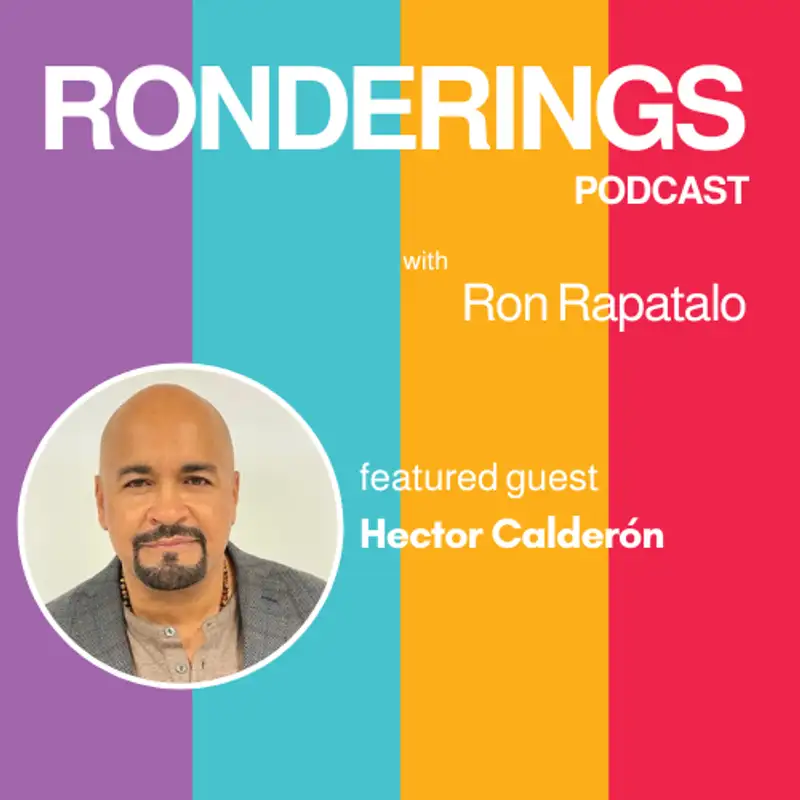
Ron Rapatalo:Hey, fam. Today's Ronderings episodes is one of those conversations that stays in your bones. I had the honor sitting down with Hector Calderón, educator, innovator, cultural steward, elder in the movement, and someone whose entire life is a master class of what it means to turn rupture into aperture, to turn pain into possibility. Hector takes us to the burning Bronx of his childhood to a one room schoolhouse in Dominican Republic, to teaching himself English through Gilligan's Island tapes, to living at the epicenter of Hip Hopsburg. And then it's the creation of a Puente Academy for Peace and Justice, first high school in the nation built on peace, justice, liberation, and community genius.
Ron Rapatalo:He talks about coaching leaders through the 18 inches between the brain and the heart, about culture of preservation is resistance, about honoring our elders who are carrying the right fight forward, and about why every generation must choose whether to fulfill its destiny or betray it. Get ready for poetry, for truth telling, for history, for hope. This is one of the most soulful, liberatory conversations I've ever had on Ronderings. Let's get into it. Hey, friends.
Ron Rapatalo:Before we get started, I wanna share something that's been a big part of my own journey. Two years ago, I published my book Leverage. That experience cracked something open for me. I saw how publishing isn't just about pages, about owning your story, sharpening your voice, and amplifying your impact. The part that meant the most, readers reached out to me to say they felt seen.
Ron Rapatalo:That's when I knew this work mattered. I loved it so much I cofounded Leverage Publishing Group with friends who would make know this world inside and out. Now we help leaders, entrepreneurs, and change makers turn their ideas into books and podcasts that actually move people. Got a star in you, and I know you do. Let's chat.
Ron Rapatalo:Find me on LinkedIn or at leveragepublishinggroup.com because the world doesn't just need more books. It needs your book. Alright. Let's get to today's episode. Peace.
Ron Rapatalo:Ronderings fam. I have my friend, new leader, cohort one, friend, co conspirator, and thankful for previous Ronderings guest, Keenan Bishop, for recommending that I bring the brilliant Hector Calderón to come on the mic to talk on Ronderings. Hector, how are doing today?
Hector Calderón:It's good to be here, brother. I'm excited to connect and have this conversation. The word conversation means with verses, so the exchange. Yeah. I love where it can go.
Hector Calderón:So I thank you for inviting me and and thank you Keenan for recommending me to be here. I'm excited.
Ron Rapatalo:Well, unlike Keenan, I can't spit for the life of me as someone who loves hip hop. I I don't know how to spit a verse for the life of me. If I had to do it to save my life, there would be a real problem. And I suspect, Hector, you probably can't spit a verse. You're not if not do spoken word, I might be able to do a little bit of that with you because I remember going to the Eureka Poets Cafe back in the day, something I always loved.
Ron Rapatalo:But I wanted to also elevate one of the things that I feel grateful for Keenan to recommend you to come on the mic is he had mentioned in a Ronderings live I did with him the term sacred syncretism. And he said, Ron, I learned that term from Hector. And so when he reconnected us to have you on the podcast, folks should know in the audience that one of the criteria that I use for guests explicitly these days Mhmm. Aside from being a multi hyphenated leader, which Hector's clearly. Mhmm.
Ron Rapatalo:You look up his bio, just Google. Uh-huh. Easy peasy. Right?
Hector Calderón:Mhmm.
Ron Rapatalo:But folks who practice sacred syncretism, which in my lay person's language, I describe as the alignment of the personal professional to spiritual. So, Hector, we'll probably riff on that a little bit about how you're practicing that because that's one of the reasons that I brought you on is the person that, you know, that Keenan learned the term from. And now I'm gonna, like, get your interpretation of it and how you live it. We can make sure we talk about that at some point in the episode. But Mhmm.
Ron Rapatalo:Let's start with the first Ronderings question. What's your story?
Hector Calderón:What's my story? My superhero origin story.
Ron Rapatalo:Yeah. This is, you know, little Wolverine, little Superman, little who you know, whatever, you know, Wonder Woman, whatever, you know, superhero that you all lied with.
Hector Calderón:No, no, no problem. I just very grateful in life. Yeah, I grew up in the South Bronx and I want you to imagine the South Bronx is burning and that kind of stuff where in my neighborhood, particularly in my block, there was only one good building and as far as the eye could see, they will burn black brick buildings. I remember when Jimmy Carter came to visit, I think that's when he got the idea for Habitat for Humanity and because they looked like burned down brick buildings, burned down Iraq or something like that to him, I think. And from there, you know, when I was five years old, my parents sent me to the Dominican Republic, that's where my parents are from, because they figure like most immigrants, they have the immigrant's dream of going back to their country and living there.
Hector Calderón:So they thought like, why send our kids to school there when we know that they will be going, we will be going back over there.
Ron Rapatalo:So
Hector Calderón:I had this incredible contrasting childhood where in the Bronx, you know, I was only five years old experiencing some things, you know, and then I went to Doctor and they're, you know, speaking Spanish and growing up where my parents grew up, growing up in a block that fundamentally hadn't changed in one hundred years. So when the old people talk about how they grew up in the Dominican Republic, I can totally relate because where I grew up, it was exactly that way And so much so that I can tell you that the first school that I went to was a school where the community came together to pay a teacher so that we can go to school. It was really a one room schoolhouse if you will, in the back, know, so I think that was the first time I the first, I won't say Ronderings, went into what a community school would look like because it was parents paying a teacher so that we could be educated. So doing that and in Doctor also I learned to be really social and really creative. Like we had to, you know, we didn't have a lot of toys, so we created our own things.
Hector Calderón:Like there was a kite season where we would take the liquid of a plant and that would be our glue to glue the paper and we would take shredded cloth that we would take to make the tail of the kite and that would be the kite season, know, or when it was time for, there was a lot of time for collecting tropical fish. Everybody had one. We would take all car batteries, truck batteries and empty them out and put fish inside of that, you know, so. Yeah.
Ron Rapatalo:Look at that.
Hector Calderón:It was playing a bunch of games, you know, tag and a bunch of games. So I used to learn a lot about that and also about being really creative and climbing up my grandmother's avocado tree and imagining different worlds and stuff. So it's like a really great seating ground for what was about to come in my life, which I didn't know those were the things that were happening. Then I came back in 1977, back to school, was in junior high school, and came back to the South Bronx, went to a wonderful bilingual school, and then I went to high school. In the high school, I won't even mention it now, but then I went to the first day of school, killed like two people in my school, you know, and that was very dangerous.
Ron Rapatalo:Yeah, high school in New York City back in the day, was, woo. Yeah.
Hector Calderón:And the standards are incredibly low, like if you just came most of the time, you'll be in the attendance honor roll. If you just pass all your classes, you'll be in the honor roll. And I remember like seeing like a 21 year old in my gym class, was like, what what is this man doing in this class? I'm I'm only 13 or 12, 13 at the time. Yeah.
Hector Calderón:So so my mom came and she got really scared and decided to to move us to Queens. And that was a big change, you know, because Queens was so diverse. I went to another Where in Queens did you go? I went to Flushing, Queens. Ah, no Flushing.
Hector Calderón:Okay. And my neighborhood is located the school that I went to was located in Jamaica, Queens. Very different, you know. 5,000 students unlike the Bronx, everybody spoke English. And there were no bilingual programs in my school.
Hector Calderón:So as a bilingual kid who I mean, somebody who's just learning English, I should just say, I really felt like I had all this language spoken around me, this English code that I couldn't break. So what I would do so no teacher came to me to teach me that they would just leave me alone because I was a nice kid. And you'll see how all the things lead to other parts of me later on. I will record a show called Gilligan's Island on this little recorder that I had, and I would put it on the inside my book bag. And during class, I would put my head down and press play.
Hector Calderón:And I will remember what I saw on the screen when I was watching the show and then hearing the words and I will combine the action of the word, what I saw with the words, and that's how I began to create meaning of things. So it'd be like, come here little buddy, that would be say the captain talking to Gilligan to come here and I'm like, in my mind would be like, oh that must mean come over here, but I will say that to myself in Spanish of course. So little by little, I began putting words together and of course, totally being immersed, you kind of put it together. I had to work I had to work really, really hard at learning the language and these things were sealed in my mind because even till this day when I I see a word and literally a play sound like a movie going through my through my head and I and I see it, you know, and I'll be like, you know, if someone's take the word transition, right? Which I'm in a great transition right now.
Hector Calderón:That's why I thought of that word right away. The word transitions got the word trans, which got cross, the word CTO in Spanish means place. So when you're transitioning, you're literally going from one place to another, but the word CTO in Spanish is located in the middle of that word. So I'm able to do that with a bunch of words now and then I went to college and I didn't know what to do, know, and I was still learning English or you know I was in remedial English classes and I knew that I had learned some English but I also understood that English what I call the cultural capital, you know, so I would take Harper's Magazine and I would look at circle words that they had and the Atlantic magazine had four new words that were about to hit the dictionary. Know, so a word like apotheosis.
Hector Calderón:I was like, it's still a big word to this day, right? But I could break it down though. I'm like apo means height, theosis means godlike or theos in there, right? It's the same word when hear the word enthusiasm or in God, right? Means elevating someone to a godlike status, you know?
Hector Calderón:I remember seeing another word, narco kleptocracy, narco drugs, klept stealing, tocracy government. So government based on drugs. I was referring to Colombia at the time when Escobar was still in
Ron Rapatalo:Did anyone teach you to do this? Is this something? So here's my wondering, Because you talked about, I'm going to bring us back to when you were in school in the yard, this level of creativity, the community expression. Right. So you had to be creative because you went to this like one room schoolhouse where like you just it's how they get a great schooling experience there.
Ron Rapatalo:And you did a lot of things despite not, quote unquote, having as many, like, resources and things to pull from, but you had each other and you just and so I'm wondering how much that creative mindset came from that. But also, what I've noticed on Ronderings is that oftentimes the apple does not fall far from the parental tree. Does this come from? Was this level of like creative expression, something that came from your parents, other family members too that you're like, yeah. You know what?
Ron Rapatalo:My dad, my mom was like blankie blank blank. So I'm wondering. Right? Because this these kinds of things around be able to figure things out. Because for every Blangolo student like you who starts to figure these things out, as we know, Hector, that you've run schools, many do not.
Hector Calderón:Mhmm.
Ron Rapatalo:This is not, I would say intuitive per se is is my point.
Hector Calderón:No. I I think well, one, shout out to my parents, right, who Yeah. All through all of this, they gave us love and sustained us and they have really high expectations for us regardless of where we lived. We knew that of course we were going to go to college, of course we're going to graduate. That was just a given.
Hector Calderón:In the midst of not seeing a whole lot of that in my neighborhood, particularly in The Bronx when I was living there, but as you know as I speak about The Bronx, The Bronx is also a place ripe with creativity you know during that time which I haven't said this part yet, you know, we gave the world hip hop. I remember you don't
Ron Rapatalo:know now you know audience, go
Hector Calderón:Exactly right. You know, I lived on Banana Kelly Street and I remember when this woman came and wanted to create like a boy band of hip hop and she came up by my neighborhood and I can't remember her name right now, but it's the first recorded hip hop album was called Rapper's Delight And there's a pizzeria not too far away from where I lived where she found two of her rappers there and who were imitating somebody else. So it was it was even their rhymes, but she put them together. And so I was
Ron Rapatalo:about that could be because I think so interesting story. I took a African American music class in college, and our professor brought some of the folks who, unless you dive more into annals of hip hop, don't get their their due, particularly Cold Crush Brothers. So So when they tell the story of rapper's delight, they're like, yo. Those are our rhymes. So I think you pointing it out from your lived experience, this all makes sense.
Ron Rapatalo:Right? Because I remember here, I was like, oh, wait. There was a little rhymes? Wait. What?
Ron Rapatalo:Exactly.
Hector Calderón:I mean, people were just looking for people. I mean, her name Sylvia
Ron Rapatalo:Robinson? Yes.
Hector Calderón:Thank you. That's the Yes. Job. Thank you for that.
Ron Rapatalo:Hip hop history for 5,000.
Hector Calderón:There you go. Exactly. You got it, Ron. So, you know, in the midst of all this, we would pass these tapes and we have double deck recordings, you know, and we play the music on one and press record on the other one. You had a microphone output and people would just rhyme and do their own thing, know.
Hector Calderón:So that was a big influence on me too and of course graffiti and b boying or b girling, all that stuff is very creative too, you know, but in the midst of educational stuff, there's a lot of people took their ashes and turned them into beauty, you know, so that's the work that we've always had, know, and going back to your question about how I put words together, I mean, I'm in this milieu of people putting words together and rhyming and stuff, and also every immigrant, very quickly if you want to survive, you have to learn some level of English, and it's funny how my father would put words together in his mind to speak functional English enough to get around to be able to do his job because he had since the day I was born, had two jobs. So he had a hustle and do whatever he took. So Right. But for me, it also like the effort of trying to break this code and being really intentional to sounds and recording episodes of different shows and then playing them again over and over again until like I understood its musicality, its cadence, the way they they broke words down.
Hector Calderón:That that I guess that that level of intentionality allowed me to later on to take my biggest weakness and turn it into strength in the work that I did. So to fast forward, I'm not too young, I told you the I nascent beginnings, the letters to incandescent ideas later on, We're you gonna need
Ron Rapatalo:a source here, Hector. My God, I didn't realize that like, I was like,
Hector Calderón:A pop. Again, I'm sorry, I'm in there like in the nation of incandescent ideas. When I had the opportunity to create my own school along with a community of Williamsburg, Brooklyn, the salsa el puente which is a community organization that's been around since 1982. In '93 we figure, or '91 particularly when I got there, but by the second year '92, we were a community organization that was there to support the community over all kinds of things, know, particularly working with young people and supporting them now from a place of deficit but from a place of potential and El Puente was really like my Wakanda, if you will. El Puente, we decided we needed, you know, we are in the health front, we're in the arts front, we are in the youth development front, we need to create a school.
Hector Calderón:So that year in '93, there was an application, a request or proposal to create new kinds of schools in the City of New York. Because a lot of, you know, came out of a lot of pressure. A lot of schools were failing during that time and people were new ideas. So
Ron Rapatalo:Rewind back. You went to two extremely large high schools that that was common back in the day in New York City. I remember in the very oversimplified version of this, like, creation of small schools was a lot of the impetus for that for what I understood policy wise. And all these really big high schools that, quote, unquote, were failing. There's no other way to say it.
Ron Rapatalo:Failing kids. Right? You need to say factories of, yeah.
Hector Calderón:So Absolutely. Yeah. So I believe 200 schools apply 200 institutions apply that year. Out of those, they chose 14 with the Irene Diamond Foundation, which later on they became New Visions as you know it. And then seven got to start in '93.
Hector Calderón:We were lucky number seven, I believe. And our school Amazing. Yeah, no, it was really incredible because to think about this Ron, most times a school lands in a community. We were a community deciding to create the vision for the kinds of schools we wanted to create. And the school was at the time, we called the El Puente, we were still called the El Puente Academy for Peace and Justice.
Hector Calderón:Yes. It was the first high school in the nation dedicated to issues of peace and justice, to social justice. They had a school for the arts, school for technology, the school for everything else, but we decided that we wanted to be, you know, as an act of self determination, that we will create our own school with our own vision, with our own community that will celebrate who we were and understood that schools are an ecosystem of academic, physical and there I say spiritual possibilities for our students. So we started humbly that year and as I began as one of the co founders of the school, I had three tenants for the kind of school that I want to create. Parenthetically, I to say that the year before, I have met Paulo Freire, and Paulo Freire came from Brazil to New York, and some people might know him from Pedagogy of the Oppressed, but this guy Pedagogy of the City, we make the road by walking, learning to question a bunch of books, and so I got to meet him and we got to connect with each other.
Hector Calderón:He was curious about the work. Of course, I have heard all about him. He was curious about the work that I was doing with young people, which is which in his case he was doing work with rural adults in the favelas of Brazil. So that became a big influence and inspiration. So there I developed three ideas, three ways, tenets if you will, that formed the school.
Hector Calderón:One is the idea of education for liberation and what I mean by liberation is the process of becoming fully human in body, mind, and spirit. Two, it was a school that we said, you know, disciplines, no matter what they are, math, science, history, language, were created to address community needs. You look at the history of any discipline that we put in schools that were created to do something in the world, right? So we will say, why don't we separate the community from school when what you're teaching was meant to address community needs? The math teacher that tells
Ron Rapatalo:me Yes! Exactly.
Hector Calderón:The math teacher that tells me, Hector, I'm just a math teacher. I would say well, what's the purpose of this discipline? Well, my fancy word was what is ontological stance? What's it meant to do in the world right? In the last, in the last tenet was disciplines in their natural state are not compramentalized in the way schools are, know, when you're in your jobs, and nobody tells you Ron, this is the math part of your job, this is the history part of your job, this is the English part of your job, you just have a job and you fulfill all these different things.
Hector Calderón:So why are schools that way? Why don't we create more integrated curriculum or at least interdisciplinary curriculum so that kids can see the interconnections between disciplines. So they don't go to the math class. Why are we writing in math? Or why are we doing math in English, you know, or in history, you know.
Hector Calderón:So with that, we started the academy and created really, I think it was really revolutionary at the time. We only had two subjects. We had youth culture in which you would learn art history and English and we'll have the environment where you had math and science and math, and again, to meet community needs. And we did a lot of incredible things as a result of that. So fast forward, that's how I got to think about a school meeting Frere and knowing the kind of schools that I went to, but also understanding the power of community to create a vision for the kinds of schools they wanted to create, how to go from self definition to self determination.
Ron Rapatalo:Alright. Let me keep it real. A lot of us have write a book sitting on our goals list, maybe for years, I sure did. Good news is there's more than one way to get it done. If you've got more money than time, a ghostwriter can help bring your story to life.
Ron Rapatalo:If you got more time than money, a great book coach can guide you through the process step by step. If you've already written a thing, you'll want someone to shepherd you through publishing so you don't waste time or cash. Here's the thing though, no matter how you do it, the real win is writing the right book. The one that builds your credibility, grows your business, and actually makes a difference. That's what the team at Books That Matter is all about.
Ron Rapatalo:Head to booksthatmatter.org and get some feedback in your ID or manuscript. Don't sit on it any longer, your book could be exactly what the world needs. So I'm wondering Hector, right, because I love that we can have this like education talk. Right? Let's call out something that per like, a number of members of Ronderings are gonna come from k 12 beds.
Ron Rapatalo:So you're gonna understand this, but some may not be situated in this sector. And so one of the things we know, especially, I think once, you know, No Child Left Behind got passed, was how much high stakes testing pervaded public education. Right? And so how did you navigate this incredible vision of a school and the high stakes performance culture system of New York City? Right?
Ron Rapatalo:Because I might argue that feels almost like diametrically opposed.
Hector Calderón:Mhmm.
Ron Rapatalo:Right? I mean, because it is. Let's just go. Right? But I'm curious as a school, like, how are you able to, like like, figure both of those things out?
Ron Rapatalo:Right? Because at the end of it all, folks didn't know, like, back in the day. Right? Well, under the Bloomberg administration. Right?
Ron Rapatalo:That you got letter grades for your school.
Hector Calderón:Mhmm.
Ron Rapatalo:And that determined over time whether you stayed open or not. Yeah. So talk to us a little bit about that, Hector.
Hector Calderón:So even prior to the to the to the school quality review where you where you would get a grade and stuff, we were asking like, what was the purpose of school, right, to ignite the word education because of the word educe. Educe means to bring forth that which is already there. And our job is like, you know, like it's like a ball has got a potential to roll. Our job is to push it and make it fulfill its potential to roll without changing the shape of the ball, right? So creating incubators with the genius of every student is allowed to emerge, you know, but to your point, right, very early on, we noticed that these exams didn't always cover what we thought was important knowledge for our kids, you know, particularly learning about themselves and learning their history and learning their context.
Hector Calderón:So just like we created a Puente, we created a we became part of a movement that decided that there are better ways to assess what our kids know. And we became part of a movement called the consortium. In the consortium of schools were 27 schools in the beginning that decided we have a better idea to assess our kids than the Regents exam. And we propose that just like in the world, right?
Ron Rapatalo:Because that Regis was a very low bar as we all know.
Hector Calderón:Right, exactly. We thought that having our kids do portfolios, which means accumulated works over time and present their knowledge base about what they've learned was a much better way to assess their intelligence. And particularly for the work that we were trying to do, may I tell you that one of the second tenet of what we were doing is like, knowledge is meant to fulfill, has an ontological sense, has a purpose, right? So when we were studying biology, we noticed that we cover the respiratory system. In Williamsburg, Brooklyn, it reads like a who's who of environmental hazards, right?
Hector Calderón:You have the Williamsburg Bridge, you have 40 waste transfer stations in Williamsburg, you have a oil spill bigger than the Exxon Valdez still spilling till this day in Greenpoint, right? You have the high levels of lead, we're part of the lead belt, right? So all these things cause high levels of asthma in our community, right? So we will go around and interview parents and see what were they doing for their kids' asthma and how they were doing it and we did a study where we looked at traditional medical practices of our community. Noticed something like Puerto Ricans and Dominicans, right?
Hector Calderón:And that work, our conclusions was the first time that those results appear in JAMA, the Journal of American Medicine, we that's this high school case along with other adults studying this stuff to see how that will be impacted. Biology, when we're studying the immune system, we figured we want to know how many people in our community were vaccinated and we noticed that was very low vaccination, one because they were afraid to go to the doctor or they didn't have medical access. So we took our school and we created a vaccination clinic in which we invited the whole community and we like a, we made it a festival. We had clowns, we have face painting, we have people performing.
Ron Rapatalo:It's like going to the kids dentist, And getting balloons and gum and colorful stuff. Exactly. What works for kids works for adults. I don't think people realize that. Yes.
Ron Rapatalo:Yes. What adult doesn't like to go to a party, especially in our communities.
Hector Calderón:Yeah.
Ron Rapatalo:You got a party and food, I might just go get a root canal.
Hector Calderón:That was given to the kids, know, and believe it or not, we were able to vaccinate more young people than what the Department of Health have been able to do in ten years. So we became a model for New York State and then we replicated that same same work Upstate New York, and they became a model for how how to how to create a vaccination campaign. But again, coming out of the clouds.
Ron Rapatalo:Can I pause you for a second? I want to elevate this, right? Because this is something I've seen as a pattern, not only in k 12 education, but in many other things. Right? Things are done onto the community rather than having the community be at the center of building the ideas and the way that things should be happening in their community.
Ron Rapatalo:Right? It I'm gonna say it. It feels like common sense what you did.
Hector Calderón:Mhmm.
Ron Rapatalo:Yet let's talk about our systems, right, which are created under tenets of white supremacy. You got to name these things, right? The things that are around, you know, believing black and brown and indigenous and Asian peoples and non white peoples around, you are expert in your community and in your bodies. Right. You are creating something that in the system of education, right, in public education.
Ron Rapatalo:Because I have this in my mind, both of my daughters go to private Montessori school. What is the Montessori tradition based on? Peace. Now, I might argue that depending on how the expression of peace happens in private schools may feel extremely watered down, but it's getting it gets better, right, depending on the school. I think ours has made progress over the years.
Ron Rapatalo:Right. But I think in public education, I get cynicals like, why would public education have a school that examines the public systems which perpetrate the bad things that happen in our community. Why would you give folks in our communities the tools to be able to say, yo, this is why we got asthma. Oh, wait. I'll hold on a second.
Ron Rapatalo:Right? And so what you create like, but in that groundswell of one, I think the brilliance of the small schools movement was to do school differently. I would argue a school like yours at El Puente happening today in this climate. I don't I don't know. I'm not gonna bet on it.
Ron Rapatalo:But in early two it just it was ripe for a lot so I just wanted to elevate that for the audience because I think this like, the Graswold community, because this is not the first or last time that folks in Williamsburg or other communities of color said, yo, this is what we want to do.
Hector Calderón:Mhmm. Right? Absolutely. You know, and and I and I wanna just punctuate this by saying that the school is still around, right? I know.
Hector Calderón:Now it's been thirty two, what 1993 till now it's like whatever it is, thirty two years in existence. So it was, you know, and in that time, we've only had like five leaders. That's it during the whole time. So
Ron Rapatalo:that's a very good track record for thirty two years. Were some other schools, You might have five leaders in five years.
Hector Calderón:Yes. Absolutely. Yeah.
Ron Rapatalo:Unfortunately. So
Hector Calderón:That's why I meant I mentioned it, you know, but to to the other point, I think that Yes. It's about acknowledging that we also have epistemologies, ways of knowing and habits. That's one of my
Ron Rapatalo:favorite nouns. Learned that in high school, man. I love that term.
Hector Calderón:Yes. Yes. So which basically means ways of knowing and we have our habits of being which we call culture, right? I think it's important to keep our culture, know, and sometimes like cultural assimilation is tantamount to cultural annihilation because we refer to a standard, you know, in which what are you assimilating into, you know, so we don't want to be whitewashed or erase who we are, you know, as a result of what's being said and particularly in the, as you see in the, what's happening in the country right now, the great erasure that's happening in our country, know, we as an act of self determination got to reclaim or reclaim and keep our our stories. Because as we know our story, we know our power.
Hector Calderón:Right? So we gotta be we gotta be able to keep those with us, you know.
Ron Rapatalo:Well, Hector, let me fast forward a little bit. What are you up to today? I know we kind of went a little bit of the crew, but I you know, it it feels natural in this conversation because some of my Ronderings episodes sometimes end up being many career walks, and but that doesn't sound right for you and I. Right? So let me fast forward.
Ron Rapatalo:What is Hector up to today? And then we'll we'll riff from there.
Hector Calderón:Absolutely. Yeah. Yeah. No. It's a long story.
Hector Calderón:I've lived a few years, but that that's, that's kind of, like I said, it's the origin story of me. So what I'm doing right now is I do a lot of coaching of leaders and I'm, you know, particularly thinking about like, how do we create the next generation, the next cadre of leaders for peace and justice in whatever work they're trying to do. And, you know, at first it looks like a leadership conversation about you being a principal in the school, but I'm also asking you for the sake of what are you being a principal? Towards what end? What is the ontological stance or whatever you're doing right now?
Hector Calderón:And to me, I'm highly highly invested in creating the next generation of leaders that will lead movements, you know, and are are passionate about creating liberatory spaces where the genius of our community can come to the forefront. And so I do a lot of coaching and I work with a lot of schools thinking about their leadership and their systems and things that you might see other coaches doing, but I'm particularly with a bent towards social justice and creating a much better world than the world that we're in. Because to me, you know, one of my favorite courses by a a French philosopher, black French philosopher, Frantz Ferdon. And Frantz Ferdon said that every generation must find its destiny, fulfill it or betray and I intend to fulfill it. So, I'm part of that generation that's trying to do that and work with other people who are creating social justice movements all throughout the country, you know, but you know the word movements got the word move me in there for a reason.
Hector Calderón:So what moves you? Like what is your why in all of this? And I think that history chose me. I didn't have a choice in the way in the I I didn't have a choice under the conditions at which I was born into, you know? Yeah.
Hector Calderón:But now that I'm here, I'm I'm ready to fulfill that.
Ron Rapatalo:Is that an amazing part of being able to understand your story? I think the way that you framed your story, Hector, and what you do today, to me makes all the sense to the world is why I have these episodes. Right? Because the thing that gets really fascinating for me is that without knowing my guest story
Hector Calderón:Mhmm.
Ron Rapatalo:It's really hard to understand why someone does what they do today. Right? And for me, the the getting the story out then allows me to eventually get to then ask this question around this thirty five minute mark is like, what are you doing today? It makes makes total sense. Right?
Ron Rapatalo:Because from your humble beginnings in the South Bronx to Doctor to back to the South Bronx to Queens and finding El Puente and other things we haven't yet talked about. Right? It makes sense that you have you were in the system that demanded that you fight for justice because you saw it around you. It was either, as you said from the French philosopher, you either Fulfill it or betray it. Or betray it.
Ron Rapatalo:Right. And you're clearly fulfilling it, right? Because to be clear, you could look at your origin story and some folks I'm sure you probably know that you grew up with or around with decided. Right. It's a lot you my eye.
Ron Rapatalo:Right? It's a lot you It's it's it's a it's a matter of, like, survival at times. Right? Like, to have to, like, see that searing in your mind and all that stuff. And and if you get a path out and we see this a lot.
Ron Rapatalo:I actually interviewed that sort of Nancy Gutierrez, right, who talked around staying or leaving, right, with doctor Roberto Padilla in a book that she wrote with him about two years ago, roughly. And how many of us who grew up in these communities of color, especially low income communities of color Mhmm. Are taught that our communities are not worth a stay. You decided to stay. Yes.
Ron Rapatalo:Like, that was an intentional choice because you knew there's brilliance in the community. Mhmm. And we deserve it's not because there is a brilliance in the community. It's the systems and things that don't allow us to flourish in a way that it takes, unfortunately, oftentimes, incredible effort to, quote, unquote, make it. Incredible effort to survive.
Ron Rapatalo:Yeah.
Hector Calderón:And again, what, you know, like, how do you stay intact in our process? Like quote unquote make it means, you know, blending in or letting go of all your cultural impurities to be accepted by a standard that will never be you or will never accept you fully to begin with, right?
Ron Rapatalo:Yeah.
Hector Calderón:And I think that, you know, like we have to use our imagination to create the imagined nation, what we're trying to fulfill, right? So it's not simply just an act of resistance, but also an act of creation, really building on who we are as a people, you know, like I said, different epistemologist, different ways of being and long before there was any, any, any oppression, we we had a way of being in the world, right? And in this generation have to create those new new vistas, those new possibilities.
Ron Rapatalo:Quick pause in the action here. I know a lot of us leaders, entrepreneurs, folks just trying to do good work, and felt that grind of pushing a boulder uphill by ourselves. The learning is you don't actually have to do it all alone. Genius discovery program at thought leader path like having a think tank in your corner. It's not some cookie cutter formula but your story, your plan of impact, giving you the clarity and assets to take the next big step.
Ron Rapatalo:I've seen people go through this and walk out with their voices amplified, ideas sharpened, some even launching podcasts like this one Ronderings. So if you're tired of grinding in the dark and you're ready to step into your impact with right support, check out geniusdiscovery.org. So, Hector, I'd be remiss because we're you know, you've brought justice to the forefront a number of times this episode. I'm gonna ask a two pronged question. Right?
Ron Rapatalo:And so though I do no longer live in New York City. I'm in Jersey City, like, hop, skip, and jump away.
Hector Calderón:It's just
Ron Rapatalo:beautiful city of New York. Yeah. Born and raised New Yorker. And so Mamdani's about to be mayor officially on January 1. Right?
Ron Rapatalo:And yet we see what's happening nationally in this country under the second term of Trump. So I ask you a two pronged question here. Right? What wisdom advice do you have for us coming into Mamdani in New York City? At a time where I think New York City this is like my spiritual.
Ron Rapatalo:But when I step in New York City, there's struggle going on in New York. Clearly, you visually see me feel it. Right? And I would say in this country too, folks are fighting hard, but there's struggle going on. And I'm not gonna sail the data points.
Ron Rapatalo:There's lots of anecdotes I can share. And, Hagrid, I'm gonna bring your, like, your justice lens and your spiritual lens. Drop us some wisdom about what you would advise us to do nationally, but also New York City.
Hector Calderón:About Mundane? Or you're saying just some what's it doesn't what's happening right now. Right?
Ron Rapatalo:Yeah. That's two pronged question. So let's talk about New York City first, and then we can talk then nationally.
Hector Calderón:Yeah. I think more than ever, you know, like the so called the the price of freedom is eternal vigilance. Right?
Ron Rapatalo:Ain't that the truth? Yeah, you can't put your foot off the pedal with this stuff.
Hector Calderón:You can't, right? And there's not, you know, if anything our ancestors have taught us is that you constantly have to fight for your existence and along the way the positive part of that is to constantly be creating and not be afraid to shine your light and not shy away from things that are not being accepted. Know, like the system right now wants to erase us in the process, you know, I have a little poem. I'm reciting to you a little bit of that poem. I think it speaks to a little bit of that, you know, and it's so the poem goes like this.
Hector Calderón:In the beginning was the word and the word was with God and the word became text And those who own the text put everything in context. Those who was without the written word resorted to the word-of-mouth and the spoken word kept our legacies alive. We were of words, preservers of culture. In the beginning was the word and the word was with God and the word became text and those who own the text try to erase us. But we learned to speak a language called confrontation and our b boy stance became our act of defiance.
Hector Calderón:So it's a longer poem but basically what I'm trying to say in those words is that it speaks of what's happening now, you know, our b boy stance, we got to keep dancing, we got to keep moving.
Ron Rapatalo:I wish I had a DJ here for spitting that poem, Hector. I'm like, uh-oh. And then we could have gone back to the East Village.
Hector Calderón:You know
Ron Rapatalo:where where he was gonna bring us. Right? It's like, there we go. Hector's on the stage, man. Come on.
Ron Rapatalo:Come on.
Hector Calderón:We gotta we gotta keep going.
Ron Rapatalo:The Eureka Poets Good Cafe.
Hector Calderón:And and and really create opportunities and organizations and and rites of passage and and rituals that celebrate the great diversity that we are, you know. As it relates to Mandali, I love the window that this brother's created for us to be able to do that in spite of all the challenges he is gonna be facing coming down his way. But man, he never shied away from his truth and he never shied away from where he stood even though some things are reflexive stances that everybody will say of course I have to say this in order to be even viable in this. I'm talking about his critique of Israel and what's happening there without seem resorting to being anti semitic necessarily. And so I do, beyond that aspect of political peace, I love the fact that we got to translate to our people that it is better to be in the state of liberation than the state of coping.
Hector Calderón:You know, like he said, here are the three things, here are the three or four things that I'm going to deliver on you as it relates to affordability. Right? And I'll take affordability and double it up to support our own viability as it relates to who we are as a people and celebrate those things too, which he represents, you know, given Yeah. If you look at his whole history, and he's never shied away from who he is. Yeah.
Ron Rapatalo:Oh, man, Hector. And let's let's zoom out. Right? We know nationally. Right?
Ron Rapatalo:We've got let's talk about k 12 education, you know, the de facto destruction of the Department of Education, you know, the pulling of funds, the various laws and things and pressure of the Trump administration. What wisdom would you share for audience members outside of New York City about, you know, keeping justice at the forefront of what they're doing?
Hector Calderón:I don't think we have a choice. I know that this is a tough tough time, but we have to amplify our voices, you know, use everything that we know how to do, the arts, the more than ever, we have multiple media streams that we can utilize to use our voice and more importantly, you know, practice the old adage of courage. The word courage has got the word coup, which means heart and rage. So out of out of filtering rage through our heart, exuding
Ron Rapatalo:I would not know that that word meant that.
Hector Calderón:Yeah. Excluding love and the same time expressing where we stand. You know? Yeah. Heck.
Ron Rapatalo:I needed you as my SAT tutor, by the way. Because I would have learned the the way that you, like, break down words and put like, I I'm thinking of you as a high school kid listening to Gilligan's Island
Hector Calderón:Mhmm.
Ron Rapatalo:And being able to paint these words with, like, a picture. It's so Mhmm. You know, from, like now I I know there are varying levels of thoughts that everyone like, learning styles is kind of, like, not as in vogue. Right? But, like, I do wanna say, like, the visualization of words and their meaning, right, especially that's a way that, like, really kind of gravitates towards you, is just so powerful.
Ron Rapatalo:Right? Because, like, I remember when I would study SAT words, it was like just trying to study. I was like to put to paint a picture and, like, think about it with a story. Because our memories are very fascinating. I was a neuroscience major at NYU, so, like, you know, memory comes in so many different ways.
Ron Rapatalo:And one of the fascinating things I learned in my neuroscience major was the one sense in our bodies that bypasses our thalamus, which is the area of our brain that sort of filters our senses for an oversimplified version of the thalamus, right, is smell. Smell goes directly to higher cortical areas and memories. So when you know, anecdotally, it like, if you smell the the rich memories that come across, a perfume, the smell of a certain food at a time of season, the smell of, like, urine reminds me of New York City subways. Don't know where I it does not matter I am at the damn world.
Hector Calderón:Like, oh
Ron Rapatalo:my god. I'm on the subway. Oh, wait. Oh, it's just pee. Damn it.
Hector Calderón:Yes.
Ron Rapatalo:You know what? That's what I'm so sorry for you. Well, that's our you know, that only New Yorkers who have taken the subways as long as Hector and I will understand that spell. Was like, oh, that's alright. But I think so.
Ron Rapatalo:Anyway, but I wanted to say, like, that was like, that's such a, like, a powerful way, and I could see why what you've learned, how you've led, being able to embody oneself comes with so much of your rich experience and the exposure you've had. So, Hector, thank you for sharing that. We're at the point in our episode that I have to ask you the Ronderings question. What is your Ronderings Hector? What's the lesser value you wanna share with the audience?
Ron Rapatalo:And my dog, look what look what Ava wrote for daddy. Aw. Love dad. Love you. No.
Ron Rapatalo:Beautiful. Oh my god. There you
Hector Calderón:I would say that, particularly because of everything that we've spoken about and how in the time that we're in learn how to take ruptures and turn them into apertures and live with a wide angle lens, right? Every crisis is an opportunity to recreate and reinvent ourselves and I think that we're in a great state of recreation, a great state of affirmation for what's possible within our lives. Know? So I would be like, learn learn to take ruptures and turn them into apertures.
Ron Rapatalo:There's something around that phrase I like was visually seeing in, ruptures and big was a aperture. Right? This, like, lens that allows you to focus on something. Like, what do you what do we each individually focus on with the cacophony and the chaos that's going on?
Hector Calderón:Yes. Yeah.
Ron Rapatalo:Thank you for that, Hector. You're welcome. You'd be sitting with that over a glass of wine and dinner tonight. Nice. So how do people find you Hector?
Ron Rapatalo:And what would you like to promote?
Hector Calderón:Yeah. I'm trying to be better about social media, but I, you can find me on my LinkedIn. That's probably the easiest place. I will Yeah. I'm making I'm making that more robust and and hopefully I'll become more social media savvy in terms of things.
Hector Calderón:But first, the simplest way to get in touch with me is that look at my LinkedIn and there you'll be able to get in touch with me or my email, you know, which is also there, I think.
Ron Rapatalo:Okay.
Hector Calderón:What am I trying to promote? I think I said it. I don't have anything particularly right now to promote. I mean, I am working on a project that's more like a long term project and I'll be, this might come out two months from now, so it might be more in fruition, but I think that the thing that I have going in me is like, I want to write a book and I've been working on it. It will be a book of personal reflections.
Hector Calderón:Love it. We didn't get into, you know, this is all again, from my early years, but it will be art, my drawings, my poetry, as well as my educational reflections and really being a whole human being because I don't separate any of those things, know, like when I speak, I try to speak to the 18 inches between your brain and your heart. So I'm I'm going I'm going up and down up and down, you know, that's the thing. You know?
Ron Rapatalo:I imagine when your book comes out and you're creative, you're super creative. And, like, my mind is going, like, 80 different directions. Like, when you have your book of it Mhmm. You'll have your art up. There'll be incredible music.
Ron Rapatalo:Right? Be amazing food. Right? There's something around your creativity Mhmm. And the kind of multi hyphenated nature of who you are, Hector, that when this book comes out and the events you have around your book, will just be these love festive communities, multiple dimensions of creativity.
Ron Rapatalo:Right? And that's not usually how I see every book. Right? It's just like who you are. And I would say
Hector Calderón:Thank you.
Ron Rapatalo:You know, in my own take of, LinkedIn, like, how do you make LinkedIn fit you rather than, like, you having to fit in the LinkedIn's box? Right. Because you're such a creative.
Hector Calderón:Mhmm.
Ron Rapatalo:Like, if people heard your word more, this is like my like my affirmation of you. Like, I can't wait for this episode to, like, be out there because you dropped so many, like, gems in your way with words is I could see when you're coaching someone, I imagine that a lot of your style is also using those words to move people. Mhmm. You have a real gift of that. That is not that's not every coach.
Ron Rapatalo:That is, I think, particularly unique to you, unique to someone like Keenan. Like, when I've had Keenan, like, on the podcast and I've done Ronderings live with him twice, You both have this way of words, which is not I'm not surprised you both have this kinship. Right? It's just like, I imagine you both talk. It's just like there's like music notes coming out of your mouth all the time.
Ron Rapatalo:I'm like, damn. Holy shit. It's like it's like, you know, when Pharrell's hanging out with people, just like the creator is just like it's just it's such a beauty of the way you both communicate. So like that gift sometimes doesn't fit in these other techno technological, like, engines that are out there. Right?
Ron Rapatalo:So it's just like, how do you make it fit you? And then you have to find other ways to express your genius that may not be those things. Right? Because none of these things could, like, can contain us in the boxes that they are is my point. There are things about us is why I podcast.
Ron Rapatalo:That's why I write. I do a little bit of all those things because I'm just like, yeah. Not a play in the games of the tool, but, like, tool doesn't I don't want the tool to define me either.
Hector Calderón:Exactly. That's boring. Yeah.
Ron Rapatalo:You know?
Hector Calderón:Yeah.
Ron Rapatalo:So
Hector Calderón:thank you Ron. I mean, you always been an amazing connector and I always appreciated your, your, your easy way of connecting with people that allows you to, to really create great tapestries of people and you interweave them in different ways, you know, by just the way, it's not a surprise to me why you do what you do also.
Ron Rapatalo:I've got podcasts? I've never
Hector Calderón:Exactly right, exactly. I mean, that's just you amplifying what you've been doing all your life as far as black. I know you from 2001 or whatever, that's when Cohort one came out. So you were around during that time too. So it's a great it's really a great gift, know, particularly in a time where it's always harping on you that we are isolated.
Hector Calderón:You are a unifier, and you remind us that we're not isolated. We are connected. You know? And
Ron Rapatalo:You've never been isolated. In fact, that is a even if we physically feel it Mhmm. It is a figment, I believe, of our imagination ultimately. Like, spiritually, you know, I leave us with this two parting thoughts. One, I always go back to this Philippine culture value, which loosely translated shared unity, this idea of interconnectedness that is in so many of our communities.
Ron Rapatalo:Like, that is a common thing. Mhmm. Right? And so this going back to, like, our ancestral wisdom, our intuition Mhmm. Even if right now my eyes don't see it, I do believe that we have to create that vision for ourselves, and we always have.
Ron Rapatalo:Right? And then the second parting thought to end our episode, I always leave our audience with in the words of one of my favorite sports heroes, Deion Sanders, we always come hot with amazing guests like Hector Calderón. Peace, y'all.
Hector Calderón:Thank you.
Ron Rapatalo:Thank you. I'm gonna be thinking about this one for a long, long time. Hector reminds us that education is not just curriculum, it's liberation. That peace and justice aren't electives, they're ways of being. That communities have always held their own solutions, their own genius, and their own power.
Ron Rapatalo:He challenged us to widen our lens, turn every rupture into our lives into an aperture. Stay rooted in our stories so we don't lose our ways of knowing, our ways of loving, our ways of imagining. And he modeled something we don't talk about enough, but it means to lead while holding deep family responsibilities, grief and caregiving. The sandwich generation is a metaphor. It's a lived experience, and Hector gives it voice and dignity.
Ron Rapatalo:Yeah. If you remove, go follow Hector on LinkedIn, support his upcoming book, and amplify the liberatory worldview he's been cultivating for decades. As always, thank you for listening, sharing, and building the Ronderings universe with me. And remember what Hector told us, learn to take ruptures and turn them into apertures. See you next time, fam.
Ron Rapatalo:Peace. Before we wrap, I've gotta give a huge shout out to the crew that helps make Ronderings come alive every week, podcasts that matter. Their mission, simple but powerful. Every great idea deserves a voice. So if you've been sitting on that spark of a show or story, don't overthink it.
Ron Rapatalo:Just start. Head to podcastsmatter.com, and let their team bring your vision to life. Till next time. Keep rondering. Keep growing.
Ron Rapatalo:Keep sharing your voice with the world. Peace. Listening Thank you
Ron Rapatalo:to today's Ronderings. I enjoyed hanging out with me and my guests, and I hope you leave with something worth chewing on. If it made you smile, think, or even roll your eyes in a good way, pass it along to someone else. I'm Ron Rapatalo, and until next time, keep rondering, keep laughing, and keep becoming.
Listen to Ronderings using one of many popular podcasting apps or directories.