 Episode 105
· 52:17
What's up? I'm Ron Rapatalo and this is the Ronderings podcast. Around here, I sit down with guests for real, unpolished conversations about the lessons and values that shaped them. And I'll be right there with you, sharing my own take, laughing at myself when I need to, and wondering out loud about this messy thing called life. Glad you pulled up a chair.
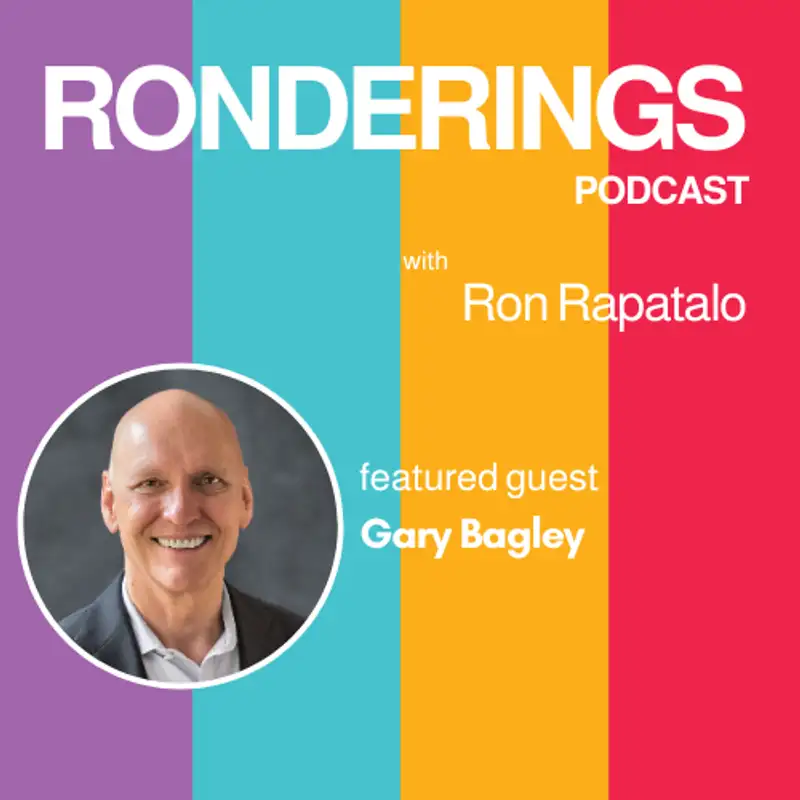
Ron Rapatalo:Let's get into it. Welcome back to Ronderings. This is the space where we sit in the tension of leadership, not to solve it quickly, but to understand it more deeply. Today's conversation is with Gary Bagley, former CEO of New York Cares, now executive coach, board adviser, professor at Columbia. But more than titles, Gary is a leader who sees leadership as creative act.
Ron Rapatalo:This moment, that for me hits different. Leadership right now, it's not linear. It's not predictable. Not even stable. It's adaptive, messy, it's human.
Ron Rapatalo:We talk about what it means to lead when the ground is shifting. Words are struggling to engage. Senior readers are carrying the weight because it's fragile. It makes external environment is moving faster than anyone planned for. Through all of that, Gary offers a simple but powerful invitation.
Ron Rapatalo:Feed leadership like something you're constantly creating. Say yes to possibilities. Let's get into it. Ronderings universe, I'm sure you know every once in a while because I love to make connections with amazing people, especially folks who are coaching and have been in the big seat in the social impact org. I had the pleasure of finally connecting with Gary Bagley about a month ago.
Ron Rapatalo:We had such a great conversation. I need to ask him to be on Ronderings. So, Gary, welcome to Ronderings. How are doing today?
Gary Bagley:Well, I'm doing great. Thanks for I was so glad you connected with me. And I think like a lot of those connections, I think it took us a couple of months to make it happen. But when we finally did, I I was equally glad to be connected with you and thrilled to join you today.
Ron Rapatalo:Absolutely. So aside from, like, Gary's many accolades, which folks will hear before they actually hear this, like, kind of part of the podcast. Right? He was the CEO of New York Care. So if you're in the New York City area, you're probably very familiar with New York Cares.
Ron Rapatalo:And right now, Gary is an executive coach, amongst many other things that I'm sure he will tell us about in lots of detail as he details the first question of Ronderings, Gary. You ready?
Gary Bagley:Yeah.
Ron Rapatalo:What's your story?
Gary Bagley:Well, you know, as I say, I'm not a young man, so it's a very long story longer than this podcast. But, oh, I'll keep it short for everybody. You know, I I found my way to to New York City and started working in the social sector. And and one thing I one reason I bring it up is because I I considered it an important part of my journey, which as is I started working in classrooms. I was teaching arts, and I was going in to about 20 to 30 different schools a year through a wonderful organization called TADA in New York City.
Gary Bagley:And it was a really amazing kind of hands on way to learn about the system and how the system, in this case, the Department of Education, makes decisions about, you know, the lives of of young people and their families. And so, as I was kind of making my observations, I eventually, threw my hat in the ring to become the director of education for the program I'd been teaching for. And Okay. Yeah. And that was I always say that's when the monster was created, the guy who loves to write grants for some reason.
Gary Bagley:The, you know, the person who loves I always say when I love something, I just want everybody in the world to have it who can. Perfect. And so that journey eventually led me to getting my master's in public administration and then ending up at New York Cares in New York City, which was an amazing, amazing gig, a chance to be at the center of a civic life, really helping people connect to the city that they were a part of and make meaningful change. And thinking about over the course of all those years, what did meaningful change look like in different moments of time? Right?
Gary Bagley:So it was a mission that constantly evolved. And, anyway, that was a joy. At a certain point, maybe we'll talk about this later. I believe that, you know, I as a good colleague of mine says, in leadership, we all kind of have a best buy date, and we have an expiration date. Right?
Gary Bagley:There's just a moment when when it's time to move, and I had felt that kind of nagging to say it's time for somebody else to take on this problem, this wonderful thing that I'm a part of, what however you wanna look at it. And that's when I was exploring what was next for me. I found my way to thinking about executive coaching, to thinking about boards of directors, to thinking about the leadership teams. I always say I've built a practice, and we'll talk more about it later, I'm sure. But really, I took all the favorite parts of my job, and I turned them into my next job.
Gary Bagley:So
Ron Rapatalo:Yeah. Smart.
Gary Bagley:Really. Well, it was a it was a cool thing. I'd love to say it was a 100% intentional. A lot of it. You know?
Gary Bagley:There's a good chunk of happy accident in it. You know?
Ron Rapatalo:Yeah.
Gary Bagley:You know, when I thought about what people came to me for and then what also brought me joy, those two things together you know, when I looked back at the themes, I was like, oh, you know, this is everything you used to love and none of the stuff that was less exciting for you.
Ron Rapatalo:Yeah. So let me rewind this back. So you mentioned one of the very first things you did was starting to teach the arts in classrooms.
Gary Bagley:Yeah.
Ron Rapatalo:So this is something I always like to ask my guests, right? Especially a lot of my guests have worked in the social impact sector. How did you know that's what you wanted to do? Because teaching in classrooms, starting to work at a place like New York Cares, being a director of ed and ta da, like, you know, when people wanna be of service, I I often hear of, a moment, moment, parent, somebody had some kind of, like, in there's an inflection point of, like, this is what I really wanna be doing.
Gary Bagley:You know? It's it's funny. I some of this is so ingrained in me. I always go back, and I I always remember this moment in time. I think I was in the seventh or eighth grade.
Gary Bagley:And Okay. They gave us these little career aptitude tests. And Yeah. Know, the the the our guidance counselor came back and said, be a teacher, be a preacher, be a social worker. And I knew what a preacher was, and I kinda knew I didn't want that.
Gary Bagley:But I, you know, I was like, I already at, you know, eighth grade, I didn't even know what a social worker was. You know? Right. And but when you kind of look at the the progression of my career, I was even though I didn't name it this, I was always looking for a way to be of service to others. That was just fundamental to who I was.
Gary Bagley:Now I will, and I often you know, when I always joke when I'm asked to speak on a career panel or something like that, I always warn people, like, I'm not the traditional story. I didn't have a light bulb moment, you know, in my freshman year at college that, like, sent me on a pathway. I one reason I'm grateful for the arts is I did just kind of let myself explore my way through the city. I was, you know, working to be a working artist. I was kind of making money on the side.
Gary Bagley:And once a good friend of mine called and said, would you be willing to play piano, for a kid's musical theater class? Okay. Inside, I thought, no. Like, no. I just that that that's not me.
Gary Bagley:But then I thought, you know what? Try it. Try it. What the hell? And I fell in love with it.
Gary Bagley:So it was in that moment that I I I went in. It was frustrating. It was like a puzzle I couldn't put together because kids are kids and, you know, art had become something I did as an adult and, like, bringing the two of them together. So it really did become a, you know, kind of an improv. They always say, just say yes or, you know, that's rule number one.
Gary Bagley:And Mhmm. Yes. And usually saying yes is it has worked out well for me. And that's a a good example of my career went somewhere I had never imagined after that moment. And so I will say, though, once I got in there and just thought about how am I of service, part of the itch that led me to go back to grad school, the eventual move to New York CARES was when I was in classrooms.
Gary Bagley:I love the arts. I think they're critically important. And I was also in classrooms and then bringing artists to classrooms where I saw so many more needs. And so the desire to kind of fill more of the needs of the community is what eventually kind of brought me to think about where else in the in the sector do I want to serve. So it's a good journey, though.
Ron Rapatalo:Yeah. It fascinates me, right, because to hear this art artistic lens, this creative lens. Right? I I have this anecdotal argument that folks who come from a creative lens, an artistic lens I think of my friend. You may know her in the New York City nonprofit space.
Ron Rapatalo:She was a former Ronderings guest, Yamele Toussaint, who had stemmed from dance. And so, you know, she went to MIT for her engineering degree, and she grew up dancing, right, and had thought about, how do I mix these things together? Fast forward, people, you can listen to the podcast, you wanna hear the full story, Create a Step From Dance, which has been around for over a decade, right? And so I have found folks who have a very creative mindset tend to lead from a different way than someone who isn't coming from a kind of creative art standpoint. So I'm wondering, Gary, especially as you move to leadership roles, New York CARES, your executive coaching, how much have you thought about that creative artistic lens influencing the way that you lead and coach?
Gary Bagley:It's such a great question. And, you know, it's funny. I was recently teaching. We'll talk about it later, but I also teach nonprofit management up at the International Public Affairs School at Columbia. And we were doing some readings around innovation.
Gary Bagley:And as I was reading it, you know, I was like, well, this is, like, what artists have been doing, like, forever. Like and I get Right. Right. Like, and I get that it's like a thing you have to teach people who are going into another kind of area and another lens of working. But I do think, you know, the and it was great in the executive director role.
Gary Bagley:Right? Because you're you're almost tasked with making one and one equal three. So you're always thinking about, like, what are our assets? How can I use them? How can I go about this in a different way that will be a better way?
Gary Bagley:You're also and I think this is really important, and I saw it when I moved from the arts to New York Cares. Right? It's like, you have to fail. Right? You have to try it.
Gary Bagley:It has to not work out. You have to go back and make it better. There were so many instances when I first got there where brilliant. It's an amazing team. And but there were so many things where people were like, oh, we tried that once.
Gary Bagley:And inside, I was like, that's not enough. Right? Like, how else did you try it? Right? Like, it wasn't worth it.
Gary Bagley:Like, how do we dismiss ideas? So I've always felt really grateful to just having been raised through the creative lens. I think the other thing, and I often tell people this side of it, artists get things done because, you know, like I say, we've always we've all once stood in front of an audience and not been ready. Right? And you just don't you never wanna live that again.
Gary Bagley:And so, you know, artists, they do it in different ways. It's creative. It's not, like, always, like, a clear timeline, but you get things done and you get them ready for others to see them. And then you keep learning. So I I yeah.
Gary Bagley:The the amount the number of ways creativity has kind of influenced, my leadership, how I think about life and work is probably immeasurable.
Ron Rapatalo:Yeah. So I'm gonna go on this idea of preparedness as it relates to leadership. And so one of my favorite podcasts to listen to is actually in the arts and music. So Sean Stockman from Boys to Men has a podcast called On That Note. So I watched a snippet because it's two parts, right, with the incredible Paula Abdul.
Ron Rapatalo:I watched a snippet of the episode where he talked about how much preparation allows you to stand out the moment. So there's this famous story in Boyz II Men lore where they wanted to perform in front of Belle Biv De Velvet, particularly Michael Bivens, they were looking Michael Bivens of the folks in New Edition was really one of the huge, like, producers in in New Edition. And so he was looking for R and B talent, and so they were like there was this chance moment to kind of, like, condense the story for Boys To Men to perform in front of Michael Bivens. And they were nervous. It was like, Here, just perform.
Ron Rapatalo:Off our concert tour bus, go ahead and sing. And they just sang. And they knocked the boots off and did a great job. And fast forward, you know, boys to men history. Right?
Ron Rapatalo:And so Paul Abdul and him were riffing about how much you don't take advantage of that moment unless there's two things. One, there's a fearlessness, but, also, you've prepared for that moment because you're always practicing, particularly when you're an artist. Right? So here's my, like, connection question. In your own leadership journey and as as you've coached leaders, how do you what's what how how is preparedness look like to be a leader?
Gary Bagley:Oh my goodness. Such a great question.
Ron Rapatalo:It's it's a big question. Right? It's like a there's like a whole course.
Gary Bagley:Right? Exactly. But, you know, it's one thing I often tell people is is that we learn to be, in this case, executive directors in nonprofits by doing it. Right? And so when we think about, like, what does readiness look like?
Gary Bagley:It it's a bit amorphous. Right? You can learn about finances. You can learn about fundraising. You can do all of them.
Gary Bagley:The the preparation to me around leadership is around a couple of bigger buckets. One is communication. Right? I've always said that the privilege and the burden of leadership is that you tell everyone what's going on. And nobody wants to listen to you for two hours.
Gary Bagley:Right? They they want it in one sense. And so this ability to be reflective, to think about what's actually happening here and distilling complex moments into a single decision or a single next step. Right? And also this ability to engage people in your view of what the world may look like if you all succeed.
Gary Bagley:Right? So those are things that we don't do without a lot of reflection. And I will say most leaders I know are reflective people. Right? They're trying to figure out, did did that thing I did yesterday make it better?
Gary Bagley:Did it make it worse? How can I do better next time? Which is kind of also that creative process. The second is and I'm always fascinated by discussions kind of of power in the workplace because Yes. In the CEO spot in a nonprofit, people assign you power that you don't actually have.
Gary Bagley:Right? The most important decisions that get made in a nonprofit don't belong to the CEO in any way, shape, or form. And the job is actually about bringing everybody in the network along to make a decision together. Right? Now if you have the vision, you know where you want everybody to go.
Gary Bagley:Right. As I say, like, you know where you want this story to end, but you also have to be open to it going a better way than you ever imagined. Right? And that's in the people. And so I would say, like, in most of our jobs, we succeed because we've basically been task oriented and done things in alignment with the direction of the organization.
Gary Bagley:So the preparation is about being the person who gives that to everybody else, gives that gift. And Yeah. So I always encourage people to first stretch themselves and and as much as they can engage in conversations about the future of the organization. CEOs are always surrounded by people who say we can't do that. Right.
Gary Bagley:Right. So I encourage people to say, be one of the people who says we could do that if. Right? Don't say no. It's old school.
Gary Bagley:Don't say you can't do it. Tell me what you would need to get it done. And you start to stretch that muscle and you start to think about strategy. And then the other thing, I and and I I tell people, like, where are you prepared for this? You know, can can start with being helping run the parent association at your kid's school.
Gary Bagley:It can be student government, but you've got to be in spaces where people regularly disagree. Don't do what you want just because it's what you said you want, and then you figure out how to bring them all along because I think those kind of two skills are are there there's, you know, con there's technical aspects to both. But one of the joys of leadership is that they're both a lifelong journey. You never get it right. Yeah.
Gary Bagley:Yeah. And so it's also what keeps leadership interesting.
Ron Rapatalo:I love this. You know, for me, and, like, this makes me geek out and thinking about, I go back to my time working in new leaders, right, you know, where I was part of the national recruitment admissions team for the Aspiring Principals program. And a lot of what you're talking about makes me reflect on the selection criteria for aspiring principals. Because those things about having the context and the space and the responsibilities to practice these things, Ideally these things happen on the job, but I think we know in like, particularly I mean, this is my watch of the nonprofit sector. For every nonprofit that pours into one's development, many others just have you do the job.
Ron Rapatalo:You sort of have to figure out, how am I going to develop myself and ask for what I need? Right? Rather than there being a system of, well, we groom people intentionally, which at times the middle part of that is like, you just have a really good manager that cares about that. Right? There may not be a system, but having a really good manager that pours into you and gives you the space and responsibility to stretch, which I did in new leaders being promoted four times, right?
Ron Rapatalo:That's where I learned more than I ever thought I would learn. Right? That's the one job I point back to him. That, that was really the deepening of my coming of age as a leader to say, Oh, this is what it could look like. Is, oh, there's some things you do wrong.
Ron Rapatalo:Oh, this is how you have to, like, manage them. Oh, this is how you have to navigate the politics that or hearing how they were being navigated and how you helped shape that. Right? So there was a lot that I learned there.
Gary Bagley:Yeah. It's it's interesting. You're bringing up a a really interesting point because there are so many aspects of the job that I often tell folks who are newer to the sector. Like, there's an aspect of apprenticeship here. Right?
Gary Bagley:You are you are observing people do this job, and there are people you're going to work with and for who you think, okay. There's a bunch of stuff they do that I don't wanna do. Right? It doesn't feel natural to me. Right.
Gary Bagley:I saw some of the negative impact of the way they communicated things. Right? And Yes. By the way, I always warn people, you'll be shocked how many ways people can take that well meaning thing you said. Right?
Gary Bagley:So it's not even that it's intentional, but you see like, oh my gosh. Like, one message kind of scatters across this organization Right. In different ways. And, and so as you're thinking about that apprenticeship, I always encourage people because a lot of people, like, in their careers to go, ugh, I had the worst boss. And I was like, you had a human being.
Gary Bagley:You worked for a human being. So, like, again, as leaders, one of those skills we need is to be able to look and go, okay. Well, what worked about the way I was managed? What didn't work about the way I managed? And how's that going to inform my journey moving forward?
Gary Bagley:This sort of they were greater, they were horrible, doesn't really help. And and I will say and and another thing I often say to folks is and I your comment about, like, beat, how you're developed by your manager really Yeah. You know, also speaks to me is, like, I don't I haven't met the person who when somebody reaches out and says, hey. Can I talk to you about your journey? Or I'm thinking about my next steps in my career.
Gary Bagley:I don't know the person who's ever said no to that request. Now they said not now. Like, I can get together with you in the summer. Whatever. But, you know, I have
Ron Rapatalo:to say to people, if
Gary Bagley:you reach out to somebody and say, like, your career is kind of a a thing that I'm thinking about, first of all, you stroked my ego. Right? Like
Ron Rapatalo:He's flattering. Absolute. I've never said no to those convos.
Gary Bagley:Exactly. But I on the other side, I hear so many people nervous, wanting guidance. Like, how do I go about this? And I'm
Ron Rapatalo:like, just
Gary Bagley:say, like, I admire your career path, and I was wondering if we could ever have coffee. And you'll let you'll end up having coffee again. It might not be tomorrow. No. But it will happen.
Gary Bagley:So there is mentorship and apprenticeship available. And Mhmm. You know? But it but it does take that assertiveness to ask for it, which, again, is a prerequisite for leadership. Right?
Gary Bagley:Like, you you've gotta be able to ask.
Ron Rapatalo:Yeah. No. Absolutely. Well, I wanna pivot a slight bit, keeping on the leadership vein. Right?
Ron Rapatalo:Something that I wanted to ask you about because you're a longtime ED of a pretty well known New York City nonprofit. Yeah. And you're now executive coach. And so curiosity question that I have is, in the time that you led, we now fast forward, we're in 2026 where we could talk about all the things that are happening in our country. There's a lot, to be clear.
Ron Rapatalo:A lot I would argue, from what I've seen in my own executive coaching practice, talking to lots of leaders and making the conference circuit, the energy and the stories I hear from leaders, that it is, generally speaking, much harder to lead now than it was certainly, even when COVID hit, certainly pre COVID. Yeah. And so I'm wondering what leadership was when you were leading and how much that's changed in this moment today in your executive coaching practice.
Gary Bagley:That's great. You know, one of the things I I often say about leading, and I think it's still happening, is I feel like from the minute I started leading that somewhere, you know, in in the in the world, somebody started pressing their foot on the gas pedal. And it's just been going and they're not letting up. It just keeps moving faster and faster and faster. And, you know, it's interesting.
Gary Bagley:As you said, I was like, I don't know why, but right now, the pandemic looks like it was a cakewalk compared to a
Ron Rapatalo:lot crazy to think about a global, like, pandemic, like, feels comparatively, not to poo poo on how hard it was then, because it was. Right?
Gary Bagley:It was.
Ron Rapatalo:This moment, I think the mechanisms are different, right, of, like, how it's happening in this moment. Right? Because the federal it it's like the I will my political conjecture and opinion, strong opinion, is that the federal government is operating like a virus upon us. That, for is a major difference.
Gary Bagley:Yeah. And definitely. And and what we see, you know, in another kind of from from another angle is we see someone employing corporate strategies in a government setting. Right? Yeah.
Gary Bagley:So it's just I step in. I'm gonna change that. No. Like, there are checks and balances. Remember those?
Gary Bagley:And
Ron Rapatalo:Yes. I learned that AP government. Yes.
Gary Bagley:Right. Exactly. Remember rule of law? Like, these kind of things. And so these things, you know, in many regards, nobody was ready for the tactics of what we're seeing.
Gary Bagley:Right? And and, frankly, we're used to the government functioning a little more slowly. So nobody thought January 21 was gonna be 01/21/2025. We were like, what? Right?
Gary Bagley:Nobody expected that. We all were like, you know, hey. Let's see what happens over these first couple months. You know, certainly, a lot of people weren't happy because they'd heard what they thought would be coming down the pike. Well, it turned out it wasn't a pike.
Gary Bagley:It was, like, across the street.
Ron Rapatalo:You know?
Gary Bagley:And then to to the You have that happening. And then, you know, I often say one thing that keeps leadership interesting, and I think it's made the current moment harder, is we always have a confluence of changes that we're dealing. Right? Like, nothing ever changes in and of itself. And for anybody who's been leading for more than ten years or been in management roles, senior roles, the needs of our current workforce, a workforce that many went through college virtually or a big chunk of it, that expect different things from our workforce is really changing things.
Gary Bagley:I think one thing that's made it harder is actually a good colleague of mine. I said, hey, what's been different about leadership than what you expected? And she said, I didn't think I could spend 60% of my time dealing with people internally.
Ron Rapatalo:Right? Fascinating. Now
Gary Bagley:I can tell you as a CEO, I didn't spend 60% of my time there. Right? If the rule was that's how much you should be out raising money and making
Ron Rapatalo:relationships. Right.
Gary Bagley:And so I think there's this, like, crazy thing happening in the world that's very hard to deal with. And then I often describe it's like suction coming internally, trying to pull you back in the office. And, you know, I used to joke with people to say, you don't want me around all the time because that means I won't be able to pay you, and we won't be able to sit at the all staff meeting for you to complain about whatever it is you need to complain about. Like, I want you all here, and I want those conversations to happen. And part of my job in it is that I don't know you all individually for an hour a week.
Gary Bagley:Right? Like, it's not possible. I exaggerate for a fact. But I think that has gotten much, much more pressure than it was when I was leading. And
Ron Rapatalo:Right.
Gary Bagley:And so I think you you you know, you look at those kind of things. And then within the political environment, and this is a big stressor on leadership right now, he's like, do I how do I both advocate and make sure I'm kinda keeping the lights on and the doors open? Right? And, you know, so many groups I I work with are asking, like, you know, first, I would say in the positive, nobody's talking about changing the actual work. Right?
Gary Bagley:They're like, we're gonna do our work. There's an added layer of how does how does how we talk about it change? And then how do we bring staff, board, everybody along to really think through an advocacy lens about how we both prevent changes that are really detrimental to our missions. At the same time, we promote the world we wanna see, which is a world that not every audience wants to hear about in. So Mhmm.
Gary Bagley:Couple Yeah. Thoughts there.
Ron Rapatalo:Yeah. Let me shift gears because you had mentioned in our first convo, a snippet here, and I wanna elevate it, is working with board of directors. Serve on two charter school boards. You know, I've been on the NYU Alumni Association for like twenty nine years, and so I've had a board seat at some level of my life as I've matured and gotten to senior leadership myself. And I think at this day and time, I would say being on a board, there's a lot more that you're seeing.
Ron Rapatalo:And because you feel the stressors of what the organization is dealing with, what the what the senior leadership team is feeling, particularly the ED and CEO, you're at some level feeling snippets of it in your monthly board meetings. Right? So I'm wondering, how are you supporting boards of directors in this day and age, right? Because this is still a volunteer base, right? I might sense that some of the pressure is like, if I'm the chair especially, I didn't sign up for this.
Ron Rapatalo:Wait, this is really a full time job now supporting the EDCO through all these changes and navigating these things. And wait, we gotta find funding now in a different way? Wait, our strategic plan is this language? So how is that ship? Yeah.
Gary Bagley:Yeah. You know, it's it's interesting because, you know, these moments, they test leaders. They test boards.
Ron Rapatalo:Yeah.
Gary Bagley:And so I think the time that boards need most and that they have least is the chance to just stop and say, who are we as a governing body? Right? Are we able to make the kind of decisions that the organization is calling on us to make. Right? And I think board and CEO leadership right now is really about figuring out, like, what's the question for us.
Gary Bagley:Right? That really that that important generative conversation of where do we need to be right now? And then how do we think about the long term sustainability of this organization? But I would also say one thing that's complicated the current moment. It's, again, going back to the pandemic.
Gary Bagley:Board meetings went virtual. And in one regard, everybody was like, this is amazing. I've got, like, the best attendance at board meetings I've ever had, but not sure they had the the best engagement they ever had.
Ron Rapatalo:Right. Yep. Yeah.
Gary Bagley:Yeah. And so now as people are coming back together, the virtual world is a very hard place to have a generative conversation. Right? Because we all speak one at a time. We might do breakout rooms, whatever that may be.
Gary Bagley:But this idea of being at a table together, knowing each other well enough to show up, to speak freely and have debate and discussion, really hard to do virtually. So I think one of the biggest things boards are discovering now is, like, we don't all know what we're supposed to do in this moment. Right? Because it's a very complex moment. And whether they're conscious of it or not, the quality of our conversations isn't such that we can get there, I'll call it efficient.
Gary Bagley:Right? Like, we're not used to discourse and debate in a way that will, you know, allow us to govern this place in what is essentially about ten to twelve hours a year. Right? When you think about the amount of time a board spends meeting together, it is precious little time. And so, you know, I think for CEOs and board presidents to be very intentional about where that time goes, what can happen in committee, what does require the full board, and then ensuring that one good thing groups started to do was thinking about bringing more diverse voices to the board table, people with lived experience.
Gary Bagley:Yeah. For instance. Right? And that's not a thing where you flip a switch and go, tomorrow, we're gonna start having really good discussions. Right?
Gary Bagley:Right. Right. Yeah. And so I I do encourage folks even though it is, you know, part of my livelihood even if it weren't. I don't have my I do encourage folks to say, like, you need somebody from outside to help you learn how to have better conversations, the kind you want.
Gary Bagley:Like, I've not met the board that doesn't want those conversations, but it's a really hard thing to do without somebody from the outside. So those are refusal.
Ron Rapatalo:Yeah. I'd agree with that. I know from having been in the client lead spot of leading a search committee through an ED search or CEO search. Right? There's a there's a reason why I've been in those roles.
Ron Rapatalo:Right? Because, know, a lot of very capable, smart people who obviously care about the entity, charter school, nonprofit, to find their next leader, and you need really strong facilitation. How do you build alignment? How do you build this agreement? There's just a lot there that how you all how you structure the communication, which you elevate is, like, one of the key points in terms of, like, preparedness as leader, the very art of, like, figuring out how communication is happening in the moment, but also in the preparation and then afterwards, is every group needs something a little bit different is what I found.
Ron Rapatalo:Sometime like, I try to keep the bar of over communicating when I was in those roles because hearing I don't wanna credit this strictly to Adam Grant, but I remember he had a, like, a a little graphic about, like, over communication being something he was preaching a ton and still preaches to this day. Right? But folks wanna be more in the know than not. And if you think they're in the know, it's probably worth telling them a couple more times. Right?
Ron Rapatalo:Because people you know, and I think this also hits with, like, being the CEO in ED role. Right? Think communication is something I often watch no matter where I am. It's just like, how are things framed? Who's saying it and why?
Ron Rapatalo:The timeliness of it? How are people reacting to it? There's this thing. I have a friend of mine who asked me to record something recently about, like, the importance of contextual intelligence.
Gary Bagley:Mm-mm.
Ron Rapatalo:Right? Right? Which I thought was really powerful for her to ask me amongst a number of people. It's like, what does that mean for you in leadership? And I went back to being a client lead for a CEO search committee and how much I had to and this is all virtual.
Ron Rapatalo:I didn't get to ever see these people in person. I had to judge on Zoom. You know? I'm like, is there a live in here? And it was like,
Gary Bagley:it's Right.
Ron Rapatalo:I've met enough reps in person with other groups. It was a spotty sense of, like, I don't know. You have to offer space for disagreement, I think, is a really key leadership skill once you start to move up higher in altitude. Right? It's like you have to say, it is okay to disagree, and it's not only okay to disagree, but it actually makes us stronger because it's what you then do with that feedback that then becomes through a power.
Ron Rapatalo:Like, to have space to say it is one thing. The space to say you're actually doing something with components of it is real it was what I found from leadership is where the proof in the pudding is because no one wants to say something and take a risk, and then it goes unheard. It goes not examined. It's just like great. The the no one ever wants to speak up again.
Ron Rapatalo:Right? Because sometimes that's even more of a killer of, like, that kind of feedback than, like, vehement disagreement with it. Right?
Gary Bagley:Yeah. Absolutely. And I mean yeah. One of the things you're bringing up is this concept, and I think it's a big change in how we think about leadership is is this idea of the responsibility for creating a safe space, which means I show up with my mistakes and my vulnerability there. Right?
Gary Bagley:And the the number one action you do to create a safe space is admit your own mistakes and allow people to unpack them with you. And that tells other people that it's safe here to unpack my mistakes. Right? But to your point, like, every moment you know, I often not rocket science, but, you know, I often say that the level of trust is equal to the sum of expectations that have been met. Right?
Gary Bagley:So every time I meet your expectation, every time I do what I said I was gonna do, you trust me a little more. Every time I don't, I actually go back two steps. Right?
Ron Rapatalo:Right.
Gary Bagley:And I'm human, so I'm going to make those mistakes. But coming out and saying, hey. I made a mistake in how I handled that. And, you know, sometimes it's an apology. Sometimes it's a can you help me understand how I could have handled that better?
Gary Bagley:Whatever that kind of, kind of communication is, that's what ultimately is going to, you know, help us also model for folks. Like, this is what leadership looks like. Remember? Like, we're we're always also an example of what we think leadership should be. And so I always say like, on my best days, that's what I modeled and tried to model.
Gary Bagley:And I didn't drive all best days, right? I had some days when I wasn't at my best.
Ron Rapatalo:So I've got one last question for you, Gary, before I ask you the Ronderings question. So I'm gonna kind of paint a picture. You're being interviewed by Nonprofit Quarterly or whatever big other national nonprofit publication there is. You have the opportunity to tell the nonprofit sector, and the audience being board of directors, senior leaders, right, about what you're seeing in the nonprofit sector that are often in just the rooms that you're in. So people may not be seeing these things a room at a time, but you are, and you're elevating, Here's some of the things that I'm seeing in this sector that alarms me, but here are some of the things that I'm seeing that give me hope that we will get through this.
Ron Rapatalo:What would you say?
Gary Bagley:What a great question. I would say one of the things first that makes me most hopeful is I see a deeper commitment to mission and purpose than I've ever seen in my career. And that's at the board level. It's at the staff level. It is everywhere.
Gary Bagley:I think the other thing I'm seeing is that and this does remind me a bit of of the pandemic, but I feel like, again, the volume knob is higher right now, is there's this incredibly difficult balance that we're trying to strike between taking care of our mission, our clients, the people we serve, and taking care of ourselves. And Oh. Right? And and there's times when, you know and I remember this in the pandemic where I was like, you know, the staff needs so much right now, and they deserve that much. And the communities we serve are more distressed than they've ever been.
Gary Bagley:So how do we balance basically not taking so much care of ourselves that we're shortchanging our communities or shortchanging our communities because we burn out in the short term while we're serving them? So how do we think about regeneration and rejuvenation as part of the world? Yes. One thing I think is interesting is we've built this, and I know there's a lot of bodies of thought on this, but I've always encouraged people to go toward a kind of work that energizes you, that you do without resentment. Right?
Gary Bagley:So that your work and your personal life both are as energizing as you can imagine. Right? Yeah. And then the the self care. For many, it can happen kind of within the job.
Gary Bagley:Right? What's the ebb and flow of how I engage in this work? How I manage my time to make sure I show up for the next meeting fully. Right? And so I can do it within the job, and I can do it outside the job.
Gary Bagley:But I I think that those are two of the things that I think are most meaningful. And by the way, it's one thing for CEOs. It's a whole another thing for, like, their senior leadership team because the CEO is in many ways insulated to a certain degree from Yeah. Some of what's happening, and it's their leadership team that more directly takes a lot of this pressure. So I also tell boards and and CEOs, like, you cannot take enough care of that kind of senior leadership level right now because they're the ones who are getting hit the hardest, I think, in the system in many regards.
Ron Rapatalo:That that hits. It reminds me sitting on these boards to ask more how our leaders are not only how they're doing, but what we can be doing to step up even more to support our senior leadership teams and the c d COs, EDs. Because I we all feel in the Miami. It's just something that I'm intimately aware from, like, multiple levels, and so it just brings me back to, like Yeah. Well, like, creating spaciousness so we're not just getting the updates, which, look, is part of our governance responsibility.
Ron Rapatalo:I totally understand the function of a board meeting, and our leaders are dealing with so much. There's just a different feeling being on board meetings these days.
Gary Bagley:Absolutely. Well and to your point, I often say to to leaders, and that's whether it's board leadership or even the CEO. Right. Yeah. Remember that everybody else, everybody wants you to think this is going great.
Gary Bagley:Right? Like, it's their job for the CEO. The board is managing you. For the senior leadership team, you you know, you wanna look good to the CEO. And so we do have to intentionally open up the conversation about, like, what's hard about this right now?
Gary Bagley:Where could the board or leadership offer the most relief or the most support? Not you're doing a bad job if this is like this, which I don't think anybody thinks. But remember that the person you're managing wants to look good. So it you know, you gotta go in and really invite these conversations in in a a very meaningful way.
Ron Rapatalo:I love that. Well, Gary, it's time for the Ronderings question.
Gary Bagley:Okay.
Ron Rapatalo:So what lesson or value do you wanna share with the audience today?
Gary Bagley:You know, such a a a great question, and I I probably would give a different lesson every time you and I talked because I I kind of wander in my conversations and believe in discovering Yes. A lot. But, you know, I would go back to some of what we talked about with creativity and said, hey. You know, finding a place to revisit leadership as a creative practice, to think about it as something that you develop, that you're continually kind of making and you're making art when you are leading and and to kind of carry that knowledge with you to say yes to possibility, which is one of the main parts of your job as a leader to say yes to possibility. I think I would go there today.
Ron Rapatalo:I love that, Gary. It's making me feel more inspired that things are possible even in this what times feels very gloomy. It just but Right. I think that mindset of possibility you know, I think one of my I've used two phrases, I'm actually gonna write a post about this right after we get off, right, is the aperture of abundance seems smaller, yet abundance is still there. And the other way I like to describe it is through a friend of mine, I don't think I I would not attribute this to her and me, but how are we sunflowers growing in concrete during winter?
Gary Bagley:Wow. Yes.
Ron Rapatalo:That's I said. When I got that, I was like, that's deep.
Gary Bagley:Right. Exactly.
Ron Rapatalo:Sunflower and concrete in winter? But that's not possible. Well, actually
Gary Bagley:Actually, it is. Right. And Yeah. You know, I I often say while we're focused on the hard part and not seeing the possibilities, there are people who are, and they're gonna make advances in this war. And they may not be as big as you would hope, But by looking for possibility, you will make it better for everybody than it would be if you don't do that.
Ron Rapatalo:I love that, Gary. Well, before I let you go Yeah. How do people find you? What would you like to promote?
Gary Bagley:I was gonna go, how do people not find me? Yeah. Uh-huh. You could certainly find me, Gary Bagley. I'm on LinkedIn.
Gary Bagley:I have a biweekly LinkedIn newsletter called Bagley isms that you can also find
Ron Rapatalo:Love it.
Gary Bagley:Where I where I muse on all different aspects of kind of managing and leading nonprofits and being board members. I also have a website, garybagley.com, that you can visit. And those are probably the best ways to find me. LinkedIn, my website. And then like I said, after that, just try to avoid me.
Gary Bagley:Yeah. I
Ron Rapatalo:think it's hard to avoid you, Gary.
Gary Bagley:My It's nice. I can't avoid myself. Why is it anybody else? Right?
Ron Rapatalo:Exactly. Yeah. Well, I end off in the phrase of one of my favorite sports heroes, Deion Sanders, we always come hot with guests like Gary Bagley. Peace, y'all. Leadership lesson that stuck out for me today is leadership isn't something you master, something you practice.
Ron Rapatalo:Gary talked about artists, how they rehearse, iterate, fail, adjust. Also, they're ready when the moment comes. And that's the invitation for all of us. Because the moment we're in right now is asking more of leaders than ever before. Clarity, communication, encourage to name what's hard, especially internally, and maybe most importantly, more intention about how we build trust.
Ron Rapatalo:Because trust can be an abstract, it's built, or broken. Smallest expectations we meet or don't. So as you leave this conversation, here's a Ronderings to sit with. Where in your leadership are you waiting to be ready? Should I practice you for the moment that's already here?
Ron Rapatalo:And where might something might saying yes to possibility open something you didn't think was available? I appreciate you being in this space. Peace. Thank you for listening to today's Ronderings. I enjoyed hanging out with me and my guests, and I hope you leave with something worth chewing on.
Ron Rapatalo:If it made you smile, think, or even roll your eyes in a good way, pass it along to someone else. I'm Ron Rapatalo, and until next time, keep promdering, keep laughing, and keep becoming. Podcaststhatmatter.org.


Listen to Ronderings using one of many popular podcasting apps or directories.