 Episode 109
· 53:51
What's up? I'm Ron Rapatalo, and this is the Ronderings podcast. Around here, I sit down with guests for real, unpolished conversations about the lessons and values that shaped them. And I'll be right there with you, sharing my own take, laughing at myself when I need to, and wondering out loud about this messy thing called life. Glad you pulled up a chair.
Ron Rapatalo:Let's get into it.
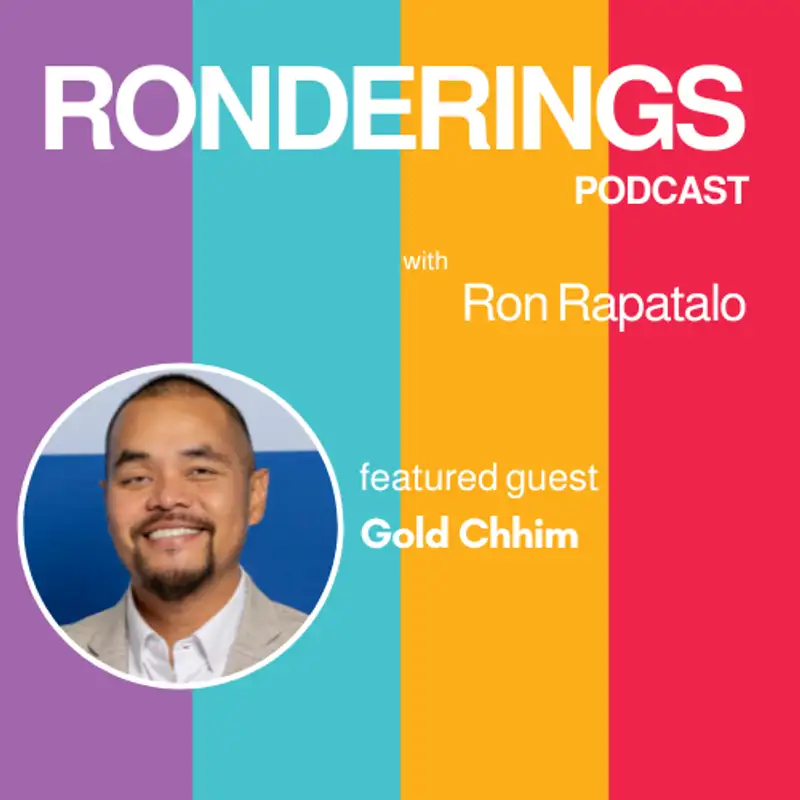
Ron Rapatalo:What does it mean to truly lead as yourself when the world is strange to you to adapt just to survive? Today on Ronderings, I'd sit down with Gold Chhim, connector, educator, a leader whose journey stretches from the East Side Of Compton to classrooms of Detroit to shaping national talent pipelines of education. Gold is the son of a Cambodian refugee mother,
Gold Chhim:first
Ron Rapatalo:generation college graduate from UCLA after starting an academic probation, high school math teacher and basketball coach who built a winning program, the city navigating bankruptcy. But this conversation goes deeper than titles. We talk about what it means to grow up as the only one. This coach chirish way into opportunity and make the courageous shift toward authentic leadership. From identity to representation, quiet question and guide's life, by living as someone my 50 year old self would look up to.
Ron Rapatalo:This is a conversation about legacy, belonging, and becoming. Let's get into it. Ronderings universe. It's always a special privilege when I get to talk to another Asian American brother in the K2 event space. Let's be clear.
Ron Rapatalo:There's just not a lot of us, And so there's also not a lot of us who represent Southeast Asia, to be clear. So it is a real treat to have one of my homies that I often see in the conference circuit because he represents partnerships for education pioneers. My homeboy, Gold Chhim is on the mic. Gold, how you doing, brother?
Gold Chhim:Rout again. I'm good. I'm good. I'm good. I'm great.
Gold Chhim:It's good to be here, Ron. Good to be here. To to echo your point, there's not a lot there's not a lot of Southeast Asian dudes that do partnerships and are partner facing and do the work that we do. So It's because it's just
Ron Rapatalo:me and you.
Gold Chhim:No. No. No. It can't. I can't be just me and you.
Gold Chhim:I I had to I started to go through my head. Like, Ron, are other people? No. There's there's a handful of us. There's a handful of us.
Ron Rapatalo:Name someone that's not Ronder Gold. Go.
Gold Chhim:I got one. I got one. I got I got one. K. Sun.
Gold Chhim:Sun Sam. That's right.
Ron Rapatalo:The You gotta get Sun Sam. I'm of course. I just saw him in South. Come on, man. Come on, Ron Rapatalo.
Gold Chhim:You'll be ASU GSV too. They're doing the the leadership stories Yeah. Over
Ron Rapatalo:He's some thank you for naming me.
Gold Chhim:Be the three, That might be the three. It might be it might be the But he
Ron Rapatalo:needs to be around so you know how I know, son? That's how he's working in New Republic schools. He was the gets up New Republic schools back when I was working there, like 2012, 2014 with Cam. He's the superintendent, and I was working in the central office. I remember, son.
Ron Rapatalo:Yeah, man.
Gold Chhim:Face. The longer I'm in it, the longer I'm everywhere I'm I meet between me and you were probably one degree separate from just anyone who's an educator in somewhere. And it's it's insane. It really is. It's it's baffling.
Gold Chhim:But it's not because it's you know, this this work is this work is this work. So Yeah. Excited to be here, Ron. Excited to I appreciate the opportunity to be on be on your your podcast and and have this conversation with you, man.
Ron Rapatalo:Yeah. Mhmm. So folks should know because they're gonna be listening to this unless this ends up as a video clip that what Gold has in the background are three of my favorite albums, man.
Gold Chhim:If we man. So I'm on these Zoom calls so so much. I I switched my records around, like every every week it's part of my I'm on reach for yeah. Because I'm I'm on these Zoom calls for five, six, seven, eight hours a day. I work remote and so I switched the records around and it just kind of, you know, different levels of inspiration.
Ron Rapatalo:Do you like being on like, maybe that's a obvious question. How do you handle being on Zoom for that long, man? I can't. I don't do it.
Gold Chhim:That's a good question. That's a good question. I think it's it's creating the right level of of of balance. And and I think some of it is how do I create conditions? Like, a lot of these calls, I I have to I wanna be on Zoom.
Gold Chhim:I wanna be able to see my our partners. I'm gonna be able to see up folks I'm having conversations with. But I think actually I'm borrowing from you. If I could take a call while I'm going on a walk or while I'm I'm cooking, while I'm doing something that that is is is less me sitting at my desk. I mean, I wanna prioritize that.
Gold Chhim:But, yeah, it's it's it's it's are good.
Ron Rapatalo:Eye strain is a real thing for me. It's the only reason why I do not like being because because it's also, I think, my ADHD. I start zoning out for any Zoom call I'm on that's more than an hour. That's why I can't do a Ronderings episode for more than an hour. I'd be like, Ron, why your eyes switching, bro?
Ron Rapatalo:I was like, uh-oh. Not computing. Not computing. Right? And that's a good phone call, man.
Ron Rapatalo:I'm like, I remember the days of not having video conferencing and things like this, man. I can let a hold a good combo and build a rapport via phone, and yet I understand people like to see each other if I'm doing, like, client work. Sometimes meeting a person for the first time, not all the time, that I've I don't always do that, but certainly client facing work, I get that. Right? But I think the majority of my calls, if someone is trying to access me for something that's not client a client call, it's phone only.
Gold Chhim:Jimmy Fallon? No. I love that. I love I mean, all that to say, and these are we're obviously making adjustments and we're creating conditions to be able to get this connection. It doesn't beat that end person space, Ron.
Gold Chhim:It just it will never be there's something about being there with you, sharing that moment with you and it's the body language and seeing how you're reacting to what I'm what I'm saying and vice versa.
Ron Rapatalo:We're social creatures then if I need to touch, see, feel, experience someone.
Gold Chhim:Mhmm. You know
Ron Rapatalo:what I'm saying? That's why I'm glad we do, you know, this the the partnerships work that you and I do, man. We get to travel to these places, and I I love being around the country and get to see and experience the great work that people are doing, have the opportunity to, like, build that in person because this is not work you can solely do through the confines of your home.
Gold Chhim:The more this work is it cannot and should not be siloed. And a lot of times we we we like to think that we're creating solutions, but I mean, and you you know this, like the more and more opportunities I have to connect with other people and decision makers and champions and folks who are doing this work across the country or it becomes abundantly clear, where is it similar? Where is it we're we're dealing with similar issues with similar changes. We're doing it in different ways and the the climate, the landscape looks different. And so, you know, I say all those resonate and, you know, quick plug.
Gold Chhim:I'm looking forward to to linking up with you again in a couple weeks too, man.
Ron Rapatalo:Man, it's baked are you going to Edlock too? Are you gonna Edlock I or not
Gold Chhim:will not be at Edlock this year, but I'm I I'm I'm gonna put a a plug in your ear, a seamless plug. I need I need a nomination, Ronderings. I need you to nominate me to to to be a member there.
Ron Rapatalo:Yeah. Then I feel like didn't I we'll talk about that offline. I feel like yeah. Yeah. Because you should you should be in the family, man.
Ron Rapatalo:You know me, like, oh, Edlock fan knows this about me, man. I'm people don't give me like, I'm I nominate people. That's my job is to open the doors to great people. So let's get it started, man. What's your story?
Gold Chhim:Let's do it. What is my story? Man, you prepared me for this question. I still I'm still, like, thinking about where to start with this question. But let let's let's let let me start from the top.
Gold Chhim:Let me start from from I I will say even before I was born. My so born and raised on the East Side Of Compton, California. So I know you're in New York, but as far from the from you in the continent of United States as as can be in. I was born most incredible mom who came to this country as a refugee from Cambodia. And so first generation American, one of the youngest child in my family and from an early, early, early age, mom taught me this hustle mentality.
Gold Chhim:If you if we're going to shift our family's trajectory in this in this country, your job is education. Your job is to figure out what it means to be, educated in this country. And so, I did that. And so from a early, early age, just had this this this focus and this this prioritization of what does it mean to quote unquote be educated. And so, was quickly labeled, the labels that we give kids, smart kid, give the kid X, Y, and Z, internalized a lot of that.
Gold Chhim:Growing up in the East Side Of Compton, California when I graduated graduated high school, had the privilege of at the time attending what was my dream school, gone to the University of California, Los Angeles, UCLA.
Ron Rapatalo:UCLA. Go Bruins, man. Alright. And as a 18 year
Gold Chhim:old from Compton, I I thought I wanted to I had life figured out. I'm like, I'm I'm I'm going to this, you know, this great school in x, y, and z. Quickly realized and quickly saw the difference between my experience growing up in the East Of Cops, California, inner city, and the experience from my peers who are from more affluent backgrounds. And so four of us from my high school got to UCLA and pretty dropped out. And I was the only one after a year one.
Gold Chhim:I was on an academic probation subject to dismissal, and there was a there was a moment of, oh, maybe I'm not smart enough to be here. I remember having this conversation with my counselor, with my mom of, I don't know if I belong here. And then there was a moment of, I'm here representing more than just myself. I'm here representing my family, my ancestors who would never have the chance to be here and so figured it out, figured out, learned how to study, I learned how to learn how to compute and I learned how to adapt and grow and thrive in in this in this, you know, very challenging environment. So eventually graduated graduated with honors from UCLA, you know, and then eventually when I graduated, I said I need to be a part what I experienced the the first couple years here isn't what what we need to be creating conditions for for young young folks to be experiencing.
Gold Chhim:And so applied to a program called Teach For America. I thought that was gonna be an avenue. On the application for Teach For America, I put it send you wherever you need me. They said great, we want you in Detroit, Michigan. And so a kid from LA, I had to go on Google, I looked up where is Detroit.
Gold Chhim:I looked up
Ron Rapatalo:Oh, lord. Oh, man.
Gold Chhim:I saw him fly. Then the second question when I saw where it was, I asked does it snow in Detroit? I I've never seen snow before. And so You
Ron Rapatalo:all see snow in Compton brother.
Gold Chhim:Don't see snow in Compton. Graduated on a Wednesday, flew out to Detroit on Friday, packed two suitcases, moved out to Detroit where I taught high school math and coached basketball, was the winningest coach in the history of my school's basketball team. That's because I started the basketball team, so there was zero wins before me. And I was there for four years. I loved it.
Gold Chhim:Loved loved Detroit, Ty for for a number of years and then What's
Ron Rapatalo:the ED at at TFA in Detroit when you were there? Was it Tiffany Taylor?
Gold Chhim:So it started as Anna Stubbs, and then Tiffany Taylor took over after my second year. So I joined staff and I actually was on Tiffany Taylor's team for for a number of years.
Ron Rapatalo:Is it a full circle moment to then go to ASU GSV and see her when she's like I mean, she's Boston right
Gold Chhim:now, president of ASU GSV. No. It's absolutely a full circle moment. And she's Yeah. No.
Gold Chhim:No. She's right. She she's great, great, great, super inspiring person. And so, yes, it's absolutely a full circle moment. Yeah, was there four and a half years and then moved back to it was time for me to come home.
Gold Chhim:So moved back to LA, worked worked worked in almost every sphere of school and school adjacent setting. So teaching, recruited teachers, work with teachers, work with principals, supported principals, work with counselors, all the different roles. And eventually, I wanna say about twenty sixteen ish, moved to the bay, also Northern California, Colorado, the county director of college or college access for post secondary access, Getting all in one call.
Ron Rapatalo:Got it. Okay.
Gold Chhim:That was one goal for four and a half years, was a part of the founding team there. And then about a year, just over a year ago was I joined ice skating pioneers for our partnerships here.
Ron Rapatalo:So one of the things I want to rewind back a little bit, right, which I think if folks don't understand the Asian American experience, right, you talked about growing up in Compton. What was it like as a Cambodian American growing up in Compton?
Gold Chhim:Oh, I love that question. It would it would I love that question. Man, it was so growing up, you don't really recognize you don't really realize it that just how much of a anomaly you are until until you realize it. And I think just growing up, what felt apparent so my the demographic of my of my middle school and high school said she was about 6065% Latino Mexican, about 34% black, and 1% other slash me, which is which you kinda you you you grew up as me and maybe like one other Cambodian kid in my in my school. But you grow up and you kind of you you you learn to adapt.
Gold Chhim:It's almost survival mechanism to understand how do I assimilate to, you know, Mexican culture if I'm going to my friend's house or black culture. And that kind of the environment almost dictates how you're how you how you perceive almost self worth, how you perceive your your your sense of belonging, what you need to know, what you what you what you don't need to know. And it was it was confusing eighteen years too. And it wasn't easy. My my name is Gold.
Gold Chhim:So it wasn't like I had a normal, quote unquote, normal name. I I I was going to different places, different schools, and I I had this unique name, and I was I looked different, I had different
Ron Rapatalo:was Nobody like knew where to place you. He's like, wait, he brown, he Asian looking, and his name is Gold? Where the hell is he from?
Gold Chhim:Well, what am gonna do with that? What am I gonna do with that information? It was Yes. I know.
Ron Rapatalo:Look at my name is like, Filipinos don't even think that I'm Filipino because my last name, even though if we rewind back in history, there was a book that the Spanish damn colonizers brought to The Philippines as a book of last names for Filipinos to take. Interestingly enough, I find my last name on that. I'm like so I I don't I can't quite trace the history of my last name because it's not there's not a straight Tagalog or Ilocano or the dialects that my parents spoke.
Gold Chhim:What do mean by Ilocano?
Ron Rapatalo:Dad's well, my dad is from Tangasinan, so he spoke Bengalito. But a lot of folks speak Ilocano when you're from anywhere not near Manila. My mom spoke Tagalog because she was Tagalog. Her, you know, her maiden so I don't think I told you this, or maybe I did, but your first name gold, my mom's maiden name, Ginto. What does Ginto mean in Tagalog?
Ron Rapatalo:So sorry. Gold.
Gold Chhim:Man. Yeah. I love that. That's the reason why my my wife is well, my wife's Filipino and her her mom is from Ilacanos Islands as well. Swap world.
Gold Chhim:But yeah. I mean, so to actually double down on the question you asked a second ago was needing to grow up as Southeast Asian kid in Compton? That was the experience from, I would say, from kindergarten through through senior high school of being the Asian kid and being just having this this identity and adapting and learning how to adapt. And what actually really messed me up or what was was what felt confusing was when I got to UCLA, I thought I was going to find other folks like me, quote unquote, like me, of other Asians, other Cambodians, other folks that shared identities. And I got to UCLA, and I quickly saw, I mean, it was predominantly white and Asian.
Gold Chhim:The Asian people in The USA weren't like me. They didn't talk like me, they didn't grow up how I grew up, they didn't have the values I had, they didn't listen to the same music I listened to. And so I walked in like, I'm gonna find my people, but they weren't, it didn't really feel like it was my people in a very tangible way of oh this is, well this is confusing and so yeah that was a big part of what it was.
Ron Rapatalo:We talked about how much in retrospect, the way that you and I grew up a lot of similarities. Right? I mean, granted in New York City, I did see a lot of other Asian Americans. Right? I was one of the few in k eight, but then going to high school, I went to Stuyvesant, it was 45% Asian American.
Ron Rapatalo:Now granted, there weren't as many Filipinos and Southeast Asians, but it was a pretty dominant like Asian American space, right? And then going to NYU was the melting pot, tossed salad extraordinaire, right? You name it, there was somebody there, right? And yet I had similarly to your college experience, right? When I went to the Filipino club, and shout out to a lot of the IFA folks that I know, right?
Ron Rapatalo:Some of it was, I was excited about it to be in a room with lots of other Filipinos, and many of them, not all, but many of them had different acculturation. They grew up in more suburban areas, right? They grew up in different parts of The United States, and so that like, let's just call it like your Compton edge, my Brooklyn edge, my my my my Jamaica, Queens edge, Sometimes I it had Pacific. Not just Filipinos. I wanna put made it clear, but certainly, remember, like, a meeting or two of, being judged differently because of the way that I talked and being called, oh, this guy's talking black.
Ron Rapatalo:And I remember hearing it. I'm nice. Look look at me. I'm nice. Until you let Brooklyn run out, I lit into this kid.
Gold Chhim:That's it. I mean, and it's and and so and it's so deeply rooted in and then something it took me me a little bit of time to compartmentalize and identify is some of it is coming from a level how well, naivety, naivety and lack of access, and lack of access, lack of proximity. And it's a combination of is it intended to be malicious? And you know, and let's not get it twisted. Sometimes it is coming from a place of looking for smoke, looking for heat, looking for insults, but some of it's coming from, oh, you legitimately have never met another Asian person before.
Gold Chhim:And that was what what felt particularly interesting in Detroit. When I taught in Detroit, my my first couple years teaching there, my kids had never seen an Asian person before. The only Asian person they had ever seen was this oh, and this was it's around 2010, 2011. This was around the time that Linsanity really popped off with Jeremy Lin. And, you know, then you have me, this 21, 22 year old he's in who coached the basketball team and I was, I mean, I was I was I was was good at basketball.
Gold Chhim:I was good at basketball. So they're they in their minds, they merely drew some some of these similarities that, you know, that at first felt very like, hold on top of He's Jeremy Lin's like, he's he's Chinese and he's he's he we look different and here we're not even close to being similar, but to them that was the only access they had to what AAPI meant in this country, which is, which was a lot to deal with as a 21, 22 year old step into early adulthood.
Ron Rapatalo:I imagine your experience growing up in Compton being one of the only probably incredibly instructive to help you navigate. So how did you navigate, like, going from, like, that's you grew up like that in childhood and you had no choice but to navigate it to, you made a choice to say, I'll be going anywhere and you went to Detroit. Right? How did that inform your abilities and navigate, you know, being the first Asian American teacher they ever saw?
Gold Chhim:Yeah. It was, I think the entry point to that was obviously a bit different. I mean, was out of me growing up where I grew up and one was essentially me opting to go to agency at twenty one-twenty two. But I quickly saw and realized and recognized the similarities of how I grew up and what my classmates, my peers, what we prioritize, what we struggled with. When I was in high school with with these experiences of of my kids in Detroit that was, you know, 3,000 miles away, 2,500 miles away, and quickly saw, holy, this is this is familiar.
Gold Chhim:This feels familiar in so many ways of of the the feel of community, the feel of where I where I go to shop, where I go to my haircut, where I go to frats knife, where I go meet with my friends. And I loved it. It was I say all the time, it was where I needed to be at that point in my life. At 21, 22, just after graduating high or graduate college. Had not been for this opportunity to move across the country to be away and redefine and rediscover the person I was supposed to be.
Gold Chhim:I don't know what route that I would have went back home. And I don't know what would have happened if I had been around the the environment that that I grew up in. So full circle moment and deeply deeply important and yeah, and I mean, have you have you spent any time in Detroit, Ron? Do you already do you know about the D?
Ron Rapatalo:You read my mind. So guess when I worked at Teach for America as a national office manager, I didn't do the core, but I worked at TFA. And I wanted to know how the sausage got made, I e, how did core member selection happen? Because I was working right at the throws of the national office, Monique Ayat's leading admissions, You know, Laura Cover was working on her team. Shout out to her, Monique Ayat, and shout out to Alyssa Kim who was heading recruitment.
Ron Rapatalo:Right? And so I wanted to know, like, what I got a sense of recruitment because my homeboy, Chris Simamora, shout out to him. He's Puerto Rican Indonesian. So he's one of my he's one of my early Ronderings podcast guests because I've known him for thirty years. He's the godfather to both my girls.
Ron Rapatalo:Right? So he, I wanted to, like, get to know the sausages made. And so though at the time, the policy was you needed to have been a TFA core member to do selection, I was like, nah. That don't that don't track fam. So I asked for an exception because I asked, like, why is that a rule?
Ron Rapatalo:It didn't make sense to me. Even to this day, the the response was like, well, we'll figure out to make an exception. The exception got made. The first place that I did corps member selection was Detroit. So I went out there in o four, man.
Ron Rapatalo:O four? O four Detroit, bro. Aside from the hotel that I stayed on in Downtown Detroit, I walked a couple of blocks up. Now you wanna talk about urban decay and the lot there was nothing. And I remember walking to, like, go to a Popeyes or something.
Ron Rapatalo:And you know me, like, Brooklyn Ron was like, you got it, man. I still was like, Ron, keep your head on the swivel because you you different out here. They don't know Brooklyn Ron. They just see some damn Asian kid. And so I was like, Ron, it was fine.
Ron Rapatalo:Nothing happened. But it was one of those moments of like just being out there of like, wow. There's this little strip of like some level of like buildings and like commerce happening, and the rest of the city blocks away. I'm sure it's changed nearly twenty two years later, but like back then it was like in my head coming out of the airport, it was so disconcerting because the amount of liquor stores that I saw on city blocks was it drew I was like it became the map of like this is what happens in many of an urban particularly black neighborhood liquor store liquor store liquor store it just liquor stores everywhere When I was being dropped off my cab, it was like I was I was angry. I was like, what the yeah.
Ron Rapatalo:Oh, you cannot notice if you looked out the window.
Gold Chhim:You it was it was jarring. It's well, and I I taught in Downtown Detroit too. And this is, again, this is six years after you were there. So 2010 through 2014 was when I was there. It was I while I was there, I woke up one day and the city the city declared bankruptcy.
Gold Chhim:I didn't even know what that meant. It was it was like I was 21, 22, and I'm like, do I not go to school today? Like, is this like, what's what's the what's hold on? What's what? And there was particularly downtown.
Ron Rapatalo:It was
Gold Chhim:it was it felt like an infrastructure for, like, 2,000,000 people. There were skyscrapers, high rises, and all but it only had a population of something like 300,000. And so it felt you could see, oh, this these are these buildings are abandoned because there's no one to live here. These skyscrapers were abandoned. And it was an eerie, eerie sight.
Gold Chhim:Was Well,
Ron Rapatalo:the white flight was real and real and real and the falling of the the auto industry in Detroit. Right? Mhmm. It's just like all those conditions. Right?
Gold Chhim:Yep. And then and then to well, and so I went there again this past year for for Teach For America that I won't fit our fifteenth year anniversary.
Ron Rapatalo:Oh, you're out there for the dope. I saw all the photos about that.
Gold Chhim:Yeah. Was there for that. So I think the two things that I think are particularly important to note when talking about Detroit is even back in twenty ten to eleven to twelve where where it was facing this very challenging, just socioeconomic like environment it was in, the level of pride, the level of what it means and grit that it meant for being in Detroit or living in Detroit or being from Detroit, you that's that was community. That was love. My family like, when when my families finally got to know who I was, they it was, oh, this is you're here for the right reasons.
Gold Chhim:You're here to to to really support and and be a part of this city. And I said all the time, like, Detroit is what is one of the cities that made me who I am today. How I how I show up in the spaces that I show up in, how I own the spaces I own, all these different things. And so I love Detroit. And then two, the city is different now.
Gold Chhim:The city is different now. It's the the revitalization, the I mean, even downtown, there is I'm not if you're a sports guy, the the Pistons are downtown, lines are down sound, the tires
Ron Rapatalo:are I'm a Knicks fan, man. So you talking Pistons, man. Knicks and man, Celtics where they are right now with Tatum coming back. I'm like, oh, uh-oh. Uh-oh.
Ron Rapatalo:I'm a I'm a little scared. I go, hi.
Gold Chhim:All that to say, I I I still don't think I I won't I don't think it would be a threat to the West. I think whoever comes out the West is and this is no shade to anyone. I mean, is just I'm not trying to have no hot shade. I think OKC, Denver, and and San Antonio is a is a a tier above tier above any team that comes out the East. We'll see.
Gold Chhim:Well, I mean, I I as you said, you're from New York. I mean, New York you you got the Knicks are good this year too. They are good
Ron Rapatalo:this year. We are. I mean, I think, you know, for me, I like I if we can make it through the East, I get we just I I just wanna see our team at a shop, You
Gold Chhim:make sense.
Ron Rapatalo:What that would do for New York?
Gold Chhim:Oh, yeah. You want to
Ron Rapatalo:see rabid, ridiculous New York pride come out? Watch the Knicks in the finals. It's going to be it would be obnoxious. You will see me being obnoxious online.
Gold Chhim:I mean, I've I've that's look.
Ron Rapatalo:I'm to It
Gold Chhim:well, it because it's it's a it's a it's a proud it's a proud city. It's a proud sports city, and it's a proud basketball city. And just as a a a hoop fan, the the niggas are one of the I mean, that's the Mecca. Like, Madison Square Garden, when I had the chance to go well, I went I went to one game. I went to one game.
Gold Chhim:It was a couple of years ago, and this was Okay. Okay. This was one y'all still hit, Trae Young. I don't think y'all hit him anymore because he's he's kinda and he he he hit a game winner on somebody, and y'all were so mad. It was it was really as a as a non yo.
Gold Chhim:He was doing the the whole the the the Yeah. Ice tray thing. So As an as a non biased person that was just appreciating the sport, it was it was it was fun to see. It was fun to see, let's say that.
Ron Rapatalo:It feels like the crowd is on top of you, MSG. So no matter what thing you're doing, a sporting event, a basketball, a boxing match, a concert. So I've been to, like I mean, I've seen Beyonce perform there. I've seen god knows how many I saw Prince perform there. You know what I'm saying?
Ron Rapatalo:I've seen, I wish Yeah, I did, may he rest That was that was live. That's definitely one of the prouder concert moments because I saw him do Purple Rain for like twenty minutes, man.
Gold Chhim:That must have been That's that sounds like one of those just just memories, one of those music memories that you just you hold on to for for the rest of your life.
Ron Rapatalo:I did have tickets. I could have gotten CMJ when they did the the Jackson anniversary thirtieth anniversary tour, and they played at MSG in the concert that shows all over Cedric and BET. I did not get tickets because I said stupidly, I could see Michael. He'll be around.
Gold Chhim:See you next time. Mhmm.
Ron Rapatalo:So, of course, when he passed and he was doing This Is It, when that concert tour was coming out about to come out, I was like, I'm gonna go hell over high water. I don't care if I'm sitting on the rafters at the top of the roof of the damn arena. I'm a be there with my missus seeing MJ live. I never got to see him live. It's one of my it's my biggest, like, musical, like, concert regret by far.
Gold Chhim:I mean but you only have so much control. You you you can't you can't live with regrets. I mean, you you gotta see I'm sure you've you've seen also a million other incredible shows too. I mean,
Ron Rapatalo:I've seen the roots over 10 I mean, don't hear me start like so I'm a pivot this before we get back and you start seeing how we see this is like a golden Ron cabled.
Gold Chhim:Yeah. Now, yeah, we we're we're sweating off. Let's get back on course. Let's get back on course.
Ron Rapatalo:Best live concert you ever been to. Go.
Gold Chhim:I like that. I like that question. I will say you put me on the spot. You know what? I'm a say the first thing that comes to mind.
Gold Chhim:It was it was a Watch the Thrones concert. Watch the throne concert. It was it was it was Jay Z and Yeah. Bro, where
Ron Rapatalo:did you see them?
Gold Chhim:They once said they came to Detroit. They came to Palace Of Auburn Hills. And so that was I would say that well, that's that's one of my top two. That's one of my top two concerts. I I I absolutely
Ron Rapatalo:This is why you and I are boys, man. Because guess what I was gonna say was like was that they performed at what was then called IZOD Center in New Jersey, which is now I forget what it's called now, right? I went with my missus. They performed ends in Paris to end by 20 straight times. It was the best juxtaposition of two artists doing their thing on the album they did, but then their own hits going back and forth.
Ron Rapatalo:I was like
Gold Chhim:It it felt it it was it was fun. It was just fun. It was because when when when Jay would do three of his hits and then Kanye would come do three of his, then they do like three or four together. It really was oh man. And yeah, it was it was it was one of those one of those concerts too that I could I don't know.
Gold Chhim:I don't know. I I was early in my career, I had to scrape up money or I had to put it on my credit card. I couldn't afford to go. And so I had to just put on my credit card and I'm like, I think it's gonna be worth it. I'll figure out how to pay for it when I get my next paycheck.
Gold Chhim:And I went and there's, I mean, there was something so endearing about, man, this is I'm I'm never gonna I'm gonna make more money in the future. I'll figure that out, but I've never had my youth the way I have it right now. And to be able to go and be as hype as I was and be as as just in it as and everyone felt like everyone in that arena was in it. And it just was,
Ron Rapatalo:oh, man. It was electric, man. I and to go on this tip one more time before I steer us back, best live moment at a concert, I'm gonna name mine to start seeing Busta come on stage during Rock the Bell's festival when Tribe was performing Scenario. It was one of those movie moments when he came on stage because I had this running thing with all of my friends, my wife, my boy, Chris. Wouldn't it be funny if Busta came on during scenario?
Ron Rapatalo:I had seen Tribe four times before that didn't happen. No. Accept that. I mean This is New York, Randall's Island. Like, if there's any chance that Busta gonna come through, it is here.
Ron Rapatalo:Their performance scenario, they're the last group. It's summer in New York is hot as balls. Well, I I mean hot. I'm with my missus. We get close and close to the front of the crowd.
Ron Rapatalo:We're not all the way to the front. We're probably, like, 10 people back. Scenario's on, up in, and then when Busta's line comes, Busta comes on the scene. It was literally like this. It was like I could not hear myself, and it was like I was moving in slow motion just like in the movies.
Ron Rapatalo:Like, it was such euphoria and slow a slow motion moment where it was like tears of like, I can't believe this is happening, and this crowd is lit. Imagine a 100,000 people all jumping up and down at the same time. I think Randall's Island shook. I swear to God. It was
Gold Chhim:That's such a New York thing too. That's such a New York thing. I and like the New York the New Yorker in you is coming out right now. I love it. Oh, yeah.
Gold Chhim:No. I love that. I that's so man. Yeah. It's it's so in it's so just something that's fascinating too is so, obviously, you're you you grew up in you you New York.
Gold Chhim:You you sound New York. You look New York. You're you're you have on your I mean, I'm I'm I'm Compton. I'm the East Side Of Compton Go. But this this conversation around just, like, music, specifically music that crafted us, the music that we have so many associated member independent memories to, but are able to share just what it means.
Gold Chhim:And I mean, honestly, that's so to your point, adding the albums and vinyls behind me, this is my sign like, hey. Look. I'll let's let's talk about it. Like, this is I I love this. This this is my you know?
Gold Chhim:And so if we could find a meaningful entry point that's rooted in something that's that's real and authentic and not just what do you do for work and how can I help you professionally, but more of what are you about? Like, what, like, who makes you what makes you you? What are you what do you value outside of your your nine to five time and how how does that show up and manifest for you? I see the and
Ron Rapatalo:I see the blue label behind you, man.
Gold Chhim:I'm look. Yeah. I'm guys oh, no. Look, This this work is hard, man. This is this is this is a reminder how hard the work is sometimes.
Gold Chhim:Sometimes you get a little a little a little something. No. Right? Oh. Oh, god.
Gold Chhim:Oh, man.
Ron Rapatalo:So let's fast forward to your partnership's work today because one of the things I wanna talk about with you as Asian American male leaders in the ed space, right? We named the only other one that comes to mind that we know this partnership work, shout out to son Sam at Big Picture Learning, right, is how do you do that work and how does your identity inform how you go about that work?
Gold Chhim:It's how do I do that work and how's my identity inform how I do that work?
Ron Rapatalo:Sounds like a Leadership Journeys question. I know. By the No,
Gold Chhim:that's a great that's a great question. I think well, I think for a long time, my identity was was something that I took in parallel of this work, of of, oh, this is this is who this is what I do, and also, this is who I am independently of them. There are two
Ron Rapatalo:Okay.
Gold Chhim:Lanes that I was I was extremely cognizant to not have too much overlap in of this is who I am at work, this is who I am professionally. Like, I mean, this the idea of code switching, the idea of values and how I talk about my values and all these different pieces that as I've gotten older, as I've gotten more mature in my career, man, this too I'm gonna show up in the spaces how I show up as my most authentic self. I'm gonna talk how I talk. This is just this is this in me not showing up as my most authentic self, I'm doing a disservice not to just the the folks I'm partnering with, but I'm doing a disservice to the kids that we're here to we say that we're here to serve. And and a lot of kids that come from environments and and social settings that I come from.
Gold Chhim:And so it just feels so deeply, deeply important for me to recognize and step into what to what my brilliance is. And so what I know, I know to be true, what I know to be to be good, to be just. And then and then and secondarily to it's not lost on me for a lot of these folks I speak with, these superintendents, these these CEOs, these these c suite folks, these decision makers and leaders. I'm a lot of times the only Cambodian person that they've ever met. And this is not like a negative matter, but it's for a lot of folks, only 7% of this country is AAPR, is Asian.
Gold Chhim:And so the number of Cambodian folks is sub 1% of the country. And so out of my attention to the different rooms, I'm cognizant of these different identity markers I have, how they've shaped my my journey here, how they're gonna continue to state where where I wanna go.
Ron Rapatalo:Let me come back to something that I wanna bring even more to the forefront. Right? Identify as a Cambodian American man. Obviously, the way that you grew up, right, you were one of the only you were navigating, like, how do you fit in this environment where, like, I'm not sure if you were the only Cambodian American family, but I'm guessing there weren't There weren't a lot of y'all growing up. Right?
Ron Rapatalo:So full circle moment, how does the way that you grew up inform how you show up as a Cambodian American male leader in these spaces? The derivative of the question, to, like, focus the Cambodian American part of it.
Gold Chhim:How repeat that question for me one more time, Ryan.
Ron Rapatalo:Full circle, how does being a Cambodian American male leader, like, how does that I part of your identity show up in these spaces that you're in knowing that growing up earlier on, you were navigating having to fit in. And I think as you've come full circle, you've realized that I need to show up as me, so what is the your particular way of showing up as Cambodian American, as a man, show up in these spaces, as you've defined it from the way you've grown up?
Gold Chhim:Deeply important to the person I am and the person I choose to be and the person I show up as, as a leader, as a leader in different spaces. I'm I'm I'm deeply I'm deeply drawn to be able to say I am I'm I'm a Cambodian kid from Compton, California, who grew up in Compton and went to my early adulthood in Detroit, Michigan, and I spent a lot of time in Oakland, California. So all intents and purposes, I've I've been in this work for a long time in so many different places, and a lot of that drive is how I show up. A lot of that, it's it's in parallel, and it's in conjunction with each other. And so, yeah, being being Cambodian, I think, is important.
Gold Chhim:And being cognizant when I do meet another Cambodian person, I'm I'm so the reason why so this third third shout at my boy's son, I saw him at a conference, he saw my name and he was like, you kept on you? And I'm like, you don't like, how you not? And he was like, I saw your last name. I'm like, man, we got we got to connect. And so it's it's so just deeply intertwined with with with the the the different multiple identities that multiple hats I I get to wear and I get to represent every day.
Ron Rapatalo:Do you happen to this is like random. I should not assume that Cambodian men are gonna know other Cambodian men, but do you know Peter K. O? What's that name? He's one of my homies.
Ron Rapatalo:Yeah.
Gold Chhim:I don't know if I do.
Ron Rapatalo:He I know if I do. Lives in outside of Vegas with his family, K. E. O. But I just talked to him recently.
Ron Rapatalo:He's one of my homies. I know him through other folks that, like, went to Harvard, like, you know, that the Harvard, like, Ed Illuminati. Right? And so he knows homies like Nancy Gutierrez amongst others, and so he's the only other side from you and son, Cambodian male leader that I can think of in the space. It's not a lot.
Ron Rapatalo:I mean, I can name, like, eight Filipino American male leaders. I did not say that's a lot either.
Gold Chhim:You got you guys doubled. You guys doubled. No, it's a. It's a. It's it's it's really interesting because it is.
Gold Chhim:Yeah, I mean, it's it's it's such an important part of just almost like an invisible invisible. Like, just something that is is is just me. And so I don't think to, like, name and feel like I need to explicitly say, Cambodia. I'm representing I'm representing me. I'm representing all of the the different dynamics of me, and I want to be as exceptional in every space of of my identity as I can be.
Gold Chhim:When I when I talk about being from Compton, I'm I'm representing Compton till I mean, from from from from Bartlett to to where I am today. I'm representing being Cambodia from Bartlett to where I am today. When someone talks to try to talk about Detroit, like they know Detroit, my first question is, have you been there? So when when the answer is no, I'm like, oh, you're not allowed to talk about Detroit because it's it's it's a pride that comes with that. So yeah.
Gold Chhim:So I'm like Mhmm. So I'm already I'm already known him. That's how you feel about about being from where you're from. I love him.
Ron Rapatalo:Interesting right there. Some there's this I forgot the name of the IG handle that talks about New York in all ways, and one of the things that always comes up about New York is, can you be in New Yorker if he wasn't born here? The answer is no.
Gold Chhim:That's no? Even if someone was there for, like, fifteen, twenty, twenty five years, they don't count?
Ron Rapatalo:No. You can be an ally. You can be down with the cause, but you can't call yourself a New Yorker. It's it's it's like it's a ridiculous pride thing, mind you. Right.
Ron Rapatalo:But it's like, wait, if I was. Not born here, but came here when I was five, could I be a New Yorker? The question is, the answer is no. I'm sorry. It's it's irrational, but I don't make up the rules.
Ron Rapatalo:I just follow the rules. I also happen to be born and raised in New York. So I I'm look, I live out of pots, but, like, I'm a New Yorker for life. Granted, I live in proximity because I'm in Jersey City. I'm, like, right across the water.
Ron Rapatalo:But, you know
Gold Chhim:Mhmm.
Ron Rapatalo:When when the New York accent start coming on, you know what I'm saying? It's like, oh,
Gold Chhim:My load, like, is good.
Ron Rapatalo:It flips real fast.
Gold Chhim:So, like, in the last last twenty minutes, man, this New York accent has started to really overtake the the the call, man. I was I'm not even recognizing you anymore.
Ron Rapatalo:And then the speed of my speech, goes through the I start speaking real fast. Let's not talk to the viewer. Like, wait. What? Say a word?
Ron Rapatalo:How what? So, Gold, my last question for you before I ask you the Ronder question is, where's the future for you in terms of your leadership? What do you see I don't wanna say see yourself in five years, but, like, what do you really see yourself in terms of the legacy you wanna build? Right.
Gold Chhim:It's a great question, man. It's a great question. I think I think I and like you, I think one of the reasons why we were able to continue to stay proximate and, get to the point where I'm on podcast now is I'm a connector. I'm a connector. I mean, I've done my strength finder numbers and two that always jump to the top or connector and
Ron Rapatalo:Not a surprise.
Gold Chhim:I find so much joy, passion, purpose in living into what does it mean to connect with really, really dope people, create strong conditions to to solve problems, to to to find solutions, to to bring great people to this work. And, I mean, that's that's what I get to do now here at EP. I get to talk to awesome organizations that that do good work. And how we find really strong people to to continue to advance to this work. And so to to indirectly answer your question, what I wanna do and how I wanna continue to make an empire is continuing to be a connector to awesome people, to connect with awesome people, and to continue to be be be someone that gets to that gets to do every day what I wanted to do when I when I graduated UCLA and I hit that apply button to to to be to to to change the rest of my life to go to Detroit and and to to to continue making a positive difference impact for for particularly for students from black and brown kids from lower income communities.
Ron Rapatalo:Amen to that, man. Well, Gold, you certainly have been pouring into that work. I'm excited to see you continue to do your great work, not only Education Pioneers, but wherever you continue to, like, do the work beyond Education Pioneers, really just excited to, like, have you not only as a co conspirator of this work, but as a friend. So a Ronderings question, my brother. What's the lesson or value you wanna share with the audience?
Gold Chhim:The lesson I wanna share with the audience in this moment, I think it's create the conditions to live into what your authentic leadership means. And that looks different for everyone. That looks that feels different for everyone that that's crafted by our our our our visible identity markers, our invisible identity markers, but we owe it to 15 year old versions of ourselves to give them someone to look up to. And so that's a question that I consistently ask myself. Am I living into the person that 15 year old Gold me 15 year old Gold will look up to?
Gold Chhim:If I'm not able to answer that yes to that question, then I think I need to I need to do a little bit of soul searching. I need I need to figure some stuff out. But if I if I use that as one of my my north stars, and I think I think that that's that's that's that's that's what that's what we help that's what we hope to do. And that's what that's what we get to do, and that's what we're we're charged to do every day and how we live and every day and how we show up.
Ron Rapatalo:I love that. Thank you for sharing that Ronderings, brother.
Gold Chhim:There it is, man. There it is. Well, Ryan, I appreciate the time. I appreciate the time. It was a pleasure to connect with you both both informally, formally in this Yeah, man.
Gold Chhim:-Well, before you go,
Ron Rapatalo:how find do you and what would you like to promote?
Gold Chhim:I mean, I think I am, again, like I mentioned, I'm a, I'm a connector. So if folks want to connect with me, if this reaches someone that that that that maybe knows both of us and is like, oh, I know Gold, I know Ronderings, or someone that's that has has the opportunity to to to hear this conversation and wants to reach it, LinkedIn is probably the best way. Find me on LinkedIn, Gold Chhim, G O L D space C h h I M. Yeah, have me connect, connect with me, like message me. I love to find a way
Ron Rapatalo:I love it.
Gold Chhim:Partner and and and create great conditions to collaborate and work with these awesome people. That's dope, man. Well, I leave us because we're both sports heads,
Ron Rapatalo:and the words of one of my sports heroes, Dion Sanders, we always come hot with guests like Gold Chhim. Peace, y'all. Peace. Thank you, Gold, for being on Ronderings. He said this quote that I wanted to elevate for y'all.
Ron Rapatalo:Create the conditions to live into your authentic leadership. Not just talk about it, not just aspire to it. Build a life where it's actually possible. Because for so many of us, especially those navigating multiple identities, a death in authenticity wasn't always safe. It wasn't always rewarded.
Ron Rapatalo:It was something to earn our way back to. Gold's journey reminds us that leadership isn't about fitting into rooms. It's about reshaping them. So the honoring where you came from, Compton, Cambodia, Detroit, pairing that with pride into every space you enter, and maybe most importantly, about staying accountable to that younger version of yourself who needed someone to look up to. So I'll leave you with the same question that Gold sits with, Are you living a life your 15 year old self would believe in?
Ron Rapatalo:This conversation with you, share with someone who needs it. As always, keep Ronderings. Peace.
Ron Rapatalo:Thank you for listening to today's Ronderings. I enjoyed hanging out with me and my guests, and I hope you leave with something worth chewing on. If it made you smile, think, or even roll your eyes in a good way, pass it along to someone else. I'm Ron Rapatalo, until next time, keep raundering, keep laughing, and keep becoming.
Gold Chhim:Podcaststhatmatter.org.
Listen to Ronderings using one of many popular podcasting apps or directories.