 Episode 100
· 01:06:07
What's up? I'm Ron Rapatalo, and this is the Ronderings podcast. Around here, I sit down with guests for real, unpolished conversations
Ron Rapatalo:about the lessons and values that shaped them.
Ron Rapatalo:And I'll be right there with you, sharing my own take, laughing at myself when I need to,
Ron Rapatalo:and wondering out loud about this messy thing called life.
Ron Rapatalo:Glad you pulled up a chair. Let's get into it.
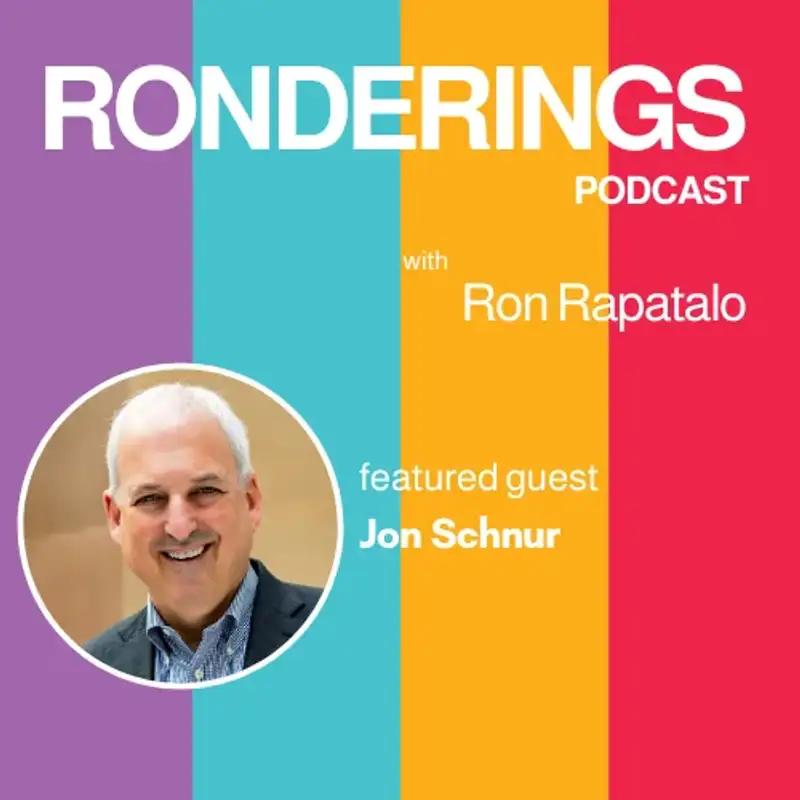
Ron Rapatalo:Welcome back to Ronderings, where we explore the ideas, experiences, and convictions that shape how leaders show up in the world. Today's conversation was Jon Schnur, cofounder of New Leaders and founder of America Achieves someone who spent decades at the intersection of education, leadership, and economic mobility. But this episode isn't just about policy or systems. It's about a question that started when Jon was a high school journalist sitting in classrooms across Milwaukee asking, why are billion students not being given the opportunity to thrive? That question took him from grassroots reporting to the Clinton administration to all to advising Al Gore to ultimately building one of the most influential principal pipelines in the country through new leaders.
Ron Rapatalo:Now he's turning his focus to something even bigger, how we create a good jobs economy in the era of AI disruption. This is a good conversation about dignity, about leadership, and about the responsibility we all have to not just ask why, but do something about it. Let's get into it. Ronderings universe. So I feel like this is a full circle moment for me.
Ron Rapatalo:So when I had my second job in the social impact nonprofit space, I landed at New Leaders back in December 2004, nearly twenty two years ago. So coming full circle, I have the real privilege of having the cofounder and multiple time social entrepreneur, Jon Schnur, is on the mic. Jon, how are you doing this morning?
Jon Schnur:Ron, it's so good. Yeah. It's so great to be with you, Ron. Oh my gosh. And I hate showing our ages a bit, but it's been more than twenty years.
Jon Schnur:And it's so great to see you. From the time that you came, you know, three or four years after we had founded New Leaders to Now, it's just amazing what's happened since. Lots of good, lots of challenging, but at the core has been the focus on for you too on leaders and leadership who are driven by mission. And that's where we started twenty years ago, and I'm so excited to join you on that topic and others today. Yeah.
Jon Schnur:No, absolutely. And so quick anecdote before we kind
Ron Rapatalo:of get into it, audience members, is I got to bump into Jon when I was doing my conference circuit for like my full time job at Strong Consulting, and he was a speaker at the Strive Together National Conference in Atlanta in September of last year. And so we ran into each other in the hotel, and I was like, Jon you're like, fraud. I was like, oh my god. And it was just so nice to see it then. You know, of course, because two busy leaders to fast forward, get on the schedule.
Ron Rapatalo:I mean, was like six months later, which I had in my head, that's about what it'll take. And so I'm just feeling really grateful to like chop it up with you and just have the audience learn a little bit more about not only your story, but the great work that you've done and then a sense of possibility that you you're seeing the space in what is a, frankly, a very difficult time in our country.
Jon Schnur:Agree on all fronts, and I'm excited to dive in with you. Really, really happy that run. Really happy we ran each other again and excited about this this time together. And the only my only regret on this is is I I'd love to ask you a series of questions. So I you, but I guess there's gonna be limits on how much I can do that.
Ron Rapatalo:Well, considering the conversation, it's funny. One of the episodes I recorded, I actually had my guest ask me a bunch of questions about what I thought about, you know, the the future for job candidates, and he was picking my brain. And so Great. You know, if it ends up being like you have a question for me, I am happy as the host to put myself in the guest seat for a second. I don't mind.
Jon Schnur:There. Get ready. Jon Schnur. Uh-oh. So, Jon, without further ado, what's your story?
Jon Schnur:My story. Well, gosh, we all have so many different, pieces of our lives to the gotten us to where we are. I guess, Ron, you know, we've known you for twenty years, and I know you really encourage people to really look at their personal professional dimensions together. So let me tell you a bit about my maybe founding story. I grew up in just outside Milwaukee, Wisconsin.
Jon Schnur:Yes. And, I had a set of amazing family members, who I was very grateful for, the chance to, learn from them and kind of stand on their shoulders. There were a number of them, but my mom was actually an older guard education entrepreneur in a way, even though they never used that term. Oh, wow. Again, didn't use that term then, but my mom, Phyllis, was the cofounder of one of the first children children's museums in the country in Milwaukee back in the nineteen fifties and seventies.
Jon Schnur:They were they were that there were not many children's museums at that point. They have a museum for kids? Oh, I want a hands on engaging experience for kids, and she got that going as one of the early children's museums in the country. And then she actually co created the Milwaukee's first racially integrated preschool back in the late 1960s.
Ron Rapatalo:Did I not know this about your mom? Oh my, this now makes a lot of sense. Okay, keep going. This all tracks.
Jon Schnur:Okay. So, again, you see me stand on the shoulders of people who've come before us. So- How's it? So I was a student. I was a kid and I went to that preschool.
Jon Schnur:Then I went to that children's museum. And so among other things, I grew up seeing my mom create things and I grew up thinking, okay, education, you're around people from all walks of life, all backgrounds, You do hands on stuff where you get to explore and learn. That's what my first experience with education was. And then I was very grateful. I went to public schools that gave me a great education, but the public schools still were not quite that, you know, where I grew in Suburban Milwaukee, somewhat, but not as diverse as the preschool that I had kind of
Ron Rapatalo:got to
Jon Schnur:earlier. And some hands on, but not as much. I had some classes, some teachers. And, again, I had an amazing public school experience. And to this day, I did a podcast recently where someone was being a little negative on schools, public schools.
Jon Schnur:And what was your experience? Like, I said, I owe my life to public schools I went to. I had an amazing teacher. Miss Merritt was my history teacher, and Mr. Hughes was my English teacher.
Jon Schnur:So but but what my mom's having founded me, they gave me a sense of there's a way when there's challenge to pain, but there's possibility. There's a way for people who are mission driven and values driven and action oriented to move things forward. Actually, I just grew up sort of thinking that's, yeah, that's the way the world works. And so I like, alright. Like, how do I my part?
Ron Rapatalo:Yeah. That makes a lot of sense. Your story, Jon, of having a parent that kind of set up the environment by which you saw what became normal for you and what you valued. Right? Racially integrated spaces.
Ron Rapatalo:Right? Being able to be around values driven, mission oriented people that you could create action. And you saw disparities, but you thought you you saw it. You could do something about it because your mom was doing so. That was normal for you to, like, do something.
Ron Rapatalo:So I'm curious if we do a little bit of fast forward, what was your track eventually? Because I know before you founded new leaders, you spent some time working in federal government and Ed policy. So what was the trajectory to say, I'm gonna start new leaders?
Jon Schnur:So, I mean, I'll I'll I'll slow walk this a bit because Yeah. The next chapter that got me there, I would say, that I described to you what was like preschool, elementary school, going to public schools. Ms. Merrigan was my fifth grade or sixth grade, amazing social studies history teacher. But then high school, I had an experience that I would say, well, I'll get more to what happened later.
Jon Schnur:What propelled me over time to the roles that I played on the Clinton administration, the Obama administration to founding new leaders in America achieves. But in high school, I and I think I have I've never reflected this until you've asked this, Ron. Think the fact that experience is a very young kid, it's just that, Gosh, okay. Even before I realized it was very helpful to me because even before I really understood all the profound challenges we faced and the inequities, I first had this sense of possibility. I'm like, Oh gosh, this is the way things can be.
Jon Schnur:And then when I started seeing the reality that actually they were often usually not that way, for me, was very helpful that I had actually first had the sense of, oh, this is what my preschool is like. This is what the children's museum is like. This is what even my Mhmm. School is like. And so then I said but then I started by high school, I'd say especially, I started seeing, oh my gosh.
Jon Schnur:This is not the way the world's working.
Ron Rapatalo:Right.
Jon Schnur:It was pretty unsettling is not the right word. It's pretty sobering for me. But then I started to do is reconcile what I knew was possible with what I was seeing happen. And then and then a kinda key moment of that is when I was in high school. I went to Shorewood High School in Wisconsin, grateful for my experience there, truly.
Jon Schnur:I was the one of the editors of the high school newspaper in in Shorewood, and I was the sports editor, actually.
Ron Rapatalo:Ah. See, I would not have guessed you were the sports editor. Okay.
Jon Schnur:I was the sports editor. Although, actually, you'll hear because I actually my pivot from sports articles to education articles in twelfth grade was kind of the key. So here's what happened.
Ron Rapatalo:Ah, okay.
Jon Schnur:I was sports editor in high school. By the way, our title, our name just I don't know. This is for fun. Yeah. I know it still is.
Jon Schnur:You have to ask people in Shorewood today, but was the Shorewood ripples, which is some papers make waves, we make ripples. That's so You know, I now I have a greater I have a greater aspirations for student journalism that, but I did get an amazing experience. It was, you know, a funny thing. Okay. But I actually wanted to go from ripples to waves, interestingly.
Jon Schnur:Yes. And so I was a sports editor, and I had met a a ninth grade student who, I probably won't name actually, but who's amazing. And she really wanted to write about sports, and she I talked to her, and she was so savvy about sports and so insightful and interesting. Oh my gosh. You should become a sports writer, for our paper.
Jon Schnur:Said you should submit an article, the mean, a draft to a political journalist for our paper. And she, the at the time, has been called the two twenty program in Milwaukee, which is kind of the desegregation program to bring students from the Milwaukee Public Schools, to the suburban public schools. And I was in Shorewood, which is the first suburb just next to the city of Milwaukee. Oh, And so we had a set of students who came in in school, but especially in ninth grade or some before. And this young woman was was had come from the Milwaukee public schools, and this is her first year, I think, in the Shorewood public schools.
Jon Schnur:She was a ninth grader at that point. So, alright. Great. Race this article. And she wrote a draft and submitted to us.
Jon Schnur:And I remember with my editors as we're looking at articles submitted from different potential journalists. And, yeah, I loved my fellow editors. They're amazing. There was one he was still the person was still growing at that point, but looked at this and said, Jon how do you think that someone like this could be a a journalist for us, a reporter for us? Wow.
Jon Schnur:He read the article. Yeah. And it was like first of this is like I mean, so many things in that moment. Like Yeah. And there's and I don't know.
Jon Schnur:I I don't think, you know, as high school students, you grow and learn. But first of all, just the like, I mean, like, this seemed to me like, what? Like, first of any person at all. I mean, part of my my core value, more I mean, more than anything is you treat every single person with respect and dignity. We're equal human beings in every way.
Jon Schnur:So anytime anyone just in any way, sort of I think that's the pro one of the most profound problems in the country in the world when people tend to wanna feel, oh, they're superior because of any superficial or in-depth doesn't matter. So one, there was that, like, jarring someone like this was like, what? Yeah. But the second thing is then I I've seen the writing that this brilliant young woman had done was really poor, actually. And it was clear that she had never learned to write effectively.
Jon Schnur:She was and her insights were amazing, but she hadn't been writing. I was also when I looked at I was like, that also was this guy said, how does it like this? Like, what? But then when I saw the writing, was like, also, what? So in some ways, all this was at odds with what I sort of thought the world was and should be.
Jon Schnur:And I was like, how could it be that she actually hasn't learned how to write better than this? I mean, she's I I I have talked to her. I know she's so insightful. So I started talking to her, working with her, and it was clear she just had gone grown up in Milwaukee public schools and had not learned how to write effectively. And so I started working with her on trying to get an article and giving her comments, edits, and trying to work on the writing.
Jon Schnur:And, you know, after a lot of effort, we did get to she got to a point that she did publish a story in the the newspaper on a basketball game and started to write some, and I felt really good that we made that progress. Mhmm. But it was limited. It was like, okay. Gosh.
Jon Schnur:I mean, there's only so much I can do. Like, I'm helping and, like, do with some editing and help. Mean, we made we're making progress on it, but there was limits to actually her being at the level that her her writing may being at the level of talent she had. That was the gap. She had talent inside.
Jon Schnur:There's the writing here. So I was trying to like, I was like, okay. No matter what I do, I'm trying to help right now. But as a you know, sports editor, there's only so much I could do when I tried. She published articles.
Jon Schnur:It was great. I And do think people began to see her and, Oh, wow, she actually has got great. So people saw her in a different way as she began to then write better. It was interesting seeing the writing, which might seem like, technical. But when she was able to write more effectively, definitely people saw her in a different way.
Jon Schnur:That was really important. But then I started to say, okay. Well, why is that? And then this to me became you asked why, what led me to new leaders and all this work. But my question is, why is this brilliant person, why couldn't she write effectively yet?
Jon Schnur:So, okay, I need to go into and and I knew there was this program in the Milwaukee public schools to try to help, race integrate the schools, improve academics. And so I was like, what's happening? So I asked I asked in my school and then the Milwaukee public schools, could I get kind of a a group a permission to go write some stories about what's were happening in Milwaukee public schools?
Ron Rapatalo:Oh, wow, Jon.
Jon Schnur:Oh, okay. Okay. I asked my editor in chief, my high school adviser, mister Heuth. By the way, Michael Heuth was my amazing high school advisor and English teacher. I got an okay.
Jon Schnur:Yep. You can sort of do a little bit of less sports stuff, delegate to others, and go into the Milwaukee public schools. I got no kids yet. So I started during the school day, was I able to start actually going to Milwaukee public schools and visit and sit in classrooms, sit at lunch and see what was happening, including some of these schools where there was these reform efforts going on. And then I wrote some stories about what I saw.
Jon Schnur:Wow. And what I saw was I understood when I saw what was happening, no critique personally, but in the school, I saw students like the young one I'd worked with who I saw they were not learning to write effectively. And there was a program that actually brought people together at a racially integrated school, but actually, first of all, the schools were originally technically, but, actually, black kids, white kids were sitting at separate lunch tables, separate classes. It was completely segregated, actually, even though the school technically was a racially integrated school.
Ron Rapatalo:Yeah. And then the
Jon Schnur:the classrooms for the kids, you know, I hate again, I'm not we're all getting better, and so this is not a people are doing the best at the time in the school system, and people keep we're making progress. It's not a critique of anyone, but systemically where we were is that the kids in the classes with overwhelmingly white kids, in fact, all white kids at the time, were academically rigorous. Yep. And they were helping kids prevail. And in fact, they had brought kids in from the suburbs in some cases into the Milwaukee public schools, and they were getting some amazing education.
Jon Schnur:And the schools that I saw for the black kids from the city of Milwaukee were getting a very low level education in these classes. And so I saw, okay. And now I sort of understood, okay. If the only one who wrote the stories, she was in that classroom and I saw I got the fact that, oh, yes, she went to one of the schools that was bringing people together. I got why you had to learn how to write better.
Jon Schnur:And so for me okay. So then I wrote and I wrote some stories for the newspaper about what was happening. And then I was like, okay. And I'm sorry. I've gone on long on this.
Jon Schnur:But then to me It's okay. Difference between what I know our kids are capable of that I saw and what we're capable of as a community coming together and leveraging our strengths and our diversity too. And the reality of what was happening in Milwaukee is like, okay. I have to do my part to reconcile these and actually make this what is the way it could be. And that's what propelled me over time to, learn more, found new leaders, worked for Clinton and Obama, found American Achieves, do everything I could to try to address that, to basically, you know, treat every single person in equal respect and dignity and to leverage the talent that we've got that is in every community part of the community that I saw in that case, my experience wasn't being.
Jon Schnur:So that's kind of what propelled me in a long long form version. That's what propelled me when we met in 2004. Yeah. I mean, I
Ron Rapatalo:love hearing that story. Right? Because I I think when I have these episodes and these conversations, Jon, it's the superhero origin story. And I know because you're one of the most humble leaders I've ever met, you don't consider yourself a superhero. Right?
Ron Rapatalo:And yet when I know and experience what I was able to, like, have the space at New Leaders to learn to lead myself, the impact that I had, many others had, the work that you've built in America Achieves, and the impact that America Achieves is having, it's still having, right, is there's often some kind of story, one of many, I'm sure there are more, but, like, that gives you the space to say, why? Like, just the asking of the question why, and then what do you do about it often starts to lead you down the trail of like, what do I decide to focus on? What is gonna be the way that I'm impacting the way the system that was frankly designed inequitably to begin with in the first place to create a system that actually does better by our kids and communities. Right? When you start to ask, like, sense of, like, journalistic integrity, which I think, from hearing your mob story, found the things you grew up with that level of curiosity and asking why and wanting to take action.
Ron Rapatalo:It was it sounds like that would be a normal thing for a Schnur to do. Right? To ask that right? And so it's an premise, like to think about this story.
Jon Schnur:Love what you're saying, Ron. Why? Why is that? Why is that? If you got the values purpose of what it should be, why is that?
Jon Schnur:And then crucially, the next question is what can we do about it? Yeah.
Ron Rapatalo:So what I'd love to talk to you about, Jon, is what how did new leaders come to be the focus on the aspiring principles, which I always like to tell people when I tell them about my time at New Leaders, like, was the original Coca Cola program of New Leaders. And, obviously, New Leaders does more than that these days. Right? But why the focus on aspiring principles?
Jon Schnur:I'll skip ahead of more personal stories because we know we've got Yeah. So I mean, the quick thing is version of the transition to this is I thought I would go teach. Oh, okay. And so I actually had an offer to go work to teach in Chicago shortly after college and I was going go teach. And it's funny, know, people to teach America.
Jon Schnur:I knew Wendy Kopp in college. Wendy and I graduated together from Princeton. And so she was just getting teach America started. So Teach For America had it was not existing yet, really. It just she's been going.
Ron Rapatalo:For for another episode, I'm like, two of the, like, largest, most, like, renowned social entrepreneurs being the same graduating class. That's for another episode. I'm people he carries, like, that origin story, but keep going.
Jon Schnur:Well, it really would've shows he's my age. My kids would say, dad, you're prehistoric. So but but I wanted to teach and teacher agro TFA wasn't an option. And so or then that when I was ready to go and offered to go, actually, this point, I guess TFA had just started by the time I was making this decision, but it was a Chicago school. And I saw Bill Clinton announce his candidacy for president.
Ron Rapatalo:And electric when that happened, Jon. I remember.
Jon Schnur:And, you know, at that point, I mean, he was, you know, ninth in the polls and, you know, I remember my my dad and my dad who I love dearly dearly. My dad still today, he's 87, and he still teaches law at the University of Wisconsin Madison, and he's an amazing guy. Okay. Yep. He said during the time, he said, Jon, why don't you work for someone who's got a chance of winning?
Jon Schnur:But I was like, dad, I think this guy actually could win and govern effectively. And so I started I started I to called him. I knew he was going to work for him after he announced. I can I help? DC.
Jon Schnur:Well, he's in the but they said, can you we don't have anyone to pick him up and we don't have secret service protection. Could you pick him up and he'll be up at the airport when they come into DC? So Oh my god.
Ron Rapatalo:Jesus started off being his driver. Oh my god. What a story.
Jon Schnur:Was so that was my substantive role. Family. I was a volunteer driver, which
Ron Rapatalo:Holy gosh. Well, I'm giving you
Jon Schnur:three secret service. So I started driving around. Again, that was my big substantive role. But, you know, one of my principles, by the way, is whatever you do, do really well. Sometimes my kids ask me for things like, whatever you do, do well.
Jon Schnur:Because then you start running, and then I but then I got, like, my role was to be for people in the political world. I got to be on advanced teams, and I was the Ron, the remain overnight Ron, which organized hotel logistics with and some people are like, gosh. Why would you organize that? It's like but I do think what core value is whatever you do, you're part of the team, you gotta do that really well. So was like, okay.
Jon Schnur:Yeah. My job is hotel logistics to make sure that the staff and the media came in and just that. So I'm gonna go do that. And I do think that you know, some people put themselves above a certain task. Like, no.
Jon Schnur:That's amazing. I got to go do that. But I just did that, and then, you know, I started playing other roles, and, ultimately, he won, of course. And I had this offer to go teach, and then I had this offer to go work for secretary Riley and deputy secretary Madeline Kunin who are coming into the education department at that point. Okay.
Jon Schnur:I was like, ugh. At that point, it was tough because I felt like there's nothing I love more than being with young people. I was so excited to go teach. I mean, I still feel that to this day. It's something personally connects when you engage young people and help throughout their strengths and support them.
Jon Schnur:Yes. But I was like, gosh. When who knew if I did that when I might have another opportunity to go work for secretary and deputy secretary of education? And so so I said, yeah, it was the toughest choice of my professional life, but I said yes to that, which is a great opportunity, I didn't teach. And then I spent seven years in the Clinton administration working for Dick Riley, and then I went, went to work for, Gore and became Gore's education adviser and his vice president and the rest of policy comes to the White House and just tried to be the guy who kept on just doing the work.
Jon Schnur:And, and, you know, the detail work from there, people smarter than I who were kinda figuring out big things, I was just, you know, writing memos and learning, and I got to go to a lot of schools. So I visited a lot of schools. I love visiting. I look it's really more like it's like, okay. I'm not teaching.
Jon Schnur:At least visiting schools to me I mean, you know this, obviously, but you go to school. You sit in classrooms. You two kids are gonna learn teachers, and so I kept going to schools. Yeah. What's actually happening?
Jon Schnur:What's working? And what I saw is that I had in all the great schools I'd seen, there were schools that were actually had provided the kind of education that I wished the young woman that I had worked with when she was a ninth grader in Shorewood. There were schools I was seeing that actually provided that kind of education for her subsequent peers. I was like, oh, it has to actually, this is happening. And I was trying to go, okay.
Jon Schnur:What is the commonality here? In every one of those schools that I saw, there was a great principal.
Ron Rapatalo:I knew it. Yeah. Here's the lineup, Jon, Yeah.
Jon Schnur:It's like so okay. It's then I then I re was doing re research. I was doing research on different models of school change, and and one of the research studies I read said, oh, with all the different models, it's some affect, some not affect different things. The issue when they were analyzing what school model, what the research remember this key report of the 1990s that I read said none of these models are really working too effectively. Some were, a few were, but the real issue just depends on the quality of the leadership of the school.
Jon Schnur:So almost like, Well, we don't know because how do the models work? What we really don't know is what matters is people leading and the work in the school. And they thought that was a disappointment. I was like, That's an opportunity. So if we realized, Okay, there were models of schools that actually were putting good results, I was like, Well, why don't you have a systematic effort to focus on school leadership and to identify people who had the mission drive but needed the skills and experience to actually become great principals instead of just having fortuitously individuals land in a principalship.
Jon Schnur:Let's just be dramatic about it. I remember people saying to me, Well, how about Jon, you're working on policy. Let's do a policy on that. And I did at the time worked on a policy a program, a school leadership competitive program that I thought could be good, which later interestingly, Hillary Clinton is senator Clinton, did champion and got past the school leadership program.
Ron Rapatalo:Ah, look at the wow.
Jon Schnur:It did it did happen eventually.
Ron Rapatalo:It did.
Jon Schnur:Okay. What I would say is even seeing that happen, and some people know the field, it was a competitive grant program that got created and but I decided, and I think it was right, like, policy is gonna be a clumsy lever to try to drive that change. Policy can support and help scale things, but to actually create a model for how do you actually figure out, okay, what makes for an effective principle? What does the selection look like? Ron, your work, how
Ron Rapatalo:do Oh you actually gosh. Can have a seven hour conversation on selection criteria right now. No. Yes.
Jon Schnur:Honestly, I'm like, why was this sitting there? I was like, we I I mean, I knew we needed you. I hadn't met you yet, but I knew we needed the new leaders. Need to figure out, okay, what do you select for on the front end? What do you train for?
Jon Schnur:And if you pass a policy, then you can have a competitive grant program or form a grant program. People do this the same thing in different ways. The policy and funding can scale as you figure something out that works, so you help figure out. And others, what do we select for? We train for?
Jon Schnur:What works? How does the residency look like? And so I felt like to me, it was gonna be more effective to do that than to just stay in policy. So I decided at that point I was Core's education adviser when he's vice president. Yeah.
Jon Schnur:And people thought he'd be the next president. And I said, I get this two pager I wrote on new leaders. It's like, This is, I thought, what I really wanna do. So I said, I wanna go create this. And I met with a mentor of mine, who's a wonderful mentor and a really great guy, very, very important for me in many ways.
Jon Schnur:He wrote the two pager on new leaders. Was born as new leaders for new schools, later in recharted new leaders. But and he said, Jon, this is a great two pager. I like it. I love it.
Jon Schnur:You've never been a principal. You've got no funding. You've got no team. Yeah.
Ron Rapatalo:Like, are you crazy? Was basically what do
Jon Schnur:you want
Ron Rapatalo:to know?
Jon Schnur:Well, he said was so great because what he said is, I think his advice is great. I was able to do it. Said, I think you should go up to the Harvard graduate Harvard, and they've got a program at the graduate school of education with the business school and Kennedy school. Go up there and be a student, meet students, some students, meet some faculty, and take it take time to devote turn into a real plan that can actually take your two pager and make it make it real with the expertise and the time. So I took his advice.
Jon Schnur:He's an amazing mentor. So I then decided I was at the White House working for Gore's. Like, I'm leaving. And I remember telling people, and some people were like, wait. You're the vice president's education adviser?
Jon Schnur:He's gonna be the president. You're leaving to go up to graduate school to work on this office. It almost felt like
Ron Rapatalo:a reverse move for a lot of like folks working federal government, I'm sure. Like
Jon Schnur:It did. It did. Yeah. Some people thought we're very supportive. Jon, this is your and look, people said, Jon, this is your mission.
Jon Schnur:This is your purpose. You see what we do, then you should go do it. But some people were like, what? Yeah. And so I did.
Jon Schnur:And and they I worked still did Gore's education on the campaign actually from Harvard. So I actually at Harvard, mostly, I kinda I created an independent study, met my four cofounders there. Mike Johnson, Monique Burns, Ben Fenton, Allison Gaines. I said, hey. Can we do an independent study together?
Jon Schnur:And then I got faculty at the education school, the business school to be faculty for an independent study. We drafted the new leaders plan together from that two original two pager, and I was advising Gore on the campaign too. So I actually you know, this is not great. But because I my main purpose was trying to develop the new leaders plan, and I was advising Gore. I did not second semester, I should not complete all of my classes.
Jon Schnur:I was just too busy working on new leaders in the Gore campaign. So I actually did not actually finish my degree because I was still working on the new leaders plan and the Gore campaign. But and again, I tell you, is not good because I really I've never finished it, I really wanna finish my graduate. I didn't. But I did advise Gordon the campaign, which unfortunately he lost or he won, but then he lost.
Jon Schnur:But we got new leaders going. And so we had the team formed, and we actually submitted it into Harvard Business School, the business plan contest, and said we're gonna submit it as a nonprofit. And then we confounded them because ours was really good. Like, how do we judge it financially? Because we have these for profit and how do you judge the financials of a nonprofit?
Jon Schnur:So we actually did very well. I think we became a finalist or something like that. Then in the next year, they actually decided they'd split the nonprofit contest from the for profit cause we'd confounded them so much in terms of but our we had done well. We joked because of that. It was the 2000 era when a lot of companies are going bust.
Jon Schnur:So we joked for a while. We said, I think we had more revenues than any of the other finalists or winners did because so many of those tech firms didn't do well. But we had the founding team. We had the plan. We launched the news and we're going make this real and we're going actually show how could the principalship actually take we've seen these individual schools, but in all seriousness, how can the principalship be a leader focused on high expectations, delivering the potential of every kid from every background?
Jon Schnur:How can the principal and leaders can be instructional leaders to really support excellent instructional improvement? How to build cultures of high expectations in the school for all kids. And they're like, okay. Now's my chance. Like, I you know?
Jon Schnur:Still had my mind, like, the ninth grade reporter, but I couldn't do much. Like, I'm gonna try to help. I can't, you know, help others like her until we get leaders who had the commitment, but then now the skills and support to make those changes that we got going. We launched new leaders as soon with your help. And and we, you know, today, as I'm still on the board and, you know, 8,000 leaders and a million kids later ran ran reports showing a causal impact on student achievement.
Jon Schnur:So, you know, we've made some progress. Not enough, but we've some progress.
Ron Rapatalo:You know, I'm sure you're well aware of this. New Leaders is celebrating their twenty fifth anniversary, Jon. And when I saw it on Facebook, on the We Are New Leaders Facebook group, this, like, swell of pride came up because I've shared this with you, and I've shared this with Cammy and many others, like, that I grew up with at New Leaders. It is the one place that I worked seven years, promoted four times, that I felt the most at home. And there's something about that that I carry with me to every place I've worked since then, right?
Ron Rapatalo:Because it was this magical time, right? And I think I owe a lot of that to you because you're someone that builds these spaces of amazing mission driven values aligned people. Because the talent I I I say this, like, pound for pound, and I'm watching, you know, my beautiful friends to teach for America and I work to teach for America eighteen months celebrating their thirty fifth anniversary. And I know that TFA, you know, folks will say. The folks, the space to teach America has, you know, the best alumni, the best people.
Ron Rapatalo:I would say pound for pound, no disrespect to Teach America, what you and Ben and Monique and Mike and Allison and many others put their stamp on a new leaders pound for pound, we have the best people in the Ed space ever. I say and and it's just so I feel the sense of gratitude. I wanna share that with you. And my question for you is, at this twenty five year mark, I'm sure you thought about it, what's the legacy of new leaders where you see twenty five years later? Like, how would you describe that?
Jon Schnur:Well, first of all, okay. I gotta ask you one question. I'm sure Yeah. Please. That you felt more at home and that kind of that sense of alignment and Yeah.
Jon Schnur:Connection. I was curious what what I I I promise to not ask you too much. It's okay.
Ron Rapatalo:But but, of what was your podcast, Jon, This is what this is called.
Jon Schnur:What? Yeah. What was it I'm curious. What was it about the experience that made you feel experienced that way? What about the rotation, the team?
Jon Schnur:I
Ron Rapatalo:go back to I I was joking around with Christy before you got on platform here, is that I still remember my informal onboarding, was attending the annual staff retreat before I started. And it was something really magical, being able to meet everybody for three days. I still remember taking Amtrak down, Rica's setup, you know, all of my stuff when she was supporting Todd, and then I met everybody across the country. Right? And it's something really magical.
Ron Rapatalo:Like, that was my first experience. And then to hear about what New Leaders is doing, its growth, each of the program sites. And so for me, I think there's two things I would say is obviously when New Leaders got created, right, it was for the Aspiring Principles program. Criteria for me became, like, the de facto values of which I was trying to live while working in New Leaders. Right?
Ron Rapatalo:There's so much of, like, that original formula of New Leaders that pervaded the space, the people that we attracted. And I can go, Jackie Grant, Jen Chao Phi. I can name many people on Slack. Laina Vlasnik Yippe, Michael Ryan. There's so many amazing people I got to work with.
Ron Rapatalo:And then the new leaders, alumni from the Aspiring Predictions program, Jon, it's it's a collective of some of the most brilliant people
Jon Schnur:on
Ron Rapatalo:the planet. Like so it was the values and the attraction of great people to be a part of something that changed what was happening in schools that I think became the fodder to like set up a culture. Like obviously culture takes time to like really grow. I remember the potlucks and the the late nights and the the spending time with each other and trying to problem solve and build something together. So kind of the startup environment, the ability to take on different roles.
Ron Rapatalo:I think my growth at Newlyers came from, you know, starting off, like, behind the scenes to taking a more public facing role to recruit, to travel the country, to meet people, and to select people myself. It just I had so much opportunity. So it became one of those places, like, if you're willing to work hard, you'll be given opportunity. That was a pretty clear signal to me pretty early on with all of the great people I work with. And so it just became a space where I was like, well, I'm willing to work hard.
Ron Rapatalo:That's never the issue. And there was opportunity for me to learn many new things. Like without that, I would not have started doing executive search. I wouldn't have the kind of relationships I have in this space, the kind of brand I have in this space, without that seven years in new leaders at all.
Jon Schnur:Maybe it
Ron Rapatalo:would happen in a different way, but I I it's certainly
Jon Schnur:the most foundational part of my professional experience by far. That's amazing. Well, you brought so much to it and bring so much to it, but I appreciate your, I felt the same about very humbled by chance to work such a set of mission driven leader working hard. But as you say, we all wanted the outcome. Okay, yeah, you gotta work hard, but then work hard is create opportunity was in fact things that everyone brought.
Jon Schnur:And from I feel like that was was and remains such a privilege. By the way, there's a a new fantastic CEO of new leaders since Thank you, Yes. Yes. Former superintendent, mission driven, and it's a privilege for me to be just a board member supporting her now. And so this is continuing.
Jon Schnur:After fourteen years of Jean's leadership and then an amazing team and community of new leaders is really the core. And then Lisa now is Stuart. But I agree with you about that. And from the very beginning, from the very beginning, I mean, that all I had is that two pager, but brought it to life. Monique and Ben and Mike and Allison and then the faculty we worked with and then that you and other the first cohorts are new leaders.
Jon Schnur:We both created we're getting through the values ultimately. And I do believe that the fundamental value of equal respect and dignity for every person, and it means we recognize the talent that every bring buddy brings. Yes. And we have high expectations than leverage respect and leverage that talent. In a way, it's like felt like honestly for me, it was like, I couldn't do anything by myself except this young woman who bid on this article, and I tried some.
Jon Schnur:But then, like anything I mean, look, there's no superheroes. I don't think there are superhero teams. And so I got to be part of a superhero team. I'm like, okay. How do do something which I couldn't do by myself for sure?
Jon Schnur:And and, yeah, then we I mean, it was yeah. Nothing's perfect. You make mistakes. You learn from them. Gosh.
Jon Schnur:This doesn't work that but then you, like, iterate and you got forward, and I feel humbled too. Like, you that I I have had a chance to be part of it. And by way, it started to attract people who had that sense of mission and purpose to come. So one story, you may know this, but it was in actually, it was in 2000 oh, when was it? It might have been yeah.
Jon Schnur:I don't know if you may remember this, but it was in Chicago. We started reaching out to elected officials where we started in New York and Chicago, come to meet principals. And I don't know if you remember this, but
Ron Rapatalo:Is this is this the Michelle Obama story?
Jon Schnur:Well, this is actually the
Ron Rapatalo:well,
Jon Schnur:this is actually the Barack Obama story.
Ron Rapatalo:Of the Barack? Okay. I knew this was what I was like, because I I remember that I think Michelle got asked to be the ED of New Leaders. She was in the mix for that, a New Leader Chicago. Right?
Jon Schnur:Well, here's the funny story about this, by the I had been asking at the time when we were founding New Leaders in Chicago, who would be the most talented person who could actually create new leaders? We had New York and Chicago create this new model for how principals could lead communities, expectations, and respect and values, and instruction, and high culture, all those things. Who could lead that? The person I had recommended, the most talented person in Chicago, I was told, who I had ever met, was Michelle Obama. And I was, okay.
Jon Schnur:No. At that point, this is 2001. I mean, have Navalow, but nobody can reach Chicago. So how do I reach her? So I said, well, I don't have her number, but I have her husband's number.
Jon Schnur:He's state senator. Can't even try to get her. So I actually emailed state senator Barack Obama, and the funny thing is I was able to reach him, integrated with him. I never could reach Michelle, actually. Was already in an important role.
Jon Schnur:I could not reach Michelle because she was already, like you know, I could but state senator Barack Obama, I did a great conversation. So I wanted Michelle, but I couldn't even get the conversation with her. To be our executive that was my goal. But what came out of that is I met him and then started giving him had engaged with him and then some team members asked me to start, as you know, giving him some advice. And
Ron Rapatalo:then he
Jon Schnur:came he when we invited elected officials to come to our gatherings of our new leaders, principals, mentor principals in residence, Uh-huh. He accepted as he started at least a couple times, started came over to our forums to sit at tables to listen to some of our new leaders. I'm sure some of our new leaders in Chicago will remember this. And then we had him speak too. Wow.
Jon Schnur:But I remember him speaking there and listening, and he was even at that point, I mean, this is years before he was president, trying to understand what was happening in schools, what was working, what wasn't so he could inform what he would do, you know, at the first as a senator, and then ultimately, obviously, he's president. But I think the power of the community that people coming together on a common mission, making progress, and attracted others, and then that builds then. Okay. State senator in The US and then president Obama got connected, and that helped inform what he did as president. So that as if that community started just, like, having a multiplier effect of who could get together and contribute to and learn from that community, and he was an amazing part of that.
Ron Rapatalo:I'm gonna put out a wish in the universe, Jon, regarding new leaders. I know the twenty fifth anniversary.
Jon Schnur:Gotta ask ask question. Yes. Absolutely. Yep.
Ron Rapatalo:Yeah, I wax poetic on the ten year summit that we held in New Orleans. It's one of my favorite times of new leaders of many.
Jon Schnur:Remember Yes. I remember so vividly.
Ron Rapatalo:I don't know. It's not summit Remember vividly to you.
Jon Schnur:We moved to New Orleans because my wife's from there, so we went post Katrina. And the summit happened two days after my daughter Elizabeth was born in a hospital in New Orleans. Oh. And Barack Obama, we've been at the event. We had Obama's senator.
Jon Schnur:We had the event with senator Obama at the school, the service event that he came to as part of the summit.
Ron Rapatalo:Yeah. My my wish before I let you ask me a question is I'm hoping that there is a summit in the horizon for new leaders. There's an energy. If I'm reading between the lines, I'm like, there's some like, there's some of this Facebook buzz about like, don't control finances or any of that stuff. But for me, there's an energy, and this is selfish admittedly, of being able to be around some of the most amazing people that informed and poured into me to make me the kind of leader that I am.
Ron Rapatalo:For me to be able to see Kate Gersond and Hector Calderon and Mike Brown. I'm gonna name, like, know, and Allison Welcher and Eric Gacaine and Tracy Breslin and Joyce Maysak and Jen Holleran and April Irvin and Deb Lange and, you know, Tyra Mariani. I I I can Jon, I have, like you, an incredibly exquisite social memories. All these peep like, that's my selfish one. I wanna be able to, be in the presence of all these people in a room one of these days.
Ron Rapatalo:So that's my wish. So
Jon Schnur:Let me answer your question and give a prompt for you and for if you want anyone to listen to this. Yes. So it is New Leader's twenty fifth anniversary
Ron Rapatalo:It is.
Jon Schnur:As you're noting. And we are having good discussions. Lisa, CEO will really drive that, but with the board's very active engagement. Again, I'm now I am a supportive board member. I've I knew from the beginning of the month.
Jon Schnur:Right. My role was to not get too involved. It's like, how could I support it and not make any decisions until I
Ron Rapatalo:Thousand percent.
Jon Schnur:I was for two on a couple of things. I'm like, I'm supporting. I'm not Exactly. Exactly. And but we're in discussions about that, just this topic.
Jon Schnur:It's twenty fifth. And I guess I'd be curious to get your take, and I guess people watching this, especially those connected to the new leaders community at all. I would be interested in people's I we have some very specific options that that we're taking about, and I I try to think with I'm not it's Lisa's place, not mine to get into those. But we are looking at some very concrete options, and I'd be really interested in your take, Ron, and others take if anyone was watching this, from the new leaders community about how to leverage this and maybe a couple principles that we're talking about that maybe would be, you know, help might be interesting. Yeah.
Jon Schnur:Because we wanna think about the twenty fifth hardly as, oh, wow. Let's look at the last twenty five years, and let's respect and honor the people who made this happen. This is a massive collective effort. This is a team community wide effort that made new leaders happen, and many people you just mentioned we're talking have been were fundamental parts of that and others. This is a co created community and chance to have celebrate that creation and what's happened and what's the successes and the challenges, the lessons learned, for sure is an important part of it.
Jon Schnur:I said we also think is given the stakes that our kids in our country face today, that at least is important, maybe even more, is not just what's happened in the last twenty five years, but what should happen in the next twenty five years.
Ron Rapatalo:Thank you to the future. Absolutely.
Jon Schnur:Some of this at twenty fifth is actually maybe even more, partly for sure, honoring and learning from the foundations. No question. It'd be really fun and exciting. But really at the twenty fifth, what's our twenty fifth go forward vision for what needs to happen in education, what needs to happen with new leaders? And so the twenty fifth is like, how might we use this moment of 2026?
Jon Schnur:Maybe it's still since 2027, but in this period. Yeah. How do we use this moment? And, also, by the way, new leaders didn't get founded in, like, my first two pager wasn't really the only founding or the business plan the five of us did wasn't really the founding. The founding, in fact, was the first few years when people came together and actually created it.
Jon Schnur:When somebody's the twenty fifth is, you know, due dated from the, you know, 1999 paper, the 2000 draft business plan of the 2001. I accidentally well, 02/2003, that was the cocreation of when so the twenty fifth anniversary of that period. What do we want what what do the people who work on this in new leaders and out, how can we imagine the next twenty fifth concretely this year, next year? What kind of concrete activity can both honor the last 25 but really leverage some of the most important experience, judgment, insight to guide and inform what should happen in the next 25? What do we want this to look like in after a half century of new leaders?
Jon Schnur:That's part of the way we're thinking about it, and I would just love now if you got thoughts about that, Ronderings, initially, we welcome your response, thoughts on that, and if there's any way you you know, we're share this with others in the news community, but we're inviting the thoughts about Yeah. That's viewing and then how we might that make that really real. And in the end, impact for the kids now in the coming years who desperately need us to recognize and leverage their talent. Yeah.
Ron Rapatalo:So I think I've seen an arc of this, right? This is a typical conference arc, right, if there is a gathering, right? So obviously that's got to be decided whether that makes sense, right? But let's
Jon Schnur:move the moment. Maybe there's a gathering, maybe there's multiple gatherings, but let's assume gatherings are part of it. If you want to think about what you might do with a gathering or multiple gatherings.
Ron Rapatalo:Yeah. For me, the easy formula is past, present, future. Right? You want to pay honor to the past, what we've learned, talk about this present moment, and then I think, how do we cocreate the future together? What are the sessions?
Ron Rapatalo:Right? It could be what does leadership in schools look like? I mean, new leaders have a particular stamp on leadership, and it's not just at the principal level, but it's certainly if you see what Jean is funding right right now at the Wallace Foundation, Harrison Peters at MSAL, and Steve Gehring, who I work really closely with, I have the privilege of, you know, coaching principals in Fresno Unified and running an Asian American principal affinity group is what's the future of leadership development? What's the future of like, there's a number of things I think new leaders in particular would have an angle on to co create with some of the luminaries and folks that are really in this space, current superintendents. Kemar Samuels, Corridate, New York City.
Ron Rapatalo:Shout out to him, New York City, like and so many others, like Lacey Robinson and others, I mean, that's two. We'd have, I think, the space to co create the future together with really good sessions, and it would have these leaders who were already thinking about it from the organizational lens, and then having people start to document it, inform it, there could be something really beautiful for this collective, like new leaders and partner talent to inform what we want this future to be. Because that's what I'm watching. I'm going to the Edlock at the time of this recording. The Ed Block tenth annual convening has not happened yet.
Ron Rapatalo:But part of the convening space is for us to create the future together. And so I just have that in mind of like, if we're gonna do this work together and make it make sense about bringing people together financially, putting my board member hat on, let's take advantage of people being in these spaces and these gatherings together to cocreate this future together. Because without it, like, if we do it desperately, we don't create a better future together. We can't do it in isolation.
Jon Schnur:We can't do it in isolation. That is for sure. And that's a that should be on our walls. We can't do it in isolation. You know, back to, like, you know, my my founding story in a way, like, my being a sports editor, like, I could play in isolation.
Jon Schnur:I know. But now I'd be part of it again. It's like if you're part of a superior team and community, then we can do a lot. So you can't do an isolation. I think that's totally right, especially given this the challenge that we face now, which are Yeah.
Jon Schnur:Can address A wondering or maybe a Ronderings if I were to Jeremy
Ron Rapatalo:or Jump in the gun on the Ronderings, please, Jon. You've you've given a number of Ronderings, by the way. I've heard you, like, insert certain, like, you know, values and things, but go ahead.
Jon Schnur:This one, I'll do a one a one a rendering on a on a sort of the the the twenty fifth, which is which is, again, this is a wondering or a rendering. I love the point about people come together and see what the future could be. I wonder if, Ronder, if we could in advance of that. This is a ask people in the new leaders community, new principals, team members, Yeah. Mentor principals from you know, over time, students in schools led by new leaders, teachers in schools.
Jon Schnur:New leaders.
Ron Rapatalo:I bet some of them like, new leaders is old enough that there may be students of new leaders who are now working in education themselves.
Jon Schnur:Wouldn't be surprised.
Ron Rapatalo:Wouldn't not be surprised.
Jon Schnur:Yeah. And then you got then the educators who've been part of new leaders' engagements that, of course, go well beyond these prime principles. We've got there's now a reach that new leaders has got of people who are at all stages, but who are in some way connected to this mission and purpose of how do we really offer and leverage the talents of every individual and having high expectations and support for every student. So could in advance, might they be wondering or wondering, could you could we invite maybe some kind of process, some kind of contest is not the right word because it's more collaborative, but try to get on some specific questions. You have a chance for people to actually think with some months notice to write some or do videos some.
Jon Schnur:You could you actually let leverage the distributed we can't use isolation. Can't use this in one meeting, actually. Right? It's a bug. If you then just said, woah.
Jon Schnur:How can people really think about what does the future look like? And what does given all the change that are happening, what we've learned about what's effective? What could the tweet and then hear from former students who maybe are now teachers Yeah. Current teachers, new principals, superintendents.
Ron Rapatalo:And then this idea. Yeah.
Jon Schnur:You know, have some of those that come to form. And then have people come together and discuss, but not then just coming together just to sort of initiate discussion. Could you then say, okay. Let's look at, in a systematic way, some of the best ideas come from this community and let's actually have substantive exceptions with interesting I wonder if it's a wondering or Ronderings, but analysts and dialogues. But starting with serious work that people have done with the action forcing mechanism of the whatever gathering or gatherings are, that's a wondering or Ronderings.
Ron Rapatalo:Yeah. There's so much you can do with that. The virality of that concept of getting people to do short snippet videos, the opportunity to have it be very short interviews, like you can a marketing team, then you can reach out to people, record on a platform like this or Zoom to get that question answered. You can do it in podcasts. There's so many avenues to do this.
Ron Rapatalo:That's interesting. Right? It'd be ama like, I think this is the reason why I wanted I started this podcast, because I'm like, wait, I have all these great conversations. If they were just recorded and people can learn from them, That's one of the gifts that I and legacies, I I know I'm building with Ronderings. It's like, let's inspire people to take action through listening to the stories and therefore the values and beliefs that these amazing guests like Jon Schnur have.
Ron Rapatalo:So I
Jon Schnur:mean, I know so it'd be interesting. I'd love to get more of your thoughts on that. And if, you know, there are people watching this who, including any of the names gosh. Hearing each of the names you mentioned we talked about gives me such joy to think about people who have been part of this for such a long time, but there are others many of guys don't know. If there are if people watch this and heard of the community, if there's a way for of getting thoughts, feedback, ideas to you, to me, informed, to Lisa.
Jon Schnur:Yeah. One of this would just welcome people's, you know, provocative candid wandering wonderings about what we could do.
Ron Rapatalo:Well, I'm conscious of time. Are you still good on time, Jon? It is one yeah.
Jon Schnur:Yeah. I should probably let me take a look. I probably I might have I do have, like, a couple more minutes, but let just see here.
Ron Rapatalo:Yeah.
Jon Schnur:Hold on. Yes. I I can go. I have until I'm in California time. 10:45.
Jon Schnur:So I've I've I've eight more minutes if you want.
Ron Rapatalo:Okay. Let's do an abbreviated I wanna make sure you had space to talk about the good jobs, economy, work that you do in America Archieves. Let me tee that up. Then we'll ask the Ronderings question, then we'll square it away.
Jon Schnur:All right, that sounds great. Yeah. I think I went long on some of those answers.
Ron Rapatalo:No, that's okay. Like, this is why we need a long form podcast with you. We need two hours together. That's okay. Let's keep going.
Jon Schnur:Okay. So good jobs, economy. So Yeah. What as we've all been working on this work in education, leveraging talents, Ultimately, are many purposes for education for sure. Education to help bring out people's just humanity and talents.
Jon Schnur:There's academic education engagement. There's but in a very one important purpose ultimately is how to have people get the skills they need and the experience needed to be able to thrive economically and to be economically independent and support a family and contribute to community. And again, it's not the only thing, but I think if we don't look at, especially in this era, how education makes sure that people from all backgrounds can leverage talents and have economic independence, wages that are self sufficient, upward mobility, it's not you know, it won't be successful without that as part of it. So we've been working on what we we've built this plan that America Achieves, which has helped create and launch a whole set of different nonprofits. And so, you know, there's Merit America on workforce development and accelerate on tutoring and matriculate on college advising and public policy will unleash a whole set of public policies and nonprofits into the world.
Jon Schnur:But our main focus now is to kind of do one or two big things at a time is this good jobs economy work, which we launched last summer. We announced this in a very bipartisan way with the National Governors Association, with Kevin Stitt, the governor of Oklahoma, who's the chair of the NGA, National Governors Association, Wes Moore, the governor of Maryland, the vice chair of the National Governors Association. And they both agree that we can disagree a lot of things. We can certainly agree. We need to provide opportunities for people from all states, all backgrounds to move and do good jobs.
Jon Schnur:And so it's very bipartisan and part of the national government association. We launched this initiative, states and local regions change, not just programs, but systems to have people have access to good jobs in a rapidly changing now AI disrupted economy. And so models of success at small scale, which exists. We've been looking at challenges at large scale, which exists. We've looked at some systems around the world.
Jon Schnur:We took a five state delegation to Singapore in November to look at what the lessons learned, actually really been a system actually really moves out. They've actually moved the lowest quintile economically the most in terms of economic growth of anyone in the country in a big way in Singapore with a very systematic effort. Now we're not gonna copy Singapore. We need a messy American version. But the the point is there are programs that are getting people into good jobs.
Jon Schnur:There are systems globally. The question, what does the numeric system look like in not the federal at this point, but states? This point, US is too big to make this have the speed of federal driven thing, but how can states do that?
Ron Rapatalo:Ron? No. Keep going. Sorry, Jon.
Jon Schnur:Not at all. Yeah. And so and so your job's economy strategy is working with governors and educators, business, looking at how do we create this? And I'm pretty excited about the potential. And I the good challenge with AI real challenges.
Jon Schnur:We're seeing very significant slow down for entry level roles because of AI, significant potential for free job creation, but also significant automation, at least transformation of existing jobs that require a lot of additional skill, maybe elimination of, of senior roles too. I mean, there's been urgency this already, but AI is compounding the urgency in the, for us. And and the good news, I know we got limited time, but I think there's some successes that are possible. I think this is an interest. This is a cross partisan interest.
Jon Schnur:It's one of these things Republicans, Democrats, business leaders, union leaders, education leaders can agree on. So I think in addition to having winded our back on a broad cross view of believing this is important, we've got some models of what can be effective. We got we got a pretty alarming opportunity, but also potential crisis in jobs with AI. I think the moment is now on how to put in place and scale solutions, and there's a lot more detail I'd be happy to talk about there, but what I'm focused on right now. How can we do our part to leverage all the educational work that's been done, but really now leverage that with education skills for young people, high school, post secondary, ongoing learning for people.
Jon Schnur:We're gonna have to make many changes in the first time. How does learning get connected more to economic independence and economic growth is really the opportunity?
Ron Rapatalo:Wow. I wish I had more time, Jon, to dive into that. It sounds like an incredible effort that you've launched with Good Jobs Economy, and I think in in many ways, like, comes from you asking the question of why, what action can we take from everything that you've seen in this space, particularly in your America Achieves lens. So I'm conscious of time, so I wanna ask you the Ronderings question, Jon. What's the lesser value you wanna share with the audience today?
Ron Rapatalo:You've given lots of lesson and value nuggets, and I think you told me you wanted to share too, so I'm gonna tee it up for you now.
Jon Schnur:Well, I think we've, in our discussion, did some of the, the, to me, the core values and purposes, but I would say that one is, which really is the foundation for me and the connection that's shared with you and so many people is every human being, every background has been created with equal dignity Mhmm. And needs equal respect Yes. And acknowledgement and support and leveraging. And I just think the most profound risk to our world is a very human tendency and a systems tendency to disparage and minimize the significance of some other groups of people. And so part of this is how we each other, but then part of this is how do we take action to say practically, we have all of us.
Jon Schnur:So each of us can work hard, get opportunity in a way that allows collectively to work hard to get up. But to me that value and that to me was from the very first new leaders selection, the very first cohort. Yeah. Hey, who actually recognize that? And they may not have those skills yet, but ultimately they're there because they recognize every kid, every kid deserves support and high expectations every month.
Jon Schnur:Right. And that's the, that's to me is the number one that's all, you know, that's part of what brings us together. And then the question of education, good jobs, but it's all founded on that principle that we all do better together. If we can actually make make all of us a chance to work hard and get opportunity. That's really the the most important, I would say.
Ron Rapatalo:Jon, so much wisdom, so much, like, just candor and sharing your story and the impact that you've had. Before I let you go, how do people find you? What would you like to promote?
Jon Schnur:Yeah. So find me email me at Jon.Schnur@AmericaAchieves.org. So it's my name, j o n dot s c h n u r
Ron Rapatalo:a will respond. I I I hope people realize that having a CEO give his email address on a Ronderings podcast is a pretty big deal. Jon will respond.
Jon Schnur:And by the way, if you want to, if you wanna make sure I don't miss it, if you wanna put like Ronderings follow-up, which I'll know how to win, feel free. Yeah. And, so, or whatever you want, but that's a way of following up and promoting. I guess maybe I'll use that in a chance just to actually get the second value because when I promote also our values, can all work toward. If one is the equality of opportunity and dignity and respect that we need to act on.
Jon Schnur:The second is what you actually reiterated is like, let's ask why. Why are things this way when they're not what they could be, ideally should be? And then what do we do about it? Practically, what's the action? How can we part of that, there's a sense of responsibility taking.
Jon Schnur:I think, just to be candid, right now in societies anywhere, including here, including now, there's a tendency for people to be passive and to be victimized Right. And to be have grievance. And there's a lot of things, by the way, people can be grieved about. I'm not saying there aren't. But
Ron Rapatalo:Right. Thousand percent.
Jon Schnur:If the response is grievance, if the response is someone else is doing that, it's a self fulfilling prophecy. We're gonna have a mutually reinforcing cycle of grievance and inaction and declining opportunity. And I fear that even if there's good intentioned people who gets caught in that cycle, the key is how do we lean and say, what can we do? Big or small? Why?
Jon Schnur:Think about it. What's the problem that's happening? Why is it happening? What are doing? How can we take responsibility?
Jon Schnur:I think anybody who's willing to say, Hey, we got some values ahead, so let's help everyone. Let's be honest about why things are the way they are, why they were not, and willing to Even put responsibility to solve if you disagree, like, I respect it. We can disagree, but at least we're in a respectful, responsible way. Let's actually move towards solutions. And out of those solutions, that's where have three kids.
Jon Schnur:My wife, tells her all of us and they're all important to me. I've been comfortable with all of them. But I was talking to my daughter recently who's in the middle of a gap year. She was in, Cape Town first semester. She was doing an internship across township in Cape Town.
Jon Schnur:Then she's in Costa Rica. Now she's in Peru. She serves there. She's had an incredible year. Oh, that's amazing.
Jon Schnur:And, you know, she was profoundly moved by her experience with people from, in Cape Town and she
Ron Rapatalo:was at
Jon Schnur:this hospital. I was talking to her about like AI and I said, hey, this is debate where I'm like, oh, these are the optimists, the pessimists about AI and jobs. And when Elizabeth, my daughter is 18, we were just happy to take that dad, that's actually the best investment. Doesn't what happens on AI and opportunity depend on what we do. Like how do you be optimistic?
Jon Schnur:Isn't it like the question of what we do? And then you can actually then think what's gonna happen given the action versus being optimistic about this. Think, yeah, discuss about that. Question is okay. Yes.
Jon Schnur:You can be optimistic about trends with the question. It's gonna, well, what happens on each topic, including jobs in the AI era? Right. So what do we individually do? So I think the solutions orientation, not just come almost the the spectator.
Jon Schnur:Oh, this is a you know, this is this is problematic. This is we're getting grieved here. It's what do we do? What's the action? Why?
Jon Schnur:And what do we do about it? Hear other people's thoughts on that.
Ron Rapatalo:So beautifully said, Jon. Well, I wanna thank you for being on Ronderings, and I wanna leave everyone with my favorite thing when I end these podcasts is the words of one of my sports heroes. You're a sports editor. One of my sports heroes, Dion Sanders, always come in hot with amazing guests like Jon Schnur. Thank you, Jon.
Jon Schnur:Thank you, Ron. Look forward to more soon.
Ron Rapatalo:Thanks to Jon for being on Ronderings. There's one thing he said that I wanted to elevate. The work doesn't start with systems. It starts with the belief. Belief in the equal dignity and potential of every human being.
Ron Rapatalo:Jon's journey from Milwaukee classrooms to national policy to co building new leaders remind us that real change happens when we combine deep curiosity, dissatisfaction. Ask the hard questions, see what others overlook, and then build something better. And maybe the most important reminder from today, what happens next, especially in this moment of AI economic change, depends on what we choose to do. If this conversation moved to you, share with someone who's building, leading, or rethinking what's possible. This is Ronderings.
Ron Rapatalo:I'm Ron Rapatalo. Let's keep going.
Ron Rapatalo:Thank you for listening to today's Ronderings. I enjoyed hanging out with me and my guests, and I hope you leave with something worth chewing on. If it made you smile, think, or even roll your eyes in a good way, pass it along to someone else. I'm Ron Rapatalo and until next time, keep raundering, keep laughing, and keep becoming.
Ron Rapatalo:Podcaststhatmatter.org.
Listen to Ronderings using one of many popular podcasting apps or directories.