 Episode 101
· 52:39
What's up? I'm Ron Rapatalo and this is the Ronderings podcast. Around here, I sit down with guests for real, unpolished conversations about the lessons and values that shaped them. And I'll be right there with you, sharing my own take, laughing at myself when I need to, and wondering out loud about this messy thing called life. Glad you pulled up a chair.
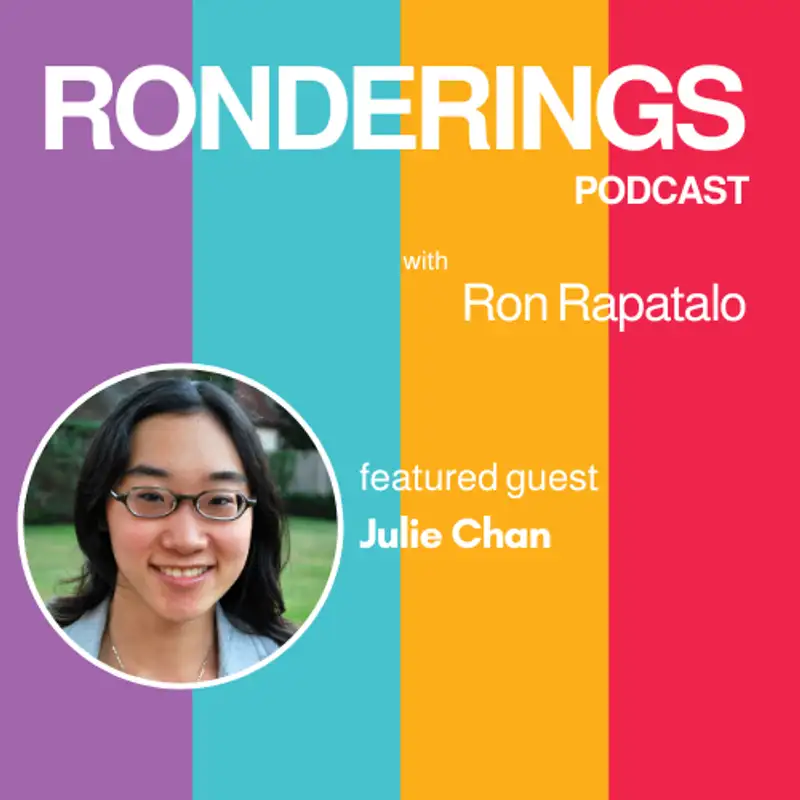
Ron Rapatalo:Let's get into it. Welcome back to Ronderings, where we slow down just enough to sit with the questions that don't have clean answers. Today's conversation stretches how we think about purpose, leadership, and what we do when the life we build no longer fits who we're becoming. My guest is Julie Chan. Julie grew up in New York City public housing, daughter of Chinese immigrant parents.
Ron Rapatalo:She did everything right. Yale, MIT, a decade in urban planning and economic development, helping build health care tech and social impact industries inside government. Then something happened she never asked for, never planned. Julie experienced a spontaneous spiritual awakening that opened a clear audience abilities, clear hearing, and completely changed her quantitative training and worldview. For years, she developed these gifts quietly, learning how to integrate intuition from the most rational high stakes environments imaginable.
Ron Rapatalo:In this conversation, we explore what happens when logic meets intuition, when purpose stops being a stop being a title, it becomes a way of being, why so many high achievers feel successful on the outside but disconnected on the inside. This episode isn't believing anything. It's about listening. Let's get into it. Ronderings fam.
Ron Rapatalo:So I gotta give y'all a little bit of context here. I should have had Julie Chan on my podcast earlier on, and I will attribute it to my ADHD where I'd get these, like, thought bubbles like, oh my god. Julie needs to be on my podcast because it's not as if I haven't talked to Julie the last two plus years of Ronderings, but yet I never would get around to sending the text, and it was only recently like, shit. I need Julie on my podcast. I need some Julie Chan love.
Ron Rapatalo:And so Julie Chan is here on the mic and so folks know she has been my purpose coach and so folks can understand the definition of that. She is someone who uses the brilliance of her intuition and spiritual guidance to support people like me on my leadership and life and career journey. So Julie Chan is on the mic. How are doing today, Julie?
Julie Chan:I am doing well. Thank you, Ron, for having me on the show. And I believe in the divine timing, so
Ron Rapatalo:all and meant I to both. You know, there's part of me that like, well, maybe not, you know, the coaching convos you've had with me, because sometimes they're very intimate, detailed and things that never are meant to be put out there in the but we've had such deep combos that I'm really excited about having you on because like all of my Ronderings episodes, I don't really know where this is gonna go, and so having you on the mic with me, we both are gonna see where this goes and have, you know, forty to fifty plus minutes of, like, incredible conversation.
Julie Chan:I'm excited. I also don't know where it goes either. I let intuition guide me whenever that
Ron Rapatalo:What does your intuition say for you, Julie, to say about your story?
Julie Chan:Yeah. Well, I think for people to understand who I am, I'll start early on. So I grew up in New York City. Grew up in public housing. My family or my parents immigrated from China, and so my dad worked in a restaurant as a cook, kind of worked his way up from a dishwasher, actually.
Julie Chan:My mom Wow. Was a seamstress, actually, in Chinatown for a while before working in a school as a as a lunch lady.
Ron Rapatalo:Wow. As
Julie Chan:you can imagine, you know, immigrant upbringing, we cared about
Ron Rapatalo:Yeah.
Julie Chan:Saving money, not spending money. Mhmm. And essentially focusing on education as our kind of climbing up the socioeconomic ladder, if you will, so to prepare us for success. And and so I I feel like I did all the things. I went to great schools, graduated from from Yale University, studied economics, you know, like the practical major, and
Ron Rapatalo:Did all the things.
Julie Chan:Studied the things. Did all instruments. I love all the instruments. And I went to the field of urban planning and economic development.
Ron Rapatalo:Think just
Julie Chan:by virtue of living in the city and seeing, you know, how do all these different types of people get along or don't get along, and how do we balance, you know, everything. I'm a multidisciplinary person, so the fact that urban planning kind of touched upon all these different topics was really fascinating to me. And so I worked in that career for maybe around ten years, and in the middle, went to MIT for grad school. And it was there that I had, ironically, my kind of biggest spiritual spontaneous spiritual awakening experience that opened up awareness of things that I had no clue about. I had I had no idea that psychic ability was real, that I could sense things.
Julie Chan:It just that experience just kind of opened up complete awareness. And it threw me for a loop because I think Yeah. I was like, well, how is this? I'm brought up to be all quantitative and, you know, quantitative is king. Yeah.
Julie Chan:Who cares about anecdotes? That's that's like how I was brought up and or like the qualitative. And it I went through this kind of period of searching and learning to try to piece the sides of me back together again, if that makes any sense. Because I felt like they were battling each other out in terms of, you know, what is real and sort of the matrix. What really is real?
Julie Chan:Mhmm. And I came out of that journey then with this yearning to hone these intuitive abilities. Mhmm. And so I dedicated my my own diligence and work ethic very much in the closet. I had no one in my circles believed in this stuff.
Julie Chan:And so I was ordering books off of Amazon just to learn about psychic intuition and how it can help in all areas of life, including purpose as I would figure out later on. And and that's really kind of what helped me to become more and more confident in this whole other realm of the universe, which I think is actually the underpinning to so many things that I was working on, whether it's health care, mental health, you know, the pursuit of happiness. How is it that we, as human beings, can live and have joy and be aligned and know what our purpose is? That's sort of the ultimate goal that I eventually kind of tapped into. And, yeah, that's sort of the first first little bit of my story.
Julie Chan:Don't know if I share the whole thing, but but, yeah, that's kind of what got me started on this path of spirituality. And I am it has just yielded so many insights, and I'm still learning. Yeah. Still on the path of discovery.
Ron Rapatalo:I don't think I've ever asked you this question, Julie. And thank you for sharing about your parents, right, which most people do, right? Usually people start I mean, it's a good starter, right, in talking about your story. Right? It's like, I often think about people's talk like, description of the story as a Marvel comic superhero origin story movie.
Ron Rapatalo:Right? And so I can see it. It's like Julie's Chinese immigrant parents. You know? Like, dad working in restaurant, mom is seamstress, became a lunch lady, and then all of a sudden, Julie got hit by some bug.
Ron Rapatalo:Spontaneous intuitive event. Right? If and when you told your parents, what was their initial reaction? And tied to that question, in your spiritual intuitive journey, is this is this something that lives in them and they just never told you about it? Because what I found in intuitive journeys is I told you, this lives in my mom.
Ron Rapatalo:My intuitive, like, ability comes from my mom. I just never believed it as a kid. I was like, my mom is smoking. She don't see she don't experience dead people. That is a lie.
Ron Rapatalo:Who does that? So I'm curious.
Julie Chan:Yeah. I think I remember growing up thinking that my mom had a sixth sense, and she always said that she did, but I always thought she was Yeah. You know, just like any mom knows what's going on. Right? It's like they have eyes on the back of their head.
Ron Rapatalo:All women
Julie Chan:exactly. Exactly. So I I didn't think too much about it, but there were definitely some some uncanniness to it. I I'm not drawing a blank on examples, but I just remember that she would always like, maybe her eye would twitch and be like, oh, you know, I thought of you and maybe something had happened. And so there there did seem to be this interconnectedness where she knew of things that she couldn't have known because we were in different locations or something like that.
Julie Chan:Mhmm. And I think also just growing up Chinese American, the Chinese side, there's just a lot of, you know, respecting of ancestors and just
Ron Rapatalo:Yes.
Julie Chan:There there is this presence of you know, in a spirit realm or spirit form that is more real. And I and I also grew up, I'd say, maybe grew up believing in God, but never went to church. I'd say maybe Christian kind esque. We we it was totally not an organized religion type of thing in my household, but it was it was just believed in something higher than ourselves. And, I mean, one story I have is I used to pray to God thinking, you know, I I really want a cat.
Julie Chan:And every night I would pray, and every morning I wake up, and there was no cat that magically materialized in my room. And so at some point, I stopped believing in God. Because I was like, this is just, you know, this doesn't materialize into anything. And it wasn't until that experience, that that spiritual awakening experience that was so physical for me that that I started to see more of a connection between our, you know, three d reality world here and the spiritual realm where, like, I felt it, I heard it, I I knew things, like a bird had landed on my windowsill. There was this kind of interconnection of things on a physical reality level that really hit home for me.
Julie Chan:Yeah. So so, yeah, my parents probably understood what had happened, but they were still, like, you know, a little freaked out.
Ron Rapatalo:How are they about you, your your skill, your journey today?
Julie Chan:How about sorry. What was how are how are they how do they feel? Or
Ron Rapatalo:Yeah. Yeah.
Julie Chan:How do they feel? I think, I mean, it's been it's been over ten years, maybe even, yeah, fifteen years. It's been fifteen years since that happened. And since then, I've gone on a journey where I kind of I wouldn't say I left urban planning and economic development. It's still a part of who I am and what I do.
Julie Chan:But I did go into starting my own company Yeah. Called Being My Purpose and then working a lot in mental health and nonprofit administration, and also the scientific research side of spirituality, metaphysics, and healing health. You know, like, again, very interdisciplinary of how do we use this information to empower us, to help us on our path. And and I think, you know, at some points, I would talk to my mom about meditation and all the studies, like scientific studies about it and how it helps meditation helps me to access intuition.
Ron Rapatalo:Oh, it sure does.
Julie Chan:It sure does. Exactly. And not many people know about that. Like, lot of people think it's just it depends on, like, what forms of meditation and what the goal is, I guess. But Yep.
Julie Chan:But I remember my mom saying, like, reading in the Chinese newspaper about meditation and about intuition. And and she's like, oh, wow. You know, it look, like, there's proof that what Julie is doing is is helping people. And so I think in in that sense, they understand more. And I have done readings for my family before.
Julie Chan:And so it's it kind of it it kind of helps them to understand.
Ron Rapatalo:I did not that's fascinating me. I mean, have you found any difference from when you have to do reading for a family member? Because here's where my mind is going, right? We are vessels at the end of this all, right? And I'm curious like how that familial relationship in being a vessel and the kind of natural human, I would say, you know, kind of five senses biases, you know, how you balance that with being a vessel and what you're kind of intuiting when you do it for family members.
Julie Chan:Yeah. It's I don't like, for me, it's doing a reading for a family member versus someone I don't know feels the same.
Ron Rapatalo:It does? Okay.
Julie Chan:It does it does feel the same. I think there's there might be like, a lot of this is driven by emotion too. So if if, let's say, I'm doing a reading on something that is very emotionally charged, like, how do I, you know, improve my relationship with my mom or dad? Or how can I help heal somebody of a health concern? That there's there's a lot at stake there.
Julie Chan:And so if if anything, I think because we're all interconnected, it it helps when I do a reading, it moves the emotion for myself as well. Like, there's a huge release of Yeah. Maybe grief or sadness or, you know, whatever the emotion might be. And and so it's healing. It's healing for for all involved.
Ron Rapatalo:Yeah. So I wanna take this because I know you haven't, like ever left that urban planning, economic development world, right? Because your, I might guess strongly, spiritual intuitive gifts and coaching probably come in quite handy when you're doing that work. So talk to me a little bit about how that gift of your intuition helps you do urban planning and economic development work in a way that maybe people aren't coming in with?
Julie Chan:Yeah, that's a great question. I guess looking back on it, so I worked in the City Of New York in their economic development corporation, And my role was kind of building industries in New York City, so kind of on the tech side, health care technology, social entrepreneurship, just building that ecosystem, which is very stakeholder oriented, like knowing what everybody wants and how everyone can work together towards a common vision. And so I think my intuition helps in a number of ways. Like one is just and maybe this is empathy or my empathic nature also of being able to feel ultimately what people wanted. And so people might say something, but I could feel what the root was, like what the underlying root was.
Julie Chan:And so I felt like I was able to negotiate and work with different people to Yeah. Move forward towards a common goal or vision a lot better than, you know, if I hadn't had intuition. Because I felt like it's you're just like, ultimately, at the end of the day, everyone wants something. And and it could be very common. There's more shared vision than one would think.
Julie Chan:So that that was one thing. Another was just like workplace managing workplace stress was fascinating too. Like, everyone might be
Ron Rapatalo:Wait. Working in government has workplace stress? I've never heard that before. No.
Julie Chan:Yeah. I mean, I feel like others others might experience it differently.
Ron Rapatalo:Yeah.
Julie Chan:But, you know, and as with any workplace, there's there's just hierarchy. There's, you know, thing like, working on things you don't wanna be doing or, like, not seeing where everything is going. You know, we when we had a change in mayoral administration, it was, you know, it was it was a a a confusing time, let's say. And so I found that this kind of intuition and and newfound spirituality, I think at that point, it was just a couple of years old, helped me to navigate it with inner peace. And so I felt like the whole ship might have been rocking around me, and everyone's just, you know, you know, either with gossip or with like, oh my god, what if this happens?
Julie Chan:What if that happens? I was able to maintain this level of peace. And and I think the people around me felt it. And and we were able to weather the storm a little better and still kind of hold on to the the vision of, you know, what we wanted to do.
Ron Rapatalo:Yeah. That's right. The the The intersection of empathy and intuition is something I wanna dive a little bit deeper into because I've had similar experiences, surprise, surprise, where I've often known where to go when I have conversations with people, whether formal, informal. Right? And it this shouldn't surprise you I'm saying this to you because you've coached me.
Ron Rapatalo:Right? It belies anything that's in my media consciousness. It's like a vibe is what I call it. Right? It's like I've known to ask this because something in me knows to ask this question, and people and I'm curious how you felt about people reacting this way.
Ron Rapatalo:I'll say the statement of like, how did you know to ask that? Or, woah. How did you know? So how have you reconciled that? Because I think there are things with, like, our intuition and our pathetic nature that we are led to things that don't really make conscious sense.
Julie Chan:Yeah. It's as you're kind of describing that, I'm thinking of one moment
Ron Rapatalo:Yeah.
Julie Chan:In and I don't even remember what we were discussing, but a picture, you know, we're all in a conference room. Me and, like, my team. Yeah. Yeah. And everyone's just debating.
Julie Chan:Like, we're not going anywhere. We're basically stuck at an impasse. And everyone's getting more and more frustrated. And and I have this thought that that I know needs to be shared. And this is from an intuition standpoint, as well as from I mean, Ron and I were were part of this CORO leadership New York program, where they do, you know, teach about different people's leadership styles, and how every every kind of type of leader has something to offer.
Julie Chan:And so so being able to speak up and share your voice and perspective is really important. So I had that going on too. I like, oh, you know what? I I need to share this thought. And and the third layer is that my purpose that that I channeled from the Akashic Records, and I can talk more about that later, is in part I mean, largely, it's to use my voice.
Julie Chan:It's to share my story. It's to empower people. But to use my voice and as a as a kind of a reference point, most of my life, I was so introverted, I could barely speak. Like, every single teacher on my report card said Julie does not speak. And and I realized it has been an entire journey in and of itself to learn to to be able to do that.
Julie Chan:It's kind of bizarre. I don't know why. I mean, looking back on it, I don't know why it was so hard. But I think because it was my purpose, the first, you know, decades of my life, it was incredibly hard. And so in this conference room, I could have been the old version of Julie, which was, you know what?
Julie Chan:What I have to say is not important. Yep. You know, everyone else is probably more intelligent than I am. You know, this kind of kind of underdog mentality, or or, you know, whatever. Just let the whole thing burn.
Julie Chan:It's like that that, like what is it? The word is escaping me right now. But it's it's the just, you know, I've I've done too much. I'm just gonna sit this one out.
Ron Rapatalo:Yes.
Julie Chan:And in an effort to protect myself. And so I had to, in that moment, go through all of those layers and say, alright, I'm gonna make a point to say this thing that isn't on my mind, and it may derail this whole thing or it may not. And so I remember it took the courage of those things, like knowing my intuition was real, having this leadership training to to know that what I had to offer was valuable and could make a big difference. And then the third was, I know it's my purpose. Therefore, it's hard.
Julie Chan:And and this is my moment to prove to myself that that I can do it. And it's sort of it's almost like the universe gives you chests, like challenges to say, hey, did you did you fully learn this lesson, this soul lesson? And soul, like s o u l, soul lesson. And and this was my moment, I feel. So I, you know, I piped up.
Julie Chan:I think I, like, got really the adrenaline rush. I must have, like, leaned on the table a little bit and was, you know, gesturing more than I typically do. But but I said what I had to share, and the whole room was silent. And I feel like that's I mean, that might be the mark of an introvert too, like what an introvert has to say. It usually takes a lot for them to speak.
Julie Chan:And when they finally do, it means something. And and it just resolved the whole thing. Everyone's like, all right, We meeting's done.
Ron Rapatalo:Wow.
Julie Chan:And and we all left, and I was I was left thinking, wow.
Ron Rapatalo:It
Julie Chan:it felt it was like, like, every single thing aligned to that moment. And and it to this day, I still remember that. And so that I keep that with me because it it shows how how you can have the intuitive hit and know what to say. Yeah. But it may be a journey in and of itself to be able to say it, especially if it sounds like it could be a hard Yeah.
Julie Chan:Thing to say.
Ron Rapatalo:Have you watched Game of Thrones? I'm I'm gonna go somewhere for a sec.
Julie Chan:Yeah. You know where
Ron Rapatalo:I'm going. Right? Because we're in two. Oh, okay. Shit.
Ron Rapatalo:Come on, Drew. It's supposed to be in my head. There are times I talk to you in my head. I'm serious. I'm like, Julie hears me.
Julie Chan:What would Julie do?
Ron Rapatalo:Exactly. WWJD. But brand, the raven
Julie Chan:Oh, yes. Yes.
Ron Rapatalo:There's something that makes me think of that point in your what you just said. Let me thread this through. Being an introvert, having teachers give consistent feedback that you don't talk a lot, and then having this spontaneous intuitive moment, right, which at least from what I'm understanding this convo and having talked to you before is really the first time you felt this instance. It's kinda like when Bran knew that he was start like, wait a second. I'm, like, seeing shit.
Ron Rapatalo:I'm different. Right? And then you have this moment at work. And obviously, there may have been moments in between, but let's kinda thread through just these singular moments of you taking that spiritual intuitive ability and that awakening and not talking as much to saying, I have the power of my voice to move people. Right?
Ron Rapatalo:There's something really powerful about that story. Like, if I were designing this as, once again, a Marvel comic superhero story, it's just like there's you know, we can figure out your costume and all that stuff where we would name you. Right? But I'm just like, that's such a poignant moment of think of threading those things through. It's like Julie always had this gift and it took a while for you to manifest it.
Ron Rapatalo:And once you started manifesting it, like that workplace, I'm not sure I'm guessing that situation at workplace was before you started being my purpose. Correct? This is
Julie Chan:Yeah. That was before. Mhmm.
Ron Rapatalo:So what got you to decide? I think you and I have talked about this. So let's elevate this for our public audience here is what got you to decide I need to do this more as a venture outside of, like, using it for good inside of, like, my economic development urban planning job?
Julie Chan:Yeah. It that was its own internal Yeah. Battle. And and I'd say with any career transition, it probably is similar to for a lot of people too.
Ron Rapatalo:A lot of
Julie Chan:it's it's and, like, I remember crying at home just with this question of like, do I leave my job knowing what paths would make me happy? So I mean, I think at that point, I I knew that I had learned what I needed to learn from that position. And the next step could be similar. You know, it could be economic development, nonprofit, government related. Or the other idea was to prove to myself that all of this was real.
Julie Chan:And just just to kind of set the stage of what was going on, by day I was doing economic development. By night, I was I wanted to figure out what this all meant. So at this time, I think I had I had honed my intuitive ability to channel information. So there's a bunch of different I'd say I call them clairs. I mean, you might have heard of clairvoyance, clear seeing.
Julie Chan:Clairaudience is my strongest sense. Clear hearing, where I can hear literally information, and I write them down like a scribe. I don't change any words. And within the Akashic Records, if you think of a library of information, which is kind of Bran. Right?
Julie Chan:Like, Bran was able to access this incredible infinite library of information of the past, present, and future. And and he knew things and saw images saw things we didn't want to see. And and which could change history, essentially. Like with knowledge, I think there can be change. And so and so I tapped into that, which, you know, like, literally, I just bought a book off of Amazon, and it was about the Akashic Records.
Julie Chan:But I hadn't read the book. It was on my bookshelf for two years until the right moment when we were, like, me and my husband. I can't remember if we were married yet. I know. Think we were married.
Julie Chan:And we both had the flu, and I was just like, you know what? I'm just gonna read a book on the shelf finally. So that was what helped me to tap into my purpose and then know how to channel from the Akashic Records to receive information. And and, yeah, that led me to start my company to help others figure out what their purpose was. So so imagine I'm still at work, and by night, I would meet up with people.
Julie Chan:I told my husband, was like, pick five people. Five people I don't know. Actually, no, I think it was 10 people. 10 people that I don't know, and I had 10 people that I didn't know that I would channel for to figure out what their life purpose is. And when I channel, I would receive pages of information.
Julie Chan:Oh, I know. Pages.
Ron Rapatalo:I have a Google Doc of all the information you've sent me. It is
Julie Chan:You have
Ron Rapatalo:a full of, like, oh, Julie C shit. Wow. Hello. Hello. Hello.
Ron Rapatalo:Hello.
Julie Chan:Yep. There yep. There's tons on Google Docs right now of of all all the channelings. So I devise an experiment of I'm gonna try channeling for these 10 people I don't know. And these 10 people I do know, I would meet with them over dinner after work.
Julie Chan:And these these dinners would be like three to five hours long. We would be talking about life purpose. People would be crying over their dinner, but nothing else mattered. It was it was about them and their lives. And by the twentieth one, I was so floored that the information resonated with people because with with especially the the ones I didn't know, it was like jumping off a cliff because I'm I'm there with the channeling, and I'm like, I hope this resonates.
Julie Chan:Because if not, we're eating to dinner together.
Ron Rapatalo:It's like when Tyler Henry meets these people, like, he he's one of my the favorite shows to watch of, like, mediums that's on public t like, on cable. Right? And he knows nothing about these people until he literally meets them. So that's what I was thinking about when these people you, like, you hope it works and you just have the skill. Then I see him.
Ron Rapatalo:He's, like, sketching, doing all these. Like, how the fuck does he come up with? Half the shit he says, it'd like, oh my god. And there's inevitably tears. I start crying when I watch the episode.
Ron Rapatalo:Damn it. I can't keep because I'm crying all the time. Damn it.
Julie Chan:Yep. Yep. Yeah. One of my favorite shows that helped give me the courage to even do this was Teresa Caputo's Long Island Medium. I would cry in every episode.
Julie Chan:It was amazing.
Ron Rapatalo:I love and it's so funny when you think Long Island Medium and, like, you and I are New Yorkers. Right? You said, like, that's, like, as Long Island as you get. You know what I'm saying? Right.
Ron Rapatalo:And she comes into a room. So this my mind is going to something I'm thinking of when I've seen Teresa Caputo do her show is you and I have talked about in terms of protecting our energy. One of the things you gave me in your coaching of me is thinking about a sleeping blanket that I would zip up to protect my energy. Because there are times I just need to turn the gift off. I just need my sanity, right?
Ron Rapatalo:Because like, I remember one of the times, and I probably told you this in a coaching session, I walked by the World Trade Center footprint some years back and I was just overwhelmed. It was like this feeling of feeling everyone that had passed. And I was like, Oh my God, this is making me like, ah! And when you gave it, was like, oh, makes sense. So I'm curious because when I watched episodes with her, like, I think her turning it on and off is really hard, what I've watched.
Ron Rapatalo:How do you support yourself? Because obviously, you're probably into you're intuiting all the time.
Julie Chan:Yes. It's it's really fascinating because I think everyone probably has a different style and and should have a a toolkit for things that work for them.
Ron Rapatalo:And Yeah.
Julie Chan:The, like, the zipper idea that that I wanna credit Gabby Bernstein. It was the show okay. Hers she she mentioned And and who knows? Like, maybe she came up with it. Maybe it was from somebody else too.
Ron Rapatalo:Probably from, like, a twenty eight thousand year old idea from some Right. Seer that lived wherever. Yeah.
Julie Chan:Yeah. Like, I feel like any it's it's the intention that that really matters. So any visualization of of protecting your space and your field will help. And and so, like, for sometimes I might imagine a golden light around me and anything that is not of love, you know, is kept outside of it. And, oh, I have some great stories about Airbnbs and ghosts where where we use this.
Julie Chan:This is, like, in the practical realm. Like, how do you use this when you go enter an Airbnb? And and so you can kind of protect yourself that way. And I think Teresa Caputo, I remember one of her episodes where she said that she wears a cap to kind of protect her head. And because otherwise she would get very anxious.
Julie Chan:And so that's interesting to like to cover the the the crown chakra there. And Yeah. And so, yeah. So whatever works for you. I mean, for me, it's it's visualization.
Julie Chan:I might say a prayer. But I don't I don't get too many intuitive hits out of the blue. They are usually very few and far between. I usually I have to set my mind to to channel, and it will happen. But when when I do receive in for hits, it's usually in the form of tingles.
Julie Chan:Like, might have, like, a full body Mhmm. Tingling, like, not pins and needles, but it, like, it feels it feels kinda like goosebumps, but, like Yeah. Electric like electric tingles, usually at my my head, top of my head, or full body. And and I have some nine eleven stories too. But but yeah, it's, you know, it we're basically walking, I feel, in, like, overlapping with other dimensions.
Ron Rapatalo:And
Julie Chan:so they're all there. We just can't see them. They probably see us. But it's that perception.
Ron Rapatalo:Have you watched the movie Everything Everywhere All at Once?
Julie Chan:Oh, yes. Yep. That's a, like, a great interpretation of
Ron Rapatalo:Bingo.
Julie Chan:Time, past, present, future, different timelines impacting other timelines. Yeah, I've had I've had some wild experiences. I went to a Dr. Joe Dispenza meditation retreat lately, and or it was over the summer.
Ron Rapatalo:Yeah.
Julie Chan:And I had some amazing experiences in the quantum field that kind of really brought to home how time impacts itself and how we impact time.
Ron Rapatalo:Yeah. I mean, one of the things I've shared with you when I've gotten coaching with you is I think one of the gifts, going back to my mom, right, is being able to experience people that have passed. And this is people I don't know like celebrities, and this is at times talking to people in my daily job. And there's one experience I remember where I was talking to someone who was in a search process I was leading and this person was telling me about things, they told me something personal about their mom passing, And that's always the thing. Julie, anytime, I think for me where the intuitive hits start happening in that particular realm for me, if someone tells me that someone in their life has passed, inevitably, I'm like, oh, they're gonna start saying stuff to me, and I'm feeling it.
Ron Rapatalo:And I then have to use the sermon about what do I say, don't say. Because I don't always say it every time I feel it. Right? But what I found is, like, there was just you know, similar to you, the tingles, like I've told you, I get my palms feel very light and then my head feels light. And then I was listening, talking, and then this person was conflating with me about like their mom's passing, etcetera.
Ron Rapatalo:And then it just, the moment hit me to say, I just want you to know your mom has told me to say this to you. It just sort of came out my mouth. And then literally this person started crying. And they said, Thank you for sharing that with me. You know what I'm saying?
Ron Rapatalo:There's sometimes like I think, as I'm telling the story to you, at least for me, they sometimes happen without me being in flow because when I get in, I don't know how to always be in flow. I just kind of, in the moment of like the dancing of energies between one person to another, like you and I are here on this virtual tour, even though we aren't in person, what I've always told folks, like our energies entangle. Proximity helps to be clear, because we are human inside of bodies. But I've told folks, and this is always, my mini, like, rant on, like, the nature of being virtual and phone is, like, I don't I told I will say this on this episode. I've told this to people in conversation.
Ron Rapatalo:I don't need to see someone to experience someone's being. I don't even need to be near you. You go, what? That don't make sense. I'm like, no.
Ron Rapatalo:If you know the power of our spirit, our intuition I tell people that's why I don't offer Zoom calls most of the time. People are like, I need to see you. I'm like, no, you don't. There was a time we didn't have Zoom. Remember that?
Ron Rapatalo:We just talked to people on the phone. Shit. How many intimate relationships have you cultivated and built with people through a phone conversation?
Julie Chan:Yeah.
Ron Rapatalo:Even typing something on social media. Yes. There's things that are off about social media, yada yada, but it's energy. When you manifest that energy, it moves people. So I always think about those things of the way that these gifts and things come up.
Ron Rapatalo:I'm glad that you elevate it. It comes up in different ways for people. So I'm curious how you let me ask this intersection question, how you've supported people like your formal practice of being my purpose, but also because you've never really left economic development, and I know you're also doing other things, Julie, outside of that, how you have helped people govern their purpose.
Julie Chan:Yeah. So I feel like it's been over yeah, I guess it's been ten, fifteen years of channeling for people. And I've I've yet to sit down and really there's a whole book in me that's that's going to come out, but I haven't haven't dedicated the time to really think about the lessons learned.
Ron Rapatalo:Julie, you and I need to talk offline if when you're ready to do that because hi.
Julie Chan:Oh, yes.
Ron Rapatalo:Some people that sponsor this podcast, my folks at, like, you know, Genius Discovery and Books That Matter, we do that stuff for amazing leaders like you.
Julie Chan:So Oh, really?
Ron Rapatalo:Not pitch wink.
Julie Chan:That's bullshit.
Ron Rapatalo:Yes, that was commercial friends.
Julie Chan:That's funny. Yeah. I mean, that's that's definitely something. Something that that is in the future, but I haven't had a moment. But, yes.
Julie Chan:So, how have I guided people? So, I tend to work with people who are maybe a little similar to me, like people who are have climbed some ladder. Yeah. And they're they're do you keep climbing and they're like, what? Why am I doing this?
Ron Rapatalo:Yeah.
Julie Chan:How is this making me happy? Or like, there's gotta be something else. Or or outright, like, what is my purpose? I just want to know. There are some people who just want to know that.
Julie Chan:And so for a lot of people, externally, their resume looks great, their pay looks great. They could be the happiest people, but inside there's something missing.
Ron Rapatalo:Yes.
Julie Chan:Or they know that there's more. There's definitely something more for them. And it usually like, people don't reach out unless there's kind of a couple of different types of people. They're the curious ones. Like, curious ones like, I just wanna know my purpose.
Julie Chan:I wanna accelerate it, express it. Because I I feel like purpose to me is a state of being. Yes. It's not a job. It's not an occupation.
Julie Chan:It's not a thing. It is an an expression. It's a it's a it starts as a state of being, and then it just kind of kind of flows forth from you through all aspects of life, through your career, through relationships, through your creative expression, your self expression, through, you know, through your home even. So there's all these different categories of how people can express themselves, and I touch upon all of them when I when I work with people. And and so, what's interesting is that you might have someone who's really high powered, let's say, like C level in your company, earning a ton of money, And but there's something off balance.
Julie Chan:Like, there's something in their life that maybe they decided, you know what? I'm not I'm not gonna get married, or I'm not gonna have kids, or I'm not gonna, like, pursue my dreams because they won't make me money.
Ron Rapatalo:Mhmm.
Julie Chan:And all sorts of reasons that people come up with. And that's usually where I like working in because those are the areas that once uncovered through a reading where, like, I don't know who these people are usually. And once that information comes out, usually people will say, oh my gosh. I've had this dream to do that. Maybe it's open up an animal sanctuary.
Julie Chan:Maybe it's to start a nonprofit that does x, y, z, that or, you know, write a book about this particular topic. They'll say, I've had that thought come into my mind repeatedly, but I've always shoved it down somewhere. Like, they've put it under the rug because they're like, oh, you know, I've I've got too many important things to do or not enough time or just generally overwhelmed, which, you know, a lot of people are just generally overwhelmed.
Ron Rapatalo:Yes.
Julie Chan:And and so I help people through these readings, through the metaphors that come through and through the coaching. It's essentially being coached by by a higher power. Like, I just take the words
Ron Rapatalo:and been my experience with you for five years. Yep. Mhmm.
Julie Chan:Yeah. And and I help interpret because I've seen how higher spiritual guidance translates into three d reality and all the stuff that gets trapped with the Exactly. Like the I'm I'm the bridge, I'm the translator, interpreter, kind of idea incubator, cheerleader to help people to actually implement it. And that's where a lot of people get tripped up because the ideas are there, but something is preventing them from actually moving forward with it. Yeah.
Julie Chan:And so and there are people who get stopped at different parts of this journey. Yes. And and so in that sense, I feel like I am an incubator for these ideas because it's how to help move that forward.
Ron Rapatalo:Yeah.
Julie Chan:With the idea that these these expressions of you are meant to transform the world. It could be transforming your family or you, it could be transforming your community, it could be global. There are some people whose purposes are global. And so they're kind of expanding into that that shoe, like filling that shoe as they keep growing and and becoming more and more confident in their expression. And and so that's that's what I do.
Julie Chan:I help people along the entire journey, and I channel pages of information to help people with metaphors that are very neutral and loving to help guide people.
Ron Rapatalo:Yes.
Julie Chan:And some of the best feedback I've received is there are some people who are like, I've been going to therapy for forty years, and we keep dancing around the topic until, like, literally the last therapy session that I got in the reading, like, in one session without knowing who they are. And so there's like, I love therapy. Therapy is great. But there's also people avoid talking about things. Of course.
Julie Chan:Yeah. Or or it may not occur to them. And there's there's a beautiful divine intelligence that comes through in these channelings that kind of presents information in this neutral way that helps people to see, oh, wow. You know what? I actually I actually really do want to do x y z.
Julie Chan:Yeah. Whatever it is. Start the animal sanctuary. Or I really like, for some people, it's it's like, I want I really want to feel like I'm flying. It's very visceral and movement based.
Julie Chan:And so their key to happiness in part is to have activities that do that. And so it might look like brainstorming of like, okay, well, what does what could that look like? Do you like ziplining? Do you like Right. You know, like, something really thrilling?
Julie Chan:Or is it, like, going on a swing? So it could be as seemingly minute or even mundane of, like, an activity. But it's it's it's like in the three d world, what can help you access that state of being that can really help your soul feel nourished and feel like it could fly, essentially. Like, it could it's it's free to do as it pleases. And and so for each person, it's unique and different.
Julie Chan:And that's been fascinating just to see how different it can be. And yet, at the same time, there are some people who are like, you know what? I think, you know, maybe some of the metaphors or some of the information reminds me of somebody else's reading. And so I'm like, hey, you know what? The two of you should get, you know, chat or something.
Julie Chan:Because I feel like they're aligned in some way, and maybe their purposes have some greater, there's something more to the projects that they wanna work on. But yeah, people have started nonprofits, they've started companies, they've grown their companies, they've started families. So it varies.
Ron Rapatalo:As a parting thought, because I think Julie, when I've gotten readings from you, often your readings from me have the Akashic Record saying you should work with Ron on X, right? And so my intuition says these testimonials and these gifts of people doing these things, right? It's like classic marketing client testimonials and these stories of what people are doing as a result of your gift. I'm hoping this podcast can shed a slight bit of light on that, but I also know there's something deeper there that I think your gift as like the next continued elevation of your gift, is for people to know these stories and the impact you're having so that people can then learn to come to you and then build this muscle themselves. Right?
Ron Rapatalo:Because that's what you've done for me. Right? I I would imagine, right, as a parting thought, I ask you the Ronderings question, all of us have this gift. Like, none of us is special per se. It's just a matter of building consciousness into the gift because everyone is a different kind of intuitive gift.
Ron Rapatalo:I've learned that over and over again. Like, people I didn't think but we all find each other is what I find. It's like when you meet a fellow intuitive person, like, there's just sort of a, oh, shit. And in fact, a number of my Ronderings guests fall in the spectrum of that gift, uncannily. But before we end, Julie, what is your Ronderings?
Ron Rapatalo:What's the lesson or value you wanna share with us today?
Julie Chan:I mean, I feel like it could be so many things.
Ron Rapatalo:But I know.
Julie Chan:I think it's it's discover who what your purpose is. Mhmm. Find find out because it may not be what you think it is. And it has opened up my own life in terms of my North Star
Ron Rapatalo:Yeah.
Julie Chan:And helped give clarity to what I'm most kind of moving towards. Mhmm. And I'd say a little maybe a little tidbit is think about what you're most afraid of and let that also be a guide. Because usually, I mean, purpose can be the hardest thing you do because you have to come up against a lot in order to
Ron Rapatalo:Yeah.
Julie Chan:Get over that that obstacle. And so fear, if it's not a life or death situation, can be a good guide for you.
Ron Rapatalo:Amen to that, Julie. Well, before we end, how do people find you? What would you like to promote?
Julie Chan:Yeah. So my website is www.beingmypurpose.com. And I will admit I'm not that great on social media, so just reach out if you want to contact me. You may know I'm pretty old school, but but I do have a Facebook page being my purpose. And I'd say for for anyone who likes who wants to try out a reading, I can offer a 10% off discount Beautiful.
Julie Chan:If you use the code ILovePurpose 2,026.
Ron Rapatalo:Well, I wanna tell folks that not only am I the host of this podcast, but Julie's coaching of me has allowed me I think our conversations partially led to me starting this podcast, for sure, and getting my voice out there. So I have to attribute a lot of your genius, your intuition to me, allowing me the space to find the kind of leader and human I want to be, and I still have a lot more work to do, be clear, but I will tell this entire audience, her coaching works. You just have to be open to it. Trust me. So Julie, thank you for being a Ronderings guest.
Ron Rapatalo:In the words of one of my sports heroes, Deion Sanders, we always come hot with amazing guests like Julie Chan. Peace, y'all.
Julie Chan:Thank you so much for having me.
Ron Rapatalo:Julie, thank you for trusting us with your story, your journey, and the depth of your work. What stays with me from this conversation is the reminder that purpose isn't something we earn, achieve, or figure out in a spreadsheet. It's something we remember and often something that asks us to face the very fears we spend our lives avoiding. Julie's work with being my purpose is especially powerful for people who look successful on paper and feel an ache they can't explain. Those who follow the practical path quietly shut down parts of themselves along the way.
Ron Rapatalo:This episode resonated. I invite you to sit with what stood out, not to rush to action, but to notice what's being stirred. You can learn more about Julie's work at beingmypurpose.com. She's spared a special discount code in the episode notes if you feel called to explore further. As always, thanks for spending this time with me, thinking, feeling, and wondering out loud.
Ron Rapatalo:Till next time. Keep Ronderings. Peace. Thank you for listening to today's Ronderings. I enjoyed hanging out with me and my guests, and I hope you leave with something worth chewing on.
Ron Rapatalo:If it made you smile, think, or even roll your eyes in a good way, pass it along to someone else. I'm Ron Rapatalo, and until next time, keep raundering, keep laughing, and keep becoming. Podcaststhatmatter.org.


Listen to Ronderings using one of many popular podcasting apps or directories.