 Episode 74
· 55:25
What's up? I'm Ron Rapopalo, and this is the Ronderings podcast. Around here, I sit down with guests for real, unpolished conversations about the lessons and values that shaped them. And I'll be right there with you, sharing my own take, laughing at myself when I need to, and wondering out loud about this messy thing called life. Glad you pulled up a chair.
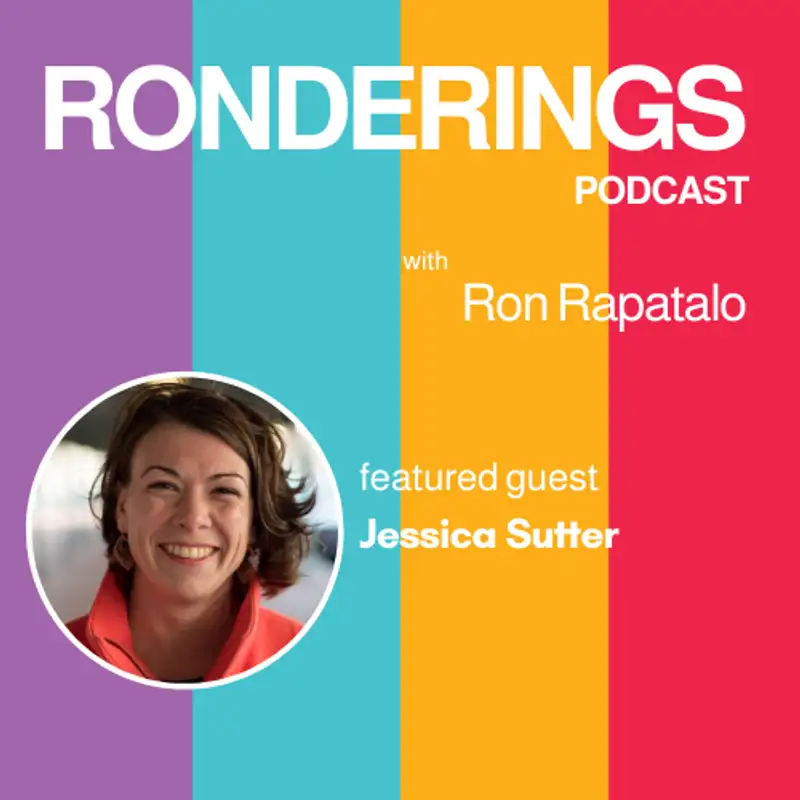
Speaker 1:Let's get into it. Welcome back to Ronderings. Today's guest is Jessica Slutter, educator, policy leader, endurance athlete, and principal at EdPro Consulting. Jessica's story moves like a trail run, full of climbs, switchbacks, and moments of stillness that remind us why we lead. We talk about how coaching and community build resilient leadership, authentic youth engagement means being for and with others, and how merger and acquisition into education nonprofit world can actually protect legacy and evolve impact.
Speaker 1:Socio shares a powerful vision to reconnect 16 to 22 year olds to civic life and sustainable careers through place based service. If you're rethinking how you lead, grow, give back, this one's for you. Let's get into it. Hey, friends. Before we get started, I wanna share something that's been a big part of my own journey.
Speaker 1:Two years ago, I published my book Leverage. That experience cracked something open for me. I saw how publishing isn't just about pages, about owning your story, sharpening your voice, and amplifying your impact. The part that meant the most, readers reached out to me to say they felt seen. That's when I knew this work mattered.
Speaker 1:I loved it so much I cofounded Leverage Publishing Group with friends who would make know this world inside and out. Now we help leaders, entrepreneurs, and change makers turn their ideas into books and podcasts that actually move people. Got a star in you, and I know you do. Let's chat. Find me on LinkedIn or at leveragepublishinggroup.com because the world doesn't just need more books.
Speaker 1:It needs your book. Alright. Let's get to today's episode. Peace. Ronderings fam.
Speaker 1:Welcome to another episode of Ronderings with my new friend, Jessica Sutter. So I had the privilege of getting to know Jessica because she does Sahara with previous Ronderings guest and one of my dear homies, Keenan Bishop. So, Jessica, how are doing today?
Speaker 2:I'm good, Ron. How are you?
Speaker 1:You know, with everything going on in the world, I'm I'm I'm hanging in there, but I'm really excited to just wind things down for the rest of the year. So I just
Speaker 2:I am with you on that. Yeah. I think this this this year deserves to come to a close, and better things must lie ahead.
Speaker 1:Yeah. I've been telling me I wanna drop kick 2025, but that seems cruel. But I that's the way it feels like. Maybe deserved. Maybe it's for Little bit.
Speaker 1:So, Jessica, let's get right into it. What's your story?
Speaker 2:I think I would tell my story as accidental educator takes wonderfully scenic route through a career that starts in a middle school classroom, wanders through policy roles in a PhD program, lands an elected board of education seat in the nation's capital, and has a decade of consulting in between, all the way along, picking up wonderful friends and colleagues, and a habit of endurance sports.
Speaker 1:Wow. That is quite the, like, narrative. So I'm really curious. Right? You said accidental educator.
Speaker 1:You're the first person I've ever had on Rondering's who's put the adjective accidental in front of educator. So I'm curious what you mean by that.
Speaker 2:Yeah. I always loved school, but I didn't think that I would do school as a job. I went to school to study biology in college. I wanted to be a marine biologist, maybe a large animal veterinarian. Turns out that I liked extracurricular activities, maybe a bit more than I liked studying, and so chemistry and organic chemistry and all of the technical aspects of my biology major were really hard for me.
Speaker 2:And I was on a scholarship. So the thought of dropping everything else I loved about college to just focus on my biology degree didn't feel great at 18 and 19, but my advisor
Speaker 1:Yes.
Speaker 2:Who reminded me that my scholarship required that I keep a particular set of grades, gently suggested that maybe I think about another major. So I had done well in humanities classes, and I picked up political science and thought maybe I'll do politics. But I went to Loyola College, a Jesuit school
Speaker 1:Okay.
Speaker 2:With a great liberal arts tradition, and father Brown, one of my, mentors and teachers on campus, said to me one day, have you ever thought about being a teacher? And I thought, a man of god says to you, maybe you should be a teacher. Maybe it's a sign from the universe. Maybe it warrants consideration. Yeah.
Speaker 2:And so I I did, and I applied to a post college service program, similar to Teach For America, but not TFA, and ended up as a teacher and had no idea how much I would love teaching students, being with students, working to help kids learn things they didn't know yet, and it formed the rest of my career.
Speaker 1:Why do you think he put teaching in front of you as the career to, like, look into that wasn't being in the hard sciences? That was it something you saw about you? Is it I mean, I'm curious.
Speaker 2:It's a great question. I you know, it's funny. I've never asked him, but I suspect that you know, one of the things that Loyola did really well for all of us who attended was, the concept of cura personalis, care of the whole person. And so while I was on campus, I had a job working in the Center for Values and Service, and it was to help professors pair up with service learning projects. So I was tutoring in middle schools and helping professors design service projects.
Speaker 2:So I just thought that was a thing I did on campus as like, you know, part of my college career. I never thought about it as something bigger. Yeah. But I think, you know, it's always wonderful when people see something in you that you don't necessarily recognize in yourself that maybe this wasn't just the thing I did in college, but maybe it was stepping stones to a bigger calling.
Speaker 1:Yeah. The service aspect I could see, you know, it's so funny when I was at NYU, so much of my time at NYU, yes, was hard sciences and math. And the thing I enjoyed the most at NYU as an undergrad was all the student leadership and activism that I did and the service. Right. And yet in the back of my mind, I was like, gets paid for that.
Speaker 1:Like, it's such a horrible thing, right? That we get conditioned to think like so many of us who end up in education particularly is like, you know, people say like, you don't do it for the money. It's true. Sure. Right?
Speaker 1:No. But like those seeds often start at some point. And I find for a lot of us, like college is a big part of that point of like really seeing service of some kind as a career rather than service is something you do to volunteer from your full time job. Right?
Speaker 2:That's right. That's right. And I think one thing I value a lot about the education I got was there were a set of folks on campus who were deeply dedicated to the idea of service in their career, whether it was, you know, in the sciences, going into medicine, going into public health, or like me in the humanities, ending up a social studies teacher, but I at least had a good cadre of people who, when I said, so I'm applying to be a teacher, the answer wasn't like, why? It was like, oh, that's cool. Yeah.
Speaker 2:Good job. Yeah. And post college service committing to even trying something out for a few years was also like something people did. So in some ways, I got to still be part of what lots of people were doing
Speaker 1:Yeah.
Speaker 2:While branching out in a way that felt different for me. It wasn't countercultural. It was part of the larger culture of at least the community I was part of at the time.
Speaker 1:Yeah. Well, it's a blessing you're able to do that before the decimation of so many of those programs federally right now. Right?
Speaker 2:If you think about 100%.
Speaker 1:You know? That I was
Speaker 2:an AmeriCorps member, so I watch it now, and it's horrifying because it was a huge part of how my career got started. It was a gift to helping me pay off some of the college loans. Yes. And it felt like you were part of a bigger mission. Like, I am one among my generation giving back to people in our communities.
Speaker 1:Yeah. One of my favorite authors, and personal development people of all time, Daniel Pink, talks about the three things that people need from the book Drive autonomy, mastery. And the third thing that you talk, the purpose. Purpose. Purpose is a big driver.
Speaker 2:Yeah. Usually.
Speaker 1:Well, Jessica, you talked about something in your intro, in your story, right? About trail running and, you know, as a metaphor for your career, because unlike, you know, regular running, right, which is very linear, trail running is not that there's a lot of like, you know, it's not a straight line by any shape of the imagination, and there's like lots of elevation. And I want you to use that metaphor, which sounds like it's near and dear to your heart, like trail running today and running generally and how that aligns with your career journey from education to Ed policy to what you're doing now.
Speaker 2:Yeah. No, that's a great question, and I'm happy to take a stab at it. So I want to tell you how I ended up doing it in the first place. So I was not a sportsy kid growing up.
Speaker 1:Okay.
Speaker 2:I I did summer swim team, but I was not a sportsy kid. I was musical theater and choir and newspaper and not so sportsy.
Speaker 1:Okay.
Speaker 2:So when I was, working in education in DC, a colleague said to me, hey, you swim? That's interesting. My triathlon club is looking for new members. Would you come join? So I was looking for something new at that point in my life, and I said, Sure, I'll come out for the info session.
Speaker 2:Okay. And I signed up for the new triathlete program at the YMCA, and I found a lot through the process. I learned a lot through training for multi sport and then gradually longer and longer distance races. And ultimately led me to trail running, which is like another, like, kinda countercultural thing. It's not something everybody does.
Speaker 1:Yeah.
Speaker 2:But it it's one of those things that fit the mold of like, well, I I did that thing. I tried it. It went okay. Let me try the next thing. Oh, I did that.
Speaker 2:I tried it. It went okay. So one thing I think is I need structure in my work to function, but when I don't find structure, I'm pretty good at creating it to give myself discipline. And so I think trails are good like that. Right?
Speaker 2:Like Yeah. I like to follow a trail, but it's okay if it's around the bend and up the mountain and down the side, but it gives me a a a path forward. Yes. So I think about that, like, when I stepped away from a classroom where structure was built in, and I was beginning time as an independent consultant, I needed to create structure for myself, but I was really good at following that structure once I put it in place. So I think that's one thing I get from trail running, endurance sports generally.
Speaker 2:I think the second thing is I'm not the fastest. I'm never gonna win a race, even in my age group, but on the trails, it doesn't matter so much, but persistence and adaptability matter a lot. Yeah, So I can see finishing the race and enjoying the view and the trip, but also what happens when you encounter roots? What happens if there's mud and you're headed down a hill? What happens if there are leaves on the path and it's pretty slippery?
Speaker 2:So in policy in particular, I mean, these are good skills in a middle school classroom too.
Speaker 3:Yes.
Speaker 2:They're really good skills in policy because oftentimes your first go at a policy doesn't get it right.
Speaker 1:Yeah.
Speaker 2:But persistence, adaptability, what's the next venue I'll try? What's the next opportunity to get it? So I think that's helpful. And then the last thing is I realized in both doing triathlon and in trail running, that I find joy in things that others find strange, and that's a strength. And I tell myself that because Ron, I've done a bunch of triathlons, but I've done two Ironman distance triathlons, where suffering is sort of part of the game.
Speaker 1:And I've seen the stories. I remember watching Wild World of Sports as a kid. I'm like, Did defecation just happen during this triathlon clip?
Speaker 2:I'm like, oh
Speaker 1:my god. This is real. Wow.
Speaker 2:Yeah. People people And keep moving. Yeah. People suffer. People suffer.
Speaker 2:But the goal is to finish, and I'm proud to say I finished both of the ones I set out to do. Uh-huh. But I like, like, I like hills in running. I find it a joy to say, gosh, that's a really big hill, and then I get up to the top of it. So I love teaching middle school, and lots of people don't like adolescence.
Speaker 2:And I love helping organizations in crisis or dealing with really thorny problems, and that's not everybody's jam. And I really like complex policies, like how do we fix this big audacious issue? Like, I don't know, let's tackle it bit by bit. That sort of joy in the productive struggle of like, let's tackle something really big and find a path forward, is just something I really enjoy. So my next goal, really big trail running goal, is a 50 miler.
Speaker 2:I know. I know. I have a big milestone birthday.
Speaker 1:You big boogans must hang out then.
Speaker 2:I would like to do that.
Speaker 1:Because I've seen his feet on Instagram after some mega run. I was like, oh my god. And, like, very similar. It's like suffering and the pain is a big part of, like, you learn from it. And I was like You do.
Speaker 2:You do. I have a milestone birthday coming up, and I'm like, well, I did an Ironman for my fortieth. What am I gonna do for my fiftieth? And so it seems only fitting to run 50 miles. So if any of your listeners have a really good 50 mile race for me, I'm still trying to nail down which race.
Speaker 2:But in 2027, I'll be tackling that. So next year is a building year.
Speaker 1:That is incredible. Alright. Let me keep it real. A lot of us have write a book sitting in our goals list, maybe for years. I sure did.
Speaker 1:Good news is there's more than one way to get it done. If you've got more money than time, a ghostwriter can help bring your story to life. If you got more time than money, a great book coach can guide you through the process step by step. If you've already written a thing, you'll want someone to shepherd you through publishing so you don't waste time or cash. Here's the thing though, no matter how you do it, the real win is writing the right book.
Speaker 1:The one that builds your credibility, grows your business, and actually makes a difference. That's what the team at Books That Matter is all about. Head to booksthatmatter.org and get some feedback in your ID or manuscript. Don't sit on it any longer, your book could be exactly what the world needs. All right Jessica, well I was so excited to hear about Father Brown asking you that question that shifted you into getting out of marine biology with organic chemistry being something on your road running slash trail running journey using that as a career analogy that got you to start teaching.
Speaker 1:So I want you to tie together two things, three things that you love. Right? Sounds like your career and education and your career generally. Also talking about how you've been running from road running to trail running. And so weave
Speaker 3:that together for me because I'm really curious to hear how this all kind of like organically came together. Oh, that's a great question. So I didn't start running actually until some of my students. By this point, was teaching at KIPP in DC. So I taught at KIPP KIPPLA prep in Los Angeles, came to KIPP DC Key Academy, and some of my eighth grade girls were doing girls on the run.
Speaker 3:And they asked if I Oh, okay. They asked if I would run with them. And I did. And it was maybe the first five ks I'd ever run. And then my dad at the time was interested in doing more running.
Speaker 3:He and my mom had done a marathon as like a life goal. They did it. My mother was like, great. I'm done. My dad got the bug and wanted to do it again.
Speaker 3:So then I ran a half marathon with him. And one of the things I began to realize is that when I was running and training, it brought an element of discipline to my life that spread into other aspects of my life. So like, it was easier to grade papers. It was easier to get projects done. It was easier to think through all these things when I had the discipline of training.
Speaker 3:So even after I left the classroom, I had, you know, a bunch of life happen, and I thought, all right, I need something to ground me again. And I signed up, thanks to another colleague in education, for a triathlon newbie program. Never done a triathlon before? Wanna try one? Come join us at the YMCA, and we'll train you to do it.
Speaker 3:So the website kinda hooked me. Their website is why try, why not? Why not? I
Speaker 2:was like, that's so clever. I
Speaker 1:love it. Yeah.
Speaker 2:And I did it, and
Speaker 3:I met wonderful people with whom I didn't talk about work. So I joined this club and learned how to do triathlon and got hooked in that too, but I didn't talk about my work day with these people. I talked about what we were eating, how swim practice was, what music we were listening to, and it actually made it easier to dig in on my own work because it wasn't all consuming. So many of my wonderful friends had come through education. But having this new thing, having this discipline of training, and having people with whom I didn't talk about work freed up places in my brain.
Speaker 3:And I took on bigger and bigger challenges both in athletics and in work, because they fed off one another. So in 2018, I trained for an Ironman. I finished writing a dissertation, and I ran for office on the school board all at once. I do not recommend this to people, but it was only possible because
Speaker 1:And I thought organic chemistry was harder, Jessica. Oh my
Speaker 2:It was.
Speaker 3:But by this point, I was a little more seasoned. I had a little more Yeah. Yeah. Resilience as a human. Yeah.
Speaker 3:But I found that the only reason I was able to do it was the discipline of the of the athletic training because I had that practice.
Speaker 1:I wanna tie into that. Right? Because when you, chatted before we recorded and got to today, we you talked about your trail running endurance sports, and I talked about my discipline of powerlifting. Yeah. And I have written about it, felt about it for the last four years that I've been really into it is that the discipline and the community and the coaching has helped me be a substantially better leader.
Speaker 1:Part of that is having another outlet. When you when you said that you had something you didn't have to talk shop about work, none of the people I I paralleled with are in the K twelve ed field. Right? Yeah. And so they don't know what I I mean, they sort of know what I do because they follow me.
Speaker 1:Right. But they don't really talk shop about, Rob, what do you really do outside of work? Right. It's like eating technique, all these things. Right.
Speaker 1:And I have found that having that extra space outside of leadership, outside of this space gives me a level of levity and harmony that I find, frankly, most k twelve ed leaders don't have. So I wanna get your reaction to that.
Speaker 3:No. I think that resonates for me a 100%. I think your piece too about the the community it builds for you outside of the workspace. You know, one of the things that's on my mind a lot lately in this moment in our world is the need for more community. And I think having a big, rich, resilient community means it can't all be grounded in just one place.
Speaker 3:Having places with whom you have relationships in work, at home, in family, and in something else, some third space, is how we build resilience as leaders. So it resonates for me a lot. I also think your piece about coaching is really interesting. So I had a running coach, a swimming coach, and a cycling coach. I even got a nutrition coach before I ever had a professional coach.
Speaker 3:It was finally when that clicked for me that was like, you know, having a swim coach really helped my stroke efficiency. Having a nutrition coach helped me prepare for, you know, if you're training for 140 mile race, you have to feed throughout the race. And
Speaker 1:feed yourself to be prepared to even run something like that. There's a You do.
Speaker 2:You do. Yeah.
Speaker 3:Because, you know and recognizing that these places where I felt no shame about reaching out for help to learn things I didn't know yet, eventually, it took a while for it to connect for me in the professional space. But like, well, of course, of course, it makes sense to seek out a professional coach because just like I need help with things I don't have expertise in, in nutrition, in swimming and cycling, I need that help as a professional as well to say, I'm really dealing with something tough right now. How do I get that for myself? How do you help me think through techniques and tactics? Because, again, it's it's another relationship too.
Speaker 1:Yeah. Yeah. That all really because you realize that you can't do these kinds of difficult endeavors alone, whether it's leading at the highest levels, doing something like a triathlon. Right? And I would argue that that's probably more of a baseline to have that kind of professional support and community because without it, right, something I've read over and over again from, like, I was pre med in college, took organic chemistry, all that stuff, and didn't nothing professionally with it per se.
Speaker 1:Right? But one of the things that really, like, sat with me from what I learned in neuroscience and reading many articles later is that, you know, our will is overrated. Yeah. Right? This idea that you're just gonna, like, grit it through in yourself.
Speaker 1:You need those other pieces, the community, the coaching, a plan that you follow, right? All of those things matter. Right? Because I think, you know, people say like, just I'm David Goggins and I did it like, no, David Goggins has a lot of support. I watch this.
Speaker 1:I don't always agree with the stay hard. I just don't. It's not mine. Yeah. But like, I understand it.
Speaker 1:Sure. Right. You know, it's like, oh, yeah, I just ran this 204, 240 mile what? Like, oh, God, my feet. And then he showed a picture of his feet.
Speaker 1:Was like,
Speaker 3:yeah, they're not pretty. They're not pretty.
Speaker 1:No. But it's like leadership, right? You know what I'm saying? Like, when you reach these I want to get into something that you talked about in your career journey, which was school board service. Right?
Speaker 1:And so I want to tie together something you and I talked about offline, which is school board service and this Jesuit concept of being a person for and with others. Tie that together for me.
Speaker 3:Oh, yeah. I like that. I like that that effort to tie it together. So
Speaker 1:I try I'm trying. That's what I can do.
Speaker 3:I it's a good provocation, Rod. It's a really good provocation. So I I ran for the board of education because I was asked to. Someone in DC reached out to me and said, you know, this seat is up for election, and there is an incumbent, and we're looking for someone to challenge the incumbent. And, you know, I wonder if you would.
Speaker 3:And my first response was, who'd you ask before me? Because I can't imagine I was your first choice for this. And after a really good conversation about the fact that I wasn't the first choice, and the other people who had considered it and said no, had done so for really good, important reasons that I think are challenges people face when they consider public service. So, one person had just gone back to the workplace after raising a family. Another person was starting a family and having a hard time imagining juggling these things.
Speaker 3:I don't have children of my own, so I was not in that position at that time. But I was also in an interesting place to run for this office at this time in D. C. Because one of the things that the State Board of Education in DC does is it's in charge of academic standards, so reading standards, math standards, graduation standards. And I was a social studies teacher.
Speaker 3:The DC social studies standards at the time I ran for office were twelve years old. In most states, they review standards five years, seven years, ten years at the max end. Ours were 12, and there was no plan in place to review them. And the reason why was because DC didn't have a process for standards review. The state board was relatively new.
Speaker 3:It was only formed in 2007. That's a longer story of DC education history. But so at this point, it was just about eleven years old, and they'd never built a process for how often we should do this. It wasn't in state law. So the opportunity presented itself to run for office and get to do something near and dear to my heart, social studies and social studies standards, but also something that I built professional skill at, which was systems process creation and implementation.
Speaker 3:Right? Yes. Thing I I didn't know I loved until I did it. And I was like, oh, I like to build a system. I like to build a process.
Speaker 3:But the other thing that was true is because I don't have my own children, other people's children have always been dear to me. Whether they were my students or my adopted nieces and nephews or my actual nieces and nephews, other people's children have always been of my concern and my care. And one of the things that comes through the Jesuit notion of for and with others is that we don't make decisions for communities without asking communities what they want. So when I was running for office and I said to people, people would say things like, oh, you you're the one who does the charter school thing. And I'd say, well, that that's true.
Speaker 3:I do the charter school thing, but tell me why you think that. You know, I read a little bit about that. I said, tell me about where you sent your children to school. And people would open up with fascinating stories of why they made choices about what was important to them in education. When you start to hear what is important to people, you are not making decisions on their behalf.
Speaker 3:You are making decisions in consultation and with them.
Speaker 1:Bingo.
Speaker 3:And for me, one of the groups we leave out often in education is young people themselves. We do a lot of things to young people, but we don't often ask them, what's on your mind? What do you think you need? What's feeling lacking in your experience right now? How do we welcome you into becoming part of the process creation?
Speaker 3:So for me running for office, one, I like people. It was fun to run and meet neighbors and knock on doors and march in the fourth of July parade and get to do all things that were fun as a classic. But it also meant that I got to listen to a lot of people tell me what was important to them. And I got to bring things that were of value to me, and we got to do them together. So this Jesuit concept of being a woman or a man for and with others is not about I do to community, but I do for community with community.
Speaker 3:And I loved doing that as the Ward 6 member of the State Board of Ed. My colleagues were kind enough in my last year to elect me to be president of the State Board. And that got to be a very different experience of doing for and with. Because now we had eight colleagues to navigate plus four student representatives who were part of our board. It was fascinating, but it was a good challenge.
Speaker 3:It was a good challenge to figure out what do we do to build for and with the people of DC.
Speaker 1:Yeah. I love that you brought up this Jesuit concept because to tie together again, hopefully, I'm bringing a really good provocation here. You cannot do authentic engagement without being a person for and with others. Right? And so tying this together to youth, I'm wondering how you tie together what you've learned about authentic youth engagement from being in the classroom to being a DC school board member, to then be the president of the board, right?
Speaker 1:Which are kind of three different things, right? So wax poetic for us about authentic youth engagement in those three different endeavors.
Speaker 3:Yeah. So I think there's one thing that is just critical in all of it, and that is like, you have to actually like young people.
Speaker 1:Right. Isn't isn't that it sounds so that's a right? Because there's some adults who work in schools who do not and don't wanna admit it. Right?
Speaker 3:It's true. But you don't like them. And by that, like, I think Yeah. You know, you have to you have to find them endearing or charming or amusing or confounding, but you've got to, like, have a desire for connection because kids can smell in authenticity a mile away. Right?
Speaker 3:They know when you're when you're not being real with them.
Speaker 1:There's such bloodhounds there. Yeah.
Speaker 3:Yeah. I don't think we should be in a, you know, overly familiar with students per se.
Speaker 2:But I
Speaker 3:think you've gotta say, like, if I'm not willing to be vulnerable as a human with young people, it's going be hard for them to be vulnerable with me. And in authenticity, you've got to have vulnerability. So I think one thing I learned is you have to like young people and find a way to get that through to them to communicate like, I'm genuinely interested in what you want to say. I think another thing that comes into that is you've got to understand what the challenges young people are facing are and come to them in a spirit of, I'm not your age, so I can't express your lived experience.
Speaker 1:No.
Speaker 3:I'm spotting something here that seems to be a challenge for you. Help me understand what it's like to be on the inside of it and what you wish the adults around you would understand, would get, would really be able to help you solve for to move forward from this place. So a recent role I had, I got to work with young people on civic issues.
Speaker 1:Okay.
Speaker 3:One of the things that was fascinating to me, especially in this moment of political polarization, is that young people are like, I'm not really interested in either party. I'm really interested in climate change. I'm worried about my economic future. I'm concerned about the national debt, and I just think war is bad for people. Is there a party that cares about all those things?
Speaker 3:Because I'd sign up for that party. And you listen to a teenager verbalize this and you're like, you
Speaker 2:kind
Speaker 1:of got
Speaker 3:a point there. These are like deeply caring questions that young people ask. And so being able to enter authentically, being able to listen and hear what their view is, and then also being able to offer the wisdom of perspective that comes with lots of years in careers, lots of years living on this planet without treating it as a patronizing effort. So I hear what you're saying. And here's how I would approach that.
Speaker 3:Does that resonate? Does that not resonate?
Speaker 1:Yeah. Do
Speaker 3:you handle it? So I think coming from the classroom, I learned about needing to really like and be able to authentically connect with young people. From my time on the board of Ed, I also learned that young people often think through things in ways that the adults around them are swimming in the same water they're swimming in, cannot see in the same way. So we had at the time on the board when I was president, we had four student representatives.
Speaker 1:Yeah.
Speaker 3:They were not able to vote in a way that affected the outcome of resolutions. So the law did not allow them to be fully voting members of the board. They're not fully enfranchised because they were not elected by the public. They were appointed by board members. But they could voice vote.
Speaker 3:So we always knew how young people felt about the resolutions. It just didn't count in the total.
Speaker 1:Yeah.
Speaker 3:So things our board did during my time on the board were like, well, we should ask the Student Advisory Council to take a look at resolutions before we bring them for a vote, and write a statement either of support or of critique, so that we have some sense of how young people feel. The other thing young people said to us is like, there's nothing in the bylaws that says we can't vote in committees, but we're not on committees. Why aren't we on committees? And my actual response was, I don't know. Do you want to be on committees?
Speaker 3:And the the most tenured student member at the time said, yeah, we want to be on committees. So we worked around how to get students on committees
Speaker 1:Yeah.
Speaker 3:Because they could vote in committee, and nothing got to the full board until it came through committee. When I tell you, nine people on the board, nine adults, we're smart, we're thoughtful, we're considering policy. We never occurred to us to consider whether students could be on committees. Now shame on us, but also we weren't sitting in the seat where the students were. So we couldn't see what they saw.
Speaker 1:Of course. Because you're the adults, you you have a vote. Right? And so when you have that right to be able to get out of it and think through when you don't have the right to vote in that way, where can you work around it? Right?
Speaker 3:That's right. That's right. And so being open to like, Hey, I never thought about that, but how do we not see it and be like, well, that's no, obviously, it's not possible, because it's never been done. Like, no, it looks like it could be done. Let's do it.
Speaker 3:And I think that's a big thing with young people too, when they realize that you've actually listened to them. Yeah. It's remarkable. It doesn't happen enough.
Speaker 1:Quick pause in the action here. I know a lot of us leaders, entrepreneurs, folks just trying to do good work, have felt that grind of pushing a boulder uphill by ourselves. The learning is you don't actually have to do it all alone. Genius discovery program at thought leader path like having a think tank in your corner. It's not some cookie cutter formula but your story, your plan of impact, giving you the clarity and assets to take the next big step.
Speaker 1:I've seen people go through this and walk out with their voices amplified, ideas sharpened, some even launching podcasts like this one bronzer is. So if you're tired of grinding in the dark, you're ready to step into your impact with right support, check out geniusdiscovery.org. No, it doesn't. And that's the kind of like feeling that those of us that work in a case whole vet space, it makes you feel warm and fuzzy, right? Because this is why people get into the work, I think.
Speaker 1:Yeah. Right? Because, you know, there's all this talk of, you know, we're building the next generation of leaders and citizens, and isn't a hallmark of that to showcase the values that we're living and be able to say, hey. Here are the values of what active listening looks like and active democracy and all these things. Right?
Speaker 1:Always easier said than done because they guess all this stuff. This makes me think of, like, all the shows in HBO Max and Showtime, all the spy shows and politics Netflix. I'm just like, well, here's the harsh reality, Ron Rapital. I'm like, oh my god. I know.
Speaker 1:I'm just like, but, you know, war, there's all the peoples, the dark money. Was like, oh my god, please. Oh god. I don't believe the world anymore. Stop.
Speaker 1:What engagement. Oh goodness. Like, okay, no. But there can be, even with that stuff being truths too. Right?
Speaker 1:Multiple truths exist at the same time.
Speaker 3:It's true. And I think the other thing on this, and this goes for a lot of things we've talked about so far. Sometimes it's so tempting to think of the big things like, how are we going to fix it all? And much of what actually gets fixed is smaller. It's more local.
Speaker 3:Might be more local inside a school, inside a classroom. Might be local inside the district or inside the town. But those small changes, they do matter. They matter to the lived experience of young people and to the adults who work with them. And I think they go a long way towards, you know, the question Father Brown asked me, like, have you ever thought about?
Speaker 3:Like, my goodness, you changed my entire career trajectory with a question, what could we do if we thought about how to engage young people in authentic ways that ask those kinds of questions more often?
Speaker 1:So Jessica, tell me a little bit about what you're up to today.
Speaker 3:So I am up to a few things. I returned to consulting. I spent a couple years. Towards the end of my time on the state board, I was really curious about this youth engagement work. So I spent some time away from consulting, working in nonprofits, deeply engaged with young people and figuring out how to make that work.
Speaker 3:I recently returned to consulting for a couple reasons. One, I wrote my dissertation on mergers and acquisitions in the charter school sector. Back in 2017, when I was doing the research, DC had had a few closures of charter schools that resulted in reopening under a new operator, essentially an acquisition.
Speaker 1:Yep.
Speaker 3:And I talked to a few people about my research. I presented at a couple of conferences. But 2017, 2018, these were economic boom times. Everything was growing. Nobody cared Turns that out, things are changing now.
Speaker 3:And so there are more people having conversations around what does mergers and acquisitions look like in the education nonprofit space. And one thing I'm passionate about is helping people reframe things in ways that they may not have considered, but which are also true.
Speaker 1:Right.
Speaker 3:So one of those things is in the corporate space, if someone sells their company to a larger company, no one thinks of that as a failure. That's a success. That's a reason for celebration. That's a win. I hear a lot of nonprofit folks and folks adjacent to the nonprofit space are like, well, you know, if organizations are really meant to fail, then they should just close.
Speaker 3:Like, who said failure? I said merger or acquisition. It's not necessarily only going to happen in a moment of distress or a moment of failure. It might, but it might not. And so how do we think about what it is to consider how nonprofits face this moment?
Speaker 3:Changing funding structures, changing political structures, changing conditions for public schools. How do we ask what is possible? Who might join forces to see the work grow even if organizational forms change? How might people think about leadership succession differently if they were considering ways to team up and partner and merge as opposed to simply handing off their leadership to another leader in the same space. So that's one reason I came back to consulting is I think there's a moment that people are talking about this work.
Speaker 3:I have some knowledge and expertise on it from my research and having worked with those schools through those processes. So I'm super interested to see how I can be of help to folks in that area.
Speaker 1:I think that's going to give you a lot of consulting work for the next five years. No. It's just I hope so. Interesting anecdote. When I was at South by Southwest edu in March, I ran into a buddy that I know in New York City nonprofit space.
Speaker 1:We caught up. And then he then approached me, like, at the end of the convo and said, if you know of any or who does blah blah blah blah blah, we're looking to acquire. I'm like, I've been around the edge of space. I don't hear you. Right?
Speaker 1:You, the usual story, we failed and we gotta get picked up and someone's acquiring us. Right. Which is, that's one kind of like acquisition, In the corporate world, there's many kinds like, you know, I usually hear the positive spin. Like if you're building your own business, I have a buddy that went through this recently, right? He's like, he sold this nice management consulting firm.
Speaker 1:He's now retired in his forties. That was the payoff. And that's common in the corporate space, right? When you do it right. But it's not common in our nonprofit k twelve ed charter space.
Speaker 1:Right? And so I I'm really curious how this is gonna all unfold because I've been an active member of Edlock. That is a big topic of conversation. Yeah. Other charters that I've taught charter leaders who have larger charters have said, we're looking with they've started to do looking into acquiring.
Speaker 1:Right? It is it is something that I'm sure you probably just not only see DC, but other spaces. Right? This is something with everything going on in our economy and federally, it has to be something that happens to keep our space afloat. It cannot.
Speaker 1:It is. And so the reframing of I'm curious how that starts to happen, not only with your leadership and many others. It's something I want to talk to you offline because it's already my Edlock. Yeah. Some connections I have.
Speaker 1:There are some stuff there I suspect. You may know some of these people, but I'm like, I want to make sure you're able to provide expertise because it's something that's like, boy, if we don't solve for this, this is gonna Yeah. Gonna be a lot of IP.
Speaker 3:Gone. Well, that's right. And and I think that's that's a key piece of this is how do you help people protect their legacy? Yeah. Yeah.
Speaker 3:And how do you help protect the work that is happening and also acknowledge that in the changing times we're living in, there's going to be a need for new kinds of work we may not have even come up with yet. And if everyone just keeps their head down doing the same thing on the same path, we're not going to free up any space, intellectual space, organizational space, space in the field. So we've got to be thinking through how do we build resilient sectors in the ed space for this work. So that's one thing I'm working on, and I'm really excited about it. And it's taking up a lot of my brain space.
Speaker 1:But Yes.
Speaker 3:While I run on the trails and wander through the
Speaker 1:woods Yes.
Speaker 3:The other thing very much on my mind goes back to the young people. And Keenan and I had a good chat about this actually when we were up at Bahara. A couple of my colleagues at Bahara sort of nudged me on this as I was talking about my leadership journey. So one thing I know to be true for kids in DC, and I suspect to be true elsewhere in the country, is that we had a real resurgence of this idea of college for all. Everyone's got to go to college.
Speaker 3:And now we're seeing lots of different thinking, different talking heads in the space around, well, what if it's not all college? What if we're also thinking more about trades and we're thinking about other things? The young people who are often finding their own footing between, let's say, 16 to 20, 22, are not thinking in these categorical boxes that the scholars and policy wonks are thinking of. They're thinking, I got to figure out what I'm going do with my life. I got to figure out how I'm going to build a family sustaining wage.
Speaker 3:Like, how am I gonna make it out there in the world? And what am I good at? What might I wanna do? The young people I've met who are most disconnected from school and work, maybe they're enrolled in school, but they're not thriving, are often also disconnected from their civic community. They're also not feeling that like what's happening in the life of their city, what's happening in the life of the community is for them.
Speaker 3:I did AmeriCorps as part of that post college service program.
Speaker 2:Okay. And I
Speaker 3:know AmeriCorps, know, is having its own struggles in this federal moment. But I think the notion of how do we give young people an opportunity to connect with community and serve, be deeply invested in civic life, and also open their eyes to things they may not have thought about doing. All right, so you're not sure if you're to cut a college or you're going to do some sort of a job with a credential. What if there are a way to combine these things together?
Speaker 1:Yeah.
Speaker 3:Help young people who are currently feeling disconnected, get connected, get compensated for that while they explore these opportunities.
Speaker 1:Yes.
Speaker 3:So I don't know what that's gonna look like yet, but this is the idea that I cannot shake from my mind, which is there must be a way to deeply connect with young people that says, I'm not asking you to tell me today, are you doing this? Are you doing that? I'm saying, here's an invitation. Come connect to your community. Let's offer you some compensation to do some community based projects and deeply connect with your own civic community.
Speaker 3:And let's help you figure out what might be next.
Speaker 1:Yeah.
Speaker 3:What does the local economy need from you? What would it take to get there? How do we pair those things together for young people?
Speaker 1:Yeah. You're probably familiar with the place based partnership world. I can let this go another two hours if we want because we like in my full time professional job at Shoreham Consulting, we started to have place based partnership clients through our friends to strive together and the catalyst exchange, being the kind of go between between the place based partnerships of many firms like ours. But that sounds like a perfect opportunity because I think what we all are finding in this political moment, it's really what's happening not only the state, but the hyper local level. Yep.
Speaker 1:That is gonna truly allow us to not only protect our communities, but allow for some level of thriving to happen. Right? That's where the moment has to happen. Right? It just I don't have any confidence in the world that this is gonna happen to like federal infrastructure whatsoever.
Speaker 1:Right? I thought you'd be clear. No. I'm just saying.
Speaker 3:No. No. And I think it's where the creativity happens. Right? Because Of course.
Speaker 3:You know your own community better than anybody who's looking at it from the outside. So I'm super curious what might happen if we also I love the the reminder of of the concept of the place based partnerships because I'm super curious what happens if we get young people invested in those conversations as authentic participants. So it's not just like, what do we think is right for you? But like, well, what are you thinking about? What's on your mind?
Speaker 3:What have you wondered or wished could be true for your community? And how do we help you get there?
Speaker 1:Yeah. Well, Jessica, before I ask you the roundering question, I wanted to bring us back to the reason why Keenan connected you to me and tying together the last thing that I have here in my notes that I wanted to bring up in conversation. So when I asked Keenan for multi hyphenated leaders, check on what you said at the beginning of your story, but also because it's a Rondering's live I did with him, leaders who practice sacred syncretism, the alignment between the person professional and the spiritual. That's a loose definition. Right?
Speaker 1:There I think there's a better Christian definition that I'm actually talking to my friend Hector Calderon about it because Keenan quoted him. He was like, Hector, who you know, it's the world ahead is small. I
Speaker 3:love it.
Speaker 1:So I'm curious, Jessica, how do you practice your sacred syncretism today with everything that you just talked about and things I didn't ask you? I know. The philosophical questions. Yes. I know.
Speaker 2:Yeah. No, it's a great question.
Speaker 3:But I recently wrote something about alignment because I was thinking a bit about the mergers and acquisitions piece and about how people talk about mission alignment, right?
Speaker 1:Okay.
Speaker 3:And I think that sometimes when we think about mission alignment, we think, okay, this is an org that does K-twelve, you know, focus on middle schoolers. This one too, okay, that's mission alignment. I think mission alignment is much more expansive than that.
Speaker 1:Yeah.
Speaker 3:So when I think about my own efforts at internal alignment, I think, alright, well, how does M and A go with youth engagement, with trail running, go with and I think for me, it's being a woman for and with others requires that you care for yourself in a way that lets you show up in your best, most prepared way. For me, and I I think this like, I can't overstate this. I have to be physically active. I joked around with parents who were like, well, do you support more recess in schools? Like, of course I do.
Speaker 3:If I don't get my own wiggles out every day, I'm never gonna be able to.
Speaker 1:Oh my gosh, yeah. And the kind of type a personalities you and I are, I have the wiggles, like, right now recording this podcast. Right. I'm like, I'm sitting still. How do I
Speaker 3:do this? Like, oh god. Support everybody getting their wiggles out. So for me, the the physical activity, the athleticism is the way that I show up best as a person. The spiritual, this notion of I wanna be with others, I wanna be for others.
Speaker 3:Well, how am I going to be of service? What's the next best thing I can do in my work to show up in this moment for what is needed in the space with the gifts that I bring? And so for me, I think the practice of the sacred syncretism is really about seeking alignment, realizing when I'm out of alignment. Yeah. And then trying to come back to it in ways that keep me healthy and whole.
Speaker 3:I should also say, and I'd be remiss if I didn't say this, I'm I'm still a newlywed. I was married in May. Congratulations. Yay. Yay.
Speaker 3:Beautiful. A lot of this is also about showing up in a way that lets me be here for building this new family I'm part of
Speaker 1:Yeah. I love it.
Speaker 3:While also building this work that I do and not putting them as opposing forces, but seeing them as things that have to grow together for there to be success. So all of that to me is about alignment. How do I try to stay in alignment? How do I recognize when I'm out of it? And how do I use healthy ways to bring myself back into it when I need to?
Speaker 1:Thank you, Jessica. Well, that's the appropriate segue into your rendering. What's the lesson or value you'd like to share today?
Speaker 3:So I think for me, the rendering is that when I was thinking about coming back to my consulting work, a friend said to me, you really just need a job that's going to pay you to let you be you. And I sort of giggled and I was like, but isn't that what we all want?
Speaker 1:I have that. No one wants me as me except wait. I have to build it? Hold on a second. What does that mean?
Speaker 3:I realized though that there's like a nugget of wisdom in that, which is that I think we all want work that lets us show up as us, but that it's really at the root of what are your unique gifts and talents that you bring to the world? And how do you think of that as your work, even if it's not the thing that's paying you at the moment? So how do you acknowledge that there may be work that is paying you, and there may be work that is your unique gifts and talents that you bring to the world? And your work is not just one of those. Your work is about the gifts that you bring to the world.
Speaker 3:So that's been on my mind a lot lately is that if my work is just being me, well, obviously, but how do I think about my work expansively enough that it's not just the things I do for billable hours, but also the things that I put out into the world, my volunteerism, my community? How do I see that as the work? And how do I make sure that work is really aligned with me? So that's the thing thinking about. I hope to talk with as many other leaders as I can about is how do you think about the work so that it includes all that you bring to it and not just that which is paid?
Speaker 1:Absolutely. Which is why you're on this podcast, Jessica, because you are seeking that and working on it. That's a that's a minimum criteria to be a podcast guest on
Speaker 3:renderings. That's the minimum criteria. Yeah.
Speaker 1:How do people find you? What would you like to promote before we end?
Speaker 3:Yeah, I appreciate that. So I am at edproconsultingllc.com. And that's where you can find me if you want to talk about any of the consulting work I do, Mergers and acquisitions in nonprofit spaces for sure, authentic youth engagement work, strategic planning and research, happy to do any of those things with people and eager to hear from folks who might need that. And then if there are folks also thinking about this civic connectedness, education attainment career training for young people, I would love to connect with folks who are thinking about that. So if there are listeners who see that as their work, I would love to be in touch with folks as I build my own thinking about how to make that true for kids here in DC.
Speaker 1:Awesome. Jessica, in the words of one of my biggest athletic heroes, Dion Sanders, we always come in hot with incredible guests like you, Jessica. So thank you for being on Ronda Rings and peace y'all. Thank you, Ron. That was Jessica Sutter, trail runner, systems builder and champion for authentic youth engagement.
Speaker 1:What I'm taking away, discipline and coaching don't just build athletes, they build leaders. Student voice belongs inside the process, not around it. And in our sector, M and A can be a bold strategic move to protect legacy and expand impact. Jessica's idea of work that pays you to let you be you hits hard. It's reminders to learn how we live, lead, and serve.
Speaker 1:Connect with Jessica at edproconsulting.com, especially if you're exploring strategic conversations, youth engagement, or place based pathways for young adults. As always, the words of Dion Sanders, our guests come in high. Share this one with a leader who's ready for a more human centered way to build impact. Peace y'all. Before we wrap, I've gotta give a huge shout out to the crew that helps make Ronderings come alive every week, podcasts that matter.
Speaker 1:Their mission, simple but powerful. Every great idea deserves a voice. So if you've been sitting on that spark of a show or story, don't overthink it. Just start. Head to podcastmatter.com, and let their team bring your vision to life.
Speaker 1:Till next time. Keep pondering. Keep growing. Keep sharing your voice with the world. Peace.
Speaker 1:Thank you for listening to today's Ronathering. I enjoyed hanging out with me and my guests, and I hope you leave with something worth chewing on. If it made you smile, think, or even roll your eyes in a good way, pass it along to someone else. I'm Ron Rapitalo, and until next time, keep promdering, keep laughing, and keep becoming.
Listen to Ronderings using one of many popular podcasting apps or directories.