 Episode 81
· 51:13
What's up? I'm Ron Rapatalo, and this is the Ronderings Podcast. Around here, I sit down with guests for real, unpolished conversations about the lessons and values that shaped them. And I'll be right there with you, sharing my own take, laughing at myself when I need to, and wondering out loud about this messy thing called life. Glad you pulled up a chair.
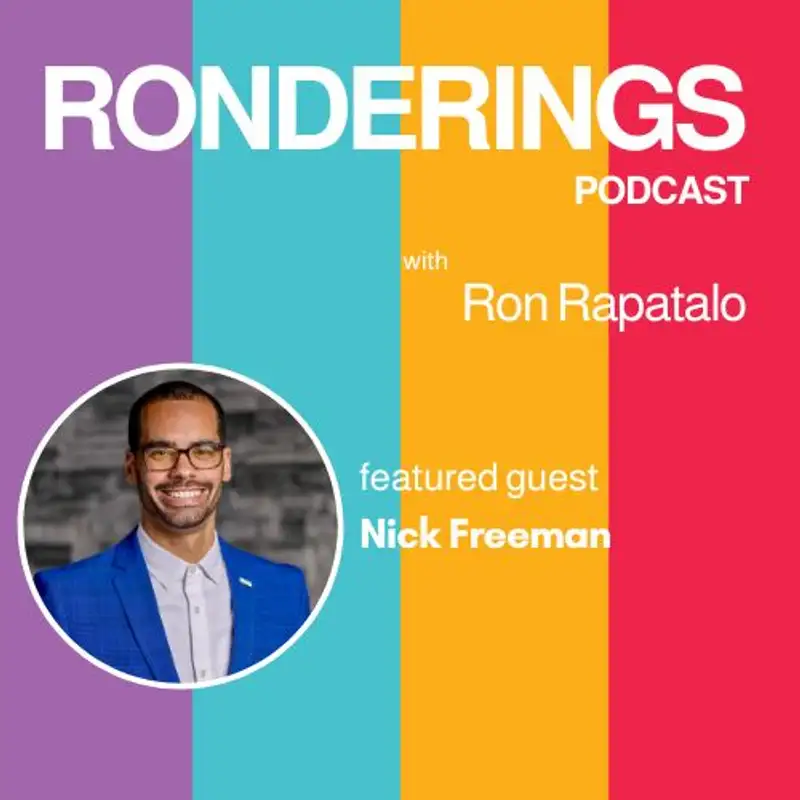
Ron Rapatalo:Let's get into it. You ever meet someone whose story doesn't just inspire you, it recalibrates you? That's today's guest. On this episode of Ronderings, I sit down with Nick Freeman, Chicago South Side born, community raised, first time on a podcast, and someone who embodies what it means to build with purpose. Nick's path is anything but linear.
Ron Rapatalo:He went from an MBA in corporate finance to quarter life prices at 26 to moving back home and stepping into education. Rod of Chicago was navigating school closures. In that moment and seeing what an equity looks like up close, something shifted. That shift eventually became Innovare, the company he cofounded with AJ DeLeon and Fernando DeLeon. Eight years in, they're creating AI solutions that don't replace educators, they restore them.
Ron Rapatalo:They're saving teachers hours, letting them focus on relationships, improving what's possible when you sense your community values lived experience. Nick brought honesty, vulnerability, and straight wisdom to this conversation. When growing up in a basement baseball league run by his parents, navigating VC rooms for less than point five percent of funding, close to founders that looked like him, to the mental health cost of carrying representation, to the conviction of not all money is good money, this episode is about genius, grit, and showing up without the mask. Let's get into it. Hey, friends.
Ron Rapatalo:Before we get started, I wanna share something that's been a big part of my own journey. Two years ago, I published my book, Leverage. That experience cracked something open for me. I saw how publishing isn't just about pages, about owning your story, sharpening your voice, and amplifying your impact. The part that meant the most, readers reached out to me to say they felt seen.
Ron Rapatalo:That's when I knew this work mattered. I loved it so much I cofounded Leverage Publishing Group with friends who know this world inside and out. Now we help leaders, entrepreneurs, and change makers turn their ideas into books and podcasts that actually move people. Got a story in you, and I know you do. Let's chat.
Ron Rapatalo:Find me on LinkedIn or at leveragepublishinggroup.com because the world doesn't just need more books. It needs your book. Alright. Let's get to today's episode. Peace.
Ron Rapatalo:Rondering's fam. I have my Chicago homie, Nick Freeman, on the Rondering's mic. And Nick and I have known each other in Ed circles for a minute and the opportunity to meet each other, I believe, the first ASU GSV summit that I attended three years ago. And so Nick and I have just been in touch ever since. He definitely gets it.
Ron Rapatalo:We both really believe deeply in relationships. And so, Nick, welcome to Ronderings. How are doing today?
Nick Freeman:Appreciate you, brother. You know, got a little bit of snow dropping here in Chicago, but I'm always excited to to be in community with you, share a little bit of the story, and and happy to jump in here.
Ron Rapatalo:Absolutely, Nick. Well, keep that snow in Chicago. Hopefully, it just turns to rain when it hits here in Jersey City, at least according to forecast. But as you know, weather's fickle. Change is hourly.
Ron Rapatalo:But but we're not meteorologists, so we're not gonna deal with that in our Ronderings. So let's dive into it, man. What's your story?
Nick Freeman:Yeah. So, you know, me, I'm born and raised Chicagoan. Grew up on the South Side of the city in Hyde Park. I'm from a biracial background where growing up, my mom was an early childhood teacher. Ended up leading the office of early childhood in Chicago Public Schools, always had that perspective of public service and support and community.
Nick Freeman:My dad, he was born and raised in South Shore in Chicago, military, corporate. We'll get into my story on how I found my way into the finance space to say the least. But, you know, my my journey has has been pretty unique. Right? And, know, I like to tell folks, I've found a way to really bring a unique perspective to the work that I do based on, know, really, at the end of the day, what, you know, my parents, you know, provided as a privilege of access, right?
Nick Freeman:When, you know, growing up in community, that's just wrapped around support, right? So, you know, growing up in a space where, you know, my parents worked full time jobs, you know, had, you know, three, four siblings as well. And, also, you know, they ran the neighborhood baseball league. Right? So there was always just a very community centric, you know, they ran it out of the basement twenty five years.
Nick Freeman:Because of what they knew.
Ron Rapatalo:As I told you, but there's always something I knew I learned about folks on this. I had no idea that you your family and you were involved in baseball for twenty that's wow.
Nick Freeman:Very much so. Grew up in the dirt to say the least, right? 30 diapers in actual baseball dirt all the way through playing some time in college as well. And that kind of was the journey that I went through. Growing up in a community like Hyde Park, very diverse, very inclusive, very supportive, and also just allowed for me to understand what difference looked like, but how difference truly brought folks together.
Nick Freeman:Whether it was their racial backgrounds, religious backgrounds, the schools we went to, the community was a centerpiece that brought all of it together. So it was very natural for me to exist within those circles of difference and saw the value and all of the cultures and upbringings and differences that folks brought to the table. Growing up and once I started to go along a journey of a career path and college, as I mentioned, my dad was corporate and military. My initial background is really in finance. So I have an MBA, I have a master's in finance, really thought that would be a path for me of what I was always told.
Nick Freeman:Growing up in inner city, you go to school, go to college, get your degrees, come back, go into the corporate workforce. It's all going to be great. Unfortunately, for me, once you get into that corporate workspace, it's a little bit different, right, you know, especially in the finance world for me, identifying as a black man in the space. So that was very, you know, non inclusive white male dominated, that that really wasn't what I was brought up on. Yeah, you know, it was for me where, you know, how the results and outcomes in Driven weren't necessarily what was seen first, right?
Nick Freeman:And that wasn't how community had supported me, right, growing up, it really was different for me in that space, you know, I was still successful, I was able to do the things I was able to achieve, I was able to, to continue to grow. And, you know, I always tell folks I'm a lifelong learner. Right? Really wanting to to kind of continue along that path. And, you know, in that space, know, I learned, you know, it wasn't for me.
Nick Freeman:Right? You know? Unfortunately, I didn't know what was for me at the time. Right? I was probably 26 years old at that point.
Ron Rapatalo:You had your quarter life crisis too then.
Nick Freeman:Yes. It work. Definitely did work. Yeah. Still remember the day where, you know, I ended up quitting my job and had to go back to my mom and both my parents say, hey.
Nick Freeman:Like, I got all these student loans. I I don't have a job anymore. Like, need a place to stay. Move back in with my parents. And, you know, it was actually lucky enough for me, I was able to find a role in Chicago Public Schools as a data strategist.
Nick Freeman:Adrian Willis, the AG, you know, the guy who actually gave me my first shot in education to network chief in the Englewood-Gresham Network, five minutes away from where I grew up.
Ron Rapatalo:Okay.
Nick Freeman:But, you know, I never really recognized the imbalance of of the community that I grew up in with just the surrounding communities of Chicago. So, you know, as I began my role in Englewood as a data strategist, right, I start to go in and out of our school buildings, right, you know, and and see the inequities that that truly existed. Right? I thought what I've Yeah. Received in public education five minutes away from where I was working was what every student was receiving.
Nick Freeman:Unfortunately, it was far from the case. Right? And wasn't one school building. It wasn't 10 school buildings. It wasn't 30 school buildings.
Nick Freeman:Black and brown, low income, students with differentiated learning needs. Really, we're getting the short end of the sick consistently. So when you talk about my ability to flip on a passion switch, it was I remember vividly walking into a school building. AG also always told us, suited to booted going into buildings because you wanted to represent and showcase for students. And I remember a second or third grader one day grabbing people by the tie, asking me what this is and why am I wearing Right?
Nick Freeman:So it's that sort of exposure and access that, you know, a lot of our communities and students weren't receiving that, you know, we could be a staple of. So for me, you know, having something tangible and and an outcome that you could see. Right. It wasn't just making folks with a bunch of money, more money, never to see it kinda get invested back in our communities. It was really allowing for communities and kids to see and aspire, to be here, even if they hadn't seen it before.
Nick Freeman:So I always tell folks that path for me and that journey within Chicago Public Schools was a humbling moment, right, coming from a finance space with measurement and data and, you the numbers I was great at. But I wasn't an educator. And so again, I had to put that learner hat on and really take a step back and really understand how could I support. Right? You know, used come in with all of my dashboards and data points and metrics to to really drive conversations.
Nick Freeman:And, you know, at the same time, you know, it really was a a path that we needed to kinda take a step back and and really make sure that we were able to provide and and allow folks to digest the information that was being shared. So there was a lot of learning that I did within CPS. I had the privilege of meeting one of my co founders, Adrian DeLeon, as a data scientist as well, and his background, heavy in education. So he and I used to go back and forth creating dashboards, creating practice and resources and and really the drivers in there. Right?
Nick Freeman:So it really allowed for me to kinda bring experience and expertise into a new ecosystem, into a new system to to really provide. And, you know, my experience in CPS was eye opening. Right? So not only kind of seeing how school buildings or communities were really driven, but I also went through, you know, school culture in 2013 here in Chicago and and seeing how devastated communities were, right, and losing buildings that were a part of generations.
Ron Rapatalo:That's right.
Nick Freeman:It really was painful, sitting on those stages, articulating to folks and community members, we had to close these buildings for underperformance or underutilization as they wanted to call it. But knowing how much folks truly cared about it, it really showed me why education was a space for me. After a few more years of working across the district, whether it was the South Side of the city, moved over to the West Side of the city as well. And again, same similar things, lack of resource, lack of input, just a lack of collective model, really driving forth was when we really started to set forth. So, as I mentioned, AJ and I were strong collaborators.
Nick Freeman:He was a part of the inaugural cohort for the Surge Institute. And his capstone project was actually Innovare as today. So as that was growing and as the work was ideating, I always tell folks, there was a Jerry Maguire moment, to say the least.
Ron Rapatalo:I think came to me
Nick Freeman:and kinda shared, you know, like, Nick, what we're doing, you know, we could scale. Right? We could take just outside of the city and the impact of, you know, the the 60 schools combined we were both supporting and about how we could do it, you know, on a larger scale. First pass, you know, I was like, I got this mortgage set up, these bills. I'm still digging out from under these student loans.
Nick Freeman:I don't know if I got it like that quite yet. But I allowed him and kinda said, hey. Like, you know, find us our first opportunity. Right? You know, find us that that first deal and and you know what?
Nick Freeman:I'll jump jump on board with you. Yeah. No more than two weeks later, came back knocking, and that was the start of Innovare. You know, that kind of just ability to continue to grow and and drive in the work was really exciting. Right?
Nick Freeman:You know, I I ended up stepping out of Chicago Public Schools and cofounding Innovare, had the chance to go through the Surge Institute fellowship program as well. And that's really where I found myself. Right? You know, that ability to remove the mask, walk in spaces, understanding my unique genius and the value add that I brought to the table. And, you know, being confident in that that, you know, the the seat at the table that I was sitting in was was rightfully mine, right, and the ability to continue to grow.
Nick Freeman:And, you know, since then, you know, it's been seven, eight years now, ten going, which is crazy to say. We've continued to build and grow and and uplift community. And and for me, that's what I'm, you know, consistently most passionate about, right, is is how we kind of reinvest in one another and and reinvest in community. And from my perspective, just through technology, through data, but most importantly, through relationships. Right?
Nick Freeman:All the work that we do and and and you know me well. Right? It's I'm a relationship driven person. Right? At the end of the day, I truly love learning about people, learning about culture, learning about travel, food, all of those things that bring together just value in my opinion was is something that I've always driven for.
Nick Freeman:So, you know, for me, I always try to, you know, exist in that space of, you know, elevating others, allowing folks to shine, all of the while, you know, remembering where I came from, right, which was, you know, community, folks that wrapped around one another and always supported him. I know I I've always told folks, you know, I saw what my parents were able to do, you know, both of them coming from nothing into a community like Hyde Park. And, you know, still to this day, I walk around the entire city of Chicago and folks remember me sitting in diapers on the baseball field. Right? And and knowing who my parents were.
Nick Freeman:Wow. For me, that showed, you know, the impact that they had. Yep. And knowing, you know, my privilege of, you know, consistently a roof over my head, you know, food on the table, quality school to go to. I always tell folks, you know, what my parents did for the the community of Hyde Park, you know, I can do for the city of Chicago.
Nick Freeman:Right? So that's how I kind of look at it in a a very tangible way of of what I'm trying to accomplish and how I'm trying to achieve and consistently just trying to show up for my city every day. Right? Born and bred here in Chicago through and through at the end of the day. And anything that I can do to kinda continue to elevate and and story tell and and bring forth the just genius that happens here.
Nick Freeman:It is is exciting for me. So really excited to to share more and and kinda dive into it and Yeah. And give you a little bit more about myself.
Ron Rapatalo:Your your parents starting that sounds like community based baseball organization, right? Which reminds me, you know, in New York City, what used to be Harlem RBI, now it's merged into like Dream Charter Schools and Dream Brighton. So there certainly have been throughout the country, you know, the use of sports as a way to build community, right? And I, you know, for me, I always look at the arc like knowing your entrepreneurial spirit, that makes so much sense that your parents starting that, I might say was the beginning of you seeing what entrepreneurship looked like. So talk to me a little bit about your parents doing that and your role in, like, early lessons you learned around entrepreneurship through the CBO in baseball.
Nick Freeman:Yeah. I mean, it's when I look back at that privilege of Yeah. Having that baseball league and all of the older brothers that I have, right, and all of the the folks who the the backyard barbecues that we would have at folks. Yeah. I bet.
Nick Freeman:I was I was also the youngest sibling, which was nice to always have the older guys and and girls
Ron Rapatalo:that looked out for me.
Nick Freeman:I Yeah. A lot of learning consistently that kind of came from that space. What I also saw from just the entrepreneurial perspective is, you know, you know, my parents never made a dime off of the baseball league. Right? A lot of it was out of pocket.
Nick Freeman:Right? Mhmm. Countless times of the intake of equipment and the clean out of my own basement to to make sure that the league was supported or driving to the Santo Sports Store. The value was in the community, though. Yeah.
Nick Freeman:Right? The value was that the community had a space where everybody was included. Right? It was nothing like, you know, opening day or the closing day ceremonies where the park is flooded with thousands of people. Right, where folks come together just to enjoy and to build and to generate like, what it actually generated for the community was astounding to me.
Nick Freeman:Right? Yeah. I didn't realize it until later on in life what it actually had instilled in me in that entrepreneurial side. Even whether it be from the the baseball league that I I learned from my parents or truly just their professions as well. Yes.
Nick Freeman:Education, business, and background, media, space,
Ron Rapatalo:and health. Yes.
Nick Freeman:Crazy. My dad actually supports me and my team around a lot of the Lean Six Sigma process improvements, data integration stuff still to this day. Very cool. Wow. My mom still does a ton of work in the early childhood space where we have very robust conversations.
Nick Freeman:But it was watching what it looked like to, one, you know, manage a business Right. And and seeing the work that they put in, but also how to get other people to invest in it as well. How do we find umpires? How do we find coaches? How do we find community members to to sponsor teams and and bring forth those efforts?
Nick Freeman:Right? It was very relational. All of it. Mhmm. Right?
Nick Freeman:And those relations, you know, weren't just on the baseball field. Yeah. Talk about the swim team that we were a part of or the arts programs or the after school program. Yeah. The local school council that all of those parents on.
Nick Freeman:So when we were walking down the street, you know, anywhere in the community, all eyes were open and the community was wrapped around us. Right? So, again, that was the the vision, you know, the relational piece that I never lost. Right? And and for me as an entrepreneur, right, truly is around trust and relationships.
Nick Freeman:Right? Like, who are the folks that are driving forth to to move the needle for our communities? And, you know, it's easier to to have a a collective impact model, right, when when there's trust involved. So that was the the biggest thing, right, the the motivating factors to do what's right for the community and all of the while, you know, with with no benefit truly to the individual leading. Right?
Nick Freeman:So that was really exciting for me to see and and something that truly, you know, as we're sitting here talking about it, is is is showcasing to me, like, why I probably am so focused on that. Right? Because it's it's those sorts of commitments that allow for us to, you know, whether it be lead an organization, drive community initiatives, that that relational piece is is something that I definitely took away from there is key.
Ron Rapatalo:Alright. Let me keep it real. A lot of us have write a book sitting on our goals list, maybe for years. I sure did. Good news is there's more than one way to get it done.
Ron Rapatalo:If you've got more money than time, a ghostwriter can help bring your story to life. If you got more time than money, a great book coach can guide you through the process step by step.
Nick Freeman:If you've already
Ron Rapatalo:written a thing, you'll want someone to shepherd you through publishing so you don't waste time or cash. Here's the thing though, no matter how you do it, the real win is writing the right book. The one that builds your credibility, grows your business, and actually makes a difference. That's what the team at Books That Matter is all about. Head to booksthatmatter.org and get some feedback in your ID or manuscript.
Ron Rapatalo:Don't sit on it any longer, your book could be exactly what the world needs. It's fascinating, right, as I reflect on like our friendship and our professional relationship, right, I'm not surprised you're sitting here on Ronderings because how deeply focused and committed we are on relationships from your superhero origin story, dare I say, right, growing up around diversity, community, that focus on relationship and seeing this is said in BSQUAM. I'm sure you've heard this over and over again, right, where business moves at the speed of trust. And yet, I think folks like you and I and let's focus on the ed space because you and I pontificated on this for a minute. You know, I fuck it.
Ron Rapatalo:I'm gonna say Most people that do what you and I do, I would say are shitty at trust. Is it just me? Am I be I'm not being an a hole saying that. Right? I just you know, I watch it.
Ron Rapatalo:I just go, fam. Yeah. Fam. And, you know, part of me wonders, and I'm going to put you because you've co founded a company, right? It would be easy to say, well, just grow up like Ron and Nick did, like, but you can't.
Ron Rapatalo:That's hard to duplicate, you know what I'm saying? And so I'm wondering and knowing particularly how you and how AJ rocks similar to you, how do you instill those values of relationship inside not only your culture, but also the way you do business where folks, I think even still in the K-twelve vet space, to be more highly transactional than their words may say they want to be more relationship based.
Nick Freeman:Yeah, man. It's tough. I know. Not being an asshole.
Ron Rapatalo:I know. Might get me in trouble, but that's okay. I
Nick Freeman:think the data shows it. Right? And if we take just a perspective of education, thirty percent proficiency rates. We're failing seventy percent of our kids. Right?
Nick Freeman:Yeah. And we look at black and brown kids. We're in the teens. Yep. Let's look at students with differentiated learning needs, English language learner students, students in temporary living situations.
Nick Freeman:Those are the students that consistently get the short end of the stick. Mhmm. Billions and billions and billions of dollars every year go into a system. What are the industry out there has a seventy percent failure rate? Right?
Nick Freeman:Like, that alone shows there's a lot of bad actors in the educational ecosystem. Right? And even if I were to hone in more targeted to the EdTech space Oh, boy. And the solution are being put in front of our kids.
Ron Rapatalo:Man.
Nick Freeman:Those solutions aren't built for our students.
Ron Rapatalo:No. They're
Nick Freeman:not. Lester Holt put an article, was the 5% problem, I guess what it was called, where we really look into who these solutions and who these tools are built for. Right? Especially now with the digital divide that is significant. Right?
Nick Freeman:Yeah. Talking computers. We're talking Internet. Right? Simple things.
Nick Freeman:Right? Some schools when COVID happened shut down straight to digital learning. Here in Chicago, took us about two to three months to get Chromebooks into the hands of kids. Wow. To get Internet into the communities for kids.
Nick Freeman:Public education. Right? It's supposed to be free, right, and and accessible. Yeah. Let's talk about free and accessible from that perspective.
Nick Freeman:Right? It's not then you have just the the interest of technology for students, right, to lean into these solutions and lean into these tools. Right? Mhmm. Not all kids have that, especially when they're built for the students who are already attaining Yes.
Nick Freeman:That are accessing these tools. Let's talk about the educators who are in front of our kids. Right? Mhmm. Some of our kids, sixth grade math, they see a sub every day for that benchmark grade in math.
Nick Freeman:Others have highly credentialed staff that continue to support and and push the narrative. Mhmm. You can guess which kids have
Ron Rapatalo:Oh, yeah. Mhmm.
Nick Freeman:Right? And at the end of the day, like, these tools are are touted as, let's go make the babies read. Let's go make them do math better. But, again, back to that 70 failure rate. Right?
Nick Freeman:That's not the case. So the data is there. Right? So nothing. Right?
Nick Freeman:There there there's nothing to say in in the event of you know, there there are a lot of bad actors who are consistently taking advantage of very well resourced industry. Right? So how do we really make sure that we drive? So you you mentioned, you know, AJ and I, and you know AJ well also. Right?
Nick Freeman:He is one that will never stand by and allow for folks to be taken advantage of. Right? From his background, from his upbringing, from his culture, him and his brother, why the three of us kind of Fernando as well came together as co founders. Right? Because of this, our belief in one another, again, to triangulate different areas and expertise and backgrounds.
Nick Freeman:We know if we're not vocal about what those particular needs are of our communities because we were those kids. Right? We were students that were undocumented as they were, right, coming in and first generation college students. Right? Mhmm.
Nick Freeman:Students that, you know, in temporary living situations, English language learners, the diverse learning needs. Right? Like, we are those students. Right? So as we stand by and and now sit in seats that allow for us to vocalize and and showcase what's truly right.
Nick Freeman:Right? We don't we don't take that lightly nor do we allow for, you know, our communities to to be taken advantage of. But to your point, it's very difficult to do that. Right? The industry has been around for a long while.
Nick Freeman:Like, we you push against some of those things and, right, you you'll be, you know, targeted. Right? For us, we're okay with that. Right? We're okay with doing what's right by our people and by our community members.
Nick Freeman:And we need more folks like that. And that's what attracts folks like that. Right? That's why, you know, at UGSB, right, we we hit it off. Right?
Nick Freeman:We're it was a very real conversation, a very supportive conversation. You know, not a what can I get from Ron or what can you get from me? It was a, how can I help? Right? Yeah.
Nick Freeman:What what can what can we do together? What can we build together? Because we know we're stronger together, especially when we're working against such systematic structures built and intentionally fine tuned to do exactly what they're doing, we need folks to truly be working to dismantle those things and not be afraid to say it. That's something that we always stand by. We always aspire to inspire others to do as well and do it confidently.
Nick Freeman:And all over the while, you know, as we're at the point where, you know, we're we've raised over 5,000,000 in venture capital. Right? Wow. When you look at venture capital fundraising and black and brown businesses, less than half a percent Yep. Of the folks that look like us.
Nick Freeman:Right? So we know there's value in what we do. We also know we have to show up and show for our community what we stand for. Because just like that kid who was yanking on my tie asked me what this was and and and what is Right? We want to show other entrepreneurs, other founders, other educators that the work they do is essential, right, to truly representing the communities they come from because their unique genius, their lived experiences are what these other folks do not have.
Nick Freeman:Right? So, again, how do we make sure that those voices are heard, those voices are elevated, and and how do we make spaces more inclusive so folks feel welcome, they feel confident, and they they feel well equipped that when the time is right, they can show up and show up at the end of the day. Right? Because that's one thing I'll also be very transparent about. Right?
Nick Freeman:We have to ensure what we put out there is of the highest of quality. Excellence is always the key for us. Right? I don't speak towards perfection. That's a very white supremacist mindset to to think that you should be perfect.
Nick Freeman:Perfection is not reality. Right? We all can get better, but we can always show up in our excellence and and ensure that that's what we're putting out into the space.
Ron Rapatalo:Amen to that. You know, I think what I got from you, Nick, simply put, is you have to stand on your values when things are really tough. Right? And you mentioned it. Right?
Ron Rapatalo:Let's be clear. You gave the percentage. Right? Like, half a percent, you know, is given by VCs, the black and brown founders like you and AJ and Fernando. Right?
Ron Rapatalo:I imagine it is not easy to stand on your values, right, with folks who do not look like you, who may not at times be as aligned as you and I and AJ, you know. And so in those moments, like, how do y'all stand on your values when it's, I think, frankly, it's it could be easier to just take the money. Right? Because I think that's that's often the Machiavellian, like, trap that I think many of us are set up in in these spaces, you know?
Nick Freeman:Yeah. Not all money is good money. Right?
Ron Rapatalo:That's something. Amen. And we learned
Nick Freeman:because yeah. Not all money is good money. Hold on.
Ron Rapatalo:Yeah. That's say no more. Say no more. Yep.
Nick Freeman:And there are times where we have to be confident enough to say, you know what? We're we we know we are solving the right problem because our users, our partners, our school leaders are telling us we are saving them the time. We're empowering them and the value we are creating. Right? These venture capital or fund folks, like, they don't understand that.
Nick Freeman:Right? They don't understand what it's like walking in the building on the West Side Of Chicago Yep. Or going into the school in Inglewood with the roof leaking but still at high attaining levels. Right? They don't understand what that looks like.
Nick Freeman:So they can tell us everything they want, right, about if we did it right or if we solved the right problem. You know, I remember on our our first pitch day on a Google stage Mhmm. Eight years ago. Wow. We were pretty much sandman swept off the stage, told y'all don't know what you're doing.
Nick Freeman:The problem you're solving doesn't exist. Pretty much shut it down. Right?
Ron Rapatalo:Damn.
Nick Freeman:If I didn't have two cofounders to walk out of that pitch day to say, no. We're good. Build each other back up. Right? To to to say, no.
Nick Freeman:Like, we know we're right. Probably might not be at Innovare today. Interesting enough. Yeah. Eight years later, some of those folks on that panel now wanting to elevate and help us storytell and and and do the work.
Nick Freeman:Right? So folks come around, right, when they see the true impact, when they start to understand and and see the other excitement from others. Yep. But it's you know, honestly, man, like, the weight that it brings also is tough. Right?
Nick Freeman:Yeah. Knowing, again, that that half a percent comes to folks that looks like us, the weight on the shoulders isn't easy to carry at all times. Right? Yeah. The fear of failure, because we could ruin it for the rest of us.
Nick Freeman:Right? That's what, you know, unfortunately, you know, I've had my bouts with the mental health and and breakdowns in in those perspectives. Right? And, again, I'm confident enough to to know and share and be vulnerable that
Ron Rapatalo:Yeah.
Nick Freeman:Stuff isn't always great. That's right. And we, especially as a black man, right, are, you know, taught to be tough military dad. Right?
Ron Rapatalo:We don't cry.
Nick Freeman:Rub some dirt. You won't be alright.
Ron Rapatalo:Yep. Yep.
Nick Freeman:That's not okay. Right? We have to be vocal. We have to be able to share. We have to be comfortable to allow that to come out because if we don't, we crack.
Nick Freeman:Right? So that piece of it for me, having my cofounders that I can really lean into. Right? Because the weight that we have to carry is not light. At times, it's terrifying.
Nick Freeman:Right? And luckily, you know, folks might see me on LinkedIn or see me in, you know, San Francisco or in Mexico City or in New York and all of these exciting spaces. Right? There's a lot that comes behind it. Right?
Nick Freeman:And I'm a family man. You know I got two little ones. Right? Yeah. Right.
Nick Freeman:It Yep. That's that's the space as well. Right? And the ability to balance, which I've learned life is not balance. Again, this mindset of of perfection and and everything being balanced.
Nick Freeman:It's more of a a push and pull. Right? And and how do we communicate with those who are most essential to us that where are we right now? Right. How many spoons do we have?
Nick Freeman:Right? How full is our cup right now? Right? And how do we really make sure? And, you know, again, the ability to kind of weather those storms because I have folks that I've known for thirty five, forty years now Right.
Nick Freeman:That, you know, have always had my back. I have folks that are committed to the work that I can go to to to help me validate. And I have cofounders, and I have family members who who really are invested in the individual of of me as I am in them. Again, I feel the relationship is is is where it really sits its core.
Ron Rapatalo:Yeah. I mean, it sounds like, Nick, because you grew up around such community care and you got to know people and you got to know them. Right? This arc of knowing each other's stories, right, which is why I started Ronderings in the first place. Right?
Ron Rapatalo:I've always found it's easier to get to love and care for someone when you set up a space that someone just lets their story be told.
Nick Freeman:Mhmm.
Ron Rapatalo:Right? And I find that it while it can feel disarming, it is one of the most powerful questions to ask someone. Right? Because I always quote Hamilton at the end of this. Right?
Ron Rapatalo:Who lives you, who dies, tells your story. We do not need to wait until we pass. We are literally writing our stories we live. So any chance we get to tell it, we should be telling because you don't know who it's gonna reach and how it's gonna inspire. Right?
Ron Rapatalo:So let's fast forward to today. Tell me what Innovare is up to. I know you you showed me some exciting stuff, and there may be some I don't know if you could share any hot off the presses stuff because I I I wanted to ask, but that may not be ready to be for public consumption yet. But tell me what y'all up to today.
Nick Freeman:Man, so I just got back from Mexico City. Fernando and I had the privilege. AJ's down in Mexico City nowadays as well. We're just at the, you know, Google for Startups alumni community, the release of Gemini three, and a lot of these new solutions. We're consistently on the forefront of access to these new technologies and tools.
Nick Freeman:You know, for me, the most exciting piece is that we get to bring it into the education space, which has historically been left behind in these transformational times.
Ron Rapatalo:Oh, yeah. Mhmm.
Nick Freeman:So when you ask, like, what are we up to? We're saving educators time so they can focus on relationships. And what does that look like? So back in October, we were in San Francisco at another alumni summit with the Google for Startups program where we actually began the work of building out a solution to support the research around freshmen on track. So we have pretty much a MTSS coach that we've built in and designed alongside of a four of our Chicago public school high schools. Did design workshops in October where we brought a bunch of our school leaders in, brought a bunch of their teams in and said, hey. Like, this research that we've been using for the past twenty years, right, like, what can we do to make this more accessible for your ninth grade team so we can really ensure that our our students are set up for success? Mhmm. They gave us all of these ideas.
Nick Freeman:The the best part about all of it, we we had prototypes that we had designed and thought, like, this is what it would look like. We didn't show them due to the fact that we're like, let's see what they come up with. Everything was completely different. Right? So, again, back to just asking folks what they need rather than being prescriptive and saying this is what you need was a game changer.
Nick Freeman:So in October, we were able to really capture that voice, understand the need. Beautiful. And through the mid November, we actually were putting those tools into the schools training. So our ninth grade teams are now equipped with intervention solutions to help them digest all the disparate systems of data that exist around the, you know, grade attendance and the behavioral metrics and and the ability to be more strategic around intervention planning. Right?
Nick Freeman:Teachers were telling us they were spending two, three hours at student for planning. We've cut that time down to a matter of minutes. So now when you talk about the ability to digest information, get insights into the hands of educators, into the hands of students, and into the hands of parents more quickly so they can really digest and and move forward. Right? The speed is what's key there, Ron.
Nick Freeman:Right? The ability to bring technology to the forefront for education as it's never been done before is key. Right? So not only do we have this tool around our, you know, AI coach that is now supporting around any key metric, freshmen on track, chronic absenteeism, students with the that might be more even adult practices. Right?
Nick Freeman:Like, ability to bring all of that data to be suggestive rather than sifting through data. That speed is key. And, you know, as Innovare, right, we really get to sit as an expert in technology. Right? We don't we can't get in the classroom and teach better than these teachers.
Nick Freeman:Right? Now we can equip those teachers with the solutions and tools to now be more effective teachers. We can equip our leaders to be able to walk into their board meetings or local school council meetings equipped with insights and information to share more easily. Yeah. So now they're really focused on that piece.
Nick Freeman:So that is really the forefront of of where we are right now is is really being a leader in the AI space. There's a a big one coming that I cannot share yet
Ron Rapatalo:that I'll talk to you about it offline. Yes. Yeah.
Nick Freeman:Lots of excitement. But again, you know, the leaders of what I'll say, Chicago Public Schools have really leaned into that. You know, again, that's where we're centered. That's where we're we're headquartered. Again, where a lot of our work is is currently happening.
Nick Freeman:But, again, us being that expert technologist, making sure that our educational industry is not being left behind as they have historically when we see these major shifts.
Ron Rapatalo:Quick pause in the action here. I know a lot of us leaders, entrepreneurs, folks who are trying to do good work, have felt that grind of pushing a boulder uphill by ourselves. The learning is you don't actually have to do it all alone. Genius discovery program at thought leader path like having a think tank in your corner. It's not some cookie cutter formula but your story, your plan of impact, giving you the clarity and assets to take the next big step.
Ron Rapatalo:I've seen people go through this and walk out with their voices amplified, ideas sharpened, some even launching podcasts like this one, Ronderings. So if you're tired of grinding in the dark and you're ready to step into your impact with right support, check out geniusdiscovery.org. I mean, Nick, you and I have talked about this offline, but where Inno is on the precipice of. Right? I'm thinking about the space, not only that where I work, but also some of the bigger fish.
Ron Rapatalo:Right? All these large professional consulting firms. Right? Mhmm. That if your tool does what it says you're it's doing and can do it at scale.
Ron Rapatalo:Right? And I've seen pieces of this also. Right? Because I have friends in the talent space who've seen some of this stuff. Right?
Ron Rapatalo:You know, the Goldman Sachs accelerators and all those things. Right? Like, wait a second. You mean my compensation study? You hit a button with all five minutes that took us and we charged the space is changing around Mhmm.
Ron Rapatalo:Recommendations via all these historically, let's point you back to when you're you and AJ were data strategists. This for data sources that you had to do, people could see me move like now at a touch of a button, here it goes. Now we can tell you what recommendations, and now you could just go with it rather than let's sit down and make meaning of the data. Let's sit down and have to analyze. It just these are game changing innovations for our space, man.
Nick Freeman:Yes. Nick. I mean, to to this I mean, like, to that exact point, Ron, like Yeah. Continuous improvement work plans. Every school goes through it every two years.
Nick Freeman:Yes. About hundred to hundred and fifty hours.
Ron Rapatalo:Oh, I've seen this.
Nick Freeman:Just take a school like CP or, like, Chicago Public Schools, 600 schools, hundred and fifty hours. We're talking about about 4 and a half, $5,000,000 in resources to go through those planning cycles. We also know Chicago Public Schools had a billion dollar budget hole last year. Right? When we're talking about that sort of significance and saving, right, because those planning tools, school improvement, like you're saying, giving recommendations to a leader to say, hey.
Nick Freeman:Here's your historical data. Take this to your community. Decide on which of these three we should move forward with. Because you don't have to create the action plan. You don't have to come up with the details in it.
Nick Freeman:Like, we can be recommended rec we can recommend those things based on the frameworks, based on the practice. Right? That's one thing. We we make all of the research more digestible and accessible for folks to actually put into implementation. So like you were saying, a lot of those folks who, you know, would keep that institutional knowledge historically, Like, it's more accessible and, you know, individual's turnover no longer has to uproot a system or uproot, you know, or uproot a school because all of that information is is still accessible.
Ron Rapatalo:Wow. Well, Nick, I gotta say, I can't wait for you and NL to announce this big news and just knowing where you all started. You you just go back to that Google stage eight years ago. Oh, hey, Alan. How are you?
Ron Rapatalo:Oh, she needs Surprise. People start, This happens right around there. He's like, we go back to back and people jump. So he would jump on a couple minutes. But what's really interesting is you fast forward to today, exciting announcement y'all make, the future where this is going.
Nick Freeman:Mhmm.
Ron Rapatalo:I mean, you and AJ and Fernando and your team are building something that is gonna have lasting legacy in the Kato bed space. How does that make you feel?
Nick Freeman:Crowd. Yeah. Right? To be honest with you. Yeah.
Nick Freeman:I don't thank you for the question. Yeah. I don't get asked it often. Yeah. And, you know, it's when I quit my job in the finance space, my dad was livid in all transparency.
Ron Rapatalo:Oh, of course.
Nick Freeman:A second. Coming out of my pockets again? Right. But Right. Fast forward fifteen years since then, and he confidently is touting to his friends and his community how his son is changing the industry.
Nick Freeman:Right? For me, I love that he sees that. I love that he can experience it. I love that he and my mom, you know, can see me kind of blending their journeys into what I've become today. It's a very unique situation to sit in.
Nick Freeman:And again, just knowing not only how proud I am, more importantly, that I know I'm not here without every one of the leaders that have really invested in me. Right? You know, Doctor. Cooks, the new chief equity officer here in Chicago public schools, the the Kia Banks, the the head of the Chicago principal administration association. Now the AGs, right, who gave me my first shot when they told him, don't hire him.
Nick Freeman:Don't give him a job in this district. He said, no. Like, I'm gonna take him under the wing. Right? It's being able to now know that every one of those individuals, every one of these leaders who, yeah, that I've sat by side side by side with just to be a support of them.
Nick Freeman:Right? I always tell folks in this work where, you know, there is we're just the guide here. Right? These leaders, these educators are the heroes in this work. And the more we can, you know, continue to support them along that journey, for me, that's all I need.
Nick Freeman:I don't want the limelight. I don't need to showcase, but I want my schools. I want my partners to to have the success, to get the resources for their students to thrive is what's most important for me.
Ron Rapatalo:Yeah. We just bought this full circle, Nick, because one of the reasons I started Ronderings was as extroverted and as front of the limelight as I like to be, one of the things that was really important to me is bigging up the incredible heroes like you and many other guests on Rondering. So with all that said, I want you to share your wisdom with the Rondering's audience. What's your Rondering? The lesser value you wanna share today.
Nick Freeman:Yeah. Walk in your own unique genius. Right? Remove that mask, show up as who you are. I always thought code switching was a skill.
Nick Freeman:What I realized, it took away my own power. Right? Relating to others to to make them comfortable. Don't let folks take that from you. You walk into those spaces, you bring your excellence and you show up.
Nick Freeman:Right? Because if we don't, nobody will. Right? So that's one thing I always push folks for is to be you, To be passionate, to be true, right? Because at the end of the day, if not, the right folks will see through it.
Ron Rapatalo:Yes.
Nick Freeman:And you know, if we can continue to stand by that to uplift one another and and to be true to what we stand for, right, our systems will get better. We will begin to dismantle, you know, the inequities and and systems of oppression that that we exist within because at the end of the day, it's it's a must. Right? And Yes. You can't do it hiding behind, you know, shades of gray of of and and fear of of retaliation.
Nick Freeman:Right? You know, at times, there there there need to be a martyrs. Right? There need to be folks who who are willing to do and and say the things. And, you know, us at Innovare, we really want to change the narrative of what education looks like and and we're empowering through technology.
Nick Freeman:But by no means are we the silver bullet in in only solution. Right. We understand we are a piece of the larger puzzle.
Ron Rapatalo:We
Nick Freeman:understand there's a lot of other coconspirators that that we go along with and that we add value with. And for us, like, we're a part of the solution, but we are not just the solution.
Ron Rapatalo:Amen to that. Well Nick, how do people find you? What would you like to promote before we, give our parting thoughts?
Nick Freeman:Yeah. You know, LinkedIn. You know, Nicholas Freeman on on LinkedIn. You know, that's where you'll you'll find everything. Innovare, SIP on all across all of the social channels.
Nick Freeman:Follow us, please. Because at the end of the day, you know, it's all about our educators. Right? It's all about our schools. Right?
Nick Freeman:That's what I want you all to see. I want you to see how educators are truly leading the effort in the tools and solutions we're designing. Right? We should no longer should we be prescribing to our communities and members. Right?
Nick Freeman:So check us out. Right? Look and and and save rest of the solutions and tools. If you're in Chicago, come visit us over on December 9. We'll be hosting an event at the Impact House to hear from some of our peers in the world.
Nick Freeman:Right? We're always consistently wanting to create space. So if you're ever in the Chicagoland area, you ever see an event that we're hosting, please come by. Come learn. Right?
Nick Freeman:Whether you're from the philanthropy side, from the nonprofit side, from the education side, from the venture capital side. Right? Come see what this community truly is about because at the end of the day, we're building it in a different way, and it hasn't been done this way. Right? We're truly proud of what we're creating.
Nick Freeman:And at the end of the day, again, it's all centered around our leaders, right, and our educators that are are truly on the ground making this work happen. And they deserve to be celebrated too.
Ron Rapatalo:Yes. Know,
Nick Freeman:elevation there. It really is about them. And any way I can kind of push you all to to do that, you know, I I always invite you. So, again, Innovare SIP across all of the channels, https://innovaresip.com, and you can check me out on LinkedIn as well as Nicholas Freeman.
Ron Rapatalo:Nick, we could probably talk another hour. There's, like, 75 different things I could have gotten into with you, but we only got some finite time. But I gotta say in the words of my favorite sports hero, Well, one of my favorites. Let me not because I'm a New Yorker. I'm like, I'm gonna say I'm not he did play for the Yankees briefly.
Ron Rapatalo:But in the words of Dion Sanders, we always come hot with guests like Nick Freeman. Peace, y'all.
Nick Freeman:Appreciate you.
Ron Rapatalo:Nick didn't just tell a story. He gave us a blueprint. If you take nothing else from today, take this. Your unique genius is your power. Dirk reminded us that code switching, shrinking, simulating, all the ways we can sort ourselves to fit come at a cost.
Ron Rapatalo:When you finally decided to stop performing, start showing up fully, that's when the real magic happened. We also pulled back the curtain on what it's really like to build an EdTech as a black founder. The nose, the Sandman moments, the investors who don't see the vision until it's convenient, and the mental toll of carrying a whole community's hope on your back. But Nick and are proof that you can build something transformational and rooted in values. You can push back against extract the tech culture that can choose purpose over hype and still win.
Ron Rapatalo:If you wanted to learn more about Nick and Innovare's work, the AI coaches transforming educators' planning, school improvement tools saving districts time and money, or their upcoming announcement, go follow Nicholas Freeman on LinkedIn, connect with @innovaresip on social, and check out https://innovaresip.com. Thank you for rocking with us. Take this wisdom with you. Walk in your genius. Remove the mask.
Ron Rapatalo:And as always, keep rondering. Peace. Before we wrap, I've gotta give a huge shout out to the crew that helps make Ronderings come alive every week, podcasts that matter. Their mission, simple but powerful. Every great idea deserves a voice.
Ron Rapatalo:So if you've been sitting on that spark of a show or story, don't overthink it. Just start. Head to podcastmatter.com, and let their team bring your vision to life. Till next time. Keep rondering.
Ron Rapatalo:Keep growing. Keep sharing your voice with the world. Peace. Thank you for listening to today's Rondering. I enjoyed hanging out with my guests, and I hope you leave with something worth chewing on.
Ron Rapatalo:If it made you smile, think, or even roll your eyes in a good way, pass it along to someone else. I'm Ron Rapatalo, and until next time, keep promdering, keep laughing, and keep becoming.
Listen to Ronderings using one of many popular podcasting apps or directories.