 Episode 112
· 01:04:43
What's up? I'm Ron Rapatalo, and this is the Ronderings podcast. Around here, I sit down with guests for real, unpolished conversations about the lessons and values that shaped them. And I'll be right there with you, sharing my own take, laughing at myself when I need to, and wondering out loud about this messy thing called life. Glad you pulled up a chair.
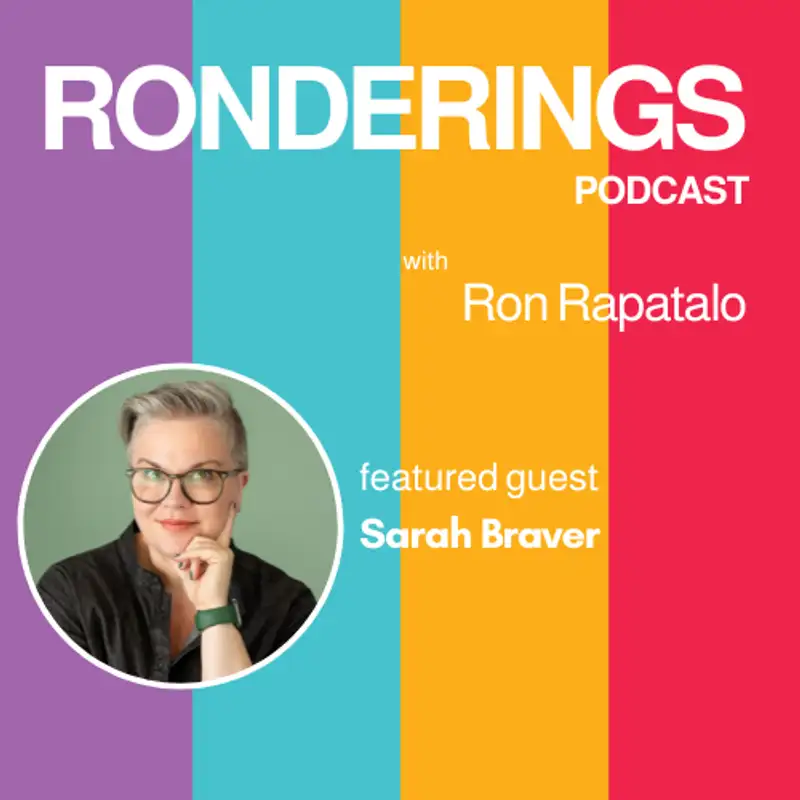
Ron Rapatalo:Let's get into it. Sarah Braver doesn't follow traditional career paths, she builds them. From editing photos at a local newspaper to traveling globally to do corporate education, Sarah got an early real see to how organizations actually work, how culture, talent, and strategy either align or fall apart. Those of us that she made a sharp pivot, start by the wire, season four, and the desire for deeper impact. She stepped into the world of education and mission driven work.
Ron Rapatalo:Since then, she's carved out a unique lane, moving from consultant to first head of people, helping organizations scale for scrappy startups to structure team, and knowing when it was time to move on. They she's co leading Colleague, a fractional talent organization where she's rethinking how people strategy shows up in nonprofits and purpose driven companies. This episode of Ronderings, we talk about ADHD leadership, fair enough for meaningful work, why most workplace rules are made up, and how creating psychological safety might be the most important job any leader has. Let's get into it. Ronderings fan, I have a buddy on the mic with me that I had the privilege of meeting in the conference circuit.
Ron Rapatalo:So Sarah Braver works for Colleague, and Colleague was founded by one of my dear Teach For America friends and future Ronderings guess, I might say, Laura Cover. And so Sarah went to ASU GSV last year. We hit it up. Have a lot in common, nerd out about talent, love eating great food, particularly in New York City, and Mhmm. Occasionally love talking smack.
Ron Rapatalo:And so Absolutely. Ronderings universe, Sarah Braver's on the mic. Sarah, how are doing today? Hey.
Sarah Braver:Hey. I am excellent. Joining you from Brooklyn.
Ron Rapatalo:Brooklyn. The borough that keeps it moving. Yes.
Sarah Braver:It's the best.
Ron Rapatalo:It is, isn't it? It's so funny. On a funny anecdote, the missus and I were eating brunch today, and Mhmm. I don't know why this particular spot, where we love eating, has a sign off to the side of the bar that says Jersey City versus Brooklyn. I'm like, why would you have I don't get it.
Ron Rapatalo:Right? And so why do I say I've lived in Jersey City for this is like year nineteen, so I love this city. Right? I'm not born and raised here, but I was born in Brooklyn, raised in Queens, so I see a sign like that. I'm like, why is that there?
Ron Rapatalo:Because it's not it's not it's not even a competition. To be clear, I'm like, I love Jersey City.
Sarah Braver:He's off of Brooklyn. I'm glad. You I'm I'm glad I don't have to say that. I'm like, come on.
Ron Rapatalo:It's an obvious I mean, come on, right, to come out. But, like
Sarah Braver:Yeah. If we're if we're doing the draft, we might pick, like, trade Jersey City for Staten Island. Like, we think that that should be the fifth borough. Jersey City is excellent.
Ron Rapatalo:Yes.
Sarah Braver:It's diverse. Lots of cool stuff going on.
Ron Rapatalo:I don't know if New Jersey would take Staten Island, though. That's the thing. Like, what part of Staten Island? Where they gonna go?
Sarah Braver:They wanna be in their own beauty. It is New Jersey. It is New Jersey.
Ron Rapatalo:Yeah. It's yeah, because right next to the Bayonne Bridge, the Bay yeah. No. I know.
Sarah Braver:Yeah.
Ron Rapatalo:Yep. For another day. For another day when you play So, Sarah, without further ado, what's Hello. What's your story?
Sarah Braver:What's my story? You know, just last week when I was in San Diego for ASU GSV, met the coolest guy and he was a cultural anthropologist and I thought that was the coolest thing. And he lives on both sides of the border part time in Tijuana and part time in San Diego.
Ron Rapatalo:Very And
Sarah Braver:he's like special, right? And it turns out that's one big metro area, right? We treat it like two radically different places. That is one big metro area, but that's like his cultural anthropology specialty. People experiencing a sort of transnational experience when you live in between two countries at the same time.
Sarah Braver:And a lot of people do in that space. So I managed over our brand new budding friendship of three days to convince him to take me to Tijuana for tacos. And so on my last night in California, he smuggled me into Mexico and I did, which just meant that he drove me. Yeah. And I didn't go through their specific process.
Sarah Braver:And I crossed back on foot, which was an interesting experience in itself. But the reason I bring that up is when you're having tacos with a culture anthropologist, they're going to ask you lots of questions about your life and all sorts of things. And so I got to talk about a lot of various things and also over the course of a few days of getting to know each other. And he said, at some point, he just like put his drink down. He was like, Every time we're talking about something, you describe a whole new part of your life that is just so separate from the other parts that I'm trying to piece it all together.
Sarah Braver:I was like, Welcome to the party.
Ron Rapatalo:That's been my excuse knowing you too.
Sarah Braver:Yeah. That's the Sarah Braver story is, what? I sent a picture of the sign as we were driving into Tijuana, giant, like, welcome to Mexico sign, and just sent it to my best friend and was like, bye. And he believed for multiple days that I had just moved to Mexico. Like, believed that I was like
Ron Rapatalo:Because it's something that sounds like Sarah Braver
Sarah Braver:just Absolutely something. Do
Ron Rapatalo:on the on on the on the random.
Sarah Braver:I guess she's in New Mexico now. I mean. So I was I was very amused by that.
Ron Rapatalo:But good were the tacos at Tijuana when you add them?
Sarah Braver:Oh, come on. They were It was ridiculous. Yeah. Like, it was it was so good. And it was like, you know, the trompo, the they they aren't al pastor, but it's the same style
Ron Rapatalo:Yeah.
Sarah Braver:As the pastor tacos, the adobada. It was ridiculous. It was so delicious. I was very pleased. And there was also a lot of cute, like, cocktail bars.
Sarah Braver:Tijuana was Tijuana was doing something. I was like, okay, Tijuana. It's a little different than what I went when I was 15 with my dad. So And we took a picture with a guy with a donkey. Like, I think it has really become more more hip, if you will, and less touristy.
Ron Rapatalo:Like ASU GSV twenty twenty seven may need to involve the Tijuana quickie trippy.
Sarah Braver:Absolutely. Oh my god. Apparently, it has the best drag scene in all of Mexico. Like, there's a lot going on down there.
Ron Rapatalo:Yeah. Fun.
Sarah Braver:A lot going on.
Ron Rapatalo:Okay.
Sarah Braver:So anyway, I was cracking up because that is a very typical thing for people to be like, wait, what? Excuse me? Well, when I was living in London, when I was working in film and TV, when I was waiting tables, like there's just infinite of that when I was in then film and play. And when I was preparing for this podcast in my form, which was the tinnitus before this podcast, and I was reflecting on my story. I was thinking about, well, I tell the same story a lot, which is that I had a series of career moves that were all putting one foot into the next thing while keeping my foot in the old thing.
Sarah Braver:And then the next foot in the next thing. So if you look at point A and point Z, it looks insane. But if you follow the path, you can sort of see the baby sets that I took from place to place. Okay. With a few jumps off of cliffs then.
Sarah Braver:Okay. There's gotta be a few. Yeah. A few cliff jumps. But I was thinking about all of the little things that never get mentioned when I told my story and a lot of them are still related to work.
Sarah Braver:And so when I think about my story, I think about, I went to a really small school in South Carolina called Furman University. It's in Greenville, South Carolina. It's in the foothills of the Appalachian Mountains. Beautiful place. I'm from The Carolinas, so it was home.
Sarah Braver:And when I found out that there was an opportunity to make up your own major, I was like, okay, just finally. Because they're going make me pick one. Was like, what? I can't pick? And I got the opportunity to make up my own major, which was super fun, and let me just do whatever I wanted.
Sarah Braver:It's not like Gallatin where you literally do whatever you want. That's the that's the school at NYU where you literally can
Ron Rapatalo:do Oh, whatever you I know. I know. When I I I'd have friends who'd go to Gallatin. I'm like, what
Sarah Braver:are you going to do with that?
Ron Rapatalo:I mean, it's a lot of fun. To be clear, there are some amazing Gallatin like, you know, alums like doing it, right? But like from a totally typical structured college perspective, it's
Sarah Braver:like, you got a job with Yeah. At Furman, it's not that you have to like You have to design a program, you have to name it, you have to explain it and defend it. So there's all sorts of things that can happen. They can just reject it outright. They can approve it outright or many steps in between.
Sarah Braver:And what I didn't know was that the person who was helping me put mine together was also the head of the committee. He failed to mention that. And so he gave me all the right advice and I sailed right through. Because I was interested in the concept of communication, but not just communication studies, right? I wanted to do art.
Sarah Braver:I wanted to do business. I wanted to do economics, like everything that you could do that was about the moving of information through the world and how we communicate and express as individuals, as institutions, everything. And I did it. It was super fun. I ended up focusing on photography and design.
Sarah Braver:That was sort of my area of specialty. But I loved it. Everything from mass communication all the way to, literally logo design. I was doing all sorts of stuff. And that really set the tone, right, for the rest of my life.
Sarah Braver:Today would have been my dad's 70 birthday. He passed away almost exactly ten years ago. And it took me a long time to realize how it's taken me probably this whole ten years and he's gone to realize how much like my dad I am. And he also was like making his own path always. Like he had a pretty traditional job path for most of his life.
Sarah Braver:He was a Southern Baptist minister, which is another one that people were like, what? Oh, look at the way you meet me. Okay. But at one point he left and started his own ministry that was about, honestly, now that I say this out loud, you're going to crack up because he called it tent making, which is a reference to Paul in the Bible. But it was for ministers who were both ministers and lay people.
Sarah Braver:So they would have a regular job to fund their life. And then they would either volunteer or be like a part time, fractional if you will, minister for churches who couldn't afford a full time minister. Oh my gosh, I hadn't realized that.
Ron Rapatalo:Look at that.
Sarah Braver:But he was constantly coming up with ideas and starting businesses and all sorts of things that I really got that honest. My brother is also an entrepreneur. And so that set the tone. And my first job out of college was at a newspaper in Greenville, South Carolina, The Greenville News. And it was a very structured job.
Sarah Braver:It was hourly. I was doing photo editing, but not the cool kind where you select which photos go in the paper. It was literally color correction and retouching, essentially, which was a very important job because, you know, I could tell you the whole story about how ink works on newsprint, but who cares? It was an important job.
Ron Rapatalo:Was paper these days. My god. Right?
Sarah Braver:Right? Yeah. I mean, I I saw the I mean, the writing was starting to be on the wall in 2003, right, when So that was that I liked it. I liked It was interesting, but it wasn't enough. So at the same time I was waiting tables.
Sarah Braver:I was working at J. Crew. I was like trying to make money and trying to do all sorts of stuff at the same time. And then I got an opportunity, out of, not out of the blue, you as a networking person know that this was absolutely not out of the blue, but it felt out of the blue time. At But an old professor and old boss, I worked in Furman's marketing and PR department when I was in school for three out of my four years.
Sarah Braver:That was my work study. And my old boss from there, who was also my professor, called me and was like, What are you doing? He said, Come work for me. And he had just graduated from Fuqua, the School of Business at Duke, and started working at this school organization called Duke Corporate Education. And Duke CE, as it's informally known, does custom executive education for Fortune 50 companies.
Sarah Braver:And so here I went from a little newspaper in Greenville, South Carolina, and I moved to Durham. And suddenly, like my first week of work, I didn't even have an apartment yet, but I was on Microsoft's campus in Redmond, doing, like supporting Microsoft executives. And I was like, I got in trouble because I wore flip flops because I absolutely didn't know what I was supposed to wear or do. I didn't know. They just threw me in there and I was like, Okay.
Sarah Braver:I was doing work that I had no idea what I was doing. That's another part of the story, is being like, okay. And then just absolutely not knowing what's going on. With that job, moved to London. That was really cool.
Sarah Braver:So there was an opportunity, and this is where I was sort of pegged as a person who deeply understood organizational culture, even though I was barely 25, is they were like, we need the team in London to be more like this team. Can you go and like spread the vibes? And I was like, okay. And so I picked up and moved to London. I had just turned 25 and did that job for a couple years.
Sarah Braver:I was traveling all over Europe and Africa for that job and also sometimes back in The States, but all like our London office was supporting Europe and Africa. So how
Ron Rapatalo:did you hear about that job? Was that job over for did you see it on, like, on No.
Sarah Braver:Remember so I said my old professor just called me and was like, what are you doing? Come interview for this. Be on my team. And so he liked to hire and Duke's generally liked to hire this is, you know, back when you could say things like this, bright young things. Right?
Ron Rapatalo:Somebody No. Yeah. That having worked
Sarah Braver:at That's such literally an Enron term. So let's not Yeah.
Ron Rapatalo:Let's not use that. Yeah. They've worked out so well.
Sarah Braver:Generally, I was like, he was like, you're smart. You can figure it out. And I was like, okay. And he was right. I could figure it out.
Sarah Braver:But in that role, that was a highly operational role. And I was wildly undiagnosed of ADHD. So like eighty percent of the time, I was killing it. And 20% of the time, I was making the most hilarious mistakes because I just couldn't keep it together. And what I really wanted to do and spent most of my time being very naughty was actually designing the learning programs that we were doing for these Fortune 50 companies.
Sarah Braver:So our clients were chief learning officers, chief talent officers, CHROs, and of these massive, massive global companies. And so I got to sit in the back of the room for three years while I was with Duke CE, where all of their programs are custom. So they bring in educators that are actual experts in the field, are actual, maybe their professors usually not. So we would have like the world's leading expert in X come and teach about that thing. So I got to sit in the back of the room for three straight years with people.
Sarah Braver:All my colleagues were MBAs and PhDs. I'm like, I'm 25 and I studied photography.
Ron Rapatalo:Did they notice you in the Were there any, like, eyes of, what's this young whippersnapping?
Sarah Braver:I was supposed to be. Like, I was I was a program manager. I was running the program. I was doing all the logistics. I was making sure everybody was having a good experience.
Sarah Braver:But I was absorbing. I was a sponge. Yeah.
Ron Rapatalo:I wanted
Sarah Braver:I was learning, learning, learning, learning. But not only was I learning the content that they were teaching, I was learning about how companies work, how teams work, how management works, how learning and development works, about how much peep how much these big companies invest in learning and development. I knew the size of these budgets. I knew the I knew about the jobs on a talent team. I was learning all of this stuff, even though my job was to make sure their binders existed for the program or to make sure that the meal was being served on time or that everybody had rides to the airport.
Sarah Braver:It was obviously more complex than that. But when it came down to it, if those things were messed up, then it didn't matter what else I was doing because we really needed to have those binders. I really struggled with binders that way. Anybody who worked with me back then would be like, yeah, Sarah really struggled with binders. Really got to get all the details right on that one.
Sarah Braver:And so I would be running around, running at top speed down hotel hallways to business centers. That was the vibe. And so I was in London in the spring of two thousand and eight. And what I didn't know, what I know now was I was pretty burned out, right? Like I was living on the road.
Sarah Braver:I was traveling three weeks out of the month. I was all over the place. I couldn't put down roots and I was just a wee little babe, you know, like I didn't, I felt really disconnected. And I also felt like something that I noticed that turned out to be a harbinger of the coming economic crash was that when I started my clients were like Microsoft, right? In 2005, Microsoft was really cool.
Sarah Braver:It's not cool anymore, but gosh, it was very cool.
Ron Rapatalo:Yes.
Sarah Braver:And by the time I left, all of our clients were like mining companies and banks and steel companies and just commodities and financial services. And that was an indicator that things were about to happen that were very bad, meaning that nobody had extra money to invest in cool learning and development for their teams, right? Unless you were extracting value from the earth. You don't have mining or banking,
Ron Rapatalo:things like that. Yeah.
Sarah Braver:So I left in the spring and was like, what I did was I accidentally invented Citizen Schools. If you know the organization Citizen Schools, turns out they had already invented it. Luckily, I did a little Googling. I was like, I want to do this like super cool hands on learning that we're doing with these executives, but I want to do it for real people. And I think that we should do it in our public schools, etcetera, etcetera.
Sarah Braver:I always admit to everyone that I really got the idea because I watched the fourth season of The Wire. That is the one of the wider things about me. It's the how how inspired I was by the fourth season of The Wire. And I was like I
Ron Rapatalo:have to say, if you pick a season from The Wire, considering the space that we work in, I've always believed that's the best season of The Wire. Is that Oh, it
Sarah Braver:can sound. It's But, like, has this school to prison pipeline ever been laid more bare, right, than in that that season? And I was like, oh, this is this is like, this is the only thing that matters. And what a time, spring of two thousand eight. So I moved back to The States and Obama's running for president.
Sarah Braver:Oh,
Ron Rapatalo:yeah.
Sarah Braver:And I go and I was going to join citizen schools. Was going apply and try to be a director of operations because that's what I've been doing. But I was like, you know what? I think something that I'd learned from all these classrooms I'd been in with all these executives is that people really respect people who've done hardest job at a company. And the hardest job in that world was teacher.
Sarah Braver:And I wasn't qualified to go be a classroom teacher. But this like hands on really cool national teaching fellowship the citizen schools had really, really was exciting and appealing. So I applied to that. I got in. I moved to Charlotte, North Carolina.
Sarah Braver:And being there in the fall of two thousand and eight when Obama was elected was pretty awesome.
Ron Rapatalo:That was pretty great.
Sarah Braver:But I did that and we can sort of fast forward through, because I loved recruiting folks into our apprenticeships at citizen schools. Then that translated, I got an opportunity to recruit art teaching fellows, very typical pathway for a lot of these big nonprofits. Like you do the thing, then you recruit for the thing. And so I moved to New York to recruit for New York and New Jersey and North Carolina. I, they were pretty clever.
Sarah Braver:They got me to agree to the job assuming I would keep living in Charlotte and the salary that I agreed to was for Charlotte. And then they were like, just kidding, you have to live in New York. So I moved to New York on a North Carolina salary. That was really hard. When I got here, was like, oh, felt like I could finally relax for the first time in my life because the the noise and the pace of New York really matched how I felt all the time.
Sarah Braver:And I reached an equilibrium with the pace and the frenetic nature of the city that I had never felt before. London is a massive city, but it is not New York. London was very cool. And I loved it and I would totally live there again. Was a New But York was like, okay, now, okay.
Sarah Braver:I had never felt settled before. I hadn't lived anywhere very long before. I kept moving. I kept doing different stuff. So when I got to New York and now I've been here almost sixteen years and it's wild to me that I have lived in this apartment in Brooklyn for almost six years, which is the longest I've lived in any domicile.
Ron Rapatalo:Wow.
Sarah Braver:Yeah. And it's, I'm so settled now, which is not a thing that I ever expected to be true because it's New York's hard, right? Like, don't you don't think of it as being an easy place that you can chill, but I Yeah. It was such
Ron Rapatalo:think a based on the kind of energy that you have, you and I have talked about, you know, I I my diagnosis for ADHD was recent, but I've always kind of known. It's always been a running joke amongst my close friends, like the last thirty years at least, right? And reflecting back on being born and raised in New York, right, I just have also always appreciated that you have so much choice. And I think, frankly, having ADHD, it's all that choice, that pace, and you think of, like, the ultimate pace in New York City if you go right in the heart and the belly of Times Square. You wanna get, like, woah.
Ron Rapatalo:This is crazy. Right? And there are times depend on my mood when I'm the middle of Times Square, summer, let's say July, it's hot as balls, about to go to a Broadway show or eat somewhere nice, like John's Pizza's, like, somewhat of the nice theaters around there. There's something about being in the middle of all that. I it's like, when you said that you you found New York City calming, I'm like, as a reflect on that, someone was just like Mhmm.
Ron Rapatalo:That energy just sort of like holds you, and if you let it, you can feel a sense of calm because there's something about being around all kinds of people and all those things that Yeah. It's kind of like being in the eye of the storm. I didn't thought have never thought about New York City like that, to be clear.
Sarah Braver:Yeah.
Ron Rapatalo:Right? But, like, your experience like
Sarah Braver:I've heard anybody talk about it. New York City is a place that one could relax. But I could finally, like also, I felt so unbelievably wonderfully ordinary. I had never felt ordinary before. Ordinary is not my path, but I could like I didn't I never feel like I'm too much in New York.
Sarah Braver:Right?
Ron Rapatalo:Which is a We we don't Too much. New York attracts
Sarah Braver:a lot. Certainly.
Ron Rapatalo:And New York City New Yorkers are a lot, to be clear. A lot. Know that. Yeah. Yeah.
Ron Rapatalo:It's a beautiful combo.
Sarah Braver:And, like, New York can never get enough of me. I can never get enough of it. It's fantastic. I like driving here. That's how that's how insane I am I about enjoy driving in this insane place.
Ron Rapatalo:That's intense because driving in that Midtown Manhattan traffic or oh my god.
Sarah Braver:Dude, all the time. Yeah. In Brooklyn, I mean, Brooklyn TV is like drumming in the Dominican Republic. Like, it's just like,
Ron Rapatalo:go for it. What lanes? Like, I
Sarah Braver:don't know why.
Ron Rapatalo:I don't
Sarah Braver:know why they painted anything on the streets. Like, it's just we're just doing whatever doing whatever we need to
Ron Rapatalo:do. And
Sarah Braver:but that was, that was a really great experience. I moved here. I worked for citizen schools for quite a few, quite a few years. But like I said, I could calm down because I didn't have to, I was, I didn't have to seek anything anymore. Everything was just there.
Sarah Braver:Choice, as you said, nothing is more valuable than interesting. Right? Interesting to me is so valuable. And I did a talking about my sort of story recently. I was talking about liking to work at the intersection of interesting and important.
Ron Rapatalo:Yes.
Sarah Braver:Which has been that is the story of my career of trying to be at that intersection because interesting is what keeps me there. And important or interesting is what draws me and important is what keeps me there.
Ron Rapatalo:Yes.
Sarah Braver:And so when I was in citizen schools, I really did feel like, you know, supporting public education, supporting kids was the most important issue of the day. It's still unbelievably important. But now we have bigger meta issues that need to be addressed. And when I left citizen schools in 2014 to start consulting, and I needed some flexibility. My dad was sick, as we learned.
Sarah Braver:He then died two years later. And I needed to be able to, this is, you know, now people could just do that because the norm working remotely is the norm, but it was not the norm at the time. And I needed real flexibility and I was managing a national team and I just, I couldn't do it, with what I needed. And so I started consulting. But what I said earlier about my story has so many other things that also include work.
Sarah Braver:During that time, I also decided to just moonlight in the film and TV industry and was doing production coordinating. I just showed up. I was like, hey, I do this now. I was working on all sorts of things. I was like, I'm gonna write a screenplay.
Sarah Braver:I'm gonna write a book. I'm gonna do this consulting. I'm do that consulting. But what ended up happening over the course of, I guess those ten years, the ten years between citizen schools and colleague, was I would consult, consult, consult, and then get sort of hooked on a client and then come on board as their first head of people. And I did that three times.
Sarah Braver:So that's, but then what would happen is I would come in, do all the establishing stuff, right? Get it started. I'd take companies from like five or 10 to like 50. And I would get there and then I would realize that I had built a company that wasn't for me. I built it for them.
Sarah Braver:And that I really liked being in the small, like five or six to 10 to 15 people where everybody's doing everything. Really liked that. And then once I did all my work of helping people understand their roles and understand the structure, building all the structure for them, then I didn't fit anymore. Because they needed me to fit in a box that I don't fit in a box. And so as soon as they're like, stay in your lane and their lane was always, always talent acquisition because I'm super good at it.
Sarah Braver:And I'm like, yeah, I'm good at it, but I want to do so much more. Like I wanted to be a part of the business, right? Not just this external part that talent always gets treated as. And that's especially when you're in the for profit world.
Ron Rapatalo:And
Sarah Braver:so I got to work at this unbelievably cool tech startup, VC backed tech startup called Grafica, that does mis and disinformation detection online, a lot of electoral integrity, like all sorts of stuff. And so after the twenty sixteen election and the significant interference we had in our elections between 2014 and 2016, and that has been ongoing, I was like, well, if we to have public schools, we got to have a government. And so I really wanted to work in. I moved into that space, which was really, really cool. And then of course, that was an unbelievably enriching experience.
Sarah Braver:It was really positive, but also it was very difficult because we all thought, okay, if we can just get through, it was the pandemic. Being ahead of people during the early days of the pandemic was really, really difficult because you had to make tough choices on behalf of other people and their safety. It was really hard. But we were like, okay, so it was a pandemic and everybody's, you know, has 10 extra challenges on top of their regular challenges. And we were like, if we can just get through this twenty twenty election, you know, because we were running a twenty four hour, whatchamacallit, hotlines for people to point out electoral interference and stuff like that.
Sarah Braver:Was like, okay, we can just get through this election. And then we did, we got through it and we were all like breathing a sigh of relief. Then January 6 happened. We were like, oh, this is never going to end. Like all of the shenanigans, the nonsense, everything that's happening.
Sarah Braver:Then people talk about these days or whatever, we're like, oh, that's literally never going to end. So I only made it. I really wanted to stay and support and protect those folks. But it was starting, I was burning out at a pace that was unsustainable. And so then I went and my next role was in health tech, right?
Sarah Braver:Because like, and it was about, access to one's own medical records at a really, really cool startup called Particle Health. But that was my last, that was my last full time regular degular job, because I also realized that the further I got from traditional mission driven work, the more bro y everything got. And when I left, you know, when I first joined that startup, it didn't feel that way. But by the time I left, I was like, oh, I really don't have a place here at all. It wasn't just that I wanted to do more.
Sarah Braver:It was that I literally, identity myself didn't fit. And it was a challenging experience. And so I was like, I'm going to become a fractional people leader. And then literally three weeks later, Laura Cover posted in a talent collaborative, I'm starting an organization that places fractional people leaders. So I reached out, I interviewed, and I was one of her first, what we call co leaguers, which is the fractional people leaders that we place in organizations.
Sarah Braver:And I noticed that she was running this whole thing by herself and she had a little bit of administrative support. But I offered the help and then I helped some more and then some more and then some more. And then here I am. I'm interim CEO right now because Laura is being the interim chief talent officer at Cleveland Public Schools, but usually I'm COO. I think traditionally, I would just be considered a partner in an organization like this.
Sarah Braver:And I do everything from running the whole back end to business development to supporting our consultants, supporting our clients during engagements. I do product development. I do all sorts of stuff. So now it's now.
Ron Rapatalo:You know, it's fascinating, right? You know, the question I was going to ask you, but I think you may have found the answer to it in your current role is when you were being fractional and then got hired and then being the head of people, there's nothing inherent. Once you get a org to a certain size, there's a container you've created that doesn't allow someone of your energy and, like, way of being in the world to thrive in any of those environments. Right? And so it sounds like what you've built at Colleague, as long as it stays small for you to do Mhmm.
Ron Rapatalo:All of these things, you still get to dip your toes in the water to do fraction work. You still get to Right. You you get to touch all these things that keep you really interested. Right? I think your natural effervescence and curiosity in wanting to learn and do things, it doesn't work well in a kind of, like, stereotypical big place.
Ron Rapatalo:Right? I found that out about myself too, you know, the experiences I had in places that were very big, like I worked in like big finance, you know, my second job out of college, and I didn't like it. It was really boring to me. And the, you know, the tip of the iceberg of me being there, I remember I don't think my manager told this to me, but my manager told us other people. He like, Ron could show up here at one, leave at five, do all of our team's work.
Ron Rapatalo:100%. And I was like, but I'm getting
Sarah Braver:paid the least to all of y'all.
Ron Rapatalo:Was like, that's some that's some bullshit. Yeah. That led me to and the I was the only one without, like, a finance or business background, and yet I was the one who could, like, work the way that I was a horse on that team.
Sarah Braver:Yeah. You know, it's funny. I had a sort of a parallel but pretty different experience in my first job on the national team at Citizen Schools. I was like, oh, we we gotta do this stuff really differently. Like, this is really inefficient.
Sarah Braver:Like, there's some upstream problems that need to be solved and how we're recruiting, who we're recruiting, you know, how we're selecting, etcetera. And so I was just churning out new, new, new, new, new. My boss at the time, who was a wonderful, wonderful person and really precious woman, had such a different approach to leadership than I was used to. And I still disagree with her in her approach, but it was her approach and I was not the leader of the team. She said that I was moving too fast and we needed to operate at the pace of the slowest person on the team.
Sarah Braver:And I was like, oh, I don't know if I can stay here. Asking me to slow down is like asking me to cut off some limbs and just keep going. Like, Another reason why a big organization wasn't the place for me. I was operating at a pace of change and improvement and trying things out, piloting things, all of that, that cannot function well in a big national organized, like giant company. I can work within a small team.
Sarah Braver:I think that those are things that are true. Yes. But they're like, this is the way that we do it. And I was like, well, if we're just going to do it the way we've been doing it, we're going to keep not meeting our goals. And nobody wants to hear that from a junior person on their team.
Sarah Braver:But I did take over that team and I did take over other team. I did sort of move up within the organization pretty quickly because I did sort of catch the the eye of some some other folks. But that sort of like, I could do everybody's job and then still have time for a two hour lunch. People don't like that. They don't like it.
Ron Rapatalo:It sounds like you and I in terms of, like, work style, pace of work, and I think this is where ADHD in the workplace can be a super, super, superpower because we get so much work done. Like, my pace when I'm on, like I you know, it's funny, like when people ask me how many hours do I work in a week? I'm like, I don't work your stereotypical forty hour week. It's because I don't work forty hours in the classic sense of the word. Mhmm.
Ron Rapatalo:I think if I really counted, I'm probably close to it because and you get this right. If you take your very wide ranging role, just focus on business development, you've seen me in action. I talk to people for a living. That's my job.
Sarah Braver:Yeah. Mhmm.
Ron Rapatalo:Talk to people. Now there's more to it than just talking to people. There's a lot of strategy and things like when I actually document it, there's actually a real level of thoughtfulness there. But Yeah. You know, aside from answering emails and other things, my own, like, continued love hate relationship with, like, answering emails, I have this whole pile of emails that are not work related, but, like, things I've said I would do with people is, like, this is my idiom, like, oh, I said I would do this, but I'm so disinterested, but I promised someone I'd do it, and so I gotta do it.
Ron Rapatalo:Because I promise.
Sarah Braver:Yeah.
Ron Rapatalo:Right? But that ability to like, go through work so quickly, in a place where people are expected this is we think the amount of time it takes someone to do this, and when folks like you and I get through it quickly and do it well, what then happens, Sarah? We get more work. I've always Oh, gotten And because like like, I'm like, you I like taking on challenges, and like, I like taking on more. It worked when, you know, similar experience you had at Citizen Schools, and I was at New Leaders.
Ron Rapatalo:I got promoted there four times. Started there on the operations side of the business, admissions operations, which right now, you ask me to do that, I'm like, could I do that? You're not you don't want to pay me to do that role. It'll get done good, but it
Sarah Braver:would have And Braver's jobs are fun when you're building, when you're solving, when you're fixing.
Ron Rapatalo:Yeah.
Sarah Braver:But when you're just turning the crank, it's a some people are so good at that and I admire them so much and I desire it. I desire the ability to do that. But I know that, you know, I will be a liability, not an asset when
Ron Rapatalo:starts.
Sarah Braver:Right? Because then things on your calendar become invisible. Like, if there isn't a motivating, interesting new thing, it's gonna be it's gonna be a tough time.
Ron Rapatalo:Yeah. It it's nice when you're able to say that you've touched a lot of things. I think you probably get this question all the time. I'm curious, Sarah, how you respond to it. I mean because I I have iris, but I'm curious how you say you know, it's like, Sarah, you're involved in so many things.
Ron Rapatalo:You do so much. How do you do it? So aside from, like oh, but I often tell people, like, my ADHD at work, like, how do you respond to that? Because I think they have a really hard time looking at all the things that we do and saying that doesn't seem to make sense that one person can touch all those things and do it well.
Sarah Braver:So, you regardless of the ADHD of it all, my coping mechanism for everything is categorization and structure, not maybe in the traditional sense. Yeah. But if I have a lot of things and I can find a category for those things, then it feels like one thing. And then I can do everything in that category. If it's
Ron Rapatalo:That attracts.
Sarah Braver:So that I might think, actually only have four things, not 12. Right? And a lot of chunking, a lot of categorization, a lot of that sort of thing. And I really so like, I was explaining to somebody the other day. I've been really I learned Laura taught me to to crochet a couple years ago.
Sarah Braver:Oh, And that has been wonderful. She's a super talented crochet or knitter. And so I started going to this my local yarn store here in Brooklyn. It's the bush wickiest place you've ever It's been in your called Cleos. Like they actually assign you a pronoun when you get there.
Ron Rapatalo:Wow. That's the vibe. Yeah.
Sarah Braver:Yeah. They dye your hair a color when you get there. But I was like, well, I learned to knit when I was on my study abroad in Italy in 2001. Like, I know how to knit technically. So let me see if I can pick that back up.
Sarah Braver:And I was going back and forth and like, knitting is so hard to me. It feels impossible. Not the actual stitches, the mechanics of it, no problem. I recently was trying to make a baby blanket for a friend of mine who's expecting and I was like, I'm going to knit it. Right?
Sarah Braver:I'm going to knit because this will be an opportunity to like practice these skills and get better at it. And it was so infuriating because if I made a mistake and missed it, technically you can sort of fix things in knitting if you have that special skill. But with crochet, you just like go back a few stitches and it's not a big deal. And with crochet, I feel like a wizard, right? Like I can understand the pattern really quickly.
Sarah Braver:I can understand what I'm doing. I can understand how it works and I can think three or four steps ahead. And that keeps me interested. I could do this. I'm making this leg right now that has repeating pattern over nine rows, repeat the nine rows, and then there's a pattern on each of those nine rows.
Sarah Braver:And I can think I know what's coming next. And that is a calming state for me. With knitting, I feel like every stitch is a new adventure. And I know that there are knitters who would say that it's not like this, but just to compare it, I compare those two because it made me think about how I whenever I have a lot of things going on, I am categorizing them in my mind and I'm thinking about only the next two or three things, right? I'm not thinking about 10 things from now.
Sarah Braver:I can't. And so in crochet, if you mess up, you only have to you just just rip out a few stitches then you're fine. In knitting you have to like, call it kink, which is the word knit backwards. Literally, you have to like backwards knit. And I'm like, this is infuriating.
Sarah Braver:And then I would make so many mistakes. I would realize that like, I'm so off course. I need something like crochet that's like innovating within a frame. Like if I mess up, I could sort of make up for it. Night.
Sarah Braver:Like, if I if I don't catch it, I can just, like, add a stitch here and everything's fine. And that's sort of how I operate. Where knitting, you have to be really precise. You have to do a lot of counting. You have to keep up.
Sarah Braver:Like, I don't know how people do it. They seem to be able to for millennia.
Ron Rapatalo:It's the difference between someone that's a good chef versus being a good baker. Baker is so precise. Oh, for do you you've got to tell me these last, like, a year and a half. You think Ron Rapatalo is precise in the kitchen?
Sarah Braver:I bet. It's vibes. It's all vibes. It's all vibes. I'm like,
Ron Rapatalo:can I have a glass of wine while you cook and I can make you feel good? Because I can talk your ass. I can talk my ass off. Oh my god.
Sarah Braver:I'm a good cook. Yeah. But, like, if I do all the ingredients in the house and I'm like, what can I make? I can literally like like a machine, like, know exactly what I can cook. Yeah.
Sarah Braver:But if it was baking, like, when I watched that technical challenge on the Great British Baking Show,
Ron Rapatalo:I like know. I don't I don't know.
Sarah Braver:I don't know how you do it.
Ron Rapatalo:I don't know. I love the, like, cook, but I watch it. I go, oh, I would be so stressed out, and then I would just tap out, like, five minutes in. There's no way. I could not.
Ron Rapatalo:It would like you know, it's funny. When you gave the analogy of, like, crocheting versus knitting, you know what came to mind immediately? Having those annoying ass manuals to put together Amazon furniture, IKEA furniture. Like, I make so many mistakes because I am not good at being able to translate the visual on it, which comes very easily to my wife. She, like Mhmm.
Ron Rapatalo:She puts together that furniture, easy peasy me, add four x, and I'm done. And I I and everly make a mistake, and I have to go back and do something. Right? And I barely go back and do it right. There's usually
Sarah Braver:Yeah.
Ron Rapatalo:A screw missing or, like, something that's put in not exactly right, and I it gives me such anxiety, but it's like, I gotta do it because sometimes, like, this is just
Sarah Braver:And I don't know if you have know. I gotta
Ron Rapatalo:put together for the furniture in the damn house.
Sarah Braver:I don't know if you have this experience, Ron, but I also enter these situations with a tremendous amount of confidence. I read the instructions of the Ikea. I'm like, I get it. I'm going. I'm like, yeah.
Sarah Braver:I am a workshopping genius. Oh my gosh. Look at me. Blah, blah, blah. And then I'm like, wait a minute.
Sarah Braver:This is entirely backwards. I've been doing this upside down, backwards. Oh, this
Ron Rapatalo:is not the right like Yep.
Sarah Braver:Like, the the the the gusto and the confidence that I entered these situations with, do you think I would learn after all this time?
Ron Rapatalo:Mm-mm. It's part of our, right? You know, we come in like guns blazing, like, move fast out! Oh wait a second. It's funny, like one of the things that I've learned to like, I think deal with like this incredible passion and pace of working is to know what that works well for and what it doesn't work well for.
Ron Rapatalo:I think this is where Yeah. My power lifting journey has allowed me to understand going slow allows me to then when I have the intensity like, I worked out this this afternoon. Right? And so Mhmm. You know, kinda doing my thing.
Ron Rapatalo:And I like working out with a lot of people because the noise of it actually keeps me really focused. Working out solo with no one in a workout spot is sort of really boring. It's not fun. Yeah. I'll do it, because I'm on program, I have a timer, and kinda but like, you know, they're doing a high rock simulation, people are running in and out, kinda talking a little bit, getting really focused, and all that noise, just like that noise of being in Brooklyn, all that shit around you, I think, particularly for you I I can't speak of the spectrum for everyone with ADHD and everyone with neurodiversity, but I think it helps folks like you and I, like, it it it tempers out all the other stuff to, like, be really focused, and I I do my best when I'm around enough stuff.
Ron Rapatalo:Like, on like, I like, white noise around me to,
Sarah Braver:Do you I mean, do you know the do you know the concept of abnegation?
Ron Rapatalo:No. Tell me more.
Sarah Braver:Okay. So abnegation is something that I'm confident you do based on what you're describing and your experience at the gym. Yeah. So abnegation is something that a lot of people with ADHD and probably other people as well. But if you have, you know, and calling it attention deficit disorder is probably a misnomer because it's an attention management disorder, right?
Sarah Braver:Because sometimes there's a surplus. But the idea being that like if you have, let's say 20% of your attention, like if you try to focus on something 100% and there are interesting distractions or those sort of things you might put all your focus into the wrong thing. And so if you do need to focus on something what you can do is create a natural designed distraction that can help you, that spends that 20% of like loose attention, spends it on something so that you can actually focus on the thing that you're supposed to be focusing on. So people who like play iPhone games while they're watching a movie in order to be able to watch the movie, that's what that is, right? I find that driving in Brooklyn versus driving in South Carolina, driving South Carolina, first of all, infuriating.
Sarah Braver:But driving in Brooklyn or in New York has such a normal, like a that 20% distraction that I actually need in order to focus. I'm just driving on the highway, I'm bored or I'm sleepy or that sort of thing. But some people, it's too much to drive in New York.
Ron Rapatalo:It's too distracting. I hear that.
Sarah Braver:But I'm like, all of my peripheral vision, I actually used a phrase the other day that I was like, am I am I insane person? I said, well, you know, my what did I call it? Something about my like magic special extra peripheral vision. If I can like turn that on, somebody walked by me at ASU GSV. I was sitting in the Hyatt lobby and this person just walked by my peripheral vision.
Sarah Braver:I was like, I know who that person is and I need to talk to them. I didn't see them. I'm literally facing the other direction. And I could just like, got a feeling. And I don't think I'm describing magic.
Sarah Braver:I think I'm describing attention. And I reckon it was like a man who had a certain kind of glasses on and I could like, sort of, if I like replayed it, I could see on his name tag that there was this organization that I was trying to connect with. And I was like, and I remembered on the website that their head of development had these giant glasses. And I was like, I bet that's in. And I took off running.
Ron Rapatalo:My He literally left
Sarah Braver:over one of those velvet rope things. Was like sprinting. Was like, he's getting out of the cab. Actually, it's fun enough that I like did recognize him or whatever, but that kind of thing where like, if you learn to sort of turn on that peripheral vision or turn it off, Right? So this is the case where I was focused on something and the side attention was really effective.
Sarah Braver:Right? Where sometimes I need the side thing to be taken care of so that I can focus on the thing. Yes. But I was like, I didn't know that was a power that I have, but apparently it is, where I could just rewind and be like, oh, that's what I saw. I was like, oh gosh.
Ron Rapatalo:I have a similar thing. Have I told you one of the party tricks I like to use when I go to conferences is, like, literally closing my eyes and being able to like play the day in terms of like who was around. Right? And then what we talked about. It's not like a detailed transcript, but like I will then like, oh yeah, we talked about this.
Ron Rapatalo:Like, I will so I was thinking about using my granola AI when it's having convos with people, I just didn't feel like it, but like, I have my still above average, like, semi photographic memory and like, audio memory, or I'm like, I remember most of what I had to remember with like business development and other things, like I just had to Mhmm. Silently think and go, alright, just go through the conversation. And then with all the people that I met, I'm like, oh yeah, bumped into this person. Like it just, I'm like, right. Going to the dance floor at the end of the night, and I'm thinking, who did you see?
Ron Rapatalo:Who did you see? And he's like, oh, yeah. Just it just then I sort of, like, wing it and then, like, start to, like, remember, like, oh, yeah. I saw all these people. It's Yeah.
Ron Rapatalo:It's a nice skill to I have I have
Sarah Braver:a really bad audio memory, to the point where it might be some sort of processing disorder.
Ron Rapatalo:But
Sarah Braver:the visual stuff for me is really strong. And the fact that I could capture this person's vibe, that I'd only ever seen a picture of him on a website. He wasn't actually the person I needed to talk to. I just knew that he could connect me to the person I needed to talk to. And so I think you and I shared that sort of networking, find connections.
Sarah Braver:Right? Like, are the connections? How do I get to where I'm trying to go through the people that I do have access to?
Ron Rapatalo:Well, I'm conscious of time. One of the questions I wanna make sure that I asked you, considering your work at Colleague, is what you're seeing in this current economy around the use of fractional talent, particularly fractional leaders. Like, what do you see? Do you think this is gonna continue for a while longer considering what you're seeing? Social impact versus for profit, their differences, etcetera.
Ron Rapatalo:So love to hear your take.
Sarah Braver:So it's really it's really good question because I actually wanna talk about not leaders because I think we we get the fractional leader space. It makes sense when you have senior leaders. You need somebody with that level of expertise and experience that you can't afford or justify or it's not the right time for a full time executive. I think we get it. What has been a really fun shift for Colleague, and I take a little bit of credit for this one, sorry Laura, but there's a temptation when you do fractional placements to go horizontal, right?
Sarah Braver:So I know that V Chief, which is a wildly fractional placement organization, they started out with just chiefs of staff, and then it was COOs, and then it was CFOs. Now they have the full horizontal, almost the full C suite on offer. But what I was noticing with organizations is that the need might not actually be for an executive level leader.
Ron Rapatalo:It might not be for
Sarah Braver:a chief level person. When Laura found a colleague, the goal was to just lease chief people officers, and that was it. And I think there is a world in which we could have built a business that did just that, but it turned out organizations really needed, really need, and more and more, people from the whole talent vertical. And we have stayed in the vertical, but we have deepened. Instead of going, we've gone inch wide mouth deep with fractional work.
Sarah Braver:So I just placed a fractional HR manager. Right? I've been placing fractional recruitment managers, like not just senior executives, not just directors, but like we place a lot of fractional business partners. And something else that I've been doing recently that I've done for a couple of organizations is putting together a little team, right? So there's going to be some sort of major shakeup in the organization and they need to do a riff or they need to do some sort of thing.
Sarah Braver:And they need people who can just like step in and start doing stuff. But they're not ready to commit to a long term structure. They need a minute to figure out what the structure is going to be. But as we know, talent work has to keep happening. They cannot.
Sarah Braver:There's no pause. And so putting together a team from within that vertical, OF or from across the talent spectrum, like I have a charter network in California that I have a fractional amount of people. I've got two people doing employee relations, and I'm about to put in a four person team working on the whole talent acquisition side. And that's because they are figuring out a bunch of stuff with their structure, with all sorts of stuff. And the goal is not for a colleague to do their talent.
Sarah Braver:It's not for them to outsource their talent work forever. The goal is to get expertise in place in the right places right now so that the work can continue, and then they can figure out their structure. So like the fractional landscape, I've been sort of unfortunately have been thinking about how fractional is going to like pretty soon we're going have fractional engineers and we're going to have fractional everybody, which will be a way for folks to not have to pay for full time employees. I don't think that's the answer long term. Yeah.
Sarah Braver:Right. I think that fractional work is interim work. I don't think that it is should be your long term solution unless you, you know, maybe I think fractional CFOs are a great example of somebody that you could have forever and not ever need a full time, full on chief financial officer. But I think the problems that we solve are temporary. We put people in that will help you find your long term solution.
Sarah Braver:I think that's really special about Colleague is that if you know you're going to hire a business partner, you know you're going to hire a director of HR, director of talent, director of recruitment, getting somebody in there who can prepare the space for the new person is really valuable. And so the whole talent vertical, we don't market that a lot. It just sort of happens that way. But it is a real value that we're providing in our world. And our world is mission driven, both for profit and nonprofit, primarily nonprofit, but we have a handful of B Corps and folks that are in a mission driven space, even if they're a for profit company.
Ron Rapatalo:So my last off the cuff question, with all the myriad of things that Sarah Braver's interested in, did not know you, you know, crocheted.
Sarah Braver:Oh, there's a long list.
Ron Rapatalo:Yeah. What's what's the current passion that comes to mind that you'd wanna bring up for the audience that, like, fills out the, like, immense variety of things that Sarah Braver has picked up on?
Sarah Braver:So I developed this model for COLI called the employee hierarchy of needs. It's great. It's really useful. It's designed for organizations to think about the order in which they implement their talent strategy and infrastructure, right? Like, I'm not going to talk about that.
Sarah Braver:It's a really useful model. But the reason it's useful is that it is actually much more universal than talent. And the idea is that organizations often focus on implementing like structures and processes first, and then they can figure out things like psychological safety. But it turns out if you miss that step, if you miss things like, you know, are people feel safe in this workplace? So psychological safety is traditionally defined as like feeling comfortable bringing up problems.
Sarah Braver:I have a much broader definition of safety at work. And it's also like, I'm not going to get a surprise mistake in my paycheck, right? I'm not going to get a surprise. My benefits didn't go through this month or that sort of thing. There's a lot of stuff that is related to psychological safety.
Sarah Braver:But an anxious person cannot do anything but be anxious. Right? Like that's basic neurology. Like we build a lot of coping mechanisms to deal with our anxiety, but when employees are anxious, when leaders are anxious, when people are anxious, that is the name of the game. That is what we're doing is we're managing anxiety.
Sarah Braver:And there are so many ways that we can support ourselves, our peers, support the people in the organizations that we work for to reduce anxiety. And so much of that is simply around sharing information. And I recently was dealing with a client who had a big breach of trust happened. And the breach of trust happened because the person who had committed the breach of trust, there was a bunch of stuff that was confidential. That's fine.
Sarah Braver:And that's normal for there to be confidential stuff. But sometimes you can actually say, hey, there's a bunch of stuff going on I can't tell you about yet. But as soon as it's through, I'm going to fill you in. So when you're going to hear some rumblings, don't worry about it. We'll get to it.
Sarah Braver:And I promise you that you will know in the end. Like that would have saved this organization so much grief. And that is universal to all of us, right? Like when people don't know what's going on, they tell their own stories, they fill in the blanks and their anxiety takes over. And the vast majority of the problems I'm seeing at work, especially with newer professionals is because they're anxious.
Sarah Braver:I'm not talking about clinical anxiety that needs to be dealt with through medication therapy, etcetera. I'm talking about basic human response to stimuli that are destabilizing and frustrating and confusing. And a lot of times we don't have the answer. We are living in rapidly evolving economy. I think that if I have to have one more, read one more big piece about AI and which job it isn't going to take, As a person who used to sort of be driven by anxiety and have done a lot of management over the course of the past fifteen years to become a much more stable and relaxed person, so much of that is understanding what I can and can't know and what I can and can't do about it.
Sarah Braver:And I encourage that sort of my, like a big takeaway is encouraging folks to like get a lay of the land. What is reasonable and not reasonable for you to know? Ask what you are allowed to know, right? Ask those types of questions because the lack of information is often the source of anxiety. And if we can either fill in the gaps with real information or give people, this is a category of information that you can't know yet, but here is what I can tell you, and here's when I can tell you the other stuff.
Sarah Braver:Like, it it solves a myriad
Ron Rapatalo:of problems.
Sarah Braver:And it gets to that base of the employee hierarchy of needs, which is that that safety issue.
Ron Rapatalo:I'd imagine that your college work and communication helped you think about that. Right? Being able to, like
Sarah Braver:I think so. The I I'm a huge Marshall McLuhan fan, if you read The Medium is the Message from back in the day. But that was hugely impactful on me, which is like, how things are conveyed is what's being conveyed. Right? And when people only hear things in PowerPoint presentations on Zoom calls versus from their manager versus from their peer, like how the information comes to them has a big impact on how they receive it.
Ron Rapatalo:Yeah. Oh, Sarah, we can go on with our natural ADHD and energy for the next three hours, but we're at that time. We're gonna have to ask you the Ronderings So what's your Ronderings? What's the lesser value you want to share with the audience?
Sarah Braver:I think my my my Ronderings isn't universal. I think it's for people like us, which is you can just make things how you want them to be. You can make things how you want them to be, and most rules are made up.
Ron Rapatalo:Correct. Yes. They are.
Sarah Braver:Most rules are made up. Most are social and not laws and rules. And that a little bit of discomfort now is worth whatever thing it is you're trying to get in the long run. And that applies to my whole career, to my relationships, like all sorts of stuff of like, you can decide how you want things to be and then do that. And some of that, I don't know, this is a whole other podcast we'll have to do that.
Sarah Braver:The key rule, like, rule that I follow in my life is that mindset follows behavior, not the other way around. If you wanna think away, you gotta be away. Do it first, and then you will feel that that is the correct thing to do because you've done it.
Ron Rapatalo:That tracks when I remember learning when I was at New Leaders, the he became the secretary of education in Delaware, Mark Murphy. And we talk a lot about, like, belief, you know, in schools, and, frankly, some of the best ways to have folks understand that kids of all types and demographics, etcetera, can achieve at high levels is to have teachers experience that and do it. You can't talk about it, and then all of a sudden, magically, someone believe like, it doesn't it doesn't work that way.
Sarah Braver:Yep. It's extraordinarily difficult to change someone's mind, but it is like, we already know how to change people's behavior. We do it all the time in in companies, in schools, in places like that. Yeah. And so if you want people to believe something, have them do it, and then their mind will be like, this is correct.
Sarah Braver:And it's it's very effective.
Ron Rapatalo:It is. That's makes a lot of sense, and it goes to show you how much, like, cognition is related to action and not the other way around. Yeah. It's the same thing. Yeah.
Ron Rapatalo:Look at that. So, Sarah, before I let you go, how do people find you? What would you like to promote?
Sarah Braver:So colleague. Yes. Colleague, I've found the magic, right? Which is keep the company small, but do big things. It's been fantastic.
Sarah Braver:So that's colleaguepartners.com. It's just Colleague, but the website is Colleague Partners. And that's like Colleague with one L Colleague. Hit me up on LinkedIn. It's literally linkedin /in/sarahbraver, and it's sarahcolleaguepartners.com.
Sarah Braver:I'd love to talk to you about what's going on in your organization. Maybe we can fix some stuff. Maybe we can talk about living in New York, whatever it is you wanna talk about.
Ron Rapatalo:Awesome. Sarah, I have to say from, like, the moment that I met you and we're talking at that, like, outdoor coffee shop, you know, in San Diego outside of the Hyatt Yep. We always have such entertaining conversations. So
Sarah Braver:Totally.
Ron Rapatalo:I appreciate you so much in the words of one of my sports heroes, the good old neon, Dion Sanders. We always come hot with guests like Sarah Braver on Ronderings. Oh. Peace y'all. I know.
Ron Rapatalo:Right? Alright. Peace y'all. Bye. Bye.
Ron Rapatalo:Stands about Sarah isn't just what she's done. It's how she thinks. Her reminder that most rules are made up isn't about being reckless. It's about being intentional, About realizing that the systems we operate in were created by people, they can be reimagined by people too. Her employee hierarchy of needs reframes leadership in a powerful way.
Ron Rapatalo:Her team is anxious, no process or strategy will fix that. Psychological safety isn't a nice to have. It's the foundation. And something as simple and as overlooked is clear communication can shift everything. Maybe the most practical takeaway, intent doesn't come first.
Ron Rapatalo:Action does. Do the thing, then the belief follows. You're leading teams, building culture, trying to figure out where you fit. This Ronderings conversation will challenge how you think about work, identity, and what's actually possible. Peace.
Ron Rapatalo:You listening to today's Ronderings. I enjoyed hanging out with me and my guests, and I hope you leave with something worth chewing on. If it made you smile, think, or even roll your eyes in a good way, pass it along to someone else. I'm Ronder Rapatalo, until next time, keep raundering, keep laughing, and keep becoming. Podcaststhatmatter.org.
Listen to Ronderings using one of many popular podcasting apps or directories.