 Episode 83
· 55:34
What's up? I'm Ron Rapatalo, and this is the Ronderings podcast. Around here, I sit down with guests for real, unpolished conversations about the lessons and values that shaped them. And I'll be right there with you, sharing my own take, laughing at myself when I need to, and wondering out loud about this messy thing called life. Glad you pulled up a chair.
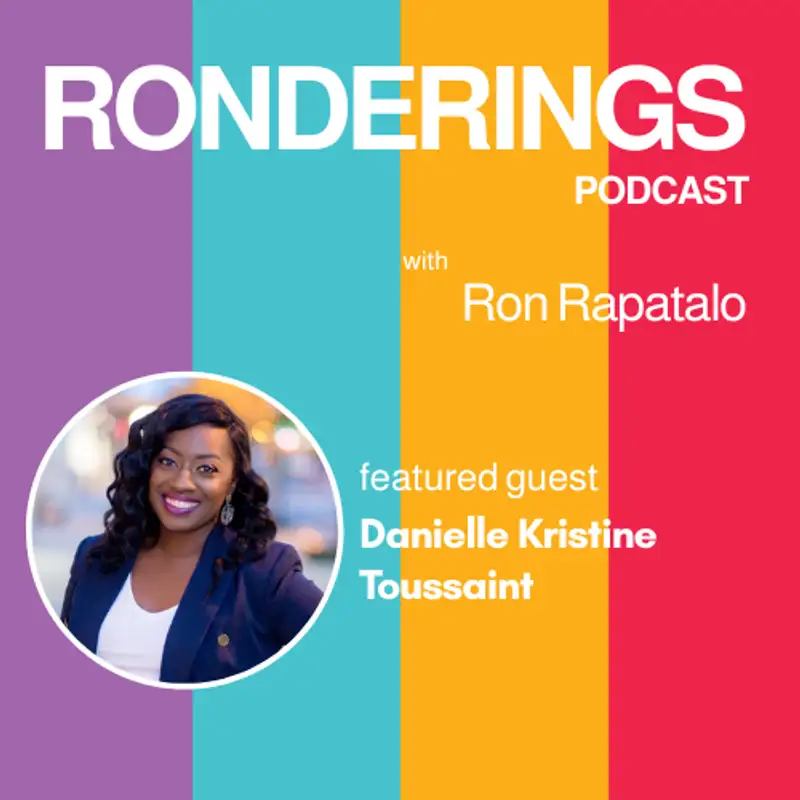
Ron Rapatalo:Let's get into it. Welcome back to Ronderings, where we unpack the stories behind how leaders lead with heart, purpose, and humanity. Today, I'm joined by Danielle Kristine Toussaint, founder and chief strategist of Purple House, a communications consultancy helping CEOs and social impact leaders say what they mean with clarity and compassion. Danielle's journey started early. She threw her teacher's retirement party in third grade, and that spark of leadership never faded.
Ron Rapatalo:For being a first generation student navigating Yale, to shaping the messages that move people, Danielle has built a career on one simple but profound truth, communication is strategic intelligence. In this Ronderings episode, we dive into mentorship across difference, power availability without oversharing, how leaders can build trust when the world feels loud and uncertain. Let's dive in. Hey, friends. Before we get started, I wanna share something that's been a big part of my own journey.
Ron Rapatalo:Two years ago, I published my book Leverage. That experience cracked something open for me. I saw how publishing isn't just about pages, about owning your story, sharpening your voice, and amplifying your impact. The part that meant the most, readers reached out to me to say they felt seen. That's when I knew this work mattered.
Ron Rapatalo:I loved it so much I cofounded Leverage Publishing Group with friends who would make know this world inside and out. Now we help leaders, entrepreneurs, and change makers turn their ideas into books and podcasts that actually move people. Got a star in you, and I know you do. Let's chat. Find me on LinkedIn or at leveragepublishinggroup.com.
Ron Rapatalo:Because the world doesn't just need more books, it needs your book. Alright. Let's get to today's episode. Peace. Ronderings universe.
Ron Rapatalo:I have a dear ed friend who's branched out outside of the education space who I have to share how we got on this podcast together because we're both in education leaders of color and met at the national convening, I believe, the first time in person back in Baltimore. I have to ask you some Baltimore questions because my wife is from Baltimore. And she commented on LinkedIn on a past Ronderings episode with my dear friend Shakira Pettit. And I was like, oh, shit. Of course, Danielle needs to be a guest.
Ron Rapatalo:My god. So I just asked on a reply to her comment. She's like, yeah, I'm down. Hit me up. I was like, yes.
Ron Rapatalo:Yes. So Danielle Kristine Toussaint is on the mic today. How are you doing?
Danielle Kristine Toussaint:I'm excited to be here. And thank you. Thank you for inviting me on. I've been watching a lot of your episodes for a while now, so this is pretty cool.
Ron Rapatalo:Uh-oh, look at that. You know, in having someone that works in comms and external affairs and supports CEOs and like that feels that just made my heart go beep beep. Beep beep. Oh, she's like, okay. Alright.
Ron Rapatalo:Thank you for that. Well, let's dive right into it. What is your story?
Danielle Kristine Toussaint:My story is that I have been loved and encouraged every step of the way from the earliest, earliest, earliest stages of my life. And so I'm like that girl who showed up at kindergarten already reading above grade level. And not because my parents were college educated, they hadn't finished their post secondary journeys and they wouldn't actually finish them until my late teens. Let's keep that in mind. These were just people who knew they wanted something different and better for their kids.
Danielle Kristine Toussaint:So we were Sesame Street kids. Any piece of learning content my mom could get her hands on, free library, they just did all the stuff without even knowing it was the right stuff. And so by third grade, school was like the thing that I was killing. And I just felt like I had this vision of who I could be because it was coming to me. I was finding so much joy in what I was learning and engagement.
Danielle Kristine Toussaint:And I, you know, I had some educators that did a lot of early encouraging too. And so I threw my third grade teacher a retirement party, Ron. Like I was able to convince the librarian like, the principal to let us, be decoys. Like, I was involved. And I didn't realize how abnormal that was, right?
Danielle Kristine Toussaint:That, like, the kids sort of listened to me, the teachers sort of responded to me, like leadership came really easily to me. And I didn't realize it then, but it was just like the influencing, right? Like the ability to see things, get other people excited about and to have them trust that you are the right person to do it, not because of authority, but just because of the active engagement of the people around you. I always knew that I was going to be leading and just doing stuff because I was just that bossy, talkative girl who was always, you know, seeming to be a step ahead. But I realized I wasn't a step ahead, you know, a step ahead on my own.
Danielle Kristine Toussaint:I was there because so many people were nurturing and seeing the promise and watering it at every step. So who I am now as a founder, who I am as a leader of other leaders, a coach and support to other leaders is always coming from this bank of generous pouring in and love. Like, I just want other people to always feel that same nurturing and belief, even when they don't see it yet for themselves, or they haven't always had people echo that for them. I'm everybody's biggest cheerleader in comms, strategic comms, executive comms is the one place that I get to really do that in an intimate way with leaders I admire who are doing work that matters, because leadership is hard. It often gets treated as a sort of individual sport when it is in fact a team sport always.
Danielle Kristine Toussaint:And so I get to be that team and that support for those who are trying to show up in the world against, you know, a lot of counter forces sometimes.
Ron Rapatalo:There's something you said about all the folks along the way that have poured and supported you. This is a very rawness question for me to ask all of my guests, right? I'm sure there are several anecdotes and stories about folks who've poured into you along the way. But is there one that immediately comes to mind is like, this particular anecdote and story taught me this about leadership?
Danielle Kristine Toussaint:I'm thinking a lot about a gentleman named Ted Swenson, who was the chair of the Dwight Hall Board of Directors when I was an undergrad at Yale.
Ron Rapatalo:Yeah,
Danielle Kristine Toussaint:and this is the Yale's nonprofit on campus. And it's like the training ground for so many of us who then go on into nonprofit leadership and social entrepreneurship. And it was my first time being on a board. Like I signed up and I was like, I should be on the board. I didn't know anything about the rules of engagement for a board.
Danielle Kristine Toussaint:I didn't know how you start and end a meeting. Didn't know, like, I just found myself in this space with like, a mix of trustees and other people who were just like, they all seemed to know what they were doing and how to do it. And I remember him taking such an early interest in me during that experience. And like in between breaks, he would always find his way over to my chair to ask, you know, how am I doing and what did I notice? And like just sort of putting me on game so that I could meaningfully participate and not awkwardly feel silenced because I just didn't know.
Danielle Kristine Toussaint:And over the two years of that tenure, he was a mentor. He supported me if I was applying to grad school. At every sort of point, I can remember a call with Ted or a touch in with Ted. And more recently, there was a celebration for him like for like a milestone birthday and his wife called and was like, You're on the list of people that my husband would want to reach out to, but I've never met you. Like, how do you even know him?
Danielle Kristine Toussaint:And I got a chance to tell her the story and she's like, It's been so hard to get ahold of you without going through him because you're the only person our family doesn't know. But I was able to share with her just like the mentorship story and like what it's And the timing didn't work out for me to be with them in person and otherwise, but I've been able to find another way to reach out. But I would say Ted, what he even then, right, was a much older white gentleman from a different background than mine. His life experiences, the industry, everything that he did, it felt foreign to me. But our friendship, our mentorship, his investment bridged so many gaps for me in just understanding.
Danielle Kristine Toussaint:And so what keeps showing up for me is like, how do we connect with people across lines of difference? How do we learn to trust that even though someone may not immediately have all the same details of their story that we do, that our values can be super aligned. When he talks about his dad and his family, it reminded me so much of things that I saw in my own dad, my own family. And so there's always a point of connection if we're looking for it. If we're only looking for the things that are not going to make us feel connected, we'll find that in abundance.
Danielle Kristine Toussaint:But I think right now more than ever, we need to be looking for humanity and shared connection with people. And I'll never forget his generosity. It's done so much for me in nonprofit and other leadership, but mostly it's just been cool to have a friend who brings a different perspective for so many years than my own.
Ron Rapatalo:Those points of shit, there's something around you said around points of shared connection and working across lines of difference that really deeply resonates with me. As someone who grew up in New York and grew up around the way and got to meet a lot of different people. Right? It's something that I think, fast forward, I think leaders like you and I, that just makes a lot of sense to us because of the professional and personal experience you've had to be situated in these places and and these organizations where you're working with you're just around a host of such different people. And so if you rewind, like, back to that experience, like, what was that Danielle like?
Ron Rapatalo:Like, talk us through Danielle when you first met Ted and where you were in your leadership journey at the time.
Danielle Kristine Toussaint:I was doing the most, but that's not atypical, right? Like, you know, as an undergrad, I was involved in so many extracurriculars. And I also feel like it was hard for me sometimes to no one had prepared me to engage with my own learning style truly, right? Like there's a way that you do school K-twelve.
Ron Rapatalo:Yes.
Danielle Kristine Toussaint:But then you get dropped into a university setting. And for those who didn't go to the types of high school experiences that were directly designed to train you to engage in a certain kind of learning, you are now like the you are now being asked to direct your own learning and path, maybe for the first time, like not having it scheduled out for you. So I would say that that element, it wasn't that I was first gen to college, but I was definitely first gen at an elite institution that was resourced and set up in a certain way with a certain demographic of other students, right? Like for most of my family, they started their sort of higher ed journeys at community colleges, and then pathways into like state universities or more local universities. Lots of my family members went to school while they were going to college like, was always a both and.
Danielle Kristine Toussaint:And I had this totally different experience than them. So that first gen element of it was always present for me. And, you know, you're kind of taught like, you just act like, you know, you don't let people know that you're there for the first time, you just fake it till you make it. And so I'm very observant, and I'm a quick study, and I don't mind asking questions. But there's always this hesitance when you're new and in different spaces of leadership where it's like, well, I was really good here, but will it translate?
Danielle Kristine Toussaint:Will I be good enough in this next space? Are my ideas actually valid enough? Like, will people want to hear from me here? And even if you know the answer is yes, you still are testing it out to find out if it's true. Yeah.
Danielle Kristine Toussaint:It wasn't ever a lack of confidence, but there was certainly a lack of comfort that I was experiencing throughout undergrad, because every single thing felt new. It was exciting. I was loving it. But I felt outside of myself a lot and always having to check back in with like, what are the core parts of me that I keep bringing along? And then what are the things that I need to learn, refine, expand in around, you know, just about how I function, how I show up, what I do.
Danielle Kristine Toussaint:And I just was appreciative. I've always been appreciative that like, if someone asks me the earliest and most important inspirations, they stay the same. Like when I really am in a pinch and I have to think about what to do. It's not something in a textbook that comes to me. I mean, love her to death, but it's not something like Brene Brown said, it is almost always something that my mother or my grandmother or my father, like the people who I know, know me, love me.
Danielle Kristine Toussaint:It is always what they said that is going to come to mind first to help me remember who I am and meet the moment. But not everybody has that, right? Like not everyone has that sort of foundation to come back to. And so I know for me, was always bothand. I never wanted to rip out the foundation of who is the core of me, but I did want to keep building on it to become like the best version of me.
Danielle Kristine Toussaint:And I think, yeah, there's been so many mentors who've shown up at different moments to help me on that journey.
Ron Rapatalo:Yeah. Wow. Part of me wanted to go who the core of you is, but I think that'll expand as we I want to ask what was like the first immediate question I thought about, like, because we're in your college years to because you said something around you always knew you would lead. So I'm curious as you've gone through your career journey, like, how did that look like for you to find what you eventually wanted to do? Because I think what I've often found in Roderick's episodes is like very few of my guests where they started in college is where they ended up.
Ron Rapatalo:Yeah. Right? Phew. Like I was supposed to be a doctor. I was pre med like every good Filipino, disappointed my mom, ran through different careers.
Ron Rapatalo:If I would have said I would have written a book and I would have a podcast and I would be this external person who relies on relationships. I'm like, that'll pay you shit. What are you talking about? People don't get paid for that. They're paid for how smart they are.
Ron Rapatalo:Right? Exactly. Not true. So I'd love to hear your story there.
Danielle Kristine Toussaint:I mean, this is maybe this is just a, like, children of immigrants thing. I don't know if this plays out everywhere, but like, you know, I this resonates with just the idea of like, you have to break everybody's hearts. Like, no, I'm not going be like a girl scientist. No, I'm not going be a lawyer. I applied as like a bio metal biomedical engineering major and was poli sci thought I was going to just like, do all the things.
Ron Rapatalo:My
Danielle Kristine Toussaint:god. It was a journey.
Ron Rapatalo:Like you had been in college for twenty years.
Danielle Kristine Toussaint:Yeah, it was a journey.
Ron Rapatalo:Yeah.
Danielle Kristine Toussaint:And, and comms and storytelling and narrative and influencing people ended up being the thing. But I if I'm being honest, yeah, it was always the thing. And what I don't know that sometimes and I think this is really for parents, I think parents are getting better at this. I'm seeing it even in my own family where like, I think we're getting this level right of like, honor the gifts in the child that is in front of you. You this is not like a build a child and this we are already this is an add water, right?
Danielle Kristine Toussaint:So like, they're already telling you what they're going to be the seed already told you what it was going to be. If you're holding pumpkin seeds, you're not getting apples, right? So it's like, add water and nurture the thing that's in front of you, the person, the human in front of you. And, you know, like, I've had all the great conversations with my parents about this afterwards, and I think they're pretty cool with how it all turned out. But it was hard because they just wanted you to be successful.
Danielle Kristine Toussaint:They wanted you to know you're gonna be okay, and they want you to be able to pay your bills.
Ron Rapatalo:Right.
Danielle Kristine Toussaint:And there wasn't a lot of discussion around alternative paths to doing that. So I don't think the tension was in me around the things I loved. And I feel like that's why I was involved in so many extracurricular things. Because even if my core classes weren't giving me that thing, I was like, well, what is it like to, like, run this conference or like, team up with friends who are launching the first digital magazine on campus? Like, we were doing all kinds of stuff that was really pointing me towards what I really loved.
Danielle Kristine Toussaint:And, and I had all of these threads in me like so there is this line that if I connect all the dots, there's no real deviation. But I was doing a lot at one point, almost running in some ways from the thing that was probably my calling all along.
Ron Rapatalo:That really resonates when I reflect on my own college experience at NYU. I always like to joke around that my college degree, which is downstairs in our 1st Floor, should not say degree bachelor of science in neuroscience. It should say bachelor of, like, student life in, like, leadership because that's where I got the most instructive learning in leadership and moving people, failing miserably at times, but also being wildly successful with some things. Right? And then learning to love coaching.
Ron Rapatalo:I didn't realize how much I loved coaching
Danielle Kristine Toussaint:Mhmm.
Ron Rapatalo:Until I started doing an undergrad doing being a freshman orientation leader, being a resident assistant, being, like, a peers ear, like, being in a peer referral service. So all of the like, the being someone who created space for others, in my head, I'm like, oh, those are fun things to be giving back, but, like, ain't nobody gonna pay for it. I got my poor social like, know, it just I had all these thoughts. Like, what do you because that financial stability that our parents wanted for for us as children of immigrants, I think was a real big push to say, you have to build stability. These professional things provide you stability.
Ron Rapatalo:And there's also, I think, kind of a prestige that these things to be clear. Right? You know, that I think also pushes many folks many parents, like, push their children into these things because it's like, well, we would be proud of you. And, like, it just you know? So there's that element as well.
Ron Rapatalo:So Yeah.
Danielle Kristine Toussaint:And because they know you can. Like, I just wanna name that. They're also it's gotta be a lot when they see they've seen you do so much. They're like, oh, you can go to the moon. Right?
Danielle Kristine Toussaint:And they just start they never wanna be the one who's putting a cap on your potential. And so in some ways, you know, some kids say, I want to be this, I want to be that. And it's like, okay, sweetie, like, we're gonna hope you get there too. And then there are other kids that say, I want to be this. And they're like, Oh, yeah, 100%.
Danielle Kristine Toussaint:And they just want to like, keep nurturing the ambition, but there just has to be space and room to flex. I didn't know that some of these career paths existed. No one had ever talked to me about what it was to lead a creative intelligence agency. Like the words that even describe the work that I do probably didn't exist in anyone's workforce vernacular when I was five ten fifteen twenty. And so right, even terms like social entrepreneurship, are I'm probably older than right.
Danielle Kristine Toussaint:So it's kind of like, these are things to keep in mind when we say like, what they were setting us up for was believing we could do anything, even the hardest things. And that's the richness. And then the part that I think is on us is to define like, what does that actually look like in practice? And how do we keep expanding what is possible for the next generation that come after us.
Ron Rapatalo:Alright. Let me keep it real. A lot of us have write a book sitting in our goals list, maybe for years. I sure did. Good news is there's more than one way to get it done.
Ron Rapatalo:If you've got more money than time, a ghostwriter can help bring your story to life. If you got more time than money, a great book coach can guide you through the process step by step. If you've already written a thing, you'll want someone to shepherd you through publishing so you don't waste time or cash. Here's the thing though, no matter how you do it, the real win is writing the right book. The one that builds your credibility, grows your business, and actually makes a difference.
Ron Rapatalo:That's what the team at Books That Matter is all about. Head to booksthatmatter.org and get some feedback in your ID or manuscript. Don't sit on it any longer, your book could be exactly what the world needs. So I'm gonna fast forward because I don't wanna do the, like, resume walk conversation that sometimes I've done in some Ronderings episodes because I was like, I don't think that's all that interesting, although I'm sure I would get some good stuff out of you. Right?
Ron Rapatalo:But let me fast forward to what you're doing today. I'm gonna kind of jump over a bunch of stuff and talk to me about what you do at Purple House. I wanna hear about your framework. I wanna hear some thinking about your new book, which we were able to talk about in our pre green room conversation. So I'm going to give you space to talk about what you're doing today.
Danielle Kristine Toussaint:Ah, okay. Well, at least one of my clients today is one of your former ronderings guests, Dr. Isha Mon.
Ron Rapatalo:The world, it's small. It's small. Oh my god.
Danielle Kristine Toussaint:I get to work with really amazing CEOs and their teams to align their executive presence, voice and leadership, right, in ways that are capacity building for their org. So lots of people think of comms as, you know, the things you do that make it sound good. They think of it maybe as your social or your website or the instruments, but not as intelligence. That is really important in your organization. The comms are the listeners, they're the translators, they are the of, they're the pulse checkers.
Danielle Kristine Toussaint:And so to really understand what is true and what is resonant and what will move in the real world is to think of it through the lens of the way that a communications person does, which is to understand, am I activating real feeling, right? Am I helping people have the clarity to know what to do? And am I also thinking always about what they need to know and understand? Right? So if you don't have that level of clarity, you don't actually have strategy.
Danielle Kristine Toussaint:And I think lots of people miss how much comms and the creative intelligence that goes into understanding human motivation and how we engage with story and the narratives that are playing in our head that move us to either do this or that matter when we have mission driven organizations, right? Because the idea is to move people to action. And you can't move people to act if you haven't moved them to feel and think differently. And so that's the core of my work is like really getting in there with CEOs, helping them do everything from structure their comms and staff it. We also provide a lot of the content and capacity support around designing product experiences, ghostwriting, speech writing, all of that.
Danielle Kristine Toussaint:But it's really about thinking what are your aims? How are you trying to grow? And what are the messages that people need to hear from you? How many times do they need to hear them? Where do they need to hear them for them to go along with you on the journey?
Ron Rapatalo:Yeah,
Danielle Kristine Toussaint:it's been a lot of fun. And I think what we're learning is that I will say what I'm definitely learning and what I felt coming into the top of 2025 was that lots of leaders were just getting stuck, Ron. Like they wanted to be out there, but being out there is scary. Being out there makes you a target. Being out there feels like a waste of time because every everybody's trying to be out there.
Danielle Kristine Toussaint:And people are like, where is even the there? And so we had to take a step back and build a framework to help leaders, you know, think about how to show up and what to say. And so like the say what you mean framework is really grounded in helping them respond to complex moments and figure out that even though silence may feel like safety, it's actually not.
Ron Rapatalo:Yeah.
Danielle Kristine Toussaint:But just because you're not silent doesn't mean you need to be speaking always on everything that there is a discipline to this. There is both science and art to how to communicate and lead. And so that's what we've been spending a lot of time on.
Ron Rapatalo:I reflect on the name of your framework because it's something that in growing up in New York, I could swear my mom, people on the street, say what you mean is such a vernacular and, like, growing up around the way that hearing that as your framework, it's thick because it's say what you mean. Like, excuse my what the fuck else is there? You know I'm saying? It's just a it's very plain and to the point. Now getting there, and as we know, when you think about the leadership frame of this, right, you know, if I think about my curiosity question here is, you know, getting to know CEOs like you have, right?
Ron Rapatalo:Especially in our space, right? Is there's how they lead, what they're bringing into the space, what the org needs, and how to, like, I would say thread that needle to be able to, like, have that all aligned. Right? And my curiosity goes into how the CEO is able to, at some level, stay true to who they are, but shape shift enough to be able to get the organization to be able to, like, share the story in a way that, like, goes with, like, where their grounding is without changing their grounding fully. So talk to me a little bit about that.
Ron Rapatalo:Right? Because that's always something of like classic example. Right? I know folks like, I don't like to be external. I don't like to talk a lot.
Ron Rapatalo:I might have a certain voice that comes across a certain way. And therefore, when I talk externally, people don't get to see the full me because I don't want people to see the full me because why should I give you access to that? Right? That's something I hear enough with leaders. I'm just like, but people wanna know you.
Ron Rapatalo:Mhmm. It all. But how do you still keep some of that stuff sacred, but they still get to know you, but it's not all of you?
Danielle Kristine Toussaint:Yeah. Well, we help folks. I think the clarity part of our model is where we spend quite a bit of time, and I'll talk a little bit about the compassion part as well. Beautiful. On the clarity part, it's like, let's not confuse and conflate disclosure with vulnerability.
Danielle Kristine Toussaint:What people want is vulnerability, right? Like they want to know that you are a human who recognizes yourself as a human fallible, imperfect, capable of getting things wrong, and therefore they can trust you because you're not just showing up with this perfect presentation of yourself, but it's really just a proxy, it's not you. So they want to make sure you are not sending your representative. That's what they're going after. That in no way means disclosing all your business.
Danielle Kristine Toussaint:And I'm like, some people, you know, engage in a certain type of content creation that is like showing you everything they're doing in their day, every thought, it's sort of this streaming run of consciousness of their life. That Ed TV approach works for some people because they really embody it and it's what they want to do. But you knowing what I ate for breakfast, I swear, does not tell you anything about my leadership. Right? It just doesn't.
Danielle Kristine Toussaint:So I am not one of those people actually who's the disclose all the details of my life, but, but I let you know who I am and I let you know what I stand for. And I let you know what the non negotiables in my leadership are. So you can decide if that's for you and we're looking for each other, then we have a way to partner. And leaders do need to do that. But what's hard is that by the time you get to be an executive leader, you have had to be so many things over the course of your career.
Ron Rapatalo:Oh, God, you have. Yeah.
Danielle Kristine Toussaint:That you probably haven't taken time lately to stop, check-in with yourself and ask a set of questions that would let you give real direction to your comms team and the folks that are supporting you so that they know where to meet you. And you may not have been thoughtful or like brave enough at the start to have the conversation with like, let's say your board of directors. They really know, again, apart from the resume, who you are, what you stand for, where those things directly overlap and where they might diverge organizationally, and then make a game plan for when those moments arise. So you do know what you're responding to and how those are really important conversations for leaders to have it rough and having them too late. Something has happened.
Danielle Kristine Toussaint:They now want you to put out a statement and you're like, I can't, I won't, it violates these, but you've never talked about it before you're in that moment of crisis. So it gets really tough. Now you've got this friction. So we're helping leaders say, start thinking about, again, comms as capacity in your leadership from day one and who you need to message, who you need to be in conversation with, who you need to go alongside with. Last part on this is like, sometimes we think we are the person that has to say something, but do you have to say it by yourself?
Danielle Kristine Toussaint:Where's the rest of your crew? Like, where are the other leaders and other partners that are lined up who you know, believe the same things and are ready to go with you alongside you and not leave you by yourself to have to be the lone the lone voice?
Ron Rapatalo:It's got hope. You you want my phone? You you spoiled child. You always want daddy's phone. Oh my god.
Ron Rapatalo:You know, it's funny. So he's not your own. Oh my god. This will all be included in the episode, by the way, because one of
Danielle Kristine Toussaint:the things I've learned right?
Ron Rapatalo:So when I was talking to my production team and they'll laugh at this, I was like, oh, I remember hearing some, like, my kids were in the background. Was like, actually, they were like, I think this works really well because this is your ronderings spot. It gives people a little bit of a glimpse. So, like, you're okay with that staying in. I'm like, yeah.
Ron Rapatalo:Yeah. Why not? So here we go. Because the kids got home from after school today. So they're
Danielle Kristine Toussaint:It's that time.
Ron Rapatalo:It it it is that time. I saw I saw my oldest bring pizza like, oh, so what's good for dinner? Anyway, what I wanted to ask you about, right, is obviously we'd be remiss not to talk about this, like, moment that we're in without talking about it in any kind of depth and blah blah blah blah blah blah blah Right? But we are in a moment.
Danielle Kristine Toussaint:We're in a moment.
Ron Rapatalo:And certainly the CEOs of social impact organizations are. Like, you coach them. You know them. I know them. I'm trying to sell services to them, I coach some of them too, right, through various ventures, right?
Ron Rapatalo:And it is incredibly difficult to do this job. Yeah. Right? And especially when I think about this in my head, right? I think CEOs and social impact orgs understand comm is important, all these things, but they're also, do we have enough money coming in?
Ron Rapatalo:Wait a second. How's my how's my staff feeling? Right? And with all this stuff, like, can I pay them enough? Are they am I get are we giving them too much?
Ron Rapatalo:Oh my god. We may need to lay people off. There's all these things. And, oh, wait. The fear of, like, alright.
Ron Rapatalo:Is something gonna happen if we get out there? And all the other things. Right? And so I'm wondering how much of your approach in doing comms and external affairs has shifted in this particular climate to meet the moment of where these CEOs are.
Danielle Kristine Toussaint:I would say that two dimensions of the work have become even more important, and I emphasize them, but it's not different. Okay. Because everything I'm doing is directly responsive to the moment that they're in right now. Like we're not designing strategies for two years ago, we're designing strategies with them for right now how to get through this moment, to still use the comms investments that they're making to help them achieve their revenue targets, etc. All that I would say is that you need it more than ever.
Danielle Kristine Toussaint:Communications becomes your lifeline in the moments of crisis, in the moments of greatest complexity, in the moments where you have to respond because people need to keep feeling like they're hearing from you and you're guiding them, right? Like there's folks that are literally in your charge and care as a leader, which means that you are always communicating whether you are doing it intentionally and well or not. Silence is also communication. So why not make your communication count? Why not make it strategic?
Danielle Kristine Toussaint:Which is to say that just having a regular rhythm and cadence, even if what you're sharing is the things you still don't know, the choice to do that is translating as trust building, as someone who is not hiding the ball, as someone who is not up to something, right? Like people will continue to fill in the blanks for you when you say absolutely nothing. And so I'm not saying overshare or over disclose. Again, not everyone has the right or need to the same information, but I'm constantly working with leaders on how to have a predictable, regular cadence of touch points with the people who matter most to your work moving forward. So that one, you can get information coming into you, right?
Danielle Kristine Toussaint:Because you also can't just be shutting yourself off behind a closed door with three people and thinking that you are going to have enough information to solve for the complexity of this moment. You actually need to be broadening your, I would just say broadening your network and the set of people that you are both in dialogue with, but also receiving information from. It's not just about what you're saying right now. It's also about the quality of your listening. And it's about the breadth of voices that are in the dialogue with you.
Danielle Kristine Toussaint:That's where I see the differentiator.
Ron Rapatalo:Yeah. I mean, it's so imperative right now, I think, with how I think the term that I would use, not only urgent, but, like, there just feels like everyone is operating with less. Right? And so being able to, like you know, you talked about your early leadership journey of, like, realizing, like, when you lead, when you were, like, younger, it was bringing all these people together. You had folks following you.
Ron Rapatalo:And so if you have people that are following you and you're not letting them know what is going on, it just it gets even more imperative. I go back to something that Adam Grant said some some conversation ago on, like, one of his podcasts. He was just like, over communication is the bar. Yeah. Right?
Ron Rapatalo:And I think in this particular circumstance, I think it's something you and I, like, doing comms and external work in different ways. Right? We're just really good astute, like, culture assessors. And if folks don't overcommunicate, it really sticks out. I'm just like, it just it's something I will confess like, bothers me.
Ron Rapatalo:Right? Because I think with what folks you you can give is a level of, like, either I don't know or let me share with you what's going on because with everything going on, we'll provide some level of, like, stability with your word. It matters more than ever.
Danielle Kristine Toussaint:Mhmm. It's not even so so yes. Because over communication is usually that place where you feel like you have heard yourself say something so many times that you're sick of it yourself. And I often like to say once you hit that point, that is the point at which people have probably just started to get and have it stick what you've been saying all along. Level of repetition, someone was saying that, you know, historically we said a person needed to hear a message seven times in marketing before it would stick.
Danielle Kristine Toussaint:But they said now, given the inundation of information that people have, it is believed that that is not even enough. That the actual sticking point comes beyond seven touches. We don't know exactly how many, but we just know that people need to hear things and be reassured of things over and over and over again because they are constantly being bombarded with counter information. So yeah, that is a different way of defining what the job of the CEO is. And it might mean that like the definition of that executive leadership spot needs to mean delegating things that maybe historically we thought were just ours to do.
Danielle Kristine Toussaint:Yeah. In to make space and room for really embodying the communicator in charge, right? Like mandate of executive leadership. And it's uncomfortable if you feel like it's synonymous with you having to singularly be more visible and now therefore an easier target. And this is why I say the mandate is for boards to think differently about what leading through communications means.
Danielle Kristine Toussaint:How do you use board members as part of this broadening of this is not an an or it's a team sport. How do you bring in other executive team members along the way? So it's not just everybody's looking to the CEO? What does she say? No, no, no, no, no.
Danielle Kristine Toussaint:What do we say? And how do you equip your organization to have strong message discipline so that every step of the way you're not the sole leader, you know, of of this message. Like, that's the transformation that would. And
Ron Rapatalo:how have you like it's something I'm reflecting on, like, sitting on boards currently, other boards that I've been sitting on like that. That's hard. I don't know if I've ever yet personally experienced, like, that feeling of, yes, we are all aligned to the same message. I'm hopeful that I will be, like, with the boards that I sent another like, if we're not there yet, it doesn't mean that, like, bad things are happening. It just that takes time.
Ron Rapatalo:And so I'm wondering, like, what do you do in your practice to help CEOs? Because it sounds like when you get into this world of, like, supporting boards, I imagine that's also part of your practice, right, at Purple House. Right? Is do you do some, like, board support on comms too when you're supporting CEOs as part of these engagements? Or
Danielle Kristine Toussaint:I do I do what they ask me to do, Ron. So
Ron Rapatalo:I hear
Danielle Kristine Toussaint:that. So sometimes yes, right? But I would say this.
Ron Rapatalo:Okay.
Danielle Kristine Toussaint:No, we're not like, I want us to get out of, it's not uniformity. Being aligned and on the same page is not all of us doing the same job, right? We're not doing it in the same voice. But we are acknowledging that there is some work that every single person is doing. And I think this idea of a board that's just silent, and gives no backup to their leader, It makes each leader more vulnerable going alone.
Danielle Kristine Toussaint:So I will say like, we take people through this framework to identify where is the work in their organization. And even at the end of a say what you mean workshop, it ends with a commitment that each person sitting in this space has to make to the next conversation or action that they will take in service of shifting their leadership so that it is, you know, aligned with, like, just not just where they're headed, but like the core story that they want to be telling in the world. And some people's next conversation is like, I need to talk to my board chair. Like, I realize that they just don't really know who I am, what I'm about, the tension I'm feeling in this role. And I need to truly understand if they will have my back as I take the organization in this other direction.
Danielle Kristine Toussaint:Other people are like, I need to convene, you know, a parent advisory circle because I realize that I am saying these things as if I have the buy in, but I actually haven't checked in with this really important constituency about how I'm representing them. So it could just be like, I need to talk to my head of comms because I realize there's more that they need to know about who I am and what I'm bringing to this work, what I'm afraid of, and why I feel this necessity to line edit, you know, every single text that is going on a LinkedIn post, right? Like, why am I overly involved here? Why am I inserting I need to share with them where I am feeling this fear or this, you know, sort of vulnerability. And just knowing what is the right next conversation is sometimes enough of a next step.
Ron Rapatalo:Right.
Danielle Kristine Toussaint:Because I don't think it's being talked about enough at all. Again, if we had bad data coming from, you know, a survey that an organization put out, we'd spend a whole board meeting talking about that, right? Because we see that as intelligence that helps us inform our practice. We need to see creative intelligence the same way. When you're getting all of this information back around what is resonating with people, what they're feeling, what they're hearing and not hearing, that is the place to get curious and align so that your, you know, your org can move forward.
Ron Rapatalo:Quick pause in the action here. I know a lot of us leaders, entrepreneurs, folks just trying to do good work, and felt that grind of pushing a boulder uphill by ourselves. The learning is you don't actually have to do it all alone. Genius Discovery program at Thought Leader Path like having a think tank in your corner. It's not some cookie cutter formula, but your story, your plan of impact, giving you the clarity and assets to take the next big step.
Ron Rapatalo:I've seen people go through this and walk out with their voices amplified and they sharpened. Some even launching podcasts like this one Ronderings. So if you're tired of grinding in the dark and you're ready to step into your impact with right support, check out geniusdiscovery.org. That is really powerful. And I think, you know, I love the usage of the word creative intelligence.
Ron Rapatalo:Right? Because I think it's not something I've seen in social impact spaces has been yet fully embraced as it should be. Right? Because, you know, my take of having worked in, you know, the social impact sector, particularly k 12 ed for some time, is, like, it's a very I'll say it on the spot. I've said it in in, like, you know, hushed tones, but, like, it's a very intellectually nerdy space with lots of socially awkward people.
Ron Rapatalo:I'm just gonna say, like, that's it's not I'm intellectually nerdy, so I fit there. Socially awkward depends on the day, but I don't I don't know, but I don't think anybody that I know knows what considers me socially awkward. Like, he's like, Ron is the one who knows everybody, like, it's like, so I'm not so it just I find that, like, this reminds me of my high school experience. Right? This is not everybody where I went to high school with, but was this take of, like, everyone's really smart, but they don't really respect creative things.
Ron Rapatalo:Even though there are hella creative people, it's not ridiculous amounts of creative people have come out of Stuyvesant. Right? And that's, you know, when I like, stepping into a space, like, that's where the culture is. Like, I'm not surprised, like, the need for what your organization, Purple House's genius is, because it's something that if that was done better, which becomes around really listening to your constituents and the people you're, like, working closely with and your staff and your board, etcetera, to be able to have the story to tell and being able to, like, share good communication about it. Right?
Ron Rapatalo:But I think a lot of times in my head, I've seen, well, our work speaks for itself. Right? I'm like, no. No. That's should be.
Ron Rapatalo:I mean, shoot. The people don't know about it, it's like it doesn't and yet sometimes we've seen I see it on the other side of it. There are lots of orgs I've seen over the last twenty five years me being the sector to talk the good game. And you get underneath it, I'm like, oh, they dressed it up nice, but you're the one on the street, and you ask around. And see, you and I, we've been around like, I always like to say, if I took all the stuff that was in my head and said it, I would be I couldn't work in space no more.
Ron Rapatalo:Know too much. I do. I have to keep
Danielle Kristine Toussaint:So let me tell you about a moment where I had to get right with myself as I was starting to build this. And I'll share this quickly. I know we're getting close to our end. Like, I was at Forbes BLK Summit, and Fantasia Barrino was giving the keynote. Yes.
Danielle Kristine Toussaint:And so she was talking about, you know, her journey and entrepreneurship and having to like, rebuild, rebuild and the company she's building now. And she was saying, she realized something, that you can't build something successful to prove a point. You can't build anything if the foundation of it is a negative foundation. In other words, you only can build if you're trying create something positive and new and different because there's something you want to give. But if you're trying to build something to counteract or take down something else like that is you're going to be at odds with yourself because you're not allowing your full creativity to bloom because it's constrained by the fact that you're always trying to speak back to something else.
Danielle Kristine Toussaint:And so she was like, let it go, like whatever is the chip on your shoulder, whatever is the thing, let that thing go. So you can really just say, what is the thing I'm trying to build that I've never seen before that people can get excited about? And in that moment, sitting in that audience, I was like, I am going to have to let go of some stuff from my K-twelve education, like leadership, like this space of just feeling like, don't we get it? Right? I've been wanting us to tell a different and better story.
Danielle Kristine Toussaint:I've been wanting us to use brand and strategy and communications to really speak to real people. For as long as I've been working in this space, I've been doing comms and ed. And it took being outside of the space to actually see us more compassionately. Like, why are we? Why has this been so hard?
Danielle Kristine Toussaint:Why are we getting tripped up? And now I feel like what I'm building at Purple House is not about saying how we've done this is wrong. It's literally just about saying we can be unstoppable if we just choose to say the words that real people say. If we just choose to talk to people like they're people, if we just choose to be human, we're going to be unstoppable because this has always been about who we believe deserves to have access and opportunity and belief. And if we can just agree that we all do, and we start to speak to that possibility and hope in our hearts, like we will bring people with us.
Ron Rapatalo:Yeah,
Danielle Kristine Toussaint:it will feel different. And that's like Fantasia was part of me like reshaping, not like, let's just show them how it needs to be done because we've never been able to do it that way. It's like, no, no, no, no. Have nothing to prove.
Ron Rapatalo:Yeah,
Danielle Kristine Toussaint:this is about what we can build together. And we're all a part of this. And even those who stumbled over this in the past can get it right if we just keep at it.
Ron Rapatalo:Yeah. I'm gonna bring politics for a second, but you don't have to. Mamdani's run and winning New York City mayor masterclass in branding and being and using comms like master, master, master class. Because game recognize game. And the thing I've been saying in conversation, which I'm gonna say here, I think for the first time on the podcast, is there's so much of what Mamdani reminds me of to 2004 DNC Obama's speech.
Ron Rapatalo:Like that be like that feeling of like inspired, captivating, speaking to feel like feel like you speak to everybody, even if that might not have showed up in the numbers. But like this feeling of like you're speaking language I can understand. Yeah. And I think sometimes, like what I watch in politics is like people could be really wonky and you could see I have a bot because I'm a super emotionally intelligent, like, yeah, I can talk academic language, but that's not where I'm the most comfortable. And I think that's what I watch is like, yes, that that language is necessary and you have to talk language.
Ron Rapatalo:If you are looking to reach other people that are not the people in the bubble, you have to learn how they how to communicate with them in a way for them to understand. Right? And I think that's often what I in lots of sectors, I'm just like when I was a neuroscience major, I'm like, this stuff is so, like, heady, but, like, how do I make this like, if I would describe this to my mom, how do I describe like why the brain is so freaking important? Right. And I'm like, well, you know, the history of the brain.
Ron Rapatalo:We're like, I hear that kid.
Danielle Kristine Toussaint:No. And we literally go to sleep. But even the people who are doing it don't realize they're putting themselves to sleep. Like if you keep saying the same talking points and they're boring, but you're just doing it because it's what you're practiced in doing, just know that you're putting a part of yourself to sleep every single time. And you're going to look up ten, twenty years later, and you wonder why, like, you're not feeling the same connection and passion for your career and for the work and for the cause.
Danielle Kristine Toussaint:You feel so burnt out and exhausted. And it's like, because you killed the part of yourself that was alive in this and you buried it under layers and layers and layers of jargon. Right. And now you don't even recognize your original message. Anyways, I could have called my framework anything in the world.
Danielle Kristine Toussaint:I could have called this book anything in the world, but it's called Say What You Mean because that's what I want people to do. And I don't want to call it some long title of jargony way of saying, say what you mean. I just really want you to like, what did you mean to say? Did is that what you actually said? How could we get you closer to that?
Danielle Kristine Toussaint:I want it to be literally that simple, because I think that's what everyone deserves. And I think it is also a gift back to those of us who have been doing the academic wonky wonky speak for a long time, because we thought it's what we needed to do. So people would take us seriously and know we were smart. And it's my way of saying, we get it, boo boo, you're smart, you've been smart. And guess what, nobody cares.
Danielle Kristine Toussaint:They're not taking action because these words are now all running together. But if you just get a little bit clearer, and you really choose to convince people with story and not just fact, and you can show some compassion for their humanity and know that like, some part of this someone somewhere is going to disagree with and they're going to be right too. And that is okay. I don't know. I just think we'll have better conversations and then I think we'll get better results.
Ron Rapatalo:So Danielle, we're we're nearing our time. We've done a time check earlier. Do it. Think it's now time for your robbering. What's the lesson or value you wanna share today?
Danielle Kristine Toussaint:Just that the way we've been doing leadership for a really long time positions leaders to feel like once you get to the top, now you're all alone. It's all on you. Yeah. And it's not leadership is never an individualized sport, no matter what level you're playing. It's always a team sport.
Danielle Kristine Toussaint:And the way you build your team is to get really clear with them about what you believe, what your non negotiables are, what you want people to know, do and feel every time you're in their presence. And that's leading through communications, not communications as an afterthought, not it as, you know, sort of accoutrement, but like leadership as a capacity in your org driving you forward. That's that's what I want for every executive right now, because it's hard times.
Ron Rapatalo:Yeah.
Danielle Kristine Toussaint:But you can get through it if you just remember who you are and why you started doing this and and say what you mean. Resist the urge to just parrot what you think people want to hear or say nothing at all. Just there's there's a different way.
Ron Rapatalo:So I know I've got my social impact CEOs, EDs listening to this and their friends who are probably also at the leadership team. Right? Y'all needs to hire Purple House. Like, I'm gonna go ahead and put like, y'all need to come on, fam. Let's do this.
Ron Rapatalo:So Danielle, what do you wanna promote and how do people find you?
Danielle Kristine Toussaint:They can just find me on LinkedIn. I'm really active there. That's where I would say find Which
Ron Rapatalo:is how we interact too. I love it.
Danielle Kristine Toussaint:I'm there. It's like the one social platform I commit to for right now. We'll see if I grow to Substack next year, but it's LinkedIn for now. Okay. And I would say, just stay tuned.
Danielle Kristine Toussaint:Subscribe to my Purple Room newsletter. That's where you'll hear everything about Say What You Mean, the book and how to how to connect in the year ahead. And thank you, Ron. Like this platform is amazing. The leaders that you have profiled is amazing.
Danielle Kristine Toussaint:And I can't wait for episode 100.
Ron Rapatalo:I can't wait either. Well, this has been a blessing, Danielle, for taking take thank you for taking time out of your busy schedule to chat with me on ronderings and taking one of my sports heroes, the good old amazing cornerback wide receiver, Deion Sanders. We always come hot on ronderings. Peace y'all. That was then Danielle Toussaint reminding us that leadership isn't about having all the answers.
Ron Rapatalo:It's about communicating with intention, empathy, and conviction. Her say what you mean framework challenges leaders to speak with both clarity and compassion, especially in complex times. Because silence is still communication, and every message, spoken unspoken, shapes how people experience your leadership. If this conversation resonated, follow Danielle on LinkedIn. Subscribe to her Purple Room newsletter for insights that blend purpose and presence.
Ron Rapatalo:And as always, thank you for joining me on Ronderings. Reflection meets action, and leadership becomes human again. Peace. Before we wrap, I've gotta give a huge shout out to the crew that helps make Ronderings come alive every week, podcasts that matter. Their mission, simple but powerful.
Ron Rapatalo:Every great idea deserves a voice. So if you've been sitting on that spark of a show or story, don't overthink it. Just start. Head to podcastsmatter.com, and let their team bring your vision to life. Till next time.
Ron Rapatalo:Keep rondering. Keep growing. Keep sharing your voice with the world. Peace. Thank you for listening to today's Rondering.
Ron Rapatalo:I enjoyed hanging out with me and my guests, and I hope you leave with something worth chewing on. If it made you smile, think, or even roll your eyes in a good way, pass it along to someone else. I'm Ron Rapatalo, and until next time, keep rondering, keep laughing, and keep becoming.


Listen to Ronderings using one of many popular podcasting apps or directories.