 Episode 75
· 47:01
Ron Rapatalo 00:00:00: What's up? I'm Ron Rapatalo and this is the Ronderings Podcast. Around here, I sit down with guests for real, unpolished conversations about the lessons and values that shape them. And I'll be right there with you, sharing my own take, laughing at myself when I need to, and wondering out loud about this messy thing called life.
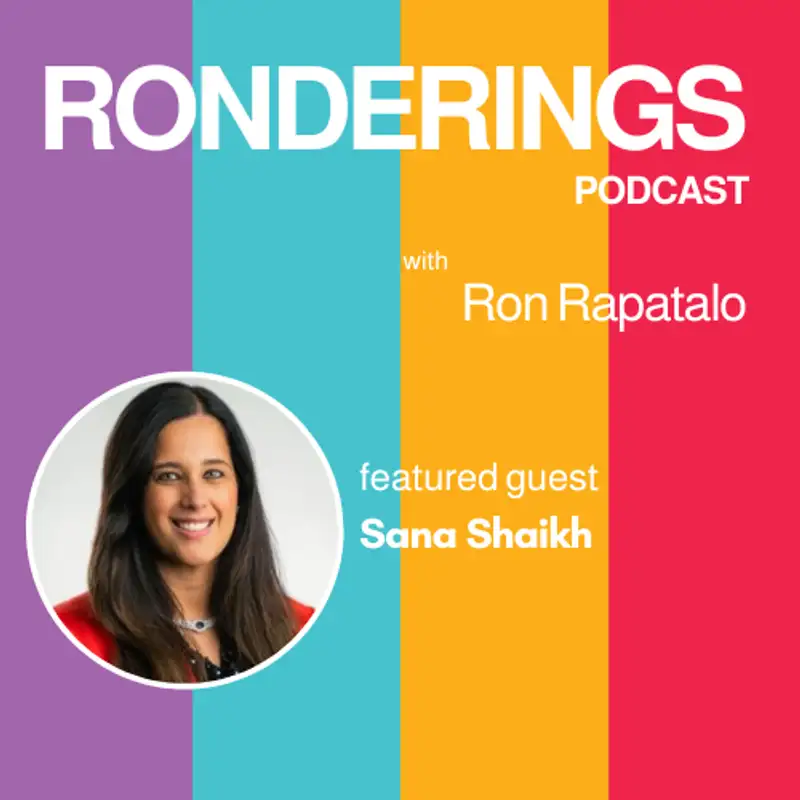
Pull up a chair. Let's get into it. Welcome to another episode of Randings where we explore the intersections of leadership, identity, and authentic connection. Today I'm joined by Dr. Sana Shaikh, a Pakistani American leader whose journey spans classrooms, policy tables, and philanthropic boardrooms from teaching high schoolers in East Baltimore through Teacher America to shaping economic development strategy at the community foundation for greater New Haven.
Sana has lived what she calls a sacred synthesis, blending policy, philanthropy, and public service into purpose. We talk about being a first generation immigrant, mother of three, and community builder fuels her work in creating systems that honor people's stories, not just their statistics. And we explore how curiosity, humility, and vulnerability redefine leadership in spaces that too often reward polish over presence.
Let's dive in. Hey friends, before we get started, I want to share something that's been a big part of my own journey. Two years ago, I published my book, Leverage. That experience cracked something open for me. I saw how publishing isn't just about pages, about owning your story, sharpening your voice, and amplifying your impact.
The part that meant the most, readers reached out to me to say they felt seen. That's when I knew this work mattered. I loved it so much. I co-ounded Leverage publishing group with friends who would make know this world inside and out.
Now we help leaders, entrepreneurs, and change makers turn their ideas into books and podcasts that actually move people. You got a star in you, and I know you do. Let's chat. Find me on LinkedIn or at leveragepublishinggroup.com cuz the world doesn't just need more books, it needs your book.
All right, let's get to today's episode. Peace. Ronda's Universe, one of my previous Ronda's podcast guest, our mutual friend, Travani Mackey, recommended that I talk to a friend that I didn't put two two together fit together with multi-hyphenated leader practices sacred syncism and I am so glad to be chopping up with Dr. Sana Shake. Sana, how are you doing today?
Sana Shaikh 00:02:40: I'm doing great, Ron. So excited to chat and even more excited that Travana put the stars together and got us all in the same space.
Ron Rapatalo 00:02:52: You know, you know what? It's funny because, you know, as I've reflected on broadening out the guests that I have on renderings, even as a recruiter, even as someone in this business development like you, I didn't start thinking about I should ask for more referrals till very recently. And so I was like, let me just hit up the my past guests.
I sent out a big BCC email and then it just started coming like wildfire. I was like, holy cajoli, Ron Rapids, sometimes you're in your own head cuz I would look through my LinkedIn list or my Facebook and just like funnel through people.
I'm like, "All right, what's my feel? Is this person you don't really know at the end of it all, right? Cuz what does a profile really say about these things, right? You have to trust in the wisdom of other people who you've had on things and say, I you need to talk to so and so." And I was like, "Oh sh of course this." Yikes. Ron, Ron, Ron, Ron. Well, I'm glad to have you on. So, let's get right to it. What is your story?
Sana Shaikh 00:04:18: I love that question. Yes, it's such a good question. But I think that for me personally, my story cannot start off without my first steps here in the United States. So, okay, story is anchored in coming to California as a first generation immigrant.
So, my dad, he did schooling in Davis. He went back home to Pakistan to get married to my mom and then our whole family here. So, for me, I'm very much first generation. My experience is anchored in being Pakistan. It's just hugely important of who I am.
So beyond. So there's like my professional trajectory. My personal story is always anchored in I am Pakistani first and I'm always going to be hyphenated. I'm always going to be Pakistani American.
Professionally my story started after Berkeley with Teach for America. So I went from Berkeley to the east coast. I was in Teach for America for two years. So I taught more and it was an incredibly pivotal moment in my life.
Ron Rapatalo 00:05:54: I Do you remember the school you taught at in East Baltimore?
Sana Shaikh 00:06:01: Oh, a million%. I It's like it's it's a component of my memory in perpetuity. So, I taught in East Baltimore, Lake Clifton. So, it used to be Lake Clifton, but then it specifically got triaged to Heritage High School. And it was a high school, but I specifically taught 10th, 11th, and 12th. So, literally everyone freshman.
Ron Rapatalo 00:06:34: And okay.
Sana Shaikh 00:06:37: you know, Teach for America is a very novel, very nuanced experience because you are 20 something going across the country and that kind of fundamentally shifted how I looked at the world because I always thought I was going to be in California, stay in California.
I was going to practice big law. I was going to do Teach for America for a few years and do that and then my life fundamentally shifted. So I got really interested in policy. I was really interested in make a systematized eventually ended up getting a doctorate and then through a variety of different worlds have landed now in economic development and so that is me in a nutshell. But I think for me the intersection of public policy, of philanthropy, of public service like that is a throughine.
Ron Rapatalo 00:08:12: Yeah. So I have to ask the Oprah Barbarara Walters question, right, which I tend to ask on Branding's episodes. I find that so many of the social impact leaders I meet like you that this doesn't just happen that often and I want to test this this comes from something around your family and like why you came here or something like that. So I'm curious this trajectory to teach for American to policy. How do you describe that story of like how you got there from like your upbringing and being first generation?
Sana Shaikh 00:09:12: You know I think that that bleeds into how I think every single day and who I am world. So in so many ways when I came from Pakistan I was in lucky. My dad, he had access to an education that he was a family filled with doctors and judges and engineers sort of like the trifecta.
Ron Rapatalo 00:09:40: Yeah.
Sana Shaikh 00:09:42: You know, that is that is definitely who we are, right? That is that the sort of like education component was anchored in me growing up. And so it's, you know, being a gunner, being an overachiever and all. And so my mom is a teacher, my was a professor. So, academic education was something that was always they were always anchored in who I am and how I grew up.
Ron Rapatalo 00:10:28: Yeah.
Sana Shaikh 00:10:31: I think for me when I did teach for America is when I saw the world with and have nots very much in my face. And it's something that when you see you can't really not see. You can't unsee.
And so I grew up with a with a perspective that if you work hard and If you have high aspirations and if you have high goals, you can achieve them. So, it's not necessarily a systematic thing that keeps people down. It's more of like how much you want something and how badly you're going to go for it.
And so, when I went from Granite Bay High School, which was very affluent, very white, to UC Berkeley in the heart of the tech Silicon Valley bubble, I had always just seen overachievers get what they want if they worked hard. And when I saw and went to Baltimore, it was a of you can work as hard as you want.
If you don't have food at the table if you don't have a parent who despite their best efforts can't be there for you because they're working three different jobs or if you are 16 years old and have five brothers and sisters and you are their caregiver.
Ron Rapatalo 00:11:54: Yes.
Sana Shaikh 00:11:57: Doesn't really matter how hard you work. It doesn't matter how smart you are on paper. It's just like the system is not designed to help you. And yes, I when I taught I felt like in many ways I was teaching myself but I was also seeing for the very first time how things can be just based on where you're born.
And because for years and years and years I had seen nothing but privilege. It wasn't until I was in Baltimore that I saw something different. So in many ways I have the immigrant experience in the sense that you know English is not my first language and I came and figured out it meant to be an American.
But in so many other ways, I had a privilege of having a two parent household. We were a well- educated family. We were a strongly middle-class family. And so having the luxury of being able to travel for debate or go to China to teach, like those are not things that are normative when you're struggling to get basic needs. And yeah, it sort of like reoriented how I looked at the world.
And it feels like when you are being afforded so many privileges. You have to do better for other people who are not afforded those privileges. And that has just been what has inspired me over my career. So yeah, that's the why.
Ron Rapatalo 00:13:58: I want to name two things and I should have known this, but let me let me tie together some personal stuff. My MS, who I'm going to connect you with because I mentioned that she's doing her Lee public policy fellowship. Guess where she was born and raised. Anna,
Sana Shaikh 00:14:23: don't tell me Baltimore.
Ron Rapatalo 00:14:26: Oh yeah. Correct the Yeah. I go we go to Baltimore quarterly because the go so her grandma lives in Edmonton Village or West Baltimore and we stay in Windsor Mill with her with her uncle and aunt who are the godparents to both of our kids like all the time. I am I am shocked that this is just.
Sana Shaikh 00:14:55: I'm It's Yeah, it's kind of Yeah.
Ron Rapatalo 00:15:02: And my own neighborhood here in Jersey City, which is a affectionately called the colony. Guess what ethnic group is predominantly in Ron Rapatello's neighborhood here in in Journal Square in Jersey City? Go ahead, Sana.
Sana Shaikh 00:15:18: Pakistani.
Ron Rapatalo 00:15:21: No, Pakistani Muslim. My entire neighborhood. There's a there is a mosque up the block from where I live. I It's I was like, "Holy s***, like your body's broke." Like to make sure We've both talked.
I'm like, and it's funny. I'm I don't know if you watching Disney Plus the the Miss Marvel one seat and the scene that was based in Jersey City and the high school that they use is the very popular well-known New Jersey magnet high school McNair as her fictitious high school. I was like, "Oh my god, this is like she lives in our neighborhood. She h if if she was really alive, she would be living in our neighborhood going to 99 Ranch."
Sana Shaikh 00:16:15: But can I tell you that I just I feel like yeah like I think that in the current moment we have to be global citizens like we have to be.
Ron Rapatalo 00:16:32: a billion% agree.
Sana Shaikh 00:16:35: like so much beauty and understanding there's so many other languages there's so many walks of life that people have been on to this moment and so like for me when I think about to your earlier question like what has been the ethos that has guided me or what has pulled me into the spaces I've gone in it is of wanting to learn the richness of other people's cultures in a way that's intentional and that values who they are where they right.
I'm here to learn from you and then that sort of intersection of global learners to being authentic and then the distinction of like okay I'm going to show up the only way I know how to show up which is me and then how do I use what I know to help make the world a little bit better.
And I think that for a lot of us We've seen the es and flows in like the political winds, but also seen the es and flows in the different verticals we're in. We realize change is actually painfully slow and you know.
Ron Rapatalo 00:17:58: who ain't it?.
Sana Shaikh 00:18:01: Think about trying to make a difference and sometimes we're like did I really make a difference or is it plateaued? And I think that when you bring different pieces of yourself to the work it's very hard to then disentangle those right then it's sort of like you're doing the thing because you want to do the thing.
Because it is you, it is for you, it is for your passion. And so I just think that it's so beautiful. It's very full circle, right? Like to be have to be global and you have to understand that you have the agency to do better.
Ron Rapatalo 00:18:48: Yeah. You know, as I reflect on that, right? You know, someone who still wants to travel more of the world, but has traveled enough certainly domestically. I want to travel more internationally. I haven't been everywhere, right?
But enough so far, right? And I'm only 50, so I think there's going to be more travel is growing up in New York City, which yes, I'm the cocky New York who says New York City is the capital of the world. Yeah, I because this is true, right? So, I just accept it as fact.
But the diversity of New York City and growing up around so many people and the privilege that I had to be in these esteemed places like a sty in NYU and then growing up around the way that I did, right, child of Filipino immigrants, youngest of seven, just sort of seeing enough and it builds, I think, a a huge empathy lens I think if things break right in my estimation right because certainly I don't know if I was I was always explicit about these values that you're just sharing with me right.
But I think similarly the proximity to get to know so many people and being community it widens your empathy muscle because you realize how similar we all are at the end of it all even of how people manifest said values has a lot of variance.
You go oh wait a second wait the way that you we oh and the way that we worship. Oh, and then Oh, and you go, wait a Oh, and then you examine the system versus the individual. This is where the stuff pops up, right?
And you realize how much you've been afforded to have when you then go places where people don't have the same things, right? It makes you question like, well, why is that, right? But you just ask that question. And this makes me curious about the transition from teaching in the classroom to policy. Like, how did you decide to get into policy work out of the classroom there?
Sana Shaikh 00:21:04: was serendipity that happened. So okay, it was serendipity and happen stance. So Mike Johnston, he does an urban leaders fellowship at the time and it was really for alums and so I went from Baltimore to Denver thinking I was going to be in for a summer.
Ron Rapatalo 00:21:30: Fascinating.
Sana Shaikh 00:21:33: and that fundamentally it shifted right so many fundamental shifts along the way of what possibility looks like because when you are in spaces you don't know you don't know and you are operating based on what you think that you'd be good at in that space.
So when I was an educator I was coming out of Berkeley with a polysai near exchange studies background global poverty and practice you know I was thinking law school is going to be my litmus test as a way of going what next steps look like and so when I went and did the policy fellowship I was like oh everything that I'm feeling is actually not just a feeling there's like language and then there's semantics there's history there's works.
There's all this behind it, right? And I worked in Teach for America for a bit kind of figuring out what sort of impact I could make on an institutional level. And then I dove myself into my PhD. And the curiosity and desire for knowledge was based on if I can define the thing, then I can fix the thing, right?
Because can go so far, but if I data at my side to like, okay, not just a SA thing, right? This is a a real thing. And I think particularly in education and policy, yeah, certain for better or for worse, right? Like certain things behind your name just make make your perspective seem more validated or at least that was my perspective at the time that if I'm equipped with a PhD, my voice will have more power. It'll reverberate, you know, more instinctive.
Ron Rapatalo 00:23:18: This reminds me why my MS got her doctorate. Ed policy it's a very similar journey of like wait I've been a practitioner it's like if I'm going to enfor policy I have to learn the semantics and the history and like the language behind it because being unfortunately being a practitioner is not enough.
Sana Shaikh 00:23:45: Yes it isn't I mean unfortunately and I and I'm so grateful for the journey but Ron what you were saying earlier deeply resonates because if you have the language if you don't have the people skills it doesn't matter how elevated your language is and now more than ever especially to in economic development and what I've learned in all the spaces that I've been working is you have to learn how to connect the person that you're speaking with.
Like you have to learn very very quickly and generally you don't have a lot of time to figure it out right you have like 15 seconds you're you're connecting with folks trying to figure out their background and you have to figure out what is the best way to connect with this person because relationships are worth their wave in platinum it is not what you know it is who values and trusts you And who's willing to elevate what you're saying?
Ron Rapatalo 00:25:05: The people around you to help you get the space to make a difference. Are you in my head, Sana? Are you in my head? Were you at the virtual building authentic connection event that I just did? Because this is exactly what we're talking about.
So, I'm going to tie this together because this is like if I'm not careful my tangents, we'll talk about a tangent for 30 minutes, right? Is I am currently an ambassador for a nonprofit called Found for social connection which ties together, you know, research and best practices to help organizations and communities and and local communities.
How to use building social connection as the fabric to move organizations and communities, right? And for me, makes a lot of intuitive sense. The best places I've ever been in a number of different circumstances, it's how we got along, the ability to to connect, right?
And there's something about you talk about how relationships are everything. Even if something is wonky as policy, those things only move if you're able to ascertain what is motivating someone, what what values they have, right? And you can't access that by coming in a certain way, right?
And so my question is for you, I'm curious around and you can answer this in anecdote, you can answer this in lesson or some whatever form that you're comfortable, but I'm curious about how you build authentic connections in your work. What does that look like? What's your feel for that?
How does Dr. Sana shake? Yes, Dr. Sana like go about because you have a doctorate, right? It's like I don't relationships. People might stare at like but I have a doctorate. But you talked about how relationships are are the premium. I'm curious.
Sana Shaikh 00:27:26: I love that question. I don't come to spaces with my doctorate as yeah right there unless someone you know unless someone wants to mention it or like oh you know I unless they're also in a doctorate program and that naturally comes to the conversation I never lead with my title for me when I meet someone I try to figure out what are they searching for.
Because we're all searching for something in this space right we're all looking for something and that something could be a warmly on a project that they're doing. It could be something like validation because they're insecure in that moment.
It could be something like affirmation because they might be a mom juggling three different things trying to get to the networking hour in time. It could be something like a CEO who doesn't really quite know what the language is for a thing, but they know that they need to delegate the thing to a group of people.
It could be someone coming in with an unability to know that they're struggling with something, but they know that they're struggling with a thing. And find that the desire for curiosity will make the person just tell you.
So when I come in spaces I simply just like you know not what do you do or where are you from but rather like how are you feeling what brought you here what was the more exciting part of the day and the types of questions that you ask are the types of responses that you give and what I've noticed it doesn't it's agnostic of title it doesn't really matter what the person does.
But if they see something someone naturally curious wanting to hear from them, people will open up about such intimate details that you didn't think that they were going to. And I think there is a desire to want to connect with people. And people are just looking for an excuse to want to connect.
And if someone to them with a desire for curiosity, a desire to truly engage, a want to engage, they will share whatever you want them to share with you. If you're coming with good intent, And so I think that for me when I come into spaces I'm happy to answer the questions that I elicit.
So it has to be a two-way street. So you have to be as vulnerable as you are pushing the other person to be vulnerable about. You know you can't just be like hey you know tell me your deepest darkest secret but I can't tell you. I can only tell you my most professionally polished version of myself.
So you know it's something to your point like you know being a mom and being a professional, you know, being a woman of color, being an immigrant, like these are not things that I can choose or not choose. These are just who I am that just come into spaces with me. So, when I do the work that I've done, I've done that having three kids, you know, I have twins, I have a two-year-old,
Ron Rapatalo 00:30:52: a beautiful
Sana Shaikh 00:30:54: and I have a husband with a very intensive job. And so, while balancing all of those things, generally I live like six 5 different lives before coming to work at 8:30 or I'm I have many many lives after I'm done with the last networking hour at 8:00 p.m.
And you know so when you're talking with someone it's not like oh I had a great you know day where everything's polished and perfect. It's like you know right you done during co season dropping off your child before Thanksgiving break to get to sch smoozing over shakurerie like and folks are like let me tell you about this.
And I think when you naturally connect with someone you know to your point it's just you become likable like you're you're you're talking about the same thing you're vulnerable about the same thing and then you can easily triage to any topic.
You know I always found that getting a PhD was not hard per se; it was like the balance of doing it with so many other like milestones.
Ron Rapatalo 00:32:12: oh my gosh yeah life also had a similar experience. But thousand% I watched her just about every Thursday, even Summers, take a Thursday night class from 5 to 8. And that was just class. It's not the readings. It's not the writing.
It's not the combo she had with her mentor professor. It just it like when she had her graduation at form in May, just the amount of elation and the amount of it just was Because what she the data point she told me like half of her class only half of them got their PhD their their not PhD because it was EDDD that they got their EDDD at the time because you have so many other life and other things right.
That just you know it's not like people aren't trying but a lot of things happen right my MS had her you know she originally was going to ask for you know permission from a school district you know to be able to use data but was like, oh, that particular state got rid of their high school graduation requirements.
So, it's like, oh, we can't use that. There was no, it just and then rewrite rethink the entire like dissertation as a result, right? It just added and she still did it on time. I don't know how, you know, I don't think people see that, right? They see, oh, you graduated on something, but it's like the amount of work and discipline and sacrifice is tremendous tremendous.
Sana Shaikh 00:34:18: having supporting partners. So, you know, you were probably an anchor for her throughout her her whole journey and I think that that is something that folks are messed to talk about very openly that it's not simply just an academic feat that you can write.
You can take a lot of data, you can take in a lot of information, you can read thousands of pages a week and you can just spit out a beautiful thematic essay. Like it's not simply like that.
Ron Rapatalo 00:34:52: Yeah.
Sana Shaikh 00:34:54: Emotional labor, right? It is physical labor because you're having a family throughout it all. You're moving throughout it all. You're operating all the institutional pieces that we talked about before.
And as we get older, you know, as we adult or, you know, life is more life thing. We're adulting more at varying decades of our life, you know, you're constantly also navigating the changing ecosystem, right?
So, you're like as non sexy as taxes while, you know, popping your dayare while figuring out the nanny, you know, all of the things to like, oh, I also have to then figure out how to how to do this larger dissertation.
But Ron, you bring up a really good point earlier which is what I think many folks don't know about PhDs unless you do them is it's a people business. It is very much getting buy in from the right people and for folks who are doing their PhDs ederal degrees, it's their chair and it is their committee that essentially approves their work or decries their work.
And often times if you're navigating four or five very esteemed people, you have to personalities, you have to know yes what moves them, you know, you have to figure out how are you human throughout this process.
So I think of getting a PhD, a master class in figuring out how do you find out what that person needs? How do you effectively communicate with them? What you would like from that conversation or interaction?
And then how do you keep on pushing forward the work? Like what is the momentum looking like? And it is just a master class in calms, negotiation, diplomacy, and trying to keep yourself calm throughout it all because you have to be your biggest cheerleader.
You have to know that you can do it. And for me, the resilience is you know when I came to you know the through line of immigration like you come to the country, you don't know the language.
Ron Rapatalo 00:37:02: Yeah.
Sana Shaikh 00:37:05: If you are operating in a space where you don't even know the language and that end up producing knowledge for other folks to learn from. Like I think that internal push was like enough for me to say, you know, nothing can stop me from finishing this.
Ron Rapatalo 00:37:24: All right, let me keep it real. A lot of us have write a book sitting our goals list maybe for years. I sure did. Good news is there's more than one way to get it done.
If you've got more money than time, a ghost rider can help bring your story to life. If got more time than money, a great book coach can guide you through the process step by step. If you already written the thing, you'll want someone to shepherd you through publishing so you don't waste time or cash.
Here's the thing, though. No matter how you do it, the real win is writing the right book. The one that builds your credibility, grows your business, and actually makes a difference.
That's what the team at Books That Matter is all about. Head to books that matter.org and get some feedback in your idea or manuscript. Don't sit on it any longer. Your book could be exactly what the needs.
Yeah. You know, it's interesting. I think something that I reflect on why my MS was so astute at the point in her life while she got her doctorate was having been a client lead and working in spaces where she had to do that kind of work like New York City DOE and working with schools, right?
Doing her own like through our LLC but also doing it for other organizations, right? We have to constantly negotiate with people that you're just getting to know, right, in a different circumstance.
The first time meeting this group of educators to like lead PD for a week, right? The first time meeting with a new person at so and so org in order to get to know what their needs are, right?
And kind of similar for me like when I have done more client lead work and I I've been in and out of that for 20 years, right? I'm on the top end of the funnel doing business development, right?
But there's a constant negotiation which I think the anecdote I wanted to share with you which I think you would enjoy is I get some of my favorite practice building connections with people where Uber rides. Yes, I am.
So I'm going to bring my daughters into this conversation especially my oldest daughter cuz she gets rightfully so annoyed. Daddy, why is everyone your best friend? Dad, why is everyone your why you treat why do you know this person? Why are they telling? Right.
Similarly like people start telling you things when you ask the right questions create the right case and you're vulnerable yourself. I find out so many things about Uber drivers. I the gamut and it starts off with the same innocuous question I often ask when I'm in a chatty mood, which is like 90% of the time, 10% of the time I don't is having to catch the 6 a.m. flight and it's like 4:30 in the morning and I'm just tired.
I'm just like but that I'm like meditation something. I'm just like I'm tired. But other times, oh, how long you been doing Uber? It opens up a whole host of combo and then if someone just says, "Oh, it's two years." Next leing question, how's it been for you so far? Right?
And it's just anecdotes from what I've processed with the hundreds of Uber drivers I've talked to in the last couple of years, right? Patterns of money is tighter. What's this mean? Oh, people talk about they do other things on the side, right?
I met someone's like, "Oh, yeah, I play for a Meden band. This is what I do on the side." Oh, the person I met yesterday taking Uber when I was going to a powerlifting meet.
Oh, I used to work at Dunkin Donuts as a site supervisor for 17 years, but I had to take care of my I have to see my sick father in Colombia. So, I didn't have flexibility. So, I had to, you know, do this because it gave me flexibility. I've been doing this for eight years.
Ah, there's this there's a story. Oh, you hear a range of these things and it's just it's bantering back and forth. And I surmise it's probably why I have I don't I have a 4.9.
I I think I have a 4.8, right? But I take a lot of Uber rides, right, for work and other things that for me the You have to practice these things, right? So, I find the moments there because I'm already in the car.
I'm just like chatted up most of the time. Not all the like like not 100, but like 90%. I'm really just chatting because I'm just curious about why do people do what they do because when you do that then you have to put in the workspace then it just brings if I can get an Uber driver then I think I'm pretty good at having other people tell me lots of things. That's what I've kind of taken.
Sana Shaikh 00:43:24: Ron, I think that's completely on brand and I'm not talking news to me. I feel like I'm most shocked that you don't have a 5.0 and you just have a 4.9 but you know hash overachiever forever. So
Ron Rapatalo 00:43:40: I know it's like look I I definitely get like the the five star rated drivers and all the I get all the per I have Uber one. So it's just you know I don't expect perfection. I just like I just bring my best self and that's it. You know keep moving.
Sana Shaikh 00:44:04: I think that's very beautiful that you don't expect perfection but you bring your best self. And I think that that is the best that we can do in moments in time where things are just so much ever wobbling and changing.
I always tell my husband this is change is the only constant in our lives and right like everything it is as we're getting older economic environments shift milestones in our life shift as your kids get older like no moment will be there forever but what we have noticed is that the way that you show up in those moments, right?
Like if you are curious like you are, like the desire for curiosity, the desire for engagement, the desire of like we're going to work together in tandem for something better. And that better is going to be defined by what your needs are, not what my interpretation of what betterment is.
Ron Rapatalo 00:45:34: Yes.
Sana Shaikh 00:45:37: For me, particularly in economic development, you know, that's that's the whole game, which is us there is businesses and entrepreneurs that need our support. They're coming in sometimes with language most often than not not.
Ron Rapatalo 00:46:02: Yeah.
Sana Shaikh 00:46:05: And they really just want to be connected to the right people, the right stakeholders, the right partners. And so oftentimes it's just about likability, trust, and you know, how do you move the needle?
And I found, you know, kind of to the earlier question about like how do you build trust or how do you figure out relationships in such a short period of time? I think it's like the small wins, right? It's figuring How can you deliver on whatever that person wants in a very short period of time?
In a way that's like personable and meaningful. Because some folks get a lot of energy from that conversation, but a lot of you and I there chatting.
Ron Rapatalo 00:47:10: Yes. Exactly. No, we would have a great
Sana Shaikh 00:47:18: Oh my gosh. Yes.
Ron Rapatalo 00:47:22: But you filled with extroverts. There's a lot of introverts and
Sana Shaikh 00:47:28: I married one. I know. She's the exact opposite of me in MyersBriggs by design, I think. Yeah.
Ron Rapatalo 00:47:40: What are Wait, what is your MyersBriggs? ESFP, aka the entertainer. When they show a picture of someone ESFP, I'm like, they just need to put mine because I'm like, for the party, charismatic, likes to feel good.
But then also comes in other things in the shadows, right? But generally, so this is an aside, but my youngest daughter came downstairs and drew this for me. So, I know like I just want to Oh my god. I know. Very sweet.
Sana Shaikh 00:48:20: You're You're doing something right.
Ron Rapatalo 00:48:23: I I hope so most days. Yeah. I hope so most days. Thank you. Yeah. Well, tell me about what you're currently doing, especially when you're in your economic development work because I have some I'm going to tie together some some points when I hear about your economic development work and I'll probably have to ask you something offline if I have my things tied together correctly.
Sana Shaikh 00:48:58: Okay, deal. So, I work at the community foundation for Greater New Haven and I specifically work at the Mick, the Mission Investments Company. We focus on supporting entrepreneurs and small businesses and
Ron Rapatalo 00:49:22: okay,
Sana Shaikh 00:49:25: sort of like the the why is a lot of small business and entrepreneurs need additional capacity whether that's financial or technical and they're trying to figure out who do you go to for anything and so our sort of larger vision and litmus test is How do we convene the right folks in the right room and how do we build a larger ecosystem that supports businesses and entrepreneurs?
And so in the way that I do that with team is a big thing that we do is we work with 26 plus entrepreneur support organizations and these are support organizations in New Haven but also throughout the course of the state.
So the idea is how are we leveraging the assets that we have the stakeholders and actors to further support businesses and then we also are working in tandem to have our second vertical like having conversations with folks providing them with technical assistance.
Ron Rapatalo 00:50:50: Yeah.
Sana Shaikh 00:50:53: Grant money. So the DEC, the Department of Economic Community Development gave us 7.2 million and we
Ron Rapatalo 00:51:08: Hello.
Sana Shaikh 00:51:11: Yes, that is, you know, that is very admirable and
Ron Rapatalo 00:51:17: God bless you more. You know, we always need more, right? This is like not a shortterm thing. It's a long-term thing.
Sana Shaikh 00:51:32: And so we've given out 2.6 million and 66 of them are women. womenowned businesses and
Ron Rapatalo 00:51:48: nice.
Sana Shaikh 00:51:51: So the third vertical that we focus on is like tech and innovation. New Haven is really the city for innovation. We have Yale right in our backyard.
Ron Rapatalo 00:52:12: Yeah.
Sana Shaikh 00:52:15: But also it's the idea of how do we leverage all our assets to help businesses and entrepreneurs get non-dilutive funding, increase SBI or STR applications, have a larger footprint in the state.
And quite frankly, we're the connective tissue. We connect people. We try to figure out what they need. need. We try to send them to the right place.
Ron Rapatalo 00:52:43: Yeah.
Sana Shaikh 00:52:46: And it's a lot. It's people development. It's understanding the person, understanding their need, and sending them to the right person that can help solve for their need.
Ron Rapatalo 00:53:14: Quick pause in the action here. I know a lot of us leaders, entrepreneurs, folks just trying to do good work and felt that grind of pushing a boulder uphill by ourselves. What I learned is you don't actually have to do it all alone.
Junior's discovery program at Thought Leader Path. It's like having a think tank in your corner. It's not some cookie cutter formula, but your story, your plan of impact, giving you the clarity and assets to take the next big step.
I've seen people go through this and walk out with their voices amplified, ideas sharpened, some even launching podcasts like this one, Bronx. So, if you're tired of grinding in the dark, you're ready to step into your impact with right support, check out geniusdiscovery.org.
So, I I'm going to ask you the curiosity question because I think I might know the answer to this. How much would you term the work that you do around creating and developing public private partnerships?
Sana Shaikh 00:55:54: Oh, is that Yeah, I f****** knew it.
Ron Rapatalo 00:56:02: I have to connect you to TFA buddy offline. I I'll say it when we stop recording. There's a spec I can't because it's not Yeah, there's a reason I'll tell you offline when I then tell you it'll like blow your Anyway, I'm really excit just like God has a way of like se and connecting and doing the sign of the cross.
Okay, but take that thought offline. That is so amazing you do. And it's like my thought bubble because I'm a connector like you. I'm like, wait, have you talked with Natasha Tvers who runs the Broad Center at Yale now?
Who now as I mean she was at Democracy Prep forever and I remember I connected her. I was at a Atlanta conference or strive together and you may already know this person in New Haven circles, but I met the woman who runs New Haven's Promise. I forget her name. Yes. Yes.
Sana Shaikh 00:58:34: So Ron, so believe So, the New Kingdom Promise was a spin-off from the Community Foundation of Grus. And because we So, we both did TEDex talks a few years ago and so it is such a tiny world.
Ron Rapatalo 00:59:04: World. Yeah. I don't know if you already are connected to Natasha, but I imagine with the work you do, like it just would be a good synergistic New Haven like conversation.
Sana Shaikh 00:59:24: I would love that I feel like, you know, that is it's so funny you use that word. That is the framing we use whenever we whenever we connect folks. We're like, we hope there's synergy. We hope that there's, you know, that is the framing that we always kind of
Ron Rapatalo 00:59:52: you know, every it's one of my favorite words to use when I email people because it's a way it's when I think about synergy as a emotional energy word because synergy energy it's in it. It's it's like it's almost like connecting Rainbows is the way I like feel it to be right
for me. The word certain words have certain like energies that I'm like I love that word so much. I say it a lot, right? Because it's about connecting people's energies and rainbows and hearts and souls in ways that I think defy just the very two-dimensional way the word comes out.
But for me, there's such a like a energetic resonance, emotional resonance of the word that I love that you and your organization use that word a lot too. Because I think that's at the heart of like the people work, right?
Is like I'm always trying to find synergies between people. I think our minds because of how much is in our head, how fast it moves. I mean, if we play the game of like who are people we know in New Haven, I'm like, "Oh, wait a second. It'd be this ridiculous Jeopardy game of like, oh my god, it's like two degrees of Dr. Sana Shake and Ron Rapal." Like, it'd be crazy town.
Sana Shaikh 01:02:17: It'd be crazy town. Yeah. You're Yes. You're hilarious, but absolutely 100%.
Ron Rapatalo 01:02:32: Well, Sana, we are starting to round out our time and so I want to ask because this feels like the good energetic moment to ask, what is your rendering? What's the lesson or value you want to share today?
Sana Shaikh 01:02:52: My rendering is be true to yourself and whatever you anchor and whatever is important to you, don't forget it. And I say that because I think that in so many spaces, we're told to be smaller and take less space for whatever reason in this world.
The beauty is that to use and leverage our language that there's synergies among different pieces of our identity and that is the value that you bring in the world. There will never be another Ron. There will never be another SA.
There will never be any other individual. And so you have to take up space. You have to make space for yourself. And you have to have confidence in yourself that you can do the thing.
Ron Rapatalo 01:03:37: I love of that message. That's very much at the heart of how I try to live my own life as imperfectly as I think about the way that manifests. But I'm like, wait a second. Give yourself grace, Ron.
Sana Shaikh 01:03:57: You're doing it. I some it's hard to when you're in it, right, to remember those things. So, I appreciate the roering. Last but not least, how do people find you? What would you like to promote?
Sana Shaikh 01:04:17: So, people can find me on LinkedIn and I would love to promote the idea of just synergies. So if there are connection points particularly in varying parts of our larger life whether that is in education whether it's policy whether it's philanthropy.
I think the beauty of the world is that you never know where life could take us and so find me on social connect with me and I would love to have a conversation.
Ron Rapatalo 01:04:49: Well I'm already be connecting you to three people. I did name two on this podcast. I'll text Natasha. I'm sure she'll say yes and And then I'm going to connect you to my misses because there's definitely the end policy connection.
Then the third person I will talk to you offline. Why do you Hey. Well, in the words of one of my heroes, how I end just about everyone in my Randings podcast, in the words of Dion Sanders, we always come in hot, fam.
Sana demonstrated that with just incredibly incredibly deep stories and and just lessons. And so I am just very very grateful you made time on your Sunday to chat with me.
Sana Shaikh 01:07:29: Thank you, Ron. Thank you so much for making the time. This was lovely.
Ron Rapatalo 01:07:41: Awesome. Peace, y'all. Thank you for joining me for this episode of Randings with Dr. Sana Shik. Her story is a reminder that leadership isn't about titles or credentials. It's about how courageously we bring our full selves into every room.
Sana's journey from the classroom to communitywide economic transformation shows what happens when authenticity meets action. Will you stop shrinking to fit systems and start redesigning them to fit people?
If you're an educator, policy maker, or change maker navigating your own intersection of identity and impact, take a page from Sana's playbook. Leave a curiosity. Connect through humanity and never make yourself smaller to make others comfortable.
Until next time, keep connecting, keep growing, and keep wandering. Peace. Before we close out, I'm going to shout out the crew behind the scenes means podcasts that matter. Your belief is simple. Every great idea deserves a voice.
I'm here to cosign that. You've been sitting on a podcast idea wondering if now's the time. I'll tell you it is. Head to podcastmatter.org. See how they can help you bring your idea to life.
All right, y'all. Thanks for listening. I'll catch you on the next one. Peace. Thank you for listening to today's Rathering. I enjoyed hanging out with me and my guest, and I hope you leave with something worth chewing on.
If it made you smile, think, or even roll your eyes in a good way, pass it along to someone else. I'm Ron Rapatau, and until next time, keep wandering, keep laughing, and keep becoming.
Listen to Ronderings using one of many popular podcasting apps or directories.