 Episode 90
· 01:04:40
What's up? I'm Ron Rapatalo, and this is the Ronderings podcast. Around here, I sit down with guests for real, unpolished conversations about the lessons and values that shaped them. And I'll be right there with you, sharing my own take, laughing at myself when I need to,
Ron Rapatalo:and wondering out loud about this messy thing called life.
Ron Rapatalo:Glad you pulled up a chair. Let's get into it.
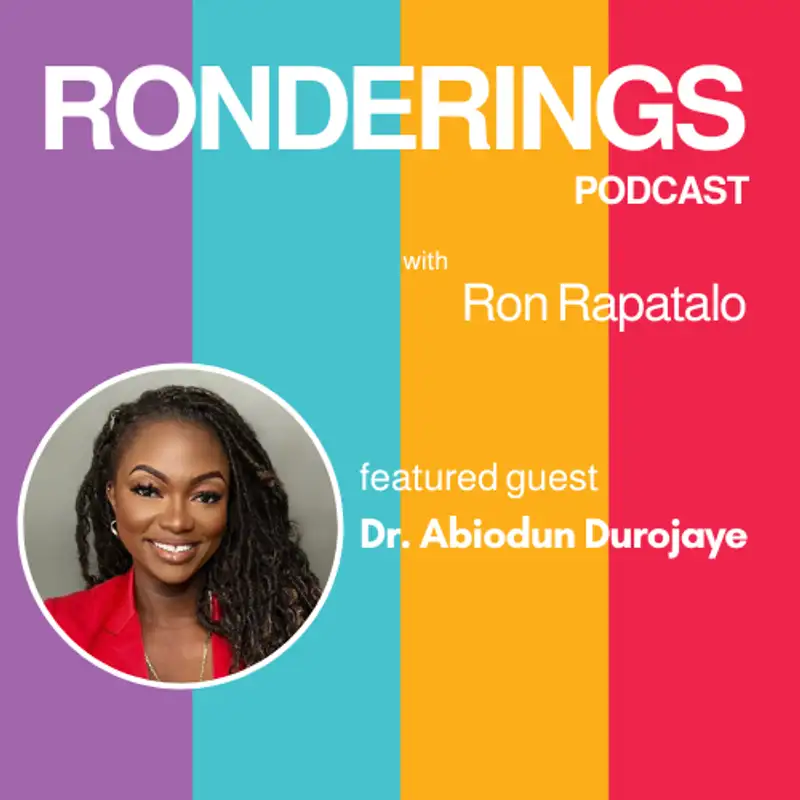
Ron Rapatalo:Welcome back to Ronderings, the space where real leaders tell real stories. Time to shape us, shake us, and sharpen us. Today's guest, whew, Dr. Abiodun Durojaye brings a story that's not just powerful, it is transformational. Arriving in The US at nine years old from Nigeria and suddenly being told who she was supposed to be, surviving bullying, identity shifts and the quiet violence assimilation. From working through her doctorate while spending months in the NICU with not one, but two micro preemie daughters.
Ron Rapatalo:To serving in Nigeria's National Youth Service Corps to launching the Asida Love Movement, where she teaches leaders that love is a strategy, not a sentiment. Dr. Abiodun's journey's resilience, faith, community and cultural grounding in motion. If there's one line that captures philosophy, it's this, authenticity is a privilege, so check yourself at the door. Today's conversation is a master class in gratitude, identity, motherhood, leadership, and choosing to say yes to who you're called to be even when life is at its heaviest.
Ron Rapatalo:Let's get into it. Hey, friends. Before we get started, I wanna share something that's been a big part of my own journey. Two years ago, I published my book Leverage. That experience cracked something open for me.
Ron Rapatalo:I saw how publishing isn't just about pages, about owning your story, sharpening your voice, and amplifying your impact. The part that meant the most, readers reached out to me to say they felt seen. That's when I knew this work mattered. I loved it so much I cofounded Leverage Publishing Group with friends who would make know this world inside and out. Now we help leaders, entrepreneurs, and change makers turn their ideas into books and podcasts that actually move people.
Ron Rapatalo:Got a star in you, and I know you do. Let's chat. Find me on LinkedIn or at leveragepublishinggroup.com, because the world doesn't just need more books, it needs your book. Alright. Let's get to today's episode.
Ron Rapatalo:Peace. Ronderings Universe. I have another new ish friend that I'd like to introduce on Ronderings today, Dr. Abiodun Durojaye. Abiodun, how are you doing today?
Dr. Abiodun Durojaye:I am good. I mean, it's cold, but I am good. It was Yeah. A great day today with the family, so thank you so much for having me here today.
Ron Rapatalo:Absolutely. Yeah. This is the time. You know, it's funny. In the Northeast, particularly being a native New Yorker, when it gets this cold, the one material that we say about how cold it is when it gets this cold, it's brick.
Ron Rapatalo:Yeah. That's such a New York thing to say is just and then it's like the memes of the maps is just like, you know, the five day forecast is just different kinds of bricks.
Dr. Abiodun Durojaye:You know what? It's so funny. Two years ago, we relocated from Chicago here.
Ron Rapatalo:Okay.
Dr. Abiodun Durojaye:And I always say you don't know cold till you've lived in Chicago. Like, Chicago, you can have all four seasons in one day and Yes. Moving from Africa, coming to Illinois, We chose the wrong. You see what I'm saying?
Ron Rapatalo:So I was like, why did you move to Texas? So, like, a warmer climate. What's what happened?
Dr. Abiodun Durojaye:Sir, you know, but I think things happen for a reason. Looking at it, I'm like, I guess I liked it. But funny enough, I still hate the cold weather after living in Chicago for so long. I hate it. Hate it.
Ron Rapatalo:Yeah. I've grown to more hate it than love it here in the New York City Metro area. Just like I need my warm, thick jacket. I need, like, my really nice fancy wool hat. I need my, like, warm gloves.
Dr. Abiodun Durojaye:Your gloves.
Ron Rapatalo:My my ski gloves. Right? I finally bought a couple years ago a pair of gloves that, like, you can plug in and they heat up for you.
Dr. Abiodun Durojaye:Oh, you're fancy.
Ron Rapatalo:Yeah. Because I didn't like I don't like my hands being cold.
Dr. Abiodun Durojaye:I don't like anything. In the cold. Oh. Right? Like That work.
Dr. Abiodun Durojaye:I yes. I I just I'm like, you know what, I was joking with my husband, I was like, I think we should like, for the cold months, we need to just move somewhere, you know, like, Florida, maybe not Florida, Texas or California or back to Nigeria. Right. Come back and like enjoy summertime here because the cold is is brutal. It's it's not for the week.
Ron Rapatalo:I'm gonna put that into like our wish list and name that you our families need to go somewhere for the winter that's warmer. I'm gonna name Costa Rica for my family. Oh. We love some Costa Rica.
Dr. Abiodun Durojaye:Oh. Oh. Yeah. The No. The people.
Dr. Abiodun Durojaye:The people.
Ron Rapatalo:Yeah. Pura Vida.
Dr. Abiodun Durojaye:You're making me just want to go on vacation. Yeah, not yet. Yet.
Ron Rapatalo:Not Well, Abiodun, let's get right into it. What's your story?
Dr. Abiodun Durojaye:My goodness, what is my story? I thought about this in our little green room before this, as you were like, Oh, what's your story? I was like, but everyone has a story. And I think my story, Ron, begins with gratitude.
Ron Rapatalo:Amen.
Dr. Abiodun Durojaye:I am first generation Nigerian, which is where the name Abiodun comes from. Gratitude for my upbringing, my parents who taught me early on that love is not just a sentiment, it's a responsibility. I grew up witnessing how systemic barriers can affect people from an early age, especially people who are not in the majority group, which I was not migrating here at nine years old from Nigeria.
Ron Rapatalo:Okay.
Dr. Abiodun Durojaye:And I think for me, my story early on, awareness became my calling. I was very aware that early on, was going to be in this space of like, something with education, something with academia, something with these very barriers that tried so hard to hinder me the fourth grade at Reavis Elementary School in Lansing, Illinois. I, you know, I remember very well. Yeah, very, very well thinking to where I am now. And every chapter of my life, from K through 12 schools to higher education to nonprofit has been rooted in the belief that when you lift people up with dignity, and I mean real dignity, and human connection, they rise.
Ron Rapatalo:Yeah. Are you comfortable sharing And when
Dr. Abiodun Durojaye:they rise community, yeah.
Ron Rapatalo:Yeah. Are you comfortable sharing? Because you mentioned fourth grade Rebus elementary school. That sounds like there's a story there.
Dr. Abiodun Durojaye:Oh, I mean, I think you can ask every immigrant who moves here early on.
Ron Rapatalo:Yeah.
Dr. Abiodun Durojaye:There's that one moment that sticks with you. And I think for me, was, it was when I realized that I was black, right? Like growing up in Nigeria, we were all Yoruba, Igbo, you know, our tribes, not by our color. Because it fit in with what America needed it to fit in. I blame my I will.
Dr. Abiodun Durojaye:I did. I did. I blame my dad. And I tell this story in a TEDx that I did a couple years ago called What is Your Starbucks Name? Oh, wow.
Dr. Abiodun Durojaye:It came from my dad. Like we went to register for school, the lady couldn't pronounce the name, and just flat out asked dad like, does she have a nickname? And he was like, Abi. I was like, Abi, what the hell is that? Who is that?
Dr. Abiodun Durojaye:Yeah. But it became who I was for the next right couple of decades of my life. And I tried to fit into this. So fourth grade was really interesting. It was the first time I knew I was a black girl in America.
Dr. Abiodun Durojaye:I figured out what an African booty scratcher was. I did not have the adults that could help me because the truth was, while I was being bullied at school, my mother was being bullied at work, right? And we were, we were both fighting our own battles. She was the CNA, trying to navigate this space with four children by herself in a new country because her mother had came then he traveled right back. Like you see this a lot in these types of family dynamics.
Dr. Abiodun Durojaye:So mom, mom stood up and did the best she could raising four of us. And I am proud to say that of the four of us, none of us have less than a doctorate degree, right? We have medical doctors and Black
Ron Rapatalo:Nigerian excellence. Come on now.
Dr. Abiodun Durojaye:Shout out mom. Mom Shout out and the grace
Dr. Abiodun Durojaye:of God. Know, I say a lot that
Ron Rapatalo:I am in an answered prayer.
Dr. Abiodun Durojaye:So that's what fourth grade Revis Elementary reminds me of is the first time my blackness became aware. I was aware of my blackness.
Ron Rapatalo:That's like courageous conversations about race, like question, when were you first aware of like your race?
Dr. Abiodun Durojaye:Yeah. It was in that moment. It was in that moment. And I, you know, I didn't have anyone to navigate it with because we were the four kids were trying to figure it out in different spaces. Mom was trying to figure it out at work.
Dr. Abiodun Durojaye:And there were no systems built in the school for us to speak about it, for us to share about it, for any adult to help us about it. So it was truly just navigating it solo. I will tell you, when you say, what is my story? I think that has really helped shape me
Ron Rapatalo:Yeah.
Dr. Abiodun Durojaye:Into being the adult that I really desperately needed in
Ron Rapatalo:the fourth grade. I've often found in the patterns of these stories where you have this, like, moment where you realized your race, that at some point, inevitably, there was an adult or many adults that, like, helped you along that journey. Is there a particular, like, adult and story you remember that from fourth grade on was like, Abiodun, I'm helping you on this journey in some shape or form to get you to be the adult you needed in that moment in fourth grade?
Dr. Abiodun Durojaye:Yeah. That's that's a great question. I think, you know, my mom tried again. She did she did a damn good job. Shout out to my mama.
Dr. Abiodun Durojaye:I stand on the shoulders of a lot of dynamic women. And I try to give them their flowers every day. Now some did not happen, a lot did not happen early on, a lot happened later on. You know, I think about Dr. Tolui Duro, who I say was the first person who gave me an opportunity to come back to education and work at the largest and only community college in Indiana.
Ron Rapatalo:Wow.
Dr. Abiodun Durojaye:I still keep in touch with her today. And I try so hard to give her her flowers. I think about Leticia Proctor, someone recently that I met that has just bored in me. I think about one of my sorority sisters, Soror Marita, who is a phenomenal older Black woman who tells me every day that nobody is going to pity you for the things you have or don't have. You got to get up and figure it out.
Dr. Abiodun Durojaye:You know, she's in her 60s and she grew up through so some she tries to pour back into me, and I am just truly shaped by these very communities that raised me truthfully, and I think I try and give back in that way, you know, the young people who have trusted me through my career, with their futures, the colleagues who have linked arms with me and tried to do this heavy work, the families who remain in contact with me, you know, the people that I have met, they have taught me that leadership is not about the titles. It's about the presence. It's about your courage. It's about love in action. So Ron, I am still writing my story, and that is my story.
Dr. Abiodun Durojaye:Yeah.
Ron Rapatalo:Well, let's keep going, right, because I'm curious, and you could start it from middle school, high school, college, after college, like, you know, in some shape or fashion, right? Let's continue your story along the line where you want to continue your story.
Dr. Abiodun Durojaye:Yeah. Yeah. That's that's my story. It goes in so many different directions. So after I think about college, let's get to college.
Dr. Abiodun Durojaye:I went to college in Illinois. Okay. My first two degrees were done at the University of Illinois Urbana Champaign.
Ron Rapatalo:Okay.
Dr. Abiodun Durojaye:I joined a sisterhood. I am a member of Delta Sigma Theta Sorority in Florida.
Ron Rapatalo:Alright, beautiful.
Dr. Abiodun Durojaye:They teach me every day. My line sisters teach me every day. They are part of just my awareness. And for me, it is really different when you weren't born in this country. There are certain things that I will never have not being born in this country.
Dr. Abiodun Durojaye:Like, let's be clear, I joke with my kids a lot. And I say, can never be President of The United States, simply because I was not born here. Yeah. I've spent most of my life here. Pay taxes here.
Dr. Abiodun Durojaye:I do all these things, right? Like, and I say that because I know other people have it far worse than this. But I just say that, for me, I still live in gratitude of the things and the people that I have connected with. So college was, again, I'm grateful that I had the opportunity to go to a Big Ten college and have the experiences that I, have and be poured into by more amazing people. I was part of the Office of Minority Student Affairs.
Dr. Abiodun Durojaye:Yeah. Which, you know, I was a graduate counselor. I was a counselor in there, worked again, with young people, and just tried to give them advice and tips on things that I was still learning myself. Like, let's be clear, like, was still learning it myself. So after I graduated college, I traveled.
Dr. Abiodun Durojaye:I went to South Africa. Okay. And then I went to I packed my bags and went to Nigeria. That was a defining moment because I needed to figure me out. I needed to figure me out.
Dr. Abiodun Durojaye:My master's is in African Studies. And I was just like, I'm gonna go and my mom thought I was crazy. Like you've left there for so long. You really have no family. What are you going to go do?
Dr. Abiodun Durojaye:And I was like, I'm gonna figure it out. And in Nigeria, you have to go through this thing called NYSD. It's the National Youth Service Corps. And in order to work in the country, you have to serve in the country for a year. It's like a year of military training and working.
Dr. Abiodun Durojaye:And Ron, they pay you little to nothing. Little to nothing. And the first month, you go into this like camp with 1000s of people. And you learn the national anthem, you learn everything about the country, you get to like, you know, the rigor of what Nigeria is about before they place you. It's almost like, what is it called?
Dr. Abiodun Durojaye:Like when you do service corps, right?
Ron Rapatalo:It's almost like that. Peace Corps.
Dr. Abiodun Durojaye:Peace Corps. Exactly. But you have to do that in Nigeria in order to be able to work there. It's like, they didn't care. So he moved away.
Dr. Abiodun Durojaye:And so I did that. It was interesting. But that's where I met my husband. That's where I met my husband. So that was another defining moment for me.
Dr. Abiodun Durojaye:And if you know me, you will know that I never thought I would marry a Nigerian man.
Ron Rapatalo:Say more.
Dr. Abiodun Durojaye:Who listens to this podcast? He's I know what you say. Because, you know, I so we moved here. I was in the fourth grade. I don't think I saw my dad again till the eighth grade.
Dr. Abiodun Durojaye:Like he just we moved here and, you know, he left. And him and mom went their separate ways, which I guess meant him and we went our separate ways. And I resented him for that.
Ron Rapatalo:Yeah.
Dr. Abiodun Durojaye:I resented everything that reminded me of this.
Ron Rapatalo:Got it. Yeah.
Dr. Abiodun Durojaye:So you know, when I went to the service corps, this man was just like, Oh, I'm going to protect you in this camp. And I was like, I don't need no damn protection. What do you think this is? I'm strong. Oh, boy, did I need protection because it was a whole different like, you had to, you had to go fetch your water to have a like a bath.
Dr. Abiodun Durojaye:Like there was no turning on the shower and shower. No, you gotta go, you want a bath?
Ron Rapatalo:So this match, youth service course has a little bit of like being trained for the military in some sense.
Dr. Abiodun Durojaye:Exactly what it is.
Ron Rapatalo:A little bit yeah.
Dr. Abiodun Durojaye:But they
Ron Rapatalo:This is a lot of countries where you have to do like a year like, you gonna be here, you gotta like
Dr. Abiodun Durojaye:You gotta of y'all. Yeah. But I will tell you, people in Nigeria fight for the opportunity to do service corps because if you don't do service corps you can't legally work. And some people have graduated for years and have not gotten their call letter. So me, right, being a Nigerian American traveling back and the opportunity, I did not take it for granted.
Dr. Abiodun Durojaye:And I knew they would look at me as, oh, thinks she's better than us because she just finished college and she just came right away and she didn't have to fight for it like we did. So I was very it's funny. I always I always joke that when I'm in Nigeria or America, one country is begging you to remember while one is pushing you passionately to forget. Right? And being in Nigeria was a humbling experience for me, that I also was not.
Dr. Abiodun Durojaye:From there, personally, I was not Nigerian and I was not long story short, I did, I did need my husband to navigate some things because I wasn't like people hated in a different way, and I understood it. I understood it. I walked in there with privilege. Like, I'm always very mindful about the privilege I have in certain spaces.
Ron Rapatalo:Alright. Let me keep it real. A lot of us have write a book sitting on our goals list, maybe for years, I sure did. Good news is there's more than one way to get it done. If you've got more money than time, a ghostwriter can help bring your story to life.
Ron Rapatalo:If you got more time than money, a great book coach can guide you through the process step by step. If you've already written a thing, you'll want someone to shepherd you through publishing so you don't waste time or cash. Here's the thing though, no matter how you do it, the real win is writing the right book. The one that builds your credibility, grows your business, and actually makes a difference. That's what the team at Books That Matter is all about.
Ron Rapatalo:Head to booksthatmatter.org and get some feedback in your ID or manuscript. Don't sit on it any longer. Your book could be exactly what the world needs. That reminded me of my trip to The Philippines. I only went to The Philippines once and had the privilege of going there.
Ron Rapatalo:My father passed away when I was 10. And so my mom brought our entire family go to Philippines for a summer trip in 1988. And I still remember this story, which I've talked about a number of times both on LinkedIn, Facebook, on other podcast episodes, of telling my mom, which disappointed her, and in retrospect, disappointed me. I would even tell this to my mom. This where I was at when I was 12.
Ron Rapatalo:I said, mom, I don't wanna go to The Philippines. I just didn't wanna like, I was going somewhere I didn't know. I didn't feel as much affinity towards. I said, I I'm more American than I am Filipino. My mom looked at me and said, oh, no, that is not true.
Ron Rapatalo:Are you saying enough to your mind? You're a Filipino burst.
Dr. Abiodun Durojaye:Right.
Ron Rapatalo:And going there, it it definitely switched. Went the other way around, right? And so a lot of it was the love that I felt from seeing so many people who look like me.
Dr. Abiodun Durojaye:Yeah.
Ron Rapatalo:And yet being achingly aware of my privilege, just by the very way I talked, moved, and dressed. It's easy to pin me out that I was
Dr. Abiodun Durojaye:married. Absolutely.
Ron Rapatalo:That was not just the way I was, like, just Filipino.
Dr. Abiodun Durojaye:And there was no need to hide it. Right? It's recognizing. Yeah. Yeah.
Dr. Abiodun Durojaye:Mhmm. And just just be aware. And I try now. So every year I try and take my daughters to Nigeria, at least once a year do a couple, you know, a couple weeks just so they know, and they're connected, and they're aware that they are larger than what they think and they are bigger and they are stronger and they are connected in many ways that they don't What even know
Ron Rapatalo:did you bring back home from that experience in Nigeria to America?
Ron Rapatalo:A husband.
Ron Rapatalo:Well, that's a big one. Found your boo, right? Your life partner.
Dr. Abiodun Durojaye:That part, that But truly what I brought back was, you know, I've said this to you, and I've said this a couple times, and I'll keep saying it, gratitude. Because no matter how things got there, like the fetching of water that like people were happy to be in those camps. The first the first two weeks, I was crying. I'm not even gonna lie. Oh my god, I got to
Ron Rapatalo:know what is this? I don't want to be here like, and people
Dr. Abiodun Durojaye:were looking at me, like an in grade, right? Like I like I was an in grade like, like we fight for to receive that letter in the mail saying you've been called to do this. You brought your black ass here from Nigeria from out from America.
Ron Rapatalo:And your privilege is showing in this moment. How dare you? Yeah.
Dr. Abiodun Durojaye:That part. So I always say, what one lesson that I say, I said, and I will continue to say that resonates from there. Authenticity is a privilege.
Ron Rapatalo:Oh.
Dr. Abiodun Durojaye:And not all of us get the ability, right, to be authentic. So like I was being my authentic oh my god. And then I was like, you better check that at the door. They don't need this right now. They don't need this right now because you are crying about an opportunity and an experience that some people have waited years for.
Dr. Abiodun Durojaye:Yeah. And all you did was write a letter to the Nigerian embassy. How dare you? And that happened for the first week. And I think my then friend who is now my husband, literally every day would talk to me and be like, You can't you can't keep doing this.
Ron Rapatalo:And I was like, Yeah, what do you
Dr. Abiodun Durojaye:mean I can't? He's like, No, you can't keep doing this. Like, check yourself at the door. Like he always says, check yourself at the door. So I, I till this day, before I walk in any room, I check myself at the door.
Ron Rapatalo:Sounds like you just named a Ronderings, I love it. Every once in a while I stamp a Ronderings during the There course of a
Dr. Abiodun Durojaye:it is, Check yourself. Check the biases that you may not know you have. Right?
Ron Rapatalo:Word.
Dr. Abiodun Durojaye:Check the privileges that may not be a privilege in certain spaces, but privilege has a way of working depending on the rooms that you are in.
Ron Rapatalo:Amen. It reminds me when I was back in The Philippines. I remember feeling not as grateful for the experience of my father's family's living situation, the provinces of The Philippines and Pangasinan. To be very, very specific.
Dr. Abiodun Durojaye:You
Ron Rapatalo:know? And the home was on wooden stilts in the dirt, and you had to go to an outhouse to take care of your biological needs. And we had to go to a water pump, which mind you, my family owned. But you still have to go to a water pump to get your water and also to take your bath. Yeah.
Ron Rapatalo:Out in the public. Yeah. And it's funny. After a while, it's just like, get used to just like, well, that's well, it's either you're be grimy or you clean yourself until
Dr. Abiodun Durojaye:That part.
Ron Rapatalo:I I I will clean myself, and it'd be funny, you know, as people waited for water, you would take a bath in front of them.
Dr. Abiodun Durojaye:100. That's what happened. So so I never I never got like, found a corner. I'm not gonna lie, I found a corner in a space where I was able to like, have a little bit of privacy, but it literally reminded me that, who are you? Like, real, who are you?
Dr. Abiodun Durojaye:Why do you think you're good enough that these thousands of people in here will remember your body, your nakedness, like you're showering? Got stuff going on. And I always, I always tell my daughters, I'm like, Who are you? Like, people like we think sometimes that people think about us more than they really do. Like, who are you?
Dr. Abiodun Durojaye:People got their own stuff going on.
Ron Rapatalo:That's right.
Dr. Abiodun Durojaye:You know? That's right. So yeah, that was that experience in this story was a humbling one for me. Again, best thing that came out was my life partner. But I think about that now.
Dr. Abiodun Durojaye:I would do it all over again. If my kids were like, Mom, we want to go, like, oh, go at your own, your own risk, though, right? Because it's you have to be cut from a certain type of box to have that mindset that I'm going to do this. And I'm going to trust a higher power that I'll be okay. And I'll find the grace of people and support to help me.
Dr. Abiodun Durojaye:So I did that. And it was great. And you know, after I came back and, you know, started working in America, again, life kind of picked back up and I got back into education and finished my it's just so many wonderful things in my story. So many dark things in my story. So many wonderful things.
Dr. Abiodun Durojaye:I always think about how the wonderful things come out of the dark things. Was sharing with you, not in this podcast, that raising three daughters, and we're trying to navigate how I'm going to raise Nigerian daughters in the American system. We'll see. But I'm raising three daughters in which two of them were born micro preemie. I'm talking about one pound, one pound, right?
Dr. Abiodun Durojaye:And no, they're not twins. Right? And those were some of the darkest days of my life, like being in the NICU for five and six months straight.
Ron Rapatalo:Yes.
Dr. Abiodun Durojaye:And like spending holidays there not knowing if they were going to live or die. But I still like on the bright side, like I got to walk out of those NICUs with my children. And I know many mothers did not and like, I feel for them. I pray for them. Like every time I look at my daughters, I say a special prayer for the mothers who never walked out with their babies in the NICU, and for the nurses and doctors that walk in those spaces.
Dr. Abiodun Durojaye:And now I'm, you know, getting ready to write and publish a book about those experiences and like what kept me going. So like just finding some good in these moments has been really important to me.
Ron Rapatalo:Yeah. I mean, goes with your attitude of gratitude, right? Because what I want to ask you is to get a preview of what you're thinking about for this book and especially paint a picture because being a parent whose two children went through the NICU, percentage wise, is a particularly small like a a small percentage. Right? So walk folks through what that experience is kind of the lessons you're gonna be sharing your book to give a preview a little bit of a taste of this amazing book that you're gonna have coming out.
Dr. Abiodun Durojaye:Thank you. No NICU baby is alike, right? And I remember when my first my second daughter who was my first NICU experience came. It should twenty four weeks, So you should be pregnant for forty weeks, Rach. Oh, twenty four.
Dr. Abiodun Durojaye:Oh, goodness gracious. And I remember being in a very stressful job, and going to bed, and just waking up in the middle of the night, flush, blood. Oh my god. Jesus. Got to the hospital, her foot was already aching out, right?
Dr. Abiodun Durojaye:Like and it was like an emergency situation So at that that that, that will shake you to the core. Because what is happening? What is this? Like twenty four weeks, she's not supposed to be here. And you know, with her, we stayed in the NICU for five months.
Dr. Abiodun Durojaye:Five months and then after that every major holiday we were back in the PICU because something happened and she got sick. So I started writing just in my time with the NICU I was told that just have faith and keep pumping the liquid gold, right? Like the gold will keep the baby. So those were the things I did. I would be there every day reading to her still working, trying to read to her.
Dr. Abiodun Durojaye:I realized that all the books in the NICU at the time were like children's books. There was never anything for me to give me like courage and hope besides like the Bible or like, you know, just whatever. So I started writing, I started writing the things that I would want to hear and know. And I wrote about my days, wrote about my nights, I wrote about my months, my holidays. I wrote about what kept me going.
Dr. Abiodun Durojaye:It is raw. It is a very raw book.
Ron Rapatalo:Sure.
Dr. Abiodun Durojaye:I wrote about the first prayers that I said for my children that probably no mother should ever say for their children. And when we got through our first daughter in the NICU, we waited four years and we're like, okay, maybe one more. Maybe we'll try for a boy. It wasn't a boy. It was another girl.
Dr. Abiodun Durojaye:Yeah. Twenty three weeks. Twenty three. He came at twenty three weeks and for two different experiences, which I talk about in the book.
Ron Rapatalo:Were you under a similar level of stress for your second No,
Dr. Abiodun Durojaye:my last daughter I was I was high risk. So right when you have a baby like that, and you're pregnant. Yeah,
Ron Rapatalo:that's yeah.
Dr. Abiodun Durojaye:And I remember going in for my last, my last like high risk visit. Yes. And the lady went in with the camera, I remember screaming, ouch, not thinking much of it. Seven weeks later, I was in the emergency room. I had leaked out all my amniotic fluid.
Dr. Abiodun Durojaye:Oh, I think that ouch was poking at the sack and puncturing it.
Ron Rapatalo:Oh, hot goodness It
Dr. Abiodun Durojaye:was it was it all and that experience was completely different from the daughter who just went through because at twenty three weeks a baby is not viable. So we had to decide whether she was going to live or they needed to flush that baby. Can you imagine? And I was like, Well, what do you what do you mean? And they were like, Well, you can decide to try and save her twenty three weeks.
Dr. Abiodun Durojaye:There's a lot of complications with these babies. There's a lot of things that they grow up with and blah, blah, blah. If it were twenty four weeks, the doctors take it into their own hand and they do all they can. But at 20, anything less than twenty four weeks, the mom has to make the decision, which is like the worst thing you could do. I don't think there's a right decision.
Dr. Abiodun Durojaye:Whether you decide to terminate or go through, I don't think there's a right or wrong decision.
Ron Rapatalo:Anyways,
Dr. Abiodun Durojaye:talk about the experience in my book about what made me make the decision to have her. And it was the right decision for me. It was the right decision for our family. And she was she's oh, boy, she's so fierce. But that was the hardest experience for me.
Dr. Abiodun Durojaye:I mean, we went through so much in the NICU with her. There was an episode where the NICU went on strike, and they had to kick us out of the NICU and wrap all the babies in the NICU and send them to different NICUs. It was a lot. Wow, that's bananas.
Ron Rapatalo:Oh, good.
Dr. Abiodun Durojaye:Can I talk about that experience in the book? I talk about the medicines they were giving her were also cracking her ribs. They were like breaking her bones. So they made her bones brittle. And they didn't know and anytime they changed her diaper and lifted her leg up, her ribs were literally cracking.
Dr. Abiodun Durojaye:Right? And it was had to advocate. When you say like, advocating for your boobies, like, that was what that experience And was I was working, right? Like, so this this notion of like a working mom and like how we're supposed to show up and be present and be perfect. So the book really talks about my experience with the NICU twice, what kept me going pumping and fraying, and how all of this happened in this world in America where you still have to earn a living, you still have to work, you still have to figure it out.
Dr. Abiodun Durojaye:All of it was happening simultaneously. I was finishing my dissertation, my doctorate degree with my youngest daughter, right? Like, all of it was still happening. It was still happening. So that book is this memoir of a mother's fight for her two children while fighting for herself and advocating and then like, my whole story.
Dr. Abiodun Durojaye:And I'm just really excited about it. You know, I'm really excited about the story of the NICU and life after the NICU and how to navigate it and give mothers hope because it it can be dark in there. It can be dark in there.
Ron Rapatalo:Yeah. You obviously were asked to do something that no mom should be asked to do. Right? One, your experience with your two of your daughters through the NICU, but being like, leading dissertation, all these like, it just so what kept you centered? What kept you going?
Ron Rapatalo:Because that's just such a I imagine the emotional and and spiritual demand on you was deep. Incredible.
Dr. Abiodun Durojaye:It was deep.
Ron Rapatalo:Yeah.
Dr. Abiodun Durojaye:Shout out to my chair, Dr. Quincy Martin, at the time who was like, you should stop, you can stop. Like, why are you trying to finish your dissertation and you just had a baby, you just went to through a traumatic experience. And Ron, I needed the distraction.
Ron Rapatalo:Makes sense.
Dr. Abiodun Durojaye:Like that. That's I needed the distraction because it was either stop, wallow, cry and think about why me or stay in it, have something to fight for, you know, when you're not at the NICU, which was like never, I was always at the NICU typing. Was, you know, going through this process. My husband was finishing his master's and for us, it became a distraction. Like school became a distraction, work became a distraction from just life, from just life.
Dr. Abiodun Durojaye:Yeah. You know?
Ron Rapatalo:Would you say there was a cost to having to use work as a distraction while you were going yeah.
Dr. Abiodun Durojaye:100%. Yeah. 100%. I, at the time, right, like it worked. I don't know if it worked.
Dr. Abiodun Durojaye:It got me through. But it became all I knew. It became all I knew. Work, work, work, work, work. Do, do, do, do, do, you know, funny, funny thing happened last last year, and my daughter will, my oldest will like, if she ever hears this podcast, she'd like, why the hell did you tell her that?
Dr. Abiodun Durojaye:So we grew up in a household where we didn't miss a day of school, sick or not, your boat was going to school, like you were going
Ron Rapatalo:to I remember that. Popping a couple Tylenol, it's okay if you got a fever.
Dr. Abiodun Durojaye:You're good to go.
Ron Rapatalo:Look, you can still learn, walk through this, go ahead, just make it happen.
Dr. Abiodun Durojaye:Just go.
Ron Rapatalo:Yeah.
Dr. Abiodun Durojaye:But that that stuck with me in my little Nigerian brain that you can't quit these things. Just keep working. Just keep going. Just keep writing. Just keep going.
Dr. Abiodun Durojaye:Go, go, go, go, go. And it became a really bad habit. Like not I don't know how to give myself a break. And I know there are a lot of women in this space who don't know how to allow themselves to have a break. So last year, I remember my daughter, my oldest who'd been like perfect attendance since kindergarten.
Dr. Abiodun Durojaye:It's crazy. I went to her school on a Friday, and I pulled her out at 11:00. She's like, Mom, am I in trouble? What's wrong? And I said, No, we're going bra shopping.
Dr. Abiodun Durojaye:Like bra shopping? I said, We're going bra shopping. I said, Because every once in a while, it's okay to just take a pill. And till today, she talks about that day being one of the best days of her life. Just because we went bra shopping.
Dr. Abiodun Durojaye:And I think for me, I hope that it allowed her to know that, yes, you do your best. Yes, you put in your all. But taking a break is also okay. And as Black women, as women of color, we don't give ourselves enough grace to just say, I don't feel like it today.
Ron Rapatalo:Yeah.
Dr. Abiodun Durojaye:And that it's okay to not feel like it. And I think that cost I paid is just like, go, go, go, go, like keep going till you burn out, run, run, run, like, nope, don't stop, like completed your dissertation in the four years and you're going to do this and you're going to end it's not, not healthy. Yeah. It wasn't healthy. It wasn't healthy.
Dr. Abiodun Durojaye:I know that. I know that now. I think then I was just trying to get through any any way I could.
Ron Rapatalo:You know, the you know, what I'm I I think I'm reflecting on is that you did the best that you could considering the incredible stack of cards you were given. Right? You persisted in the way you knew how. That's what I'm that's what I'm reflecting back on. Now the the situation is different.
Ron Rapatalo:And so now, I guess my next question, because you're in a transitionary part of your life and your career.
Dr. Abiodun Durojaye:So
Ron Rapatalo:I wanna get a sense of like, where are you sitting now? What are you thinking about? You know, you
Ron Rapatalo:have the book, so you've talked about that, but like
Dr. Abiodun Durojaye:Yes.
Ron Rapatalo:What is Dr. Abiodun Durojaye up to right I
Dr. Abiodun Durojaye:have some exciting things that I am working on.
Ron Rapatalo:You like that alley oop that I just laid up for you?
Dr. Abiodun Durojaye:I did, did, let me explain.
Ron Rapatalo:Like to be a lot of my role as Jose is to play, like, you know,
Ron Rapatalo:a little bit of magic, a little bit of, like,
Ron Rapatalo:you know, come on now.
Dr. Abiodun Durojaye:Yes. I I love, love, love it. And I will tell you so many exciting things that I'm working on.
Ron Rapatalo:Yeah.
Dr. Abiodun Durojaye:And two that I want to highlight and call out today. And I hope it falls on and reaches the right audience. So a seed of love is something that got put on my heart back in 2016. But I didn't, it wasn't birthed, I will say, till '20 last year, late last year, I made it an official LLC, and I'd just been dibbling and dabbling. And now I'm looking at how do I make this a movement?
Dr. Abiodun Durojaye:So Asida is a meal that is eaten in places in Africa and it is a warm dish and you enjoy it in community. And when I put it together with AsidaLove, so Asida is A S I D A, but phonetically it's Asida Love, like a seed of love. It's a movement. I love it. It's a movement that is rooted in this belief that I shared with you earlier, love is a strategy that transforms people, communities, systems, created to cultivate spaces where I believe individuals feel seen, valued, supported.
Dr. Abiodun Durojaye:And that is what we're doing. Like, I want to bring together communities, leaders, people, partners, to share the commitment of healing, connection and collective action, right? Again, so love not as a sentiment, but as an action. And, you know, I've been doing some work with just coaching leaders on how to do this and how to like, through intentional, right, dedication, how we make people better, how we build leaders together. And one thing that see the love, the second thing I will share is that a see the love is working on something.
Dr. Abiodun Durojaye:And I hope this falls on the right ears where next year, shout out to two amazing people who are helping with this. We want to secure enough funding to bring together women of color into a space next year for a movement that we are calling For Her, By Her. You know, over 400,000 women have been impacted since the beginning of this year. They've walked out
Dr. Abiodun Durojaye:of their jobs, they've lost their
Dr. Abiodun Durojaye:jobs, departments have been dismantled, And at the heart of what a seat of love is, we inspire people to show up, to show up with courage, compassion, and purpose. So this two day convening is going to bring thousands of women of color together, and we're going to sow a seed of love in each other, in our spaces, in our communities, and we're going to offer things to these women that they can take back to their spaces and begin to plant their own seed of love. So right now we're just looking for the funding. It's going to be in Chicago next year. We're looking for the funding to be able to host about 2,000 women of color and bring other Black leaders who have either, you know, are also in a transitional or transformational phase, but have figured it out and have done real well.
Dr. Abiodun Durojaye:We're going to give hope. We're going to build people. Ron, we're going to plant seeds of love and seeds of love. And I'm just really excited about that conference. And I hope, you know, we started to seek the funding.
Dr. Abiodun Durojaye:And I'm hoping that this falls on the right ear, somebody who will say, that sounds pretty dope. That's not just an event, it's a movement.
Ron Rapatalo:Quick pause in the action here. I know a lot of us leaders, entrepreneurs, folks who are trying to do good work, and felt that grind of pushing a boulder uphill by ourselves. The learning is you don't actually have to do it all alone. Genius discovery program at thought leader path like having a think tank in your corner. It's not some cookie cutter formula but your story, your plan of impact, giving you the clarity and assets to take the next big step.
Ron Rapatalo:I've seen people go through this and walk out with their voices amplified, ideas sharpened, some even launching podcasts like this one Ronderings. So if you're tired of grinding in the dark and you're ready to step into your impact with right support, check out geniusdiscovery.org. You know, it's funny. Like, if you were to look through the list of Ronderings guests in the past, there are already people I'm immediately thinking of that probably would be great for you to talk to. My homegirl, Kamara Thompson, actually, someone's based in Chicago, who worked in the ed and nonprofit space, but now started her own wellness company.
Dr. Abiodun Durojaye:Oh my gosh. That's what we need.
Ron Rapatalo:Stephanie Morimoto, who the company is called Asutra. I use her magnesium oil. A soon to be, like, published guest, the one when we were in the green room, talked to you a little bit about Dr. Kimik Lear because she's the DM. Like, that's like four. There's probably like 12.
Ron Rapatalo:There's probably like
Dr. Abiodun Durojaye:20 Yeah. Because we want to bring vendors, to like Yeah. Share their own space. We want keynote speakers. We want women to come with notebooks.
Dr. Abiodun Durojaye:We want to like offer something. And then when people leave, we want to create a virtual community where we meet quarterly to talk about who has helped who, what seeds have you planted. And you know, we always say, we reap what we sow, right? Or we sow what we reap, we reap what we sow. And that is what this event is about.
Dr. Abiodun Durojaye:That is what this movement So is I'm just excited. And sometimes I believe that you have to put it out there.
Ron Rapatalo:Of course.
Dr. Abiodun Durojaye:Yeah. Let the ether do what it will do. So Asida Love is trying to lead that.
Ron Rapatalo:Yeah. We'll definitely have to talk offline about how I can use my superpower of connecting
Dr. Abiodun Durojaye:and get you. Love that.
Ron Rapatalo:I'm A
Dr. Abiodun Durojaye:lot of women face, who need to heal, who need each other, right? And even 400,000, over 400,000, that's a
Ron Rapatalo:big number.
Dr. Abiodun Durojaye:Who are they talking to? What, what like, how can we, what is my responsibility, right, to this group? So that those are the things that I'm
Ron Rapatalo:Yeah.
Dr. Abiodun Durojaye:Excited about and I'm working on. I'm still public speaking. Yeah. Yeah.
Ron Rapatalo:When you mentioned acita being a a food that's made in some countries in Africa, I was curious then about what does that taste like? You mentioned it being warm. And I'm like because I don't know, like, not familiar with Asida, because when I heard you say a seed of love, I thought it was literally a seed of love. I was like, that's really that's really cool. Right?
Ron Rapatalo:So I love the the play on words here. So Asida, what does it taste like? Because I think for me, like, viscerally understanding it, in my head, I'm like, I can see.
Dr. Abiodun Durojaye:So you are how do I how do I share? How do I share? How do I help you explain? It's almost like a porridge. It's it's rich.
Dr. Abiodun Durojaye:Okay. It can be sweet. It's nurturing, right? It's nutritious. It's buttery.
Ron Rapatalo:What's made out of? Or is it?
Dr. Abiodun Durojaye:So when I had it, when I had it, and I think different, maybe different tribes, like you can have it in Sudan, Morocco. I know different people do it. It's an ancient dish that they enjoy. When I had it, I don't know if it was like a yam porridge. You know, we eat like fufu in our country, like we have fufu.
Dr. Abiodun Durojaye:Yeah. So yeah, I think it can depending on which region in Africa and what part you go to, it's a little bit different. And you know, we're going to Nigeria in June. Typically you find it in like North African, but I'm hoping that I can taste it and sneak it. And I can't even tell you how I came up with the name AsidaLove.
Dr. Abiodun Durojaye:Like, you wouldn't believe me if I tried. So I don't I I'm not gonna try. I'm just gonna say that that, yeah, here we are.
Ron Rapatalo:You know, that's reminding you of hearing AsidaLove. There is a Philippine. It's more sweet, but it can be it's definitely a hearty, and I wouldn't say it's a porridge. It's like a dessert stew. It's like my kind of, like, Americanized version.
Ron Rapatalo:It's called guinea dow. So my mom would make guinea dow growing up. So there would be some, like, yam or, like, kind of complex I didn't even have yuca. Right? But then it would have my favorite part of it, freaking rice balls put in it.
Ron Rapatalo:Oh my And then it was sweet, and I would eat it, I was just like, fuck. But And it's warm and it's sitting, like, to you.
Dr. Abiodun Durojaye:Oh, I'm so sticky. It sticks to you. So, like, if you think about Asida and what Asida is Yeah. And this notion of love, this nourishing love
Ron Rapatalo:that Y'all sticks to just y'all need to have some bomb ass food at this convening.
Dr. Abiodun Durojaye:You know what I'm saying? That's you.
Ron Rapatalo:That's something that we as people of color do when
Dr. Abiodun Durojaye:we bring our people together.
Ron Rapatalo:That food that shit better be lit. Because if it's not lit, I'm leaving.
Dr. Abiodun Durojaye:When I I don't
Ron Rapatalo:get how good the kind of, like, mind stuff, like, the food is whack.
Dr. Abiodun Durojaye:It's gonna it's gonna be it's gonna be amazing. We're gonna have a healing circle. Like we're gonna have like traditional African drums one of those evenings and just and I just put this on And I was like, okay, gosh, well, need the money to do this. And he was like, but I've given you the platform. So the money will come.
Dr. Abiodun Durojaye:And I said, I'm listening. And one thing this season for me is kind of like, Shonda Rhimes book, The Year of Yes. 2026 is my year of yes. It's my year of being obedient, right? It's my year of being obedient and just saying, that's how you want me to move?
Dr. Abiodun Durojaye:Yes. Because one thing, life is extremely short. And we always think we have longer than we really do.
Ron Rapatalo:Yeah. And and and our bodies in this iteration as we speak right now, it's in the kind of totality of, like, how long this current iteration of the universe is Extremely short and multiple truth, our our souls are energy, I believe, forever.
Dr. Abiodun Durojaye:Yes.
Ron Rapatalo:Right? And so what do we do in this purpose, in this lifetime, in our bodies
Dr. Abiodun Durojaye:I
Ron Rapatalo:to be able to come to a way to manifest, like, a a better collective humanity and, like, dream that future. That's something in the spaces I've been around. Right? You know? And, certainly, having you on my next, like, episode I'm recording with is someone who also does a lot of, like, future forward thinking.
Ron Rapatalo:Like, you have if you don't know Shawna Wells, she's also someone, like but I'm thinking of, like and and surprise, surprise, what's the theme here? It's, like, who are all the dope black women and women of color that I know that Abiodun needs to talk to? I'm like, oh shit. And like, and to be clear, I I'm so grateful that I'm poured into by so many dope black women and women of color because without that, I'm I'm not who I am at all today without that being poured into.
Dr. Abiodun Durojaye:I just appreciate you. And there will be a section at this convening on allyship. So you may you you gonna get an invitation on like a panel like, it doesn't mean because people, I think people think that they are allies. And I don't think people know how to be allies and we need to call people out and we need to talk about and if we need to talk about the damage, you know what, that's gonna be a whole another podcast.
Ron Rapatalo:That's a whole another podcast.
Dr. Abiodun Durojaye:One of my friends, Leticia Proctor shared with me, it's in the Bible and it talks about just how short life is and how all these things we're doing, the work and that it's meaningless on this earth and you have to enjoy it now. So I like challenge people like what does enjoyment look like for you? Like, you know, my sister who's a doctor, my younger sister who's an anesthesiologist here in Maryland says one person she knew retired at 62 and died the Because very next he was like, trying to like wait till like vacation and do all the things. And it's like, why do we think we have that long? And like, book that trip.
Dr. Abiodun Durojaye:Like, if you want to go on that trip, go on that trip because tomorrow is just not guaranteed. And a seat of love is again, I thank God that yes, that he gave me this idea in 2020. It didn't come to pass till or 2016, excuse me, it didn't it wasn't born till 2020. And He gave me that long. Like, some people are given an idea, and they don't have that long.
Dr. Abiodun Durojaye:Like, we always say, the most undiscovered talent is at the cemetery because a lot of people die without discovering their true purpose. Don't let that be you.
Ron Rapatalo:Yeah. Amen to that. Yeah. Well, Abiodun feels like it's a good time to ask you the title of this podcast. What is your Ronderings?
Ron Rapatalo:What's the lesser value you wanna share with the audience?
Dr. Abiodun Durojaye:I think you I think you captured one earlier that we said that that that's the rhyme. Right? But, like, you know, in this new space of ACITA, I think I would want to remind people that again, love can really be a strategy for change, especially in the world in a world right now that wants us to hate so badly.
Ron Rapatalo:That's right.
Dr. Abiodun Durojaye:Empathy is not softness, it is strength.
Ron Rapatalo:Oh, thousand percent.
Dr. Abiodun Durojaye:And investing in people is the most powerful and lasting work any of us can do. And I think more than anything, will want folks to know that and to understand that transformation starts with presence. And when you slow down enough to listen, and when you choose compassion over judgment, and when you give grace to ourselves, to yourself and to others, we create the conditions for extraordinary things to happen. So that's my wandering.
Ron Rapatalo:I love that. Right? Because I think that this slowing down, the ability to be present, I mean, I think it aligns with why having you as a guest and and us talking for this amount of time in previous conversations, future conversations. Right? I believe it is the, like, building block, the DNA that we can see and experience of how we build trust and love.
Ron Rapatalo:Yeah. Because when you do that, the kinds of things we're able to explore and build together become incredible because you're all these business isms. Right? You know, business moves at the speed of trust, blah blah blah blah. Right?
Ron Rapatalo:And I think I've experienced in my fifty years on earth, and I know, yes. Ronderings fifty.
Dr. Abiodun Durojaye:I know you know.
Ron Rapatalo:How'd that happen? I was like, you know, it's the, you know, the Filipino gun to steal. Okay. Let me not I mean, I show up even like, who is is this a is this a narcissist podcast? Like, what?
Ron Rapatalo:What? Damn. I can't help up again. That's not my fault.
Dr. Abiodun Durojaye:You gotta you gotta give yourself
Ron Rapatalo:tap yourself on the back when the world doesn't wanna tap you.
Dr. Abiodun Durojaye:Okay. So yeah, no, you do not look 50 Ron. You look great.
Ron Rapatalo:Thank you. But I think it's just one of those things where when we create those spaces to let Ourselves love on each other. Like the amount of creativity that comes out of this incredible is like one of my favorite Pixar movies. There are many of them. Monsters Inc.
Ron Rapatalo:Did
Dr. Abiodun Durojaye:you think
Ron Rapatalo:about it right? Monsters Inc. Energy of this fictitious monster's world was originally scares getting kids to, like, get some energy. And then you get to see with Boo, right, when they're hiding Boo and she lacks, and the amount of energy that comes through the entire apartment building that they live in. It's like Yeah.
Ron Rapatalo:Planted the seed, like,
Dr. Abiodun Durojaye:come. That.
Ron Rapatalo:Then fast forward, like, when they realized that was laughter that would get them incredible amount of energy to sustain the city, change things. Change.
Dr. Abiodun Durojaye:I'm I'm telling you, and I truly believe, and I've been in spaces where it's it is scary. And, like, I think people are set up to, like, they want you to fail or they just want to freak you out or they want to lead through fear. And yeah, I don't know, I'm in this space and mindset that why is it that when we talk about love, it has to be something that makes us feel the ick at work? No, I want to love myself enough to show up for you. I, in turn, right, I want that I want to plant a seed in you.
Ron Rapatalo:Yeah.
Dr. Abiodun Durojaye:That allows you to unlock that for you, which in turn unlocks it for someone else. It's like a domino effect. Right?
Ron Rapatalo:Yeah. It's just important as you know, and this is for, like, podcast episode number three we have to record together, organizational workspaces are not created with love in mind. And so to try to bring that energy in feels like a in spite of rather than for the reason of. Right? And yet you can still do it because love is like that, you know, Care Bear, good kryptonite that just transforms things, right?
Ron Rapatalo:It is so dynamic.
Dr. Abiodun Durojaye:It is dynamic and it's infectious. And I will tell you, and yes, I always say that I hope people see God in me before they see me and me, but the Bible says love on thy neighbor.
Ron Rapatalo:Oh, amen.
Dr. Abiodun Durojaye:Like, it's not it like, I don't have to, like, be to, like, love you, but I can show you dignity. I can show you, like, you know, just that's it. Humanity. And, like, because I don't want Ron to fail, I'm gonna love up on Ron. Not in the same way I love her for my husband, but in the way that shows you humanity and shows you dignity.
Ron Rapatalo:Yes.
Dr. Abiodun Durojaye:And that has become extremely hard for people now more than ever. And I'm hoping that, I don't know, Rod, I just hope this, somebody hears this, and something clicks, right? And they share it with someone, and something clicks, right? I'm really would
Ron Rapatalo:be amazed at how my experience of having this podcast, my newsletter writing about Ronderings as, like, a New Year's resolution several years ago is I don't know who I'm gonna touch Yeah. Teaching alliance. Right? And she told me towards the end of it, she was like, you know, you've inspired me to start lifting weights, Ron, because I'm a Pilates girl, and I see you on Instagram and doing things. Now granted, Instagram, Ron, is a little bit of, like, workout Ron personality, which is a very different Ron than podcasting leadership Ron and LinkedIn.
Ron Rapatalo:Right? And so
Dr. Abiodun Durojaye:But it's all part of your story.
Ron Rapatalo:It is. Right? Because I admittedly post those things because it is self accountability, first and foremost, because I write my workout out. Sometimes I take a video, depending on what it is. Right?
Ron Rapatalo:And sometimes I don't, but at least I post the workout. Right? Because me putting that workout, one of the things I've realized and even just writing the workout out publicly or write is it helps me remember what I did and, like, show progress. Right? Like, I don't track all of these things in a spreadsheet per se.
Ron Rapatalo:Some of my workouts I do, but the very act of showing it and doing it constantly, like, if you just followed me on Instagram, people's like, this dude lives at the gym, but the amount of time I spend at the working out for his totality of a week, it's only ten hours of one sixty eight. You know? But how many I will put this out before I ask you the last question, is how many 50 year old men are working out ten hours a
Dr. Abiodun Durojaye:week? Yeah.
Ron Rapatalo:I know many. It's not for me. I mean, are some, but like, I I don't know a lot of people generally. Yeah. Despite removing the spades, right?
Dr. Abiodun Durojaye:It's just clear, how do you define workout too? I think intensity of your workout is very different than what some people For real, like other people may say they're gonna do, they walk twice That's a working out. Is. Very different from the intensity of what I've seen you do. So I think, granted, you have to use intensity in there.
Dr. Abiodun Durojaye:Yeah. Yeah.
Ron Rapatalo:And as we know, like, you've led at the highest levels, like, to be a CEO and ED, that kind of, like, mindset, energy, and the things it takes to thrive and be at that level is different than when you first started that rollout of it just 100%. Like but it all builds upon each other.
Dr. Abiodun Durojaye:100%.
Ron Rapatalo:But, Abiodun, before we end together, how do people find you? What would you like to promote? And I know you started promoting Acita Love, and I'm wondering how people can find out more information about that aside from, like, however they're gonna contact you.
Dr. Abiodun Durojaye:So we are working on Acita's website and makes an idea that launch is gonna be early next year in q one. Until then I know. I'm so excited about it. But till then, I am all over LinkedIn. I'm on Instagram.
Dr. Abiodun Durojaye:I'm easy. You type in my name, and you will find me and one thing that I try to be do, or I tried to do excuse me, is be present. So a message on LinkedIn, I try very hard to respond. Even if you're trying to sell me something, I try to say I'm not interested, because the least I could do is give you the same time you gave me. So I'm on LinkedIn.
Dr. Abiodun Durojaye:I'm on Instagram. Am my website is coming up, and I'm excited about all the great things.
Ron Rapatalo:Well, Abiodun, I'm gonna end our time together. In the words of one of my sports heroes, Dion Sanders, we always come in hot with amazing guests like Abiodun Durojaye.
Dr. Abiodun Durojaye:Thank you so much. Thank Peace, y'all.
Ron Rapatalo:Peace. Fam, I told y'all Dr. Abiodun was gonna take us somewhere. What you heard today is more than a story, it's a blueprint. Reminder that empathy is strength, slowing down is transformation, investing in people is the only real legacy.
Ron Rapatalo:Even when life hits us with NICU Knights, Cultural Collisions and Leadership Crossroads, we can still choose gratitude. We can still choose love as action. If Dr. Abiodun's journey moved you, go follow her. Engage with the See The Love Movement, support the For Her, Buy Her convening in Chicago, and send her a message on LinkedIn.
Ron Rapatalo:She really does respond. As always, take what resonated today and bring it into your next room, your next meeting, your next season. But first, like she said, check yourself at the door. I'm Ron Rapatalo. This is Ronderings.
Ron Rapatalo:I'll see you on the next one. Peace. Before we wrap, I've gotta give a huge shout out to the crew that helps make Ronderings come alive every week, podcasts that matter. Their mission, simple but powerful. Every great idea deserves a voice.
Ron Rapatalo:So if you've been sitting on that spark of a show or story, don't overthink it. Just start. Head to podcastmatter.com, and let their team bring your vision to life. Till next time, keep pondering, keep growing, keep sharing your voice with the world. Peace.
Ron Rapatalo:Thank you for listening to today's Ronderings. I enjoyed hanging out with me and my guests, and I hope you leave with something worth chewing on. If it made you smile, think, or even roll your eyes in a good way, pass it along to someone else. I'm Ron Rapatalo, and until next time, keep rondering, keep laughing, and keep becoming.
Listen to Ronderings using one of many popular podcasting apps or directories.